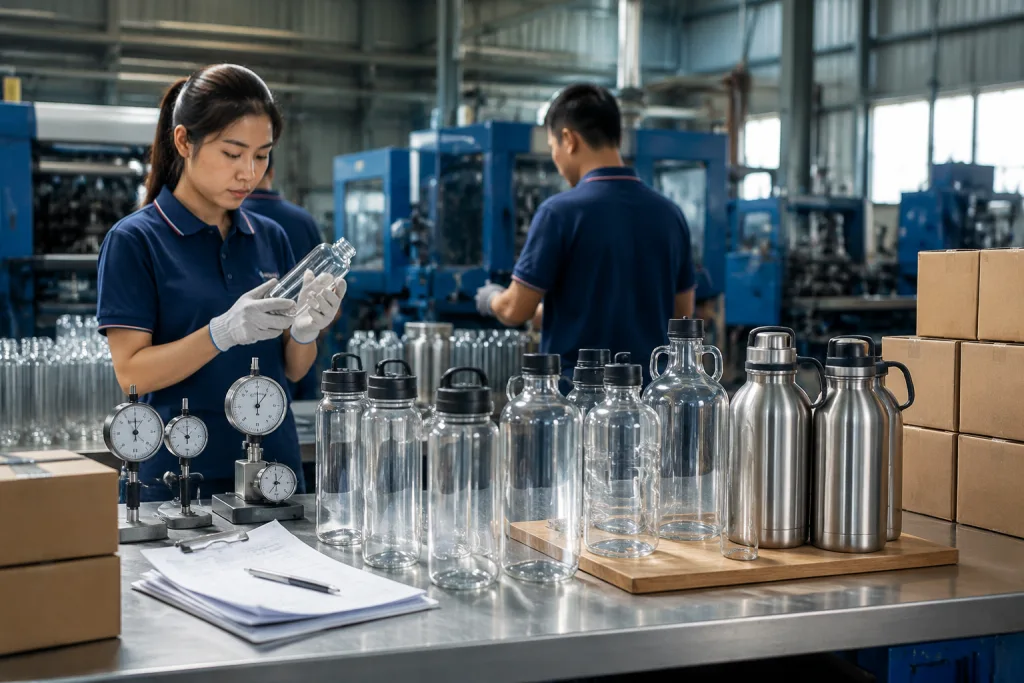
Key Takeaways
- Start RFQs with resin grade, capacity, wall thickness, decoration area, packaging, and MOQ of 3,000 pcs per SKU
- Sample POs should separate mold fee, decoration setup, courier cost, and approval deadline
- For bulk drinkware, use AQL 2.5 for major defects and AQL 4.0 for minor defects unless your channel requires tighter limits
- A realistic Zhejiang factory lead time is 30-45 days after deposit and approved pre-production sample
Tritan Renew drinkware bulk looks easy on an RFQ until the quote comes back with “renew material” but no Eastman grade, decoration priced as one lump sum, and a 35-day lead time that becomes 48 days after artwork approval. We see this often. If you buy for retail shelves, staff gifting, hotel rooms, or Amazon cartons, finding a bottle factory in China is the wrong question to ask. You need comparable data before the deposit: resin certificate, mold status, logo method, carton spec, inner bag choice, and who pays when QC pulls 12 scratched samples from a 500-piece pre-production run.
We run drinkware lines in Zhejiang, and the clean orders usually follow the same path: RFQ with target price, engineering check with calipers on wall thickness, sample PO, packaging sign-off, production PO, AQL inspection, then shipment booking. Miss one step and the math gets ugly. A buyer once sent a PO with the color code typed as “PMS 286C” while the approved sample was “PMS 268C”; the line caught it at the silk-screen jig, but a 10,000-piece order would have turned into rework, air freight, or stock nobody wants to receive.
Start With A Comparable RFQ
Your RFQ is where sourcing mistakes start. If you ask for tritan renew drinkware bulk with one photo and a target price, we will see factories quote 30% recycled content, 50% recycled content, PP lids, Tritan lids, loose bulk cartons, color boxes, and sometimes plain Tritan with “Renew” typed into the offer sheet. QC pulled one sample last month with a standard Eastman Tritan hangtag and no Renew claim on the resin COA. You cannot compare those prices.
For a clean RFQ, name the product family first: sports bottle, canteen, tumbler, beer growler, infuser bottle, or alcohol flask. Then define the sales use. A 750 ml retail canteen wholesale program needs color-box drop testing from 80 cm and barcode placement checked with a scanner. A 500 ml event giveaway can run simpler packing. A beer tumbler bulk order for stadium sales needs cup stacking tolerance, often 0.3-0.5 mm on the rim. A beer growler wholesale bulk order needs a tighter cap seal and a carton compression test, or the math doesn't work after 6 cartons are stacked in the container.
Ask the factory to quote exact line items, not one blended number. We run RFQ sheets in Excel, and one typo on a PO, “Tritan” instead of “Tritan Renew,” has caused a buyer to push back after the first sample set. A practical RFQ table should include:
- Material: Tritan Renew copolyester, requested certified recycled content percentage, and food-contact compliance target, with resin COA required before mass production.
- Capacity: 500 ml, 750 ml, 1,000 ml, 1.9 L, or your required fill volume with tolerance measured to the fill line.
- Wall thickness: for example 1.8-2.2 mm body wall on a reusable canteen, checked by caliper at shoulder, body, and base.
- Lid: PP, Tritan, silicone gasket, stainless loop, straw lid, or screw cap, with gasket hardness and leak test method stated.
- Decoration: one-color silkscreen, 360-degree print, laser plate, heat transfer, or molded logo, with artwork size in mm.
- Packaging: bulk pack, white box, color box, FSC paper sleeve, or Amazon-style carton labeling, including inner bag and carton mark rules.
- Incoterm: FOB Ningbo or Shanghai, EXW Zhejiang, or DDP if your team needs landed pricing.
RFQ PO line items to request: unit price at 3,000 / 5,000 / 10,000 pcs, tooling charge, logo setup charge, sample charge, master carton quantity, carton size, gross weight, lead time, payment terms, and quote validity in days. This is not paperwork for fun. It stops the cheap quote from turning expensive after artwork approval, mold text correction, or a 12 kg carton failing the pre-shipment check at AQL 2.5.
Confirm Material And Compliance Early
Tritan Renew gets picked because buyers want a clear, drop-resistant, BPA-free bottle with a recycled-content story. Fine. The story is only worth putting on a carton if the documents match it. Before you sign the sample PO, ask for the resin documentation path: resin supplier, grade, recycled-content claim, and which market claims the finished bottle can carry in Europe or North America. On our line, QC checks the resin bag label against the BOM before the first 30 pcs are shot; if the PO says “Tritan Renew” but the bag label only says copolyester, the buyer will flag it later.
For EU buyers, ask about food-contact compliance, REACH, LFGB if needed, and migration testing based on real product use, such as hot fill at 70°C or dishwasher claims. For the US, confirm whether the bottle can be tested under FDA food-contact expectations and relevant ASTM checks if it is for children. Kids bottles often need CPSIA-related testing and tracking labels, including batch code position on the cup body or bottom sticker. If your range includes alcohol flask wholesale or alcohol flask in bulk programs, check whether your retail channel treats the item as drinkware or barware, because labeling rules can differ; we have seen a PO typo change “gift set” to “kids set,” and the lab scope had to be reissued.
Do not accept a generic line saying “eco material.” Ask for test reports dated within 12 months where possible. For recycled content, decide whether a supplier declaration is enough or whether you need third-party chain-of-custody evidence. This is where the math often does not work: 5,000 bottles with bold sustainability copy on the box need better backup than a one-page factory letter. QC pulled the sample once after the buyer printed “50% recycled content” on artwork, while the resin file only supported a lower claim for that grade.
Compliance PO line items to lock: required test standards, number of finished samples submitted to lab, test cost payer, pass/fail responsibility, retest cost responsibility, and document delivery date. For lab submission, we usually send 6 finished bottles per color, plus 2 spare lids, because labs damage samples during migration cuts and torque checks. If your wholesale drinkware order ships to 4 countries, name those countries on the PO now. A report suitable for one market may not satisfy another buyer’s technical file.
Practical view from Zhejiang: material questions are cheapest before sampling. After the mold, color, and artwork are approved, changing resin or lid construction can add 10-20 days, and the line may need a new injection trial on a 380-ton machine.
Buy Samples Like A Small PO
Sampling should not be casual. Treat it like a 50-piece trial PO with written acceptance criteria. For Tritan Renew drinkware bulk, a nice-looking sample does not clear the line. Check transparency, haze, odor, cap fit, gasket compression, logo adhesion after 3M tape pull, Pantone match under a D65 light box, barcode position within 2 mm, and whether the bottle still stands flat after 48 hours in a 45°C warehouse test box.
For a standard custom-logo item from our Hangzhou-area supply chain in Zhejiang, sample lead time is usually 7-12 days after artwork approval if no new mold is needed. New lid tooling or body tooling can push that to 18-30 days. Our normal MOQ for customized drinkware bulk starts at 3,000 pcs per color, and monthly output across plastic and stainless categories can reach about 600,000 units/month depending on model mix. We run the first sample check with calipers on the thread OD, because a 0.25 mm miss on the lid can turn into leaking cartons.
Use one sample PO for engineering samples and one for pre-production samples if the project has high retail value. Engineering samples check shape and function. Pre-production samples check actual resin, color, logo, packaging, barcode, and carton marks. Do not let a supplier treat the first 20 pieces as final approval while the decoration method or packaging is still changing. We have seen this go sideways when the buyer approved a blank body, then QC pulled the sample after the heat-transfer logo curled at the edge.
Sample PO line items to include: 5-10 blank samples, 5-10 decorated samples, Pantone color code with tolerance, logo file version, decoration size in mm, packaging mockup, sample fee, courier fee, approval deadline, and sample ownership. If you are comparing canteen bulk, growler bulk, beer tumbler wholesale, and alcohol flask wholesale bulk options in the same project, split each model into its own line with separate resin, cap, decoration, and carton specs. Mixed product families hide cost and quality differences. The math does not work when a 750 ml growler and a 350 ml flask sit under one vague “drinkware sample” line on the PO.
When samples arrive, test them harshly. Fill and shake each bottle for 60 seconds. Drop a filled bottle from 80 cm onto plywood if your channel allows it. Run 3 dishwasher cycles if you plan to claim dishwasher safety. Check the carton mark too; last month a buyer flagged a wrong SKU digit before deposit, and that 5-minute catch saved a full reprint. Simple buyer-side checks catch problems before you wire a 30% deposit.

Price The Full Landed Program
Unit price is the wrong place to stop in bulk drinkware sourcing. We price the landed program: product, decoration, packaging, testing, inspection, China domestic trucking, ocean freight, duty, customs brokerage, warehouse handling, plus retailer chargebacks if the routing guide is strict. A bottle quoted at USD 2.10 FOB can lose to a USD 2.28 FOB option once QC measures the carton cube with a tape rule and the first one needs repacking on the line.
Ask for packing data before you lock the PO. For example, a 750 ml canteen may pack 24 pcs per master carton, 54 x 38 x 32 cm, 9.5 kg gross weight. A 1.9 L beer growler bulk item may only fit 12 pcs per carton and use more cubic meter per 1,000 pcs. If you ship to Amazon FBA or a 3PL, carton weight and FNSKU labeling sit right next to unit price. We have seen a buyer flag a 16.8 kg carton because their warehouse limit was 15 kg, and the math did not work after re-cartoning.
For pricing, compare tiers against the real order split. A 10,000 pc single-color wholesale canteen order should price better than 10 colors of 1,000 pcs each. Same story for wholesale growler and wholesale drinkware programs. Color changes mean resin purge, lid matching, and 30 to 45 minutes of downtime on the injection line. Logo changes need new screen setup. If your sales plan needs 18 small SKUs, accept the higher factory cost rather than pushing for one blended price.
Bulk PO pricing lines should show: item code, SKU name, capacity, color, logo method, packaging type, unit FOB price, MOQ, over/under shipment tolerance, payment terms, deposit amount, balance timing, carton quantity, and HS code suggestion. For North America, ask for the estimated duty basis, but have your customs broker confirm it. Factories can suggest; brokers classify. QC once pulled a signed PO where the SKU name had one typo and the barcode file matched the wrong color, so this line detail is not paperwork decoration.
If you are searching for the best wholesale drink bottle, do not chase the lowest quote by USD 0.05. Ask whether the resin claim has a document trail, whether the lid survives 500 open-close cycles on the test jig, and whether the carton dimensions fit your freight lane. We have seen this go sideways when a cheap lid saved USD 0.03 but created 2% leakage at incoming inspection.
Freeze Artwork And Packaging
Artwork and packaging delay more orders than resin supply. We see it every month. A buyer approves bottle color on Monday, asks for a 6 mm larger logo on Wednesday, then adds a retail sleeve after the deposit lands. The line can handle it, but the pre-production sample clock starts again, usually 5-7 days lost before mass printing. For drinkware wholesale, artwork approval needs to be a hard gate, not a casual email thread.
Your artwork file should call out the print area in millimeters, not just show a nice mockup. Curved Tritan bodies stretch logos; QC pulled one sample last season where a 120 mm wrap looked oval after heat transfer because the bottle tapered 9 mm from shoulder to base. A 50 mm logo on a flat panel behaves differently from a 120 mm wrap on a tapered bottle. Silkscreen works well for 1-2 colors and clean line art. Heat transfer gives stronger full-color branding, but the math doesn't work if the surface has texture or taper because rejection can jump from 2% to 6%. Laser engraving usually belongs on stainless parts, not clear Tritan bodies, unless there is a metal badge or lid insert.
Packaging needs the same discipline. For retail, lock the color box board thickness, shipper flute, barcode size, warning copy, recycling marks, country of origin, plus any retailer routing marks before we cut the dieline. Our packing table checks barcode scan distance at about 300 mm with a handheld Zebra scanner; if it fails there, the buyer will flag it later. For online packs, ask for a 1.0-1.2 m drop-test approach and skip thin gift boxes that photograph well but crush during parcel handling.
Artwork and packaging PO lines: approved AI or PDF file name, Pantone references with coated or uncoated callout, logo position drawing with mm dimensions, color box dieline version, barcode numbers, FNSKU if needed, carton mark layout, pallet requirement, final approval date. We once caught a PO typo where “matte black lid” became “mate black lid” in the artwork folder, and prepress almost used the wrong lid render. If your order combines beer tumbler in bulk, beer growler wholesale, and canteen wholesale SKUs, do not reuse carton marks casually. Warehouse teams make expensive mistakes when carton labels look 90% the same.
For China export orders, confirm the country-of-origin statement before printing. “Made in China” placement looks like a small design issue, but we have seen this go sideways after 30,000 color boxes were finished and the retailer required a different panel location. Fix it at the PDF proof stage, before the CTP plate is made.
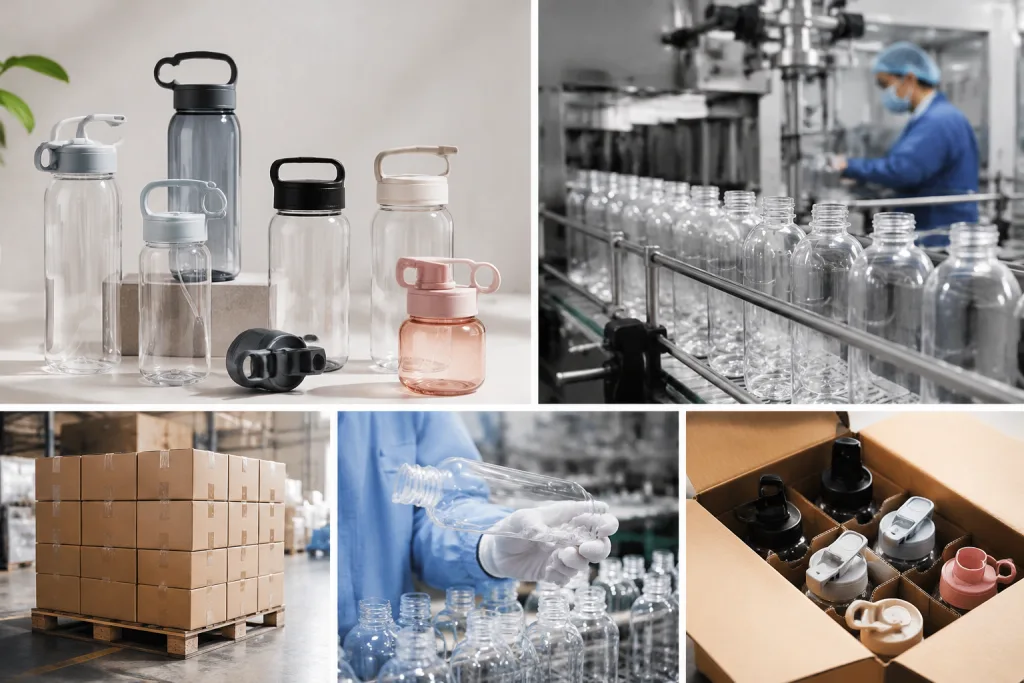
Control Production Before Shipment
Once the production PO is signed, the job moves from buying to control. For a normal Tritan Renew drinkware bulk order, we run 30-45 days after deposit and approved pre-production sample. Peak season, new tooling, complex packaging, or multi-SKU orders can add 7-15 days; last April, one 6-SKU tumbler job sat 9 extra days because the EVA insert knife mold was 2 mm off. If a supplier promises 15 days for a custom drinkware bulk order during peak season, ask which step they plan to cut.
Your production PO should name inspection points. At minimum, use incoming material check, first-article approval, in-line inspection at 20-30% completion, plus final random inspection before balance payment. For final inspection, AQL 2.5 major and AQL 4.0 minor is a common starting point. Critical defects such as leakage, sharp edges, wrong material, mold contamination, or failed barcode scanning should be zero tolerance. QC pulled the sample on one line last month after 11 lids failed the 3-minute upside-down leak test.
Define acceptable tolerances clearly. Capacity may allow ±3%. Color should follow an approved physical sample, not only Pantone; the buyer flagged this once when “smoke gray” on the PO printed closer to tea brown under a D65 light box. Decoration position may allow ±1.5 mm for small logos and wider tolerance for wrap prints. Carton count should match the packing list exactly. If you sell alcohol flask bulk or growler wholesale products into retail chains, barcode scanning and carton labeling need their own checklist. The math doesn't work if 1 wrong UPC blocks 2,400 pcs at the DC door.
Production PO line items to fix: approved sample reference number, production quantity per SKU, allowed overage/shortage, inspection standard, defect classification, shipment window, freight forwarder contact, loading port, document set, and penalty or remedy for late corrective action. Keep the language practical. A factory can manage measurable requirements; it cannot manage “premium quality” as a PO term. We once had a PO typo listing 304 stainless for a Tritan Renew bottle insert, and the merchandiser caught it only when checking the BOM against the ERP printout.
Before shipment from Zhejiang or another China production base, request final photos of goods, cartons, labels, and container loading if applicable. Then match commercial invoice, packing list, bill of lading instructions, and any certificate documents before the cargo leaves port. Do it before sailing. Document cleanup after sailing is slow and irritating for everyone; we have seen a missing “CTN 1-96” mark on the carton label delay telex release by 4 days.
Send Your Tritan Renew RFQ For Factory Review
Share capacity, MOQ target, logo method, packaging, and destination market. We will return a practical China sourcing quote with clear PO lines.
Frequently asked questions
What MOQ should I expect for Tritan Renew drinkware bulk?
For custom Tritan Renew drinkware bulk, a practical MOQ is usually 3,000 pcs per color or SKU. Some stock-shape programs can start at 1,000-2,000 pcs if you accept existing colors, simple logo printing, and bulk packaging. New color matching, retail color boxes, or custom lids often push the effective MOQ back to 3,000-5,000 pcs because resin purging, decoration setup, and packaging print runs need volume. If you need 10 colors at 500 pcs each, ask for a mixed-SKU quotation instead of assuming the same price as one 5,000 pc run. Canteen bulk and beer tumbler bulk orders are usually easier to combine than custom growler bulk items because larger bodies consume more machine time and carton space.
Is Tritan Renew suitable for wholesale drinkware sustainability claims?
It can be, but only if the claim is supported by documents. Tritan Renew is used because it offers clear appearance, impact resistance, and recycled-content positioning, but your packaging language should match the evidence available for that specific resin grade and finished product. Ask for resin declaration, food-contact test reports, and any recycled-content support before approving artwork. For EU programs, REACH and food-contact migration reports may be needed; for US programs, FDA food-contact expectations and retailer-specific documentation may apply. Avoid printing broad claims like “100% sustainable” or “fully recycled” unless your legal and compliance team approves them. A safer PO line is the exact recycled-content claim you can document.
How long does sampling and bulk production take?
If the model already exists, blank or logo samples normally take 7-12 days after artwork confirmation. A pre-production sample with final packaging can take 10-18 days because color box proofing and decoration setup add time. New tooling for a body, cap, or special handle usually adds 18-30 days before proper samples are ready. Bulk production is commonly 30-45 days after deposit and approved pre-production sample. Add 7-15 days during peak season or for complex orders with several SKUs, such as wholesale canteen, beer growler in bulk, and alcohol flask wholesale items in one PO. Ocean freight is separate, so build your retail launch calendar backward from the required warehouse arrival date.
What should be on my production PO for drinkware bulk?
Your production PO should read like a control document, not just a price agreement. Include item code, product name, capacity, material, resin grade requirement, color, logo method, packaging type, quantity per SKU, unit price, total value, Incoterm, payment terms, lead time, approved sample reference, inspection standard, carton quantity, carton dimensions, barcode requirements, and shipping document requirements. For drinkware bulk shipped to retail or FBA-style warehouses, add FNSKU or carton label instructions and maximum carton weight. For canteen wholesale or beer tumbler wholesale bulk, also state leak testing, decoration adhesion checks, and barcode scan checks. A clear PO prevents arguments when goods are finished and the balance payment is due.
Can I combine canteen, growler, tumbler, and flask SKUs in one order?
Yes, but quote and manage each product family separately. A canteen bulk item, beer growler wholesale item, beer tumbler in bulk item, and alcohol flask wholesale bulk item use different molds, lids, packaging, inspection points, and carton dimensions. Combining them under one PO can help with payment and shipping coordination, but each SKU still needs its own MOQ, unit price, sample approval, barcode, carton mark, and defect checklist. For example, a 750 ml wholesale canteen may focus on leak testing and strap strength, while a 1.9 L beer growler bulk item needs cap seal performance and carton compression. Mixed orders work best when you freeze artwork and packaging for all SKUs before production starts.