
Key Takeaways
- A basic 650 ml Tritan PP bottle usually lands at USD 0.95-1.80 FOB China at 3,000-10,000 pcs
- Custom color matching typically adds 7-10 days and works best above 5,000 pcs per color
- New mold tooling for a bottle or cap can cost USD 2,500-12,000 and take 25-45 days
- AQL 2.5/4.0 inspection plus carton drop testing should be planned before final balance payment
If you are buying tritan polypropylene bottle wholesale for a retail launch, corporate program, or distributor catalog, finding 20 suppliers is easy. Sorting the real quote from the bait quote is the work. We saw one USD 0.82 bottle land at USD 1.35 after the buyer confirmed Eastman Tritan resin, a flip cap with silicone plug, 1-color pad print, Pantone color matching, 5-layer export carton, and AQL 2.5 inspection; QC pulled the sample and the cap hinge failed at 3,000 open-close cycles.
Our Hangzhou, Zhejiang team sees 6 to 8 of these projects each week from buyers comparing bulk drinkware, canteen wholesale, and wholesale drinkware projects across China. The better question is not “who is cheapest?” The math doesn’t work if the mold, resin, and carton spec are loose. Ask what changes cost, what pushes lead time from 35 days to 60 days, and where money protects the shipment; last month a buyer flagged a PO typo listing “PP lid” while the approved sample used Tritan, and the line stopped until purchasing corrected it.
Start With The Real Unit Cost
A tritan polypropylene bottle wholesale quote usually breaks into three buckets: bottle price, decoration, and export handling. The first number is the wrong question to ask. For a standard 600-750 ml bottle with Tritan body and PP lid, we see a workable FOB Ningbo or FOB Shanghai range of USD 0.95-1.80 at 3,000-10,000 pcs. A thin promo bottle can go below USD 0.90, but the math comes back somewhere: 1.6 mm wall instead of 2.1 mm, softer cap seal, lighter 5-layer carton, or resin paperwork that stops at a supplier letter. QC pulled a 600 ml sample last month where the bottle price looked good, then the drop test cracked the shoulder at 1.2 m.
Tritan is not priced like ordinary PP. The resin costs more, and the molding window is less forgiving on clarity, gate marks, and stress whitening. PP works better for lids, handles, straws, flip caps, and inner parts because it is lighter and keeps the lid cost under control. If your buyer asks for REACH, LFGB, FDA food-contact documentation, or California Proposition 65 screening, confirm the exact resin grade before sampling. Get the grade name on the PI. We have seen this go sideways when a PO said “eco plastic,” then the buyer flagged the missing Eastman Tritan grade during pre-shipment inspection.
Decoration changes the quote fast. One-color silk screen may add USD 0.05-0.12 per pc, with a 50 mm x 70 mm logo needing a cleaner screen than a small side mark. Heat transfer can add USD 0.18-0.45, depending on artwork coverage and whether the film wraps over a curved grip area. A molded logo requires tooling, often USD 300-800 for a cap insert or simple emblem. For drinkware bulk programs with 20-50 SKUs, decoration setup fees can beat a USD 0.03 bottle-price saving, especially when the line has to change fixtures every 2,000 pcs.
At BottleForge Industrial in Zhejiang, a normal production line can handle about 600,000 plastic drinkware units per month across bottles, canteen bulk orders, and sports caps. Capacity helps. It does not fix a loose spec. We run material purchasing against confirmed drawings, Pantone codes, and packing details, because changing from 24 pcs/carton to 36 pcs/carton after resin is booked can push shipment by 6 days and create carton compression failures on the stack test.
MOQ Tiers That Actually Matter
MOQ is not a factory trick. It normally comes from resin procurement, color masterbatch, injection machine setup, carton printing, and labor scheduling. For a stock Tritan body with an existing PP cap, we run 1,000-3,000 pcs per model if you accept available colors and simple logo printing. QC pulled one 750 ml sample last month where the pad-print logo shifted 1.8 mm after the first setup, so even a small order still burns setup time. For custom Pantone colors, expect 5,000 pcs per color. For a new cap, straw lid, handle, or odd canteen shape, the commercial MOQ often moves to 10,000 pcs or higher because the line needs trial shots, fit checks, and leak testing.
Here is the tier math we use with buyers. At 1,000 pcs, you are buying flexibility, not the best price. The factory may slot your order between 2 larger jobs, and the unit cost carries more setup burden. At 3,000-5,000 pcs, decoration pricing and carton customization get easier, and scheduling is less jumpy. At 10,000-30,000 pcs, resin purchase and machine time work harder for you, and the FOB price may drop 8-18% compared with a small pilot order. We have seen this go sideways when a buyer pushed for 800 pcs with a 4-color logo and individual color boxes; the math did not work after the carton factory charged a separate plate fee.
If you also source bulk canteen, wholesale canteen, bulk growler, or wholesale growler items from the same supplier, ask whether the MOQ can be grouped by material, color, or carton specification. Sometimes yes. Sometimes no. A Tritan bottle, beer growler bulk item, and alcohol flask wholesale project may use different molds, different production lines, and different compliance files, so combined MOQ is not automatic. On our floor, a Tritan bottle runs on an injection blow line, while a stainless growler moves through polishing and vacuum testing; one shared PO number does not make those parts share the same MOQ.
For brand owners testing the market, I prefer one strong model in 3 colors over six weak models in one color each. You reduce mold risk, keep spare caps under control, and give your distributor a cleaner sell-in story. Last quarter, the buyer flagged a PO typo that listed “matte black” on the bottle but “gloss black” on the carton artwork, and that kind of small mismatch gets worse when six models are open at once. The best wholesale drink bottle is not the cheapest sample on your desk; it is the one your supplier can repeat within tolerance 3 months later.
Lead Time From Sample To Vessel
A realistic timeline starts before the purchase order. If you need a tritan polypropylene bottle wholesale shipment for a seasonal retail window, count backward from the warehouse arrival date, not from the day your team feels ready to order. We’ve had buyers send the PO 9 days after artwork approval, then ask why the vessel date moved. For existing molds, a plain reference sample can usually ship from China in 3-7 days. A logo sample takes 7-12 days for silk screen or pad printing, and 10-18 days for heat transfer or color proofing where the ink room has to match Pantone under a D65 light box.
Once the sample is approved and deposit is received, mass production for 3,000-10,000 pcs usually takes 25-35 days. Add 5-10 days if you require custom Pantone resin, special packaging, instruction sheets, hang tags, FNSKU labels, or retailer-specific carton markings. One typo on a PO carton mark can stop the packing line for half a shift. For new tooling, add 25-45 days before production begins. If the first tooling trial fails leak testing or cap fit, another 5-12 days can disappear fast; QC pulled one 650 ml sample last month with a 0.35 mm cap gap, and the math didn’t work for shipment that week.
Export logistics add another layer. Trucking from Zhejiang to Ningbo port is usually 1-2 days after goods are packed. Booking, customs declaration, and port handling may take 3-7 days. Ocean transit to the US West Coast can be around 16-24 days on water, while Europe often runs 28-38 days depending on routing. DDP, Amazon FBA, and mixed-pallet distributor shipments need more time for labeling and appointment handling; we run FNSKU scans at carton level because one missed label can trigger a warehouse chargeback.
Do not approve production based only on photos if the order matters. This is the wrong place to save 2 days. Use a signed golden sample, a pre-production sample, and a production inspection plan with AQL 2.5 written into the file. For drinkware wholesale programs, the fastest orders are the ones with clear details before deposit: Pantone code with tolerance, logo size in mm, lid material, carton layout, testing standard, and barcode position. We’ve seen this go sideways when the buyer flagged the lid texture only after 18 cartons were already sealed.
Mold, Cap, And Leak Risks
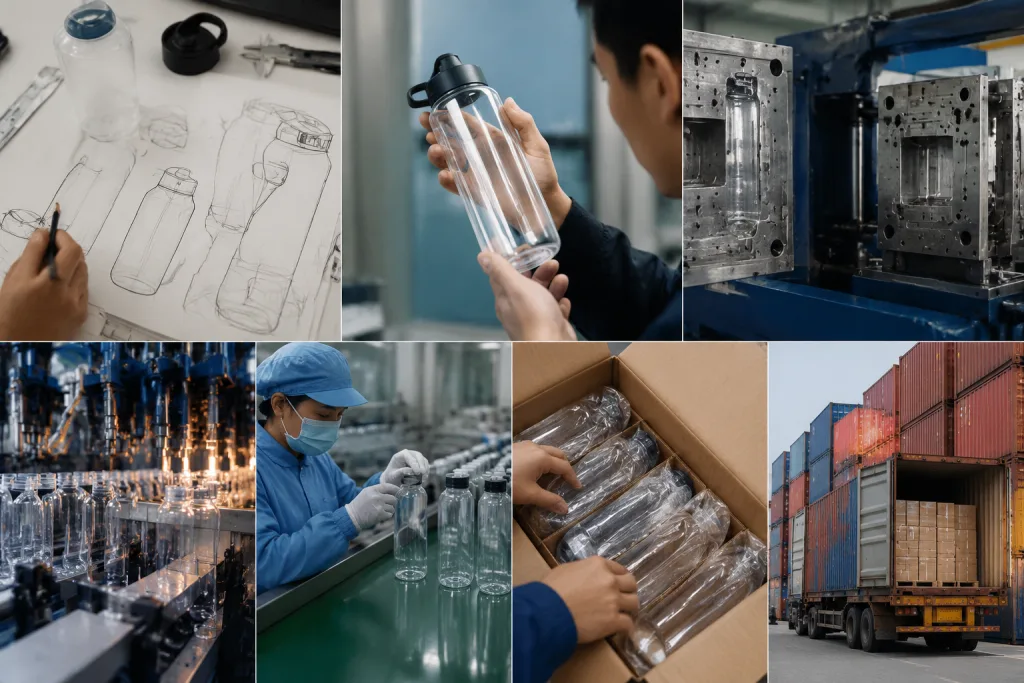
Most bottle failures start at the cap system, not the body. A Tritan body can look clean under the light table and still fail because the PP cap thread is shallow, the silicone gasket is too soft, the flip hinge has play, or the straw hole is running 0.3 mm loose after molding. We run leak testing upright, inverted, and after 50-100 open-close cycles for canteen wholesale and sports bottle programs. For a screw cap, our floor test is simple: 30 minutes inverted with room-temperature water, then 20 hard manual shakes. QC pulled the sample. No excuses.
Wall thickness matters too. For a reusable Tritan bottle, most buyers we ship to target around 1.2-1.8 mm body wall thickness depending on shape and capacity. Go too thin and the bottle feels cheap, or the carton compression test shows deformation after a 5-layer stack. Go too thick and the math doesn't work because resin cost rises while the shelf price stays the same. PP lids should be checked for thread engagement, hinge fatigue, odor, and dimensional consistency after molding. A 0.2 mm tolerance miss looks small on a caliper, but it can turn into a visible leak rate once the line reaches 10,000 pcs.
New tooling makes sense when you need a proprietary silhouette, a unique lid, or a brand-protected feature that cannot be copied from an open mold. For a bottle body, tooling can cost USD 4,000-12,000. For a cap component, USD 1,500-6,000 is common. The buyer usually pushes back here and asks, “Can we use an existing mold first?” For promotional bottles for alcohol flask bulk campaigns, beer tumbler wholesale bulk gift sets, or beer growler wholesale bulk seasonal bundles, that is often the safer call because existing molds can cut sampling from 18 days to 7-10 days.
For wholesale growler, beer growler in bulk, or beer tumbler in bulk projects, confirm whether the product is intended for carbonated beverages. This is the wrong question to skip. Standard plastic drink bottles are usually not pressure-rated, and a nice-looking Tritan bottle can still fail if the buyer fills it with beer and leaves it in a hot van. If a supplier avoids that question, take it seriously. Better to spend two days clarifying usage and checking the cap seal on a pressure jig than receive 8,000 units that cannot pass a basic customer complaint review.
Decoration, Packaging, And Retail Readiness
Decoration is where bulk drinkware orders slip. One-position logo? Easy. A 4-color wrap on a curved Tritan body is where the line slows down, because the jig has to hold the bottle within about 1 mm or the seam walks. Silk screen suits bold logos and mid-size runs; laser marking is usually for stainless steel, not plastic; heat transfer covers color better but adds setup time and more rejects when the film edge lifts. For 5,000 pcs, expect 2-4 days for artwork confirmation, 3-7 days for printing plates or film, and 1-3 days for a signed decorated sample to be reviewed. We had one buyer approve the PDF, then QC pulled the sample and found the Pantone looked 1 shade too dark under the D65 light box.
Packaging must match the sales channel. A distributor selling drinkware bulk to corporate buyers may only need a white box, barcode label, and 5-ply master carton with a 12 kg target gross weight. A retail brand usually asks for color box artwork, instruction leaflet, warning statement, recycling symbol, country-of-origin marking, and sometimes a hang tag with a typo copied from the PO. Amazon FBA needs FNSKU or UPC control, carton weight limits, and labels that scan cleanly after tape is applied. If you plan to sell alcohol flask wholesale bulk, beer tumbler bulk, or growler wholesale items alongside Tritan bottles, one packaging format will not cover the range. The math doesn't work.
Carton strength is not glamorous, but it protects margin. For export cartons, 5-ply corrugated is common, and a 76 cm drop test is a useful baseline for small drinkware cartons; we run it on the corner, edge, and flat side before booking the container. Inner polybags, paper sleeves, or molded pulp trays add cost, often USD 0.03-0.25 per unit, but they cut scuffing on clear Tritan surfaces. Clear plastic shows scratches faster than matte PP, especially when 24 bottles rub through a 40-day sea shipment. Decide the packing method before mass production, not after inspection finds cosmetic rejects and the buyer asks for a discount.
If your artwork includes claims such as BPA-free, dishwasher safe, recycled content, or kid-safe, ask for supporting test reports before the box layout goes to print. Europe and North America buyers are less forgiving now; one unsupported icon can hold 3 pallets at inbound QC. We ship FDA and LFGB report copies when the claim needs backup, and the buyer's compliance team often flags wording like “eco-safe” because nobody can define it. A pretty bottle with weak packaging claims is not retail-ready. It is a purchase order dispute waiting to happen.
Quality Control Before Balance Payment
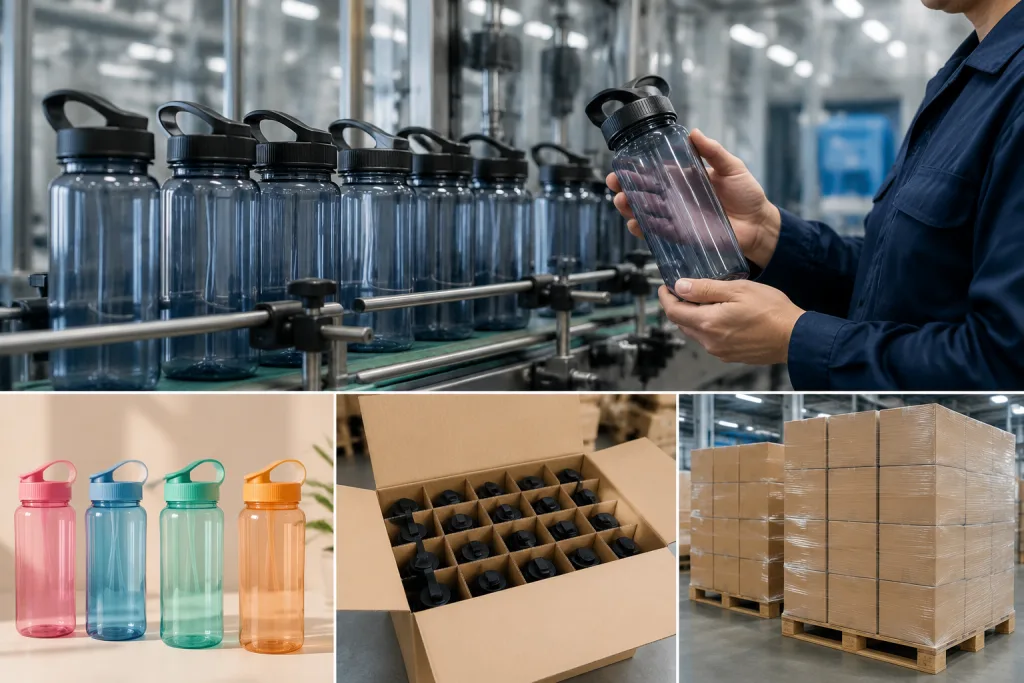
For tritan polypropylene bottle wholesale orders, put QC terms directly on the purchase order, including the inspection standard, defect classes, and who pays for re-inspection. A WeChat “don’t worry” is not a control point. We’ve seen this go sideways when a PO said “normal inspection” and the buyer later expected full carton drop testing on 18 kg master cartons. A typical inspection level is AQL 2.5 for major defects and AQL 4.0 for minor defects, using ANSI/ASQ Z1.4 or ISO 2859 sampling. Critical defects should stay at zero tolerance: sharp edges, contaminated material, serious leakage, wrong material, wrong logo, or unsafe odor.
Your inspection checklist should include capacity measurement with a graduated cylinder, weight check on a 0.1 g scale, wall thickness spot check by caliper, lid torque, gasket presence, leak test, logo adhesion, color comparison against approved Pantone, barcode scan, carton marking, and quantity count. Don’t just ask “is the bottle good?” That is the wrong question to ask. For a 650 ml Tritan bottle, QC pulled the sample last month because the fill line was 6 mm off from the approved drawing, even though the bottle looked fine on the table. For kids bottles, confirm ASTM or relevant food-contact requirements based on the destination market. For EU programs, REACH and LFGB may be requested. For US programs, FDA food-contact and Proposition 65 screening are common buyer questions.
Inspection timing matters. Pre-shipment inspection should happen when 80-100% of goods are produced and at least 80% packed. Too early, and you miss carton labels, inner bag count, silica gel placement, and packing ratio mistakes. Too late, and the math doesn’t work. If the 70% balance is already paid, the line has moved on, the warehouse wants the space back, and a 12-day correction can turn into an 18-day shipment delay. In China, most factories expect 30% deposit and 70% balance before shipment, but serious buyers often tie balance payment to passed inspection.
For mixed orders that include alcohol flask in bulk, beer growler wholesale, beer tumbler wholesale, and standard Tritan bottles, separate the inspection criteria by product type. A stainless flask, plastic canteen, and PP lid fail in different ways, so one checklist will miss something. We run stainless flask checks with weld inspection and leak pressure, while Tritan bottles need odor checks, cap fit, and drop testing from the buyer’s required height, often 1.2 m. BottleForge Industrial in Hangzhou, Zhejiang normally prepares internal QC records by SKU, carton, and production date, so buyers can trace a problem from carton 37 instead of arguing from photos after delivery.
How To Compare Supplier Quotes
When 3 China suppliers send quotes, we put every line into one sheet before we talk price. Compare capacity, material grade, lid structure, decoration method, MOQ, tooling ownership, sample time, mass production lead time, Incoterm, carton specification, testing included, and payment terms. Small misses matter. Last month QC pulled a 720ml Tritan bottle sample that was 18g lighter than the quoted spec, and the buyer flagged it before we ran the mold trial. A quote at USD 1.05 FOB with no test report, no color box, and no inspection support is not cheaper than USD 1.18 with confirmed REACH documentation and export packaging.
Ask direct questions and ask for numbers. What is the Tritan grade? Is the PP virgin material? What is the bottle weight in grams? What is the gasket material? How many cavities are in the mold? What is the daily output per machine? What defect rate did the last similar order have? Can the factory provide BSCI, ISO 9001, or customer audit documents? We run a simple check here: if the lid drawing says silicone ring 2.0mm but the sample measures 1.6mm with a digital caliper, the leak test result does not mean much. A good supplier may not answer cleanly in one email, but they will not dodge measurable questions.
For wholesale drinkware buyers managing canteen bulk, growler bulk, alcohol flask wholesale, beer growler bulk, and beer tumbler wholesale projects, supplier consolidation cuts admin work. The math works when cartons, artwork files, and inspection bookings sit with one export team. It goes sideways when the technical fit is wrong. Plastic Tritan bottles and PP sports lids need injection control, stainless vacuum bottles need weld and vacuum testing, and glass infuser bottles bring breakage risk in a 5-ply master carton. We have seen buyers push 4 product lines into one factory to save 3 emails, then lose 12 days on re-sampling.
The best buying process is boring: confirm spec, approve sample, issue PO, pay deposit, run pre-production check, monitor schedule, inspect before balance, ship under agreed Incoterm. Boring is good. If a supplier promises 15-day mass production for custom color, custom logo, custom box, and third-party testing, assume something is missing. For a normal 10,000pcs Tritan bottle order, color masterbatch approval alone can take 2 days, pad printing needs a plate, and SGS or Intertek booking is not controlled by the line. Zhejiang factories can move quickly, but tooling, curing time, and Ningbo port schedules still set the pace.
Send Your Bottle Spec For A Factory Quote
Share capacity, material, logo, MOQ, packaging, and destination market. We will return practical FOB pricing and lead-time options from Zhejiang.
Frequently asked questions
What MOQ should I expect for tritan polypropylene bottle wholesale orders?
For an existing Tritan bottle body with a standard PP lid, expect 1,000-3,000 pcs if you accept stock colors and simple logo printing. For custom Pantone colors, 5,000 pcs per color is more realistic because masterbatch mixing, purge loss, and machine setup create cost. For a new mold or proprietary cap, plan for 10,000 pcs or more. If your order includes canteen wholesale, growler wholesale, or alcohol flask wholesale items, do not assume the factory can combine MOQ across categories. Different materials and production lines may require separate minimums.
How long does production take after I approve the sample?
For existing molds, mass production usually takes 25-35 days after sample approval and 30% deposit. Add 5-10 days for custom color, color box, hang tag, FNSKU labeling, or retailer carton requirements. A logo sample usually takes 7-12 days, while new tooling can add 25-45 days before mass production starts. From Zhejiang to Ningbo port, local trucking is usually 1-2 days, with another 3-7 days for booking and export handling. Ocean freight to North America or Europe must be added separately.
Is Tritan better than PP for wholesale drinkware?
Tritan is better when you need clear appearance, higher retail feel, and stronger impact resistance than many commodity plastics. PP is better for cost-effective lids, handles, straws, and opaque bottle bodies. Many successful wholesale drinkware designs use both: Tritan for the bottle and PP for the cap. The trade-off is cost. A Tritan body can push the FOB price into the USD 0.95-1.80 range at 3,000-10,000 pcs, while a full PP bottle may be cheaper. Your market position should decide the material, not just the lowest quote.
What quality tests should I require before shipment?
Use AQL inspection, commonly AQL 2.5 for major defects and AQL 4.0 for minor defects. Require leak testing, capacity check, bottle weight, lid torque, gasket inspection, logo adhesion, barcode scanning, carton drop testing, and color comparison against the approved sample. For Europe, ask about REACH and LFGB if applicable. For the US, FDA food-contact documentation and Proposition 65 screening are common. Inspect when 80-100% of goods are produced and at least 80% packed. Do not release the 70% balance until the inspection result is acceptable.
Can I order beer growler or alcohol flask items with Tritan bottles?
Yes, but treat them as separate technical projects. Beer growler bulk, beer tumbler in bulk, alcohol flask bulk, and Tritan PP bottles use different materials, molds, safety questions, and packaging requirements. If a beer growler is intended for carbonated beverages, confirm pressure suitability in writing; many plastic bottles are not pressure-rated. Stainless alcohol flask wholesale bulk orders may need different surface finishing, welding checks, and packaging. A consolidated China supplier can simplify communication, but each SKU still needs its own specification sheet, sample approval, and inspection checklist.