Key Takeaways
- For molded Tritan and PP bottles, practical MOQ is usually 3,000-5,000 units per color
- A 600 ml Tritan bottle with PP lid often lands around USD 1.25-2.10 FOB China depending on cap, print, and packaging
- Confirm LFGB, REACH, FDA, and BPA-free declarations before approving production
- Use AQL 2.5 for major defects and AQL 4.0 for minor cosmetic defects on distributor orders
You are not buying “plastic bottles.” You are buying a container that has to pass a 1.2 m carton drop test, sit in a 40HQ for 31 days, handle retail shelf knocks, support dishwasher claims, survive child use, keep the logo from rubbing off, and avoid your customer’s first complaint email. Start with the order scenario, not the catalog page; we have seen this go sideways when the PO only says “clear bottle with lid.”
Say you need 8,000 custom drinkware units for a summer promotion: 600 ml Tritan body, PP flip lid, silicone seal, one-color logo, packed for a European canteen distributor. Our Hangzhou, Zhejiang team would run it as a spec and risk-control job, not a quick China price quote; QC pulled the sample, checked the lid gap with a 0.05 mm feeler gauge, and the buyer flagged logo wear after 20 dishwasher cycles.
Start With The Actual Order
A useful RFQ is not “send price for bottle.” That goes nowhere. A useful RFQ says: 8,000 units, 600 ml capacity, Tritan body, PP flip lid, silicone gasket, transparent smoke gray body, black lid, one-color logo on the front, individual kraft box, 40 units per master carton, FOB Ningbo, target ship date 45 days after deposit. With that, we can pull the mold card, check the 600 ml cavity set, and calculate carton CBM before quoting.
That single paragraph lets a canteen supplier check the real cost drivers. Tritan resin costs more than PP but gives better clarity and impact resistance, so the bottle looks closer to retail shelf grade. PP is still a smart lid material because it molds cleanly, keeps cost under control, and survives flip-hinge testing better than buyers expect. We run the hinge on a small cycle jig; if it whitens after 3,000 flips, QC pulls the sample. If you ask for a full Tritan cap, your quote changes. If you ask for a PP bottle body instead of Tritan, your price drops, but the product stops feeling like premium customizable drinkware. The math does not work for every market.
For this buyer scenario, we would quote two versions. Version A: existing 600 ml mold, Tritan body, PP lid, silicone seal, silk screen logo, USD 1.48-1.72 FOB China at 8,000 units. Version B: same body but with a customized canteen lid color and laser-marked stainless accent plate, USD 1.85-2.10 FOB. On one PO last year, the buyer wrote “smok grey” instead of “smoke gray,” and our merchandiser caught it before the Pantone chip went to the mixing room. New private mold work is a separate talk, usually USD 4,000-12,000 depending on bottle geometry and cap complexity.
At BottleForge Industrial in Zhejiang, our mixed plastic drinkware capacity is about 450,000 units per month across Tritan, PP, PETG, and related sports bottle lines. That does not mean every order ships tomorrow. Color matching, logo approval, packaging print, and QC booking still control the lead time. For 8,000 custom canteen units, we usually plan 7 days for sampling, 25-30 days for mass production, and 5-7 days for inspection and export loading. QC checks lid fit with a 0.2 mm feeler gauge, then we load by carton count, not hope.
Lock Materials Before Artwork
About 8 of 10 buyers ask about the logo first because the sales team can see it on a mockup. I start with the material sheet. Before we open the AI artwork file, we ask the canteen manufacturer to confirm bottle body resin, lid resin, gasket material, straw material if used, pigment type, and food-contact test basis. For Europe, ask for LFGB and REACH documentation. For North America, ask for FDA food-contact compliance and BPA-free declarations. If the bottle is for children, discuss ASTM F963 or relevant small-parts and labeling requirements early. Last month QC pulled a 650 ml kids bottle sample where the PO said Tritan body, but the lid BOM showed mixed recycled PP. That is a red flag.
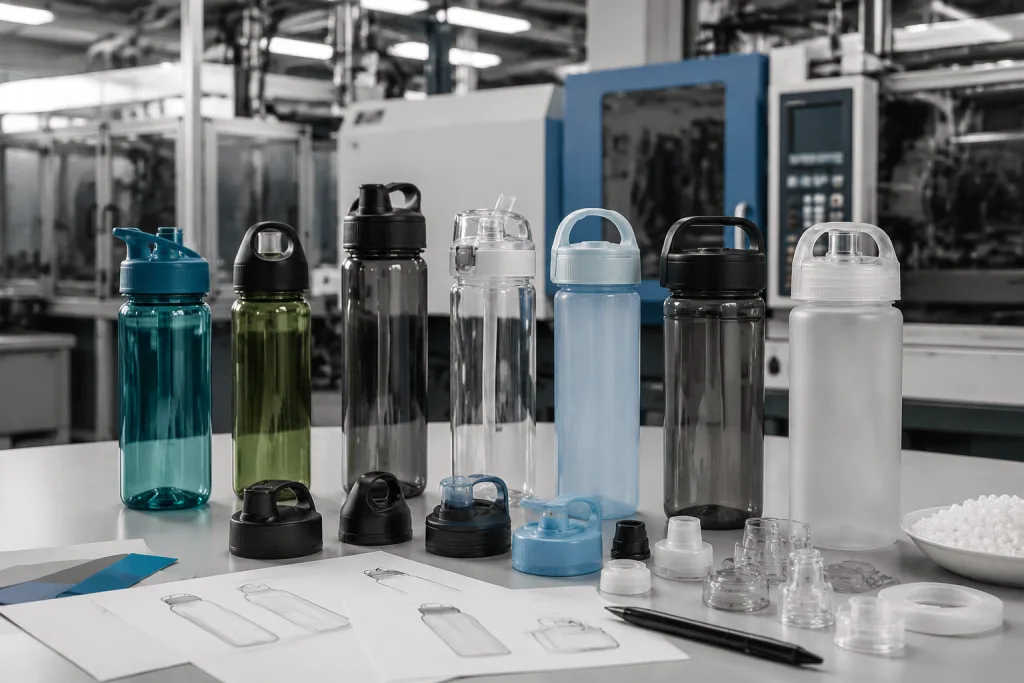
Tritan is picked when the buyer needs clear walls, drop strength, and BPA-free positioning on shelf. We run it for retail sports bottles and distributor drinkware programs where a cloudy PP body would make the item look cheap. Polypropylene costs less, flexes better, and works well for lids, handles, hinge caps, and budget canteen promotional projects. The common build is simple: Tritan body with a PP lid. On our line, that usually saves about USD 0.18 to 0.32 per set versus a full Tritan structure, depending on cap weight and MOQ.
Be careful with temperature claims. This is where we have seen orders go sideways. Some sellers write “dishwasher safe” or “100°C resistant” after testing only the empty body, not the assembled bottle. The body, lid, gasket, print ink, and colorant all matter. For a safer commercial claim, we normally test assembled samples at 70°C for deformation, leakage, odor, and logo adhesion. QC uses a water bath, torque gauge, and 3M tape pull on the printed area after cooling. If you need top-rack dishwasher positioning on retail packaging, put that exact wording in the purchase order and test it before mass production.
Color also changes the risk. Clear, smoke, amber, and light blue Tritan bodies are usually stable. Dark transparent colors can show flow marks, especially near the injection gate on thicker 1.8 mm walls. Opaque PP lids can be Pantone matched, but expect a tolerance. A responsible canteen factory will state Delta E tolerance or approve a physical color chip. We prefer Delta E ≤ 1.5 for retail lids, while promo buyers often accept Delta E ≤ 2.0 if the price target is tight. For repeat orders, keep one sealed golden sample in China and one in your office; a buyer once flagged a “blue” reorder because the first PO had a Pantone typo.
Make The Customization Practical
A custom canteen order usually dies in the small stuff, not the big idea. The logo comes in at 42 mm wide on a curved bottle wall, the buyer asks for four colors, and the artwork was built for a flat brochure. We see this every month. On Tritan, we run silk screen for clean logos, best at one or two colors; three colors needs tighter registration and a patient printing line. Pad printing handles narrow curved zones better, but the cycle is slower because the jig has to hold the bottle without rocking. Heat transfer gives fuller graphics, but the math doesn't work unless the setup cost and 3M tape adhesion test pass first. Laser engraving only makes sense on a metal badge or coated part; QC pulled one clear-plastic sample last year, and the buyer flagged “engraving” on the PO, which was the wrong process from day one.
For the 8,000-unit order, I would quote one-color silk screen, 35-45 mm wide, positioned 90 mm below the shoulder line. Keep it there. That area stays away from the heavy curve, so the logo does not stretch into an oval when the squeegee passes. A normal logo setup charge is USD 50-120 per color, and pre-production samples with logo take 5-7 working days after artwork confirmation. On our line, the print master checks position with a 0.5 mm ruler before baking; if the buyer later moves the logo 18 mm higher, we reset the screen and lose a day.
If you want a canteen customizable enough for several distributors, build the base product around shared parts. Keep the Tritan body mold common, then change lid color, silicone band color, logo print, or the packaging sleeve. This lets a canteen distributor place 3,000 red-lid units, 3,000 blue-lid units, and 2,000 black-lid units without asking for a new mold each time. The buyer gets campaign flexibility, and we keep the injection schedule sane. We've seen this go sideways when every region wants a different cap shape; the mold room then quotes 25-30 days per new lid tool, and the launch date starts slipping.
For a customized growler or customizable growler, the same rule applies, but wall thickness, closure torque, handle strength, and leak testing need stricter checks because the bottle carries more weight. A 1.2 L plastic growler needs tougher drop-test control than a 500 ml gym bottle. Do not approve decoration before the blank bottle passes function. On the floor, QC tightens the cap with a torque meter, fills the sample to 1.2 L, lays it sideways for 30 minutes, then checks the handle after a loaded drop; printing a good logo on a leaking growler is just expensive scrap.
Check The Quote Like An Engineer
Compare quotes line by line, or the price is noise. A USD 0.18 gap often comes from a 0.6 mm thinner wall, a weaker PP lid hinge, lower-durometer silicone, no white box, or no AQL 2.5 inspection buffer. Ask the canteen vendor to state the assumptions on the quote sheet: body material, lid material, capacity, unit weight, carton quantity, logo method, packaging, MOQ, lead time, and Incoterm. We had one PO last year where the buyer typed “polypropylene body” instead of “Tritan body”; QC pulled the sample before mold trial, and that one typo saved 12 days of argument.
For a 600 ml Tritan bottle, we usually run the body at 85-115 g, depending on the shoulder shape and wall thickness at the blow pin area. PP lids usually land at 18-35 g. If one canteen supplier quotes a bottle 25 g lighter than the other 3 factories, ask for the weight drawing and drop-test standard. Lighter is not automatically wrong. The wrong question is “why is your price higher?” Ask what they removed to reach that price. For distributor growler programs and heavier outdoor canteens, buyers feel that missing 25 g as soon as they pick up the sample.
FOB Ningbo or FOB Shanghai is cleaner for European and North American B2B buyers than EXW because export handling is already inside the quote. From Zhejiang, we ship most plastic drinkware through Ningbo; the truck from our Hangzhou area line to the forwarder warehouse is normally same day if the cartons are palletized before 3 p.m. If you need DDP for Amazon or retail warehouse delivery, quote it as a separate line. Duty, VAT, customs risk, carton labels, appointment booking, and final-mile delivery change the math fast.
Payment terms matter too. Standard first-order terms from China are often 30% deposit and 70% before shipment after inspection. For repeat distributor canteen programs, we can discuss staged releases or blanket purchase orders after stable forecasts and clean payment history. We have seen this go sideways: one buyer pushed for 60-day credit on a first 2,000 pcs order, then changed the Pantone lid color after mass production. The math does not work for that setup.
Cheap quotes are easy to issue. Stable repeat shipments are harder. Buy the second outcome, not the first PDF.
Build QC Into The Purchase Order
Do not wait until production is finished to talk about QC. Put the inspection rules inside the purchase order. For this 8,000-unit canteen customized order, we run the PO line by line before the deposit: approved golden sample, PP or Tritan material certificates, logo position tolerance in mm, capacity tolerance, leakage test method, drop test, carton drop condition, and AQL level. QC pulled one sample last month where the logo was 7 mm off center; without a written tolerance, that argument goes nowhere.
A practical QC plan should call out AQL 2.5 for major defects and AQL 4.0 for minor defects. Major defects include leakage, cracked body, broken hinge, sharp edge, wrong material, severe logo misprint, missing gasket, or failed cap closure. Minor defects include small flow marks, tiny specks, light scratches outside the main logo area, or slight carton scuffing. Critical defects, such as unsafe contamination or strong chemical odor, need zero tolerance. No debate there. We have seen buyers ask for “standard inspection” on the PO, then reject 6 cartons for specks that were never defined.
For function testing, inspect filled samples upside down for 30 minutes, shake test for 20 cycles, and perform a 1.0 m drop test on filled bottles at room temperature. If the bottle is marketed for outdoor use, add a cold-condition drop test after 4 hours at 0-5°C. For logo adhesion, use 3M tape pull testing after 24 hours of ink curing. For capacity, measure to the practical fill line, not just brim volume. A claimed 600 ml bottle should not hold only 545 ml in normal use. This is the wrong place to be vague; one 50 ml measuring cylinder can save 12 emails after inspection.
Packaging QC is not cosmetic nonsense. A distributor drinkware order may be handled by two warehouses before it reaches retail. Use a 5-ply export carton for heavier bottles, keep carton weight under 15 kg when possible, and confirm barcode, SKU, FNSKU if needed, carton mark, country of origin, and warning label. In China, 3 out of 10 shipment delays we see come from packaging artwork approvals, not molding itself. The buyer flagged one PO typo last quarter: “Made in Chian” on the carton mark file. The line was ready, but shipping waited 4 days for corrected artwork.

Manage Production Without Guesswork
After sample approval, ask for a plain production schedule with dated checkpoints. It can be ugly. It must show the resin purchase date, injection molding start, lid assembly date, logo printing window, packing date, internal QC, buyer inspection, and loading day. For an 8,000-unit order in Zhejiang, we normally run mass production in 25-30 days after deposit and final artwork, assuming existing molds and ordinary colors. If the PO says “transparant blue” instead of a Pantone number, the line waits while sales, mold room, and the ink supplier argue over the same color chip.
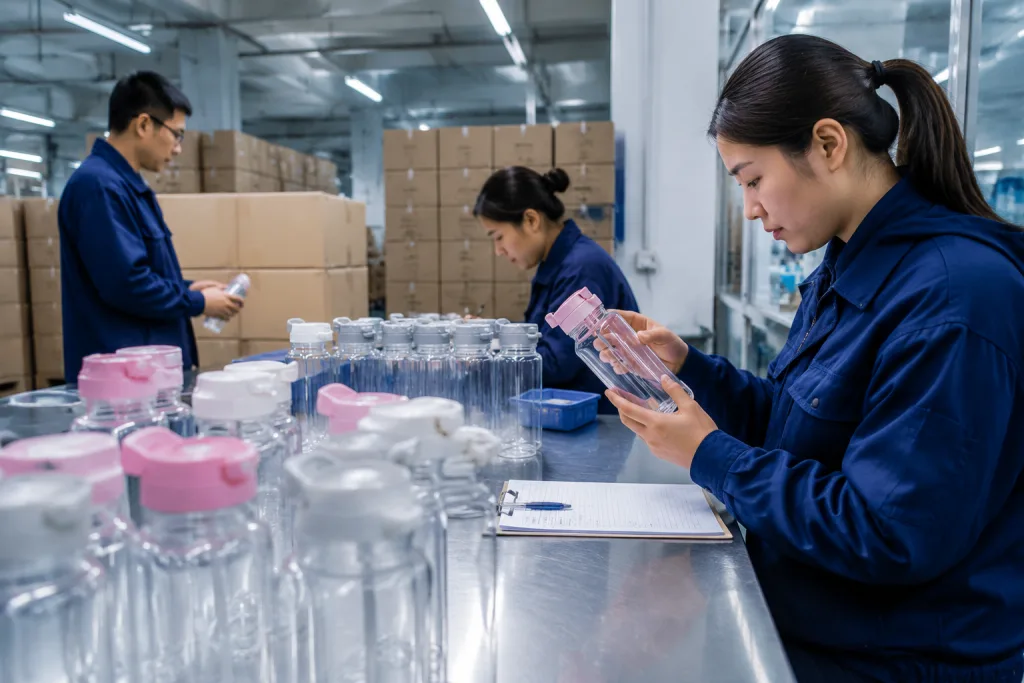
Your supplier should send production photos at fixed points, not random close-ups of cartons. Ask for resin bags with lot numbers, molded bodies before printing, lid assembly on the bench, the logo print line, the leak test station, packed cartons, and pallet loading. QC pulled the sample last month on a Tritan canteen run because the lid gasket sat 0.8 mm proud after assembly; that photo saved the buyer from finding the issue after arrival. This matters when buying from a new canteen manufacturer or splitting regional orders across 3 canteen manufacturers.
If you are a canteen distributor building a seasonal program, leave buffer. Do not book retail launch dates on the shortest promised lead time. Add 7 days for sample revision, 7 days for packaging approval, and 7-10 days for freight schedule changes. Ocean freight to Europe or North America can sail on time, then lose 5 days at the destination port or warehouse appointment. Air freight can rescue 500 units for a launch event; the math doesn't work on 8,000 bottles when the carton is 58 x 42 x 36 cm and chargeable weight jumps.
For repeat customized drinkware orders, the best improvement is not arguing over USD 0.03. Build a stable spec sheet and reorder file with the final BOM, Pantone numbers, logo AI file, carton dimensions, test reports, inspection checklist, and approved-sample photos. We keep one gold sample in the QC room with masking tape on the base showing order number and approval date. That file makes the next distributor growler or canteen promotional order faster, cleaner, and less dependent on someone remembering what happened 6 months ago.
Choose The Supplier Fit
A good tritan polypropylene bottle supplier can discuss resin grade, mold status, decoration limits, testing steps, and export paperwork in the same call. If every reply is “yes, can do,” you still have no working spec. Ask where the mold is stored, who owns it, MOQ per color, daily output on the line, inspection standard, and whether BSCI, ISO 9001, or other factory audits are ready to share. We once had QC pull a sample because the buyer’s PO said PP lid but the approved sample used a Tritan flip cap.
For existing molds, a practical MOQ is often 3,000 units per color and 5,000 units for deeper customization. For new mold custom drinkware, we usually quote MOQ at 10,000-20,000 units because tooling, trial shots, and line setup need volume. If you are testing a new market, do not over-customize the first order. Use an existing bottle body, run 2-3 color chips, add the logo, then pay for private tooling after sell-through data is real. The math does not work if the first order needs a new lid mold, custom carton, and only 1,200 units.
Location also matters. Hangzhou, Zhejiang gives access to plastic molding, packaging, printing, and Ningbo/Shanghai export routes without moving parts across half of China. That cuts coordination risk. It does not replace clear specifications, but it helps when a lid color, carton print, or gasket fit needs correction. Last month the buyer flagged a 1.5 mm gasket gap; our mold tech checked it with a caliper before lunch, not after three days of trucking samples between provinces.
As a canteen supplier for B2B buyers, we prefer direct, complete RFQs. Send target quantity, market, compliance requirement, logo file, packaging idea, delivery address or port, and target retail or landed cost. We will push back if the target is unrealistic. Better now than 35 days later. We have seen this go sideways when a PO typo changed 6,000 pcs from “matte black” to “match black,” and the sales team had already promised delivery to a chain store launch.
Send Your Bottle Spec For A Factory Quote
Share quantity, market, logo, packaging, and target FOB price. We will reply with practical options, MOQ, lead time, and QC notes.
Frequently asked questions
What MOQ should I expect from a tritan polypropylene bottle supplier?
For existing molds, expect 3,000-5,000 units per color for Tritan body and PP lid bottles. If you need a custom canteen color, one-color logo, and standard packaging, 5,000 units is usually workable. For private mold development, MOQ often moves to 10,000-20,000 units because tooling, testing, and line setup must be recovered. Some canteen vendors may accept 1,000-2,000 units, but the unit price will be higher and color options may be limited to stock components.
How long does a customized canteen order take from China?
For an existing mold, plan around 7 days for plain or logo sample approval, 25-30 days for mass production, and 5-7 days for inspection, packing, and export loading. That means 37-45 days before vessel departure is realistic. If packaging needs retail artwork, add another 5-10 days for proofing and corrections. From Zhejiang to Ningbo port is efficient, but freight booking and destination customs can still change the final delivery date.
Is Tritan better than polypropylene for custom drinkware?
Tritan is better when you need clarity, higher perceived value, and stronger impact resistance in a transparent bottle. Polypropylene is better for cost control, lids, hinges, handles, and opaque budget bottles. Many B2B orders use both: Tritan for the body and PP for the lid. For canteen promotional programs, that mix gives a good balance of retail appearance and price. If your target FOB price is under USD 1.00, full PP may be more realistic than Tritan.
What tests should I require before shipping distributor drinkware?
At minimum, require material compliance documents, capacity check, leakage test, closure cycling, 1.0 m filled drop test, logo adhesion tape test, and AQL inspection. For Europe, ask for LFGB and REACH support. For North America, ask for FDA food-contact and BPA-free declarations. Use AQL 2.5 for major defects and AQL 4.0 for minor defects. For children’s bottles, discuss ASTM requirements, small-parts risk, and age labeling before production starts.
Can one supplier handle bottles, canteens, and growlers?
Yes, if the supplier has the right mold base and quality system, but do not assume every canteen factory is good at every format. A 600 ml Tritan bottle, a 1 L custom growler, and a kids bottle have different leak, drop, handle, and packaging risks. Ask for production photos, current monthly capacity, sample history, and test reports for similar items. A capable canteen manufacturer should explain the limits instead of quoting every product at the same speed and confidence.