Key Takeaways
- Tritan custom bottle MOQ usually starts at 3,000 pcs; PP can often start at 5,000 pcs for color-matched runs
- Tritan suits clear retail bottles, while polypropylene suits lighter, lower-cost canteen customized programs
- Private tooling normally takes 30-45 days before mass production approval
- Typical mass production lead time is 25-35 days after deposit and artwork confirmation
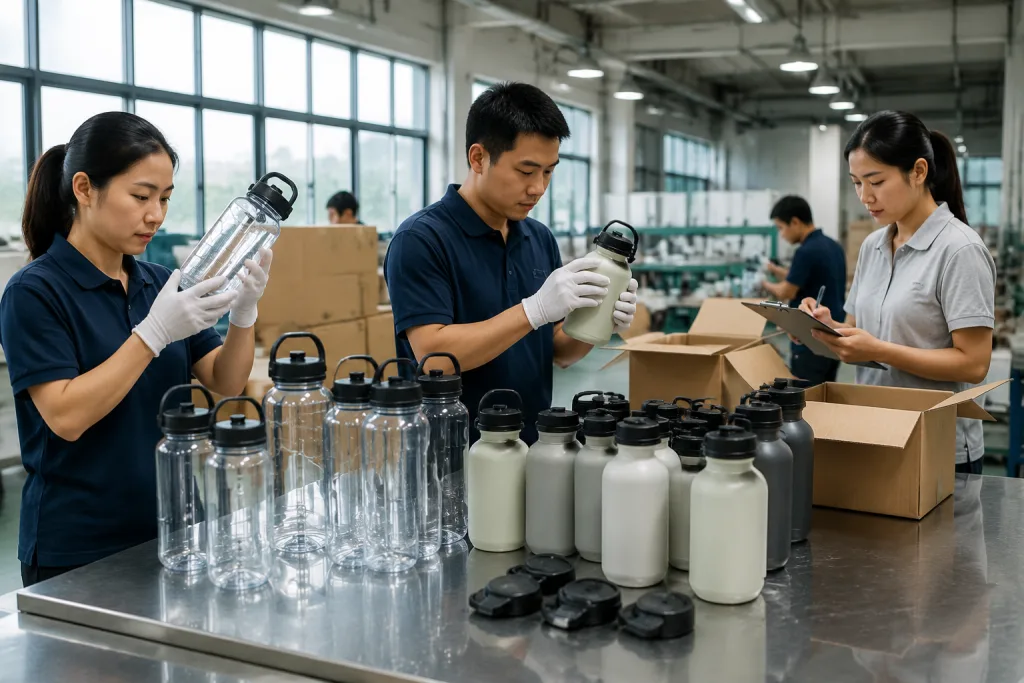
If you are sourcing a tritan polypropylene bottle custom project, the first problem is not the logo. It is material fit. Tritan and PP can both look fine in a PDF catalog, but they behave differently once we cut the mold, run 65°C heat checks, drop test from 1.2 m, match Pantone chips, and calculate landed cost. The buyer often asks, “Which one looks more premium?” Wrong question. QC pulled samples from a 3,000 pcs PP trial last month, and the cap thread was 0.35 mm tight after cooling.
We manufacture custom drinkware in Hangzhou, Zhejiang, and the wrong material choice can turn a clean RFQ into 12 days of sampling versus 18 days with rework. A North America canteen distributor may need dishwasher-safe retail packaging with a 6 kg carton drop test. A European promotional buyer may care more about REACH, food contact paperwork, and a firm FOB China price that still works after color masterbatch and insert mold costs are added. We’ve seen this go sideways when the PO says Tritan, the artwork file says PP, and the buyer flags it only after the line is ready.
Material Matchup At Quotation Stage
For a custom canteen quote, starting with “copy this photo but cheaper” is the wrong question to ask. Start with resin. On our Hangzhou line, one 600 ml Tritan body from a 32-cavity mold usually lands heavier and clearer, so the buyer gets glass-like shelf appeal and better drop performance than basic SAN or PC options. PP, short for polypropylene, is lighter, semi-opaque, and cheaper per kg of resin; we run it for school promos, event bottles, and price-sensitive distributor orders. Last month QC pulled 12 Tritan samples after the buyer flagged hairline scratches from loose polybag packing.
This is the head-to-head check we use before quoting a new RFQ from a canteen vendor or distributor drinkware buyer:
| Spec | Tritan | Polypropylene |
|---|---|---|
| Visual finish | Clear body, retail shelf look, shows water line cleanly | Translucent or opaque body, softer color, hides scuffs better |
| Typical bottle weight | 85-130 g for 600 ml body | 55-95 g for 600 ml body |
| Heat resistance | Usually around 90-100°C depending grade | Often 100-120°C depending grade |
| Logo options | Silkscreen, UV print, sleeve, laser on metal parts | Silkscreen, in-mold label, pad print |
| Best use | Retail sports bottle, office bottle, premium custom drinkware | School bottle, event canteen promotional, budget canteen customizable orders |
This table is not classroom theory. It changes the mold steel choice, carton layout, QC checklist, and FOB cost. A Tritan bottle needs scratch control during packing; we often add a PE bag plus divider, which can move packing from 12 pcs/carton to 24 pcs/carton depending bottle shape. A PP bottle needs tighter color checking because pigment dispersion shifts across batches; our QC team checks the first 30 shots against the Pantone chip under a D65 light box. We’ve seen this go sideways when a PO says “blue lid” but the approved sample was PMS 2925C.
Where Tritan Usually Wins
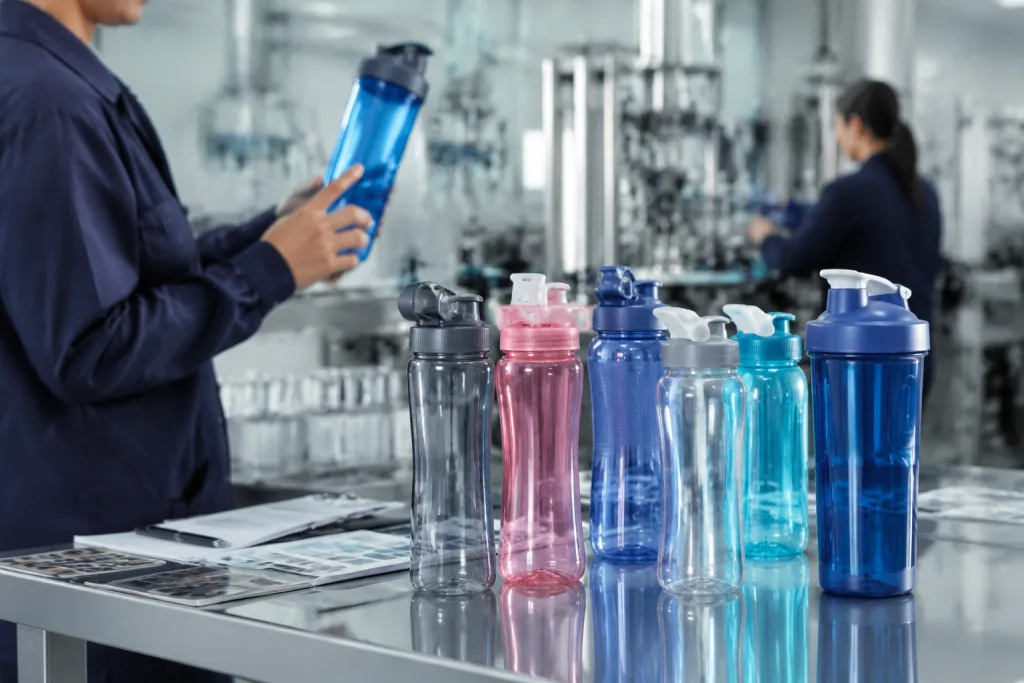
Tritan wins when the bottle has to look clean on a retail shelf. Think of a transparent 650 ml sports bottle with a flip lid, fruit infuser, laser-marked measurement scale, and a logo sitting behind clear plastic. PP will not give that same glass-like wall. On the line, QC checks the first 20 shots against a light box because one 0.3 mm black speck near the logo area is enough for a buyer to reject the carton sample. Tritan gives buyers the clear look they expect from customizable drinkware, without the old polycarbonate concern.
For a distributor canteen program, Tritan fits gyms and outdoor retail better than basic PP when the buyer wants a premium hand feel. It also works for corporate wellness kits and higher-price school ranges where the bottle must look like a gift, not a giveaway. Color tinting is controllable: smoke gray, amber, blue, and pink bodies stay consistent when we approve the resin grade and masterbatch chip before production. We run that check before bulk, not after. For logo work, single-color silkscreen can hold through 1,000-2,000 cycles of tape and rub testing if the ink, mesh count, and oven curing time are set correctly.
The trade-off is cost. A 600-750 ml Tritan bottle with PP lid, silicone seal, and one-color logo may sit around USD 1.45-2.40 FOB Ningbo or Shanghai at 3,000-10,000 pcs, depending on cap complexity and packaging. Add a straw lid, carry loop, retail box, and full-color UV print, and the math changes fast. We have seen buyers push back on USD 0.18 for a box upgrade, then spend 12 days arguing over artwork because the shelf photo looked too cheap.
As a canteen manufacturer in Zhejiang, China, we recommend Tritan when return risk is expensive. Clear bottles expose scratches, bubbles, black dots, flow marks, and lid-fit gaps right away. No hiding. QC pulled one sample last month where the hinge pin sat 0.6 mm off center; on a frosted PP bottle, nobody noticed, but on clear Tritan the buyer flagged it in 5 minutes. Stricter incoming material checks and AQL inspection cost more, but this is the wrong place to save USD 0.03 if your retail margin depends on clean shelf presentation.
Where Polypropylene Makes Sense
Polypropylene is not the bargain-bin fallback. Used correctly, it works for custom canteen orders where the buyer needs a dependable bottle and the unit price has a ceiling. PP is about 15-20% lighter than Tritan on a 600 ml body, and the living hinge on a flip cap survives the bend test better than buyers expect. On our line, QC bends the cap hinge 3,000 times before we sign off a new mold, because a cracked lid ruins the reorder.
For canteen suppliers serving wholesalers, PP is easier to sell when the design does not need glass-clear transparency. A 500-700 ml PP bottle works with a wide mouth, screw cap, silicone gasket, and molded grip; we usually hold the mouth ID at 52-58 mm so ice cubes and cleaning brushes fit. If the project is a 20,000 pc event run, charity campaign, or private label value line, the gap between USD 0.80 and USD 1.25 FOB is not small money. The math doesn't work if the buyer asks for Tritan clarity but budgets like PP.
PP also gives solid brand colors more room. If your customer wants 12,000 pcs in navy, 12,000 pcs in green, and 6,000 pcs in orange, PP runs efficiently once the color chips are signed and the pigment masterbatch is locked. The caution is consistency. Pantone matching on PP is not a digital promise; wall thickness, pigment dosage, cooling time, and recycled-content restrictions all shift the final shade. We had one buyer flag a blue sample because the shoulder looked 1 tone darker than the body under a D65 light box. For food-contact bottles, we normally avoid post-consumer recycled PP unless the buyer gives us the market requirement and the paperwork route before sampling.
PP fits canteen distributors who need repeat orders, not one perfect hero SKU. It also works for canteen vendors selling to schools because the bottle can be tough, light, and cheap enough for seasonal replacement. We ship plenty of 3,000-5,000 pc school orders this way, and QC pulled fewer dent complaints on PP than on thin-wall AS bottles last summer.
Spec Table For Real Use Cases
The cleanest comparison is by use case, not the resin sheet. This is the wrong question to ask if the RFQ only says “Tritan polypropylene bottle custom.” A 1,000 ml growler-style bottle and a 450 ml school canteen fail in different places. We’ve seen caps leak after a 30-minute inverted rack test, logos rub through after 6 cartons of sea freight vibration, and buyers ask for EU food-contact files after the injection line was already running.
| Use case | Better material | Why | Watch point |
|---|---|---|---|
| Premium retail sports bottle | Tritan | Clear body, shelf appeal, better price feel at retail | Scratch marks, PE bag packing, 5-ply carton spec |
| School canteen customized program | PP | Lower weight and cheaper replacement when kids lose lids | ASTM, CPSIA, small parts, age grading |
| Corporate wellness gift | Tritan | Logo reads cleaner through a transparent body | Cross-hatch logo adhesion and 24-hour lid leak test |
| Mass event giveaway | PP | Lower FOB price, faster color matching on 5,000 pcs | Delta E color tolerance and carton crush after stacking |
| Customizable growler style bottle | Depends | Tritan if the buyer wants drink visibility; PP if the math is tight | Wall thickness, handle pull force, cap torque |
For most B2B buyers, material is only one line on the PO. Before approving the pre-production sample, confirm capacity tolerance, wall thickness, cap thread design, gasket material, and carton drop requirements with the factory drawing. We run plastic bottle body walls around 1.0 mm to 2.0 mm, while lids and hinge zones need thicker local ribs; QC pulled one sample last month where the hinge cracked at 500 openings on the test jig. Nice render. Bad sample.
Cost, MOQ, And Tooling Reality
Buyers ask us this at least 6 times a month: “Can you make 300 pcs in our PMS color, with our own lid, and a new mold?” The short answer is no. The math doesn't work. Injection molding needs resin drying at 80°C for Tritan, machine setup on the 160T or 220T press, color purging, mold hanging, T0/T1 checks, first-article inspection with calipers, then packing line changeover before one sellable carton is taped.
For existing molds, our usual MOQ in Zhejiang is 3,000 pcs for most Tritan bottle styles and 5,000 pcs for PP color-matched bodies. We can talk about 1,000-2,000 pcs for simple logo-only customized drinkware if the bottle body uses a stock color, but don't build a serious retail launch around that number. We've seen this go sideways. For private molds, a new bottle body and cap set can cost USD 4,000-15,000 depending on cavity count, slider structure, lid mechanism, and surface finish. Tooling time is usually 30-45 days, then T1 samples, adjustment, and production approval; last quarter QC pulled one cap sample because the flip hinge gap was 0.6 mm off the drawing.
Our monthly output for plastic and stainless drinkware combined is about 600,000 units/month across partner workshops and in-house packing lines in China. Normal mass production lead time is 25-35 days after deposit, approved artwork, and confirmed packaging. From March to July, peak season can push that to 32-49 days, especially for distributor growler or distributor canteen orders with mixed colors and retail boxes. The line slows down fast when one PO says “matte black” and the artwork file says “black gloss”; we had that typo on a PO in May.
FOB pricing must include the exact packing method. Bulk polybag, kraft box, color box, PDQ tray, and Amazon-ready carton labeling do not sit in the same cost bucket, so we quote them line by line with carton size and gross weight. A buyer flagged a USD 0.18 difference last week, and the reason was simple: their comparison quote used bulk bags while ours used a 350 gsm color box plus FBA outer carton labels. If you compare quotes without matching packaging, you are not comparing the same product.
Compliance And Quality Checks
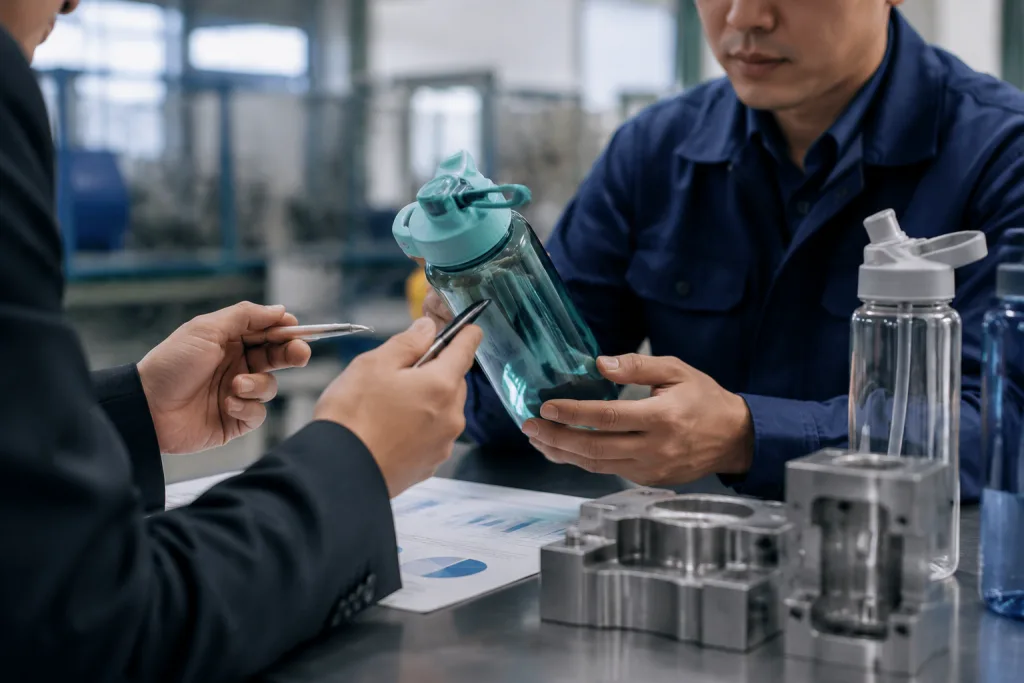
A canteen manufacturer should not treat compliance as a PDF to attach at the end. For Europe, we usually quote EU 10/2011 food-contact migration testing first; if the buyer sells into Germany, LFGB goes on the test plan, and REACH screening covers restricted substances in colorants, coatings, and packaging. For the United States, FDA food-contact suitability and California Proposition 65 risk review need checking before artwork approval. If the bottle is for children, CPSIA or ASTM requirements enter the file. Canada and the UK often ask for their own declaration formats too. We had one PO last March where “EU food safe” was typed in the remarks column, and QC stopped the booking until the lab scope named EU 10/2011 line by line.
Ask your canteen vendors for material declarations before you approve mass production. The file should name the Tritan grade and supplier, the PP grade used for the cap, the silicone gasket material, the ink system, any coating, and the packaging ink if the retail box touches the product. “Food grade” is not enough. This is the wrong question to ask if the factory cannot name the test standard, because European and North American buyers will not accept a loose phrase during document review. On our line, the merchandiser checks the resin code against the injection machine tag before the first 500 pcs run, not after 20 cartons are already packed.
For quality control, we normally use AQL 2.5 for major defects and AQL 4.0 for minor defects, unless the buyer sets a stricter inspection plan. Critical defects get zero tolerance: leakage, sharp edges, broken caps, wrong material, or unsafe odor. A practical pre-shipment inspection should cover a carton drop test from the agreed height, lid torque check with a torque meter, logo position measured against the approved artwork tolerance, a 30-minute inverted leak test, and barcode or FNSKU scan check for marketplace warehouses. QC pulled a sample last week where the silicone ring sat 1.2 mm proud of the groove; the bottle passed a quick shake test but failed after 18 minutes upside down. That is how orders go sideways.
BSCI or ISO-style factory management audits help, but they do not replace product testing. A clean audit report proves the factory has management records, not that your customized growler or canteen custom order passes migration, dishwasher, or drop performance. Treat audits and lab tests as separate controls, then use the inspection report to confirm the actual shipped batch. The math does not work if a buyer pays for a social audit but skips a USD 180 leak and drop check on a new cap mold.
How To Brief The Factory
A good RFQ saves 3 to 5 working days. A loose RFQ gives us three rounds of guessing, then a quote the buyer does not trust. If you are contacting canteen manufacturers in China, put the basics in the first email: capacity in ml, target material, lid style with straw or screw cap, logo process, number of colors, inner box or bulk pack, destination port, compliance market, and annual forecast. We run RFQs through a one-page costing sheet; if the material line says “plastic bottle” only, the merchandiser has to stop and ask. If you do not know the material yet, tell us what matters most: shelf clarity, low cost, dishwasher use, or drop resistance from 1.2 m.
For a tritan polypropylene bottle custom comparison, ask for two price columns in the same RFQ: Tritan and PP. Same capacity. Same cap. Same logo size. Same carton pack and Incoterm. That is how you see the real cost gap. Last month a buyer flagged a 14% PP saving, but the PP quote used bulk pack at 48 pcs per carton while the Tritan quote had a retail box, barcode sticker, and 24 pcs per carton. The math does not work when the packing spec changes.
Artwork should come as AI, PDF, or EPS vector files. For silkscreen, keep thin lines above 0.2 mm where possible; our print room checks this with a film ruler before making the screen. For curved bottles, ask for a print area template before your designer locks the layout, because a 65 mm wide logo can wrap badly on a tapered body. For color approval, use physical Pantone chips or resin plaques, not only screen images. QC pulled one PP sample where the monitor looked like 2995C, but the plaque matched closer to 300C.
Our practical advice is blunt: choose Tritan when appearance and retail value drive the order; choose PP when budget and repeat volume drive the order. Both work as custom drinkware materials. The wrong question is “which plastic is better?” Ask which one fits the selling channel, target FOB, and expected reorders. We have seen this go sideways when a buyer forced PP into a premium retail set with a clear window box, then rejected the natural haze during pre-shipment inspection under AQL 2.5.
Send your bottle specs for a factory quote
Share capacity, material, logo method, MOQ, destination, and compliance market. We will compare Tritan and PP options with realistic FOB pricing.
Frequently asked questions
Is Tritan better than polypropylene for custom bottles?
Tritan is better when you need a clear, premium-looking bottle for retail, corporate gifts, or higher-end sports lines. Polypropylene is better when you need a lighter and lower-cost bottle for schools, events, or large canteen promotional programs. For a 600-750 ml bottle, Tritan may cost roughly USD 1.45-2.40 FOB China, while PP may sit closer to USD 0.80-1.50 depending on cap and packing. Tritan usually shows scratches and cosmetic defects more clearly, so QC and packing must be tighter. PP is less premium visually but practical for repeat distributor canteen orders.
What MOQ should I expect for a tritan polypropylene bottle custom order?
For existing molds, expect around 3,000 pcs MOQ for many Tritan bottles and about 5,000 pcs for PP bottles in custom body colors. Logo-only orders on stock colors may sometimes start at 1,000-2,000 pcs, but that depends on inventory and printing setup. Private mold projects are different: the MOQ often starts at 10,000 pcs or more because tooling, resin setup, and sampling costs must be spread across enough units. If you are a new canteen distributor, start with an existing mold before investing USD 4,000-15,000 in tooling.
Can I use the same logo method on Tritan and PP?
Often yes, but the result is not identical. Silkscreen printing works on both Tritan and PP, but ink selection, surface treatment, curing temperature, and adhesion testing differ. PP can require flame or corona treatment for better ink grip, especially on curved or textured areas. Tritan usually gives cleaner logo definition on clear walls, but scratches around the print area are easier to see. For B2B customized drinkware, ask for a printed pre-production sample and run tape test, rub test, and 30-minute leak test before approving mass production.
What compliance documents should a canteen supplier provide?
For Europe, ask for EU 10/2011 migration testing and REACH information; LFGB may be needed for Germany. For the United States, ask about FDA food-contact suitability and Proposition 65 risk, plus CPSIA or ASTM if the bottle is intended for children. The canteen supplier should identify the Tritan grade, PP grade, silicone gasket, ink system, and packaging materials. A general food grade claim is not enough. For stronger control, align testing with the exact production sample, not a similar old bottle from another order.
How long does production take after sample approval?
For an existing mold custom canteen or bottle, normal production is 25-35 days after deposit, approved artwork, confirmed packaging, and final color approval. Add about 7-14 days during peak season or when retail boxes, mixed colors, FNSKU labels, or special carton marks are required. New tooling usually adds 30-45 days before mass production can even begin, because T1 samples often need adjustment. If your launch date is fixed, give the canteen factory your required warehouse arrival date, not only your preferred ship date.