Key Takeaways
- For tritan polypropylene bottle bulk, define resin grade, wall thickness, lid resin, and seal material before asking for FOB pricing.
- A practical MOQ is 3,000 pieces per color for stock molds and 10,000 pieces for custom PP lid colors.
- Standard production lead time from Zhejiang is 25-35 days after artwork approval and deposit.
- Use AQL 2.5 for major defects and AQL 4.0 for minor defects on most drinkware wholesale inspections.
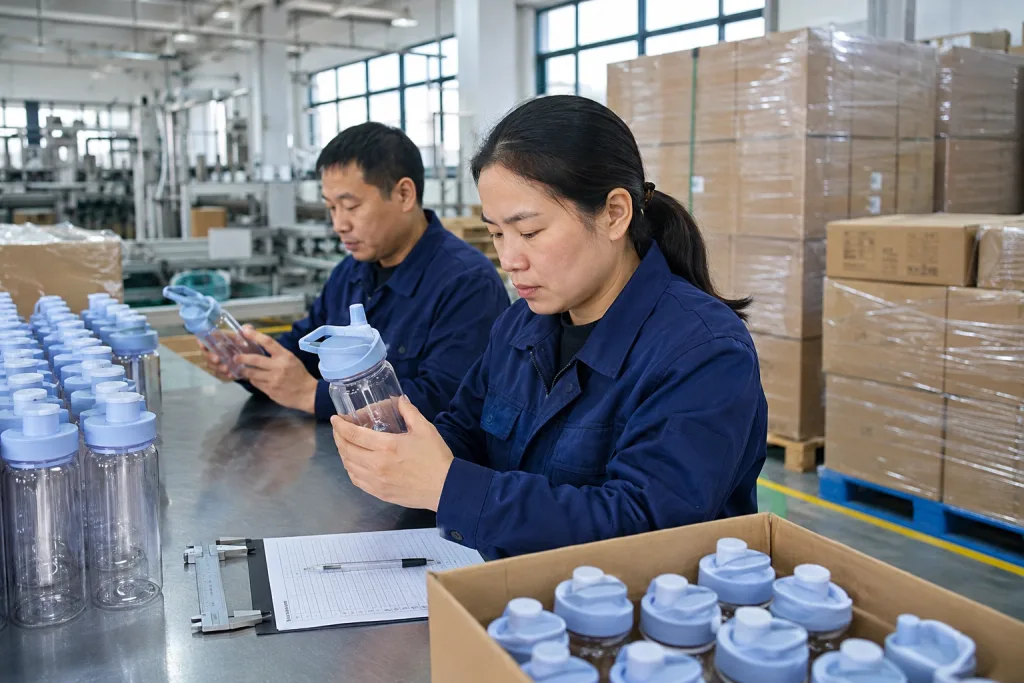
If you are buying tritan polypropylene bottle bulk, the product photo tells you almost nothing until the spec sheet is locked. A clear Tritan body, PP lid, silicone seal, straw, carton pack, and logo all look simple on a screen. On the line, the real questions are resin code, body wall at 1.2 mm or 1.5 mm, lid thread tolerance within 0.15 mm, and which test report the buyer’s QA team will accept.
At BottleForge Industrial in Hangzhou, Zhejiang, we see this on 6 out of 10 new bulk drinkware RFQs: the buyer compares FOB prices before comparing specifications. This is the wrong question to ask. We had QC pull a sample at 45 degrees after a 300 ml water fill, and the cheaper lid started weeping at the seal. A USD 0.18 cheaper bottle gets expensive fast if the carton fails a 76 cm drop test, the PO says “PP bottle” but the drawing shows Tritan body, or the material file cannot pass EU or North American compliance review.
Material Line: Tritan Body, PP Lid
The first spec line should split the bottle body from the cap system. Write it that way on the RFQ. Tritan works for the clear body because buyers get the glass-like shelf look without the weight; on a 650 ml stock mold, our body weight is usually around 92-105 g before printing. PP is the safer call for the lid because the injection line holds threads cleanly, and the tap gauge catches loose-fit caps before packing. If the RFQ only says plastic bottle, we can quote PETG, PC, AS, or a cheaper copolyester, and the buyer will think four prices are comparable. They are not.
For tritan polypropylene bottle bulk, ask for the exact body resin family, the food-contact declaration, and whether the resin is virgin or recycled-content. We run virgin Tritan-type copolyester on most export orders because clarity and odor are easier to control; QC still pulls 3 bottles after hot-water rinsing to check smell before carton sealing. For PP, specify food-grade PP, not recycled PP, unless your market and test plan allow it on paper. For EU orders, request LFGB or EU 10/2011 food-contact support. For North America, ask for FDA food-contact confirmation and, when needed, California Proposition 65 review.
Buyer impact is simple: unclear material creates compliance risk. A distributor selling wholesale drinkware into Germany or Canada needs documents, not a supplier saying “same as before” on WeChat. We have seen this go sideways when a PO typo changed “Tritan body + PP lid” into “plastic bottle,” then the buyer flagged the file during pre-shipment review. If you are building a best wholesale drink bottle range for gyms or schools, the material file should be ready before mass production starts. China factories can move fast; paperwork chased after the vessel leaves Ningbo usually means 12 days of email instead of 2 days of checking.
Our normal stock-mold MOQ in Zhejiang is 3,000 pieces per color, with 120,000-180,000 plastic bottle units per month available across standard drinkware bulk lines, depending on season and decoration load. During peak August runs, the printing line may be the bottleneck, not molding; one 1-color logo job can clear in 3-4 days, while full-wrap artwork with a tight Pantone match can stretch to 7-9 days after the buyer signs the PP sample.
Capacity Is Not Just Milliliters
Capacity looks simple on a PO, then QC pulls the sample and everyone starts arguing. A 650 ml bottle might mean brim-full capacity, safe drinking capacity, or the number your designer printed on the color box. Define it in writing. We run this as two lines on the spec sheet: 720 ml brim capacity, 650 ml usable fill at 18 mm below the thread. Clean and boring. It also stops the buyer from sending photos of water sitting in the lid thread and asking for a discount after 12 cartons are opened.
This matters when one catalog mixes canteen wholesale, bulk canteen, sports bottles, and travel bottles. Buyers put all of them under drinkware wholesale, but users do not treat them the same. A hiking canteen bulk order often needs a 48 mm mouth so ice cubes fit and the cleaning brush reaches the shoulder. A school bottle has to sit inside a 72 mm backpack side pocket. The fitness bottle needs one-hand opening and a drop test that survives 1.2 m onto concrete. If capacity is right but the diameter is wrong, the math doesn't work. Returns eat the margin.
Ask for these numbers in the spec sheet: brim capacity in ml and oz, usable fill line, bottle height, body diameter, mouth inner diameter, and weight without packaging. Better yet, ask for the caliper readings from pre-production samples, not just the 3D drawing. A 70-75 mm body diameter fits a lot of cup holders, but not all; we have seen a 76.8 mm body fail in a Toyota holder during buyer testing. If you sell to North America, test 3 common vehicle holders before you commit to 20,000 pieces.
For bulk growler, growler bulk, or beer growler bulk projects, capacity gets touchier because beer customers expect the ounce claim to be exact. The buyer flagged this once on a 64 oz Tritan growler when the usable fill was closer to 60 oz with foam space. Plastic Tritan bodies work for outdoor events where glass is restricted, but check local alcohol packaging rules before you print “beer growler” on a carton or launch any beer growler wholesale bulk program.
Wall Thickness And Drop Performance
Wall thickness is where cheap quotes hide. For 500-750 ml Tritan bottles, we usually run 1.5-2.2 mm nominal body wall, depending on mold geometry and the drop target written on the RFQ. Thin looks fine. We have seen a 1.35 mm shoulder pass the showroom check, then crack after a 1.2 m drop when QC pulled 6 filled samples from the first trial run. A heavier wall adds resin cost, slows the injection cycle by 3-5 seconds, and pushes carton weight up, but the math works better than handling claims from school, outdoor, or corporate gift channels.
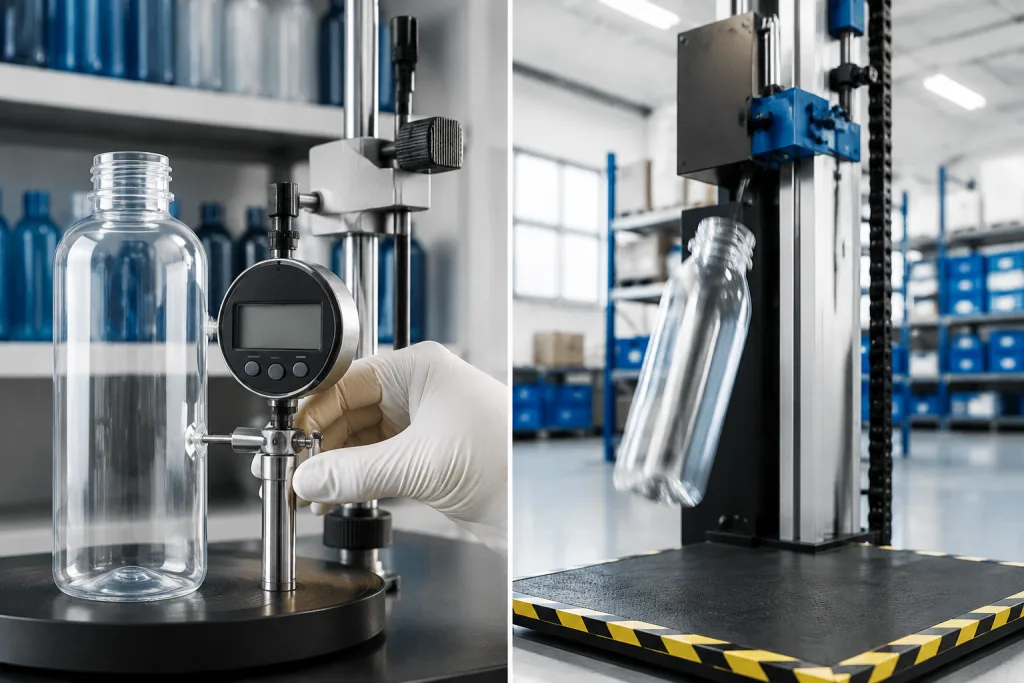
Do not accept average wall thickness only. Ask the factory to mark the minimum reading at the shoulder with a digital thickness gauge, check the base corner after trimming, and record the side wall near the parting line. Those are the stress points. Also ask whether the base is flat, concave, or reinforced with a thicker ring. If your bottle sits on warehouse shelves or retail displays, base wobble turns into a quality complaint fast; we had a buyer flag 2.8 mm wobble on a counter display sample before approving artwork.
A test plan for tritan polypropylene bottle bulk does not need to be fancy. We run a room-temperature drop test at 1.0 m or 1.2 m on 6 filled samples, with separate hits for base, side, shoulder, and cap so the failure point is clear. For children or outdoor products, raise the sample count to 12 and add 0-5°C conditioning if the bottle ships into winter markets. ASTM-style wording helps only if it matches the buyer's protocol; pretending one generic drop test covers every retailer is the wrong question to ask.
For alcohol flask bulk or alcohol flask wholesale requests, impact testing needs a tighter spec if the item is used at festivals, camping, or sports events. We usually ask for cap torque after drop, seam inspection under a 10x loupe, and a leak check with colored water before packing. A plastic alcohol flask in bulk may pass in one sales channel and get blocked in another, so the PO should spell out both durability and channel compliance before we cut the mold insert.
Cap, Seal, And Leak Tolerance
The cap is the part your customer handles 20 or 30 times a day, and this is where factories often shave the spec. Polypropylene lids come as flip-top, screw cap, straw lid, chug lid, or carry-loop style, but those names do not tell you enough. Ask how the line tests them. Flip tops loosen at the hinge pin. Straw lids leak through the vent hole. Screw caps live or die on thread accuracy and gasket compression, usually within 0.2 mm. A carry loop can pass one 12 kg pull test and still crack after 500 open-close cycles. We have seen this go sideways.
For the spec sheet, call out food-grade PP for the lid, silicone or TPE for the gasket, gasket hardness if the supplier has it, thread turns, and opening force. No guessing. For common sports bottle lids, we run a leak test at 45 degrees and upside down for 30 minutes after filling with room-temperature water. QC pulled the sample last month because one lid leaked after 18 minutes, not 30. For hot-fill claims, this is the wrong question to ask if the bottle was designed for cold drinks. Tritan and PP handle warm use better than cheap plastics, but that does not make the bottle a thermos.
If you are sourcing beer tumbler wholesale, beer tumbler bulk, or beer tumbler wholesale bulk, lid fit changes foam control and aroma release. The buyer will feel it. For a beer tumbler in bulk, a loose sliding lid may work for picnic use but not for a commuter bag. For a beer growler in bulk, the closure needs tighter performance because carbonation pressure changes the risk. We would not put a standard water-bottle lid on carbonated beverage claims unless pressure testing supports it; the math does not work. On the factory floor, we check the mouth ID with a digital caliper before signing off the lid mold.
The buyer impact is simple: cost and reputation. A USD 0.06 silicone ring upgrade can prevent 2,000 complaint emails on a 50,000 pcs wholesale run. On wholesale canteen and canteen bulk orders, we often recommend approving pre-production samples from the same cavity set used for mass production, not hand-polished showroom samples. One PO typo we caught said “PP ring” instead of “silicone ring,” and the buyer flagged it before deposit. Good catch.
Decoration Specs Buyers Should Lock
Treat decoration as a production spec, not a last-minute artwork note. For bulk drinkware orders, we run single-color silkscreen, multi-color screen print, pad print, heat transfer, UV print, and laser marking on stainless trim when the design has metal parts. On Tritan bodies, screen printing is the safe, lower-cost choice for simple logos; our line usually holds a 35 mm logo clean on a curved 650 ml bottle with a standard screen jig. UV print gives sharper gradients, but QC pulled samples last month with edge lift on a curved wall after tape testing, so adhesion testing is not optional.
Before quoting, send logo size in mm, print position, Pantone code, and the direction the logo must face against the lid hinge, straw, or handle. Small detail. Big headache. A logo centered on the bottle can still look wrong if the cap tightens 20 degrees off after assembly. We saw one PO say “front logo,” but the buyer flagged the first carton because the straw side became the real front on shelf photos. If brand presentation matters, the cap thread and print fixture need to be controlled together.
For most wholesale drinkware programs, we suggest 3M tape adhesion testing, 50-cycle hand-wash rubbing, and a visual check after 24 hours drying. Dishwasher-safe claims need a defined test, such as 50 or 100 dishwasher cycles. The math doesn’t work if the ink supplier only tested flat plaques while the bottle has a 72 mm curved body and a raised grip area. Most printed Tritan bottles should be sold as hand-wash recommended unless the ink system, curing temperature, and line speed prove the claim in testing.
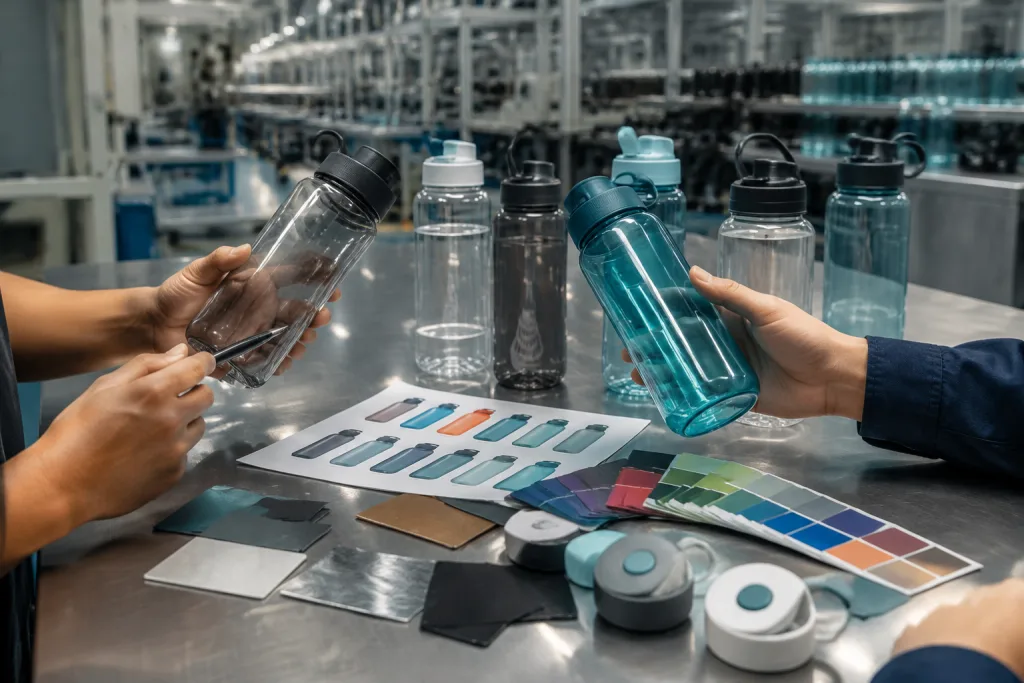
Custom color needs discipline too. A PP lid in custom Pantone usually needs 10,000 pieces per color to justify resin purging and color matching; our injection team can burn 18 kg of resin just clearing the barrel after a dark color. Body tinting can raise MOQ and add lead time because transparent color variation shows faster than solid PP variation. For a seasonal wholesale drinkware campaign, stock body colors plus a custom logo is the cleaner choice. For a permanent retail line, custom resin color makes sense because the repeat orders pay for the setup.
Packaging, Cartons, And FBA Details
Packaging is not glamorous. It is where landed cost meets damage claims. For tritan polypropylene bottle bulk, we usually run 1 bottle in a PE bag or tissue wrap, then 24 pcs into a 5-ply master carton. Retail orders may need a color box, kraft box, belly band, hang tag, or barcode label, but each one changes the packing line speed and the carton cube. Amazon-style shipments need FNSKU labels, carton weight limits, and no mixed SKU cartons. If these points are missing from the RFQ, the merchandiser will quote the cheapest export carton; we have seen buyers flag this only after QC pulled the pre-shipment sample.
Ask for carton dimensions, gross weight, net weight, pieces per carton, carton burst strength, and a pallet loading plan with container count. For 600-750 ml plastic bottles, 24 pieces per carton is the safe setup on our line, while 36 pieces works only when the bottle body nests cleanly without cap rub marks. Keep master cartons under 15 kg when possible. The math gets ugly when a 17.8 kg carton arrives at a US DC and the buyer rejects it for manual-handling rules. A 5-ply K=A or K=K carton costs more, but for North American distribution centers it is often cheaper than replacing cracked caps and crushed color boxes.
For bulk canteen and wholesale canteen orders going to club stores or outdoor distributors, packaging often needs drop testing from 76 cm on corner, edge, and face. We run this with a packed production carton, not an empty sample box, because the bottom row tells the truth. For alcohol flask wholesale bulk or beer tumbler wholesale bulk, retail packaging may also need warning labels or age/channel-specific text depending on your sales territory. One buyer sent the PO with “California Prop 65 label: TBD”; that wording stopped artwork approval for 4 days.
China export teams can handle these details, but send the routing guide early. At our Hangzhou, Zhejiang operation, normal lead time is 25-35 days after deposit and approved artwork for stock molds, plus 7-10 days for sea freight booking preparation during peak months. If your forwarder needs carton labels in a fixed template, share it before mass packing begins. We print carton marks on a thermal label printer at the packing table, and changing a 40HQ after 62 cartons are sealed is the wrong question to ask the line.
Inspection And Pricing Lines
A good quotation should read like a condensed contract. For tritan polypropylene bottle bulk, ask for FOB Ningbo or FOB Shanghai price, material description, capacity, logo method, packaging, MOQ, sample fee, sample lead time, production lead time, payment terms, and validity period. We run quotes in a 14-line sheet, and if the buyer’s PO says “PP bottle” while the approved sample is Tritan body + PP lid, QC will stop it before deposit. A unit price and one product photo are not enough. You cannot compare that.
Inspection terms should be written before deposit. For standard drinkware wholesale, AQL 2.5 major and AQL 4.0 minor is a practical starting point. Critical defects should be zero tolerance: sharp edges, contamination, wrong material, severe leakage, or unsafe packaging. Major defects include leaking caps, cracked bodies, wrong logo position beyond tolerance, and cartons that cannot protect the goods. Minor defects include small print specks, light scuffs, or slight color variation within the approved range. On the line, QC pulled a 650 ml sample last month with a 2.8 mm logo shift; the buyer flagged it because their tolerance was 2 mm, and they were right.
Price also needs context. A simple 650 ml Tritan body with PP screw lid and one-color logo sits in a different FOB band from a straw lid with silicone boot, custom color, retail box, and FNSKU service. For comparison, changing from plain polybag to color box can add roughly USD 0.12-0.35 per piece depending on board grade and print coverage. A silicone carry strap or upgraded gasket can add USD 0.03-0.10. Small numbers? Not at 30,000 units. The math gets ugly when the buyer asks for 5,000 pcs MOQ but wants four Pantone colors, barcode stickers, and a drop-test carton.
If you also source growler wholesale, wholesale growler, beer growler wholesale, or alcohol flask wholesale alongside plastic bottles, do not force all products into one inspection checklist. Stainless steel, plastic, and glass fail in different ways. We have seen this go sideways: a checklist written for Tritan bottles missed weld discoloration on a stainless growler and inner glass scratches on a sample flask. Use one commercial master agreement with product-specific specs attached for each SKU, including wall thickness, leak test method, carton kg limit, and packing photos.
Send your bottle spec sheet for a factory quote
Share capacity, lid type, logo, packaging, target MOQ, and destination. We will return a practical FOB quote and sampling plan.
Frequently asked questions
What MOQ should I expect for tritan polypropylene bottle bulk?
For stock molds, a practical MOQ is 3,000 pieces per color with one standard logo method. Custom PP lid color usually starts at 10,000 pieces because the molding line needs resin purging, color matching, and setup time. A fully custom bottle mold can justify 20,000-50,000 pieces depending on tooling investment. At BottleForge Industrial in Zhejiang, sample lead time is usually 7-12 days for logo samples and mass production is normally 25-35 days after deposit and artwork approval. If you need only 500 pieces, you are likely buying from a trader or domestic stock channel, not a direct China export factory run.
Is Tritan better than polypropylene for the bottle body?
For a clear bottle body, Tritan-type copolyester is usually the better choice because it has stronger clarity, better impact resistance, and a more retail-friendly look than PP. Polypropylene is still useful for lids, handles, and some opaque bottle bodies because it molds efficiently and keeps cost down. A PP body will look cloudy or milky compared with Tritan. If your product is a low-cost giveaway, PP may be acceptable. If you are building a best wholesale drink bottle range for gyms, schools, or outdoor retail, Tritan body plus PP lid is a stronger specification. Confirm food-contact documents for both materials before approving production.
Can I use the same supplier for bottles, canteens, growlers, and flasks?
Yes, but the spec sheets should not be copied across categories. A bulk canteen order may focus on strap strength and outdoor drop performance. A beer growler bulk project needs closure performance, capacity accuracy, and sometimes pressure-related review. Alcohol flask bulk programs may require channel-specific labeling and legal checks in your sales market. A plastic Tritan sports bottle needs resin documentation, cap leak testing, and print adhesion. A capable China drinkware factory can coordinate these SKUs, but you should use separate QC criteria for plastic, stainless steel, and glass. One commercial supplier is convenient; one generic inspection checklist is risky.
What tests should I request before shipping wholesale drinkware?
At minimum, request material food-contact documentation, visual inspection under AQL 2.5 major and AQL 4.0 minor, leak testing, drop testing, carton drop testing, and logo adhesion testing. For a 650 ml Tritan PP bottle, we normally suggest 1.0-1.2 m filled drop tests on at least 6 samples, upside-down leak testing for 30 minutes, and 3M tape testing on printed logos. For EU buyers, add REACH screening if the product has colored plastics, coatings, inks, or accessories. For North America, FDA food-contact support and California Proposition 65 review may be needed depending on distribution channel.
How should I compare FOB prices from different China factories?
Do not compare FOB prices until the spec is aligned. Check capacity definition, resin type, body wall thickness, lid design, gasket material, logo method, packaging, carton strength, inspection standard, and port. FOB Ningbo at USD 1.42 with a color box may be cheaper than FOB Shanghai at USD 1.31 in a thin carton after you add repacking or damage claims. Ask each supplier to quote the same MOQ, such as 5,000 or 10,000 pieces, and the same artwork size. Also check whether sample cost, mold cost, FNSKU labeling, and pre-shipment inspection support are included or charged separately.