Key Takeaways
- For Tritan bottle wholesale, set AQL at 2.5 for major defects and 4.0 for minor defects before production
- Bottle body wall thickness should usually sit around 1.8-2.4 mm for 500-1000 ml retail-grade Tritan
- A realistic custom MOQ is 1,000-3,000 units per color, with 25-35 day production after sample approval
- Logo, lid, gasket, carton, and drop-test requirements matter as much as the bottle material itself
Buyers search “Tritan glass bottle wholesale” because the product causes confusion on the first RFQ: it has the clear shelf look of glass, but the body runs like plastic on the line. We see it used for gym chains, outdoor retail, school programs, and corporate gift orders from 1,000 to 20,000 pcs. The risk starts when the PO just says “glass bottle” and the buyer expects drop resistance, dishwasher safety, and a retail-grade logo without spelling out wall thickness, lid material, or test standard. Bad spec. Bad math.
If you buy bulk drinkware from China, the failures are usually not dramatic. QC pulled one 650 ml sample last month where the lid passed at room temperature, then seeped after 30 minutes at 45°C because the silicone ring was 0.4 mm undersized. Other repeat problems are cloudy bodies, warped threads, weak logo adhesion, crushed export cartons, and suppliers quoting canteen wholesale pricing before checking food-contact paperwork. From our Hangzhou, Zhejiang export desk, we see these issues often enough to price them before production starts, not after 38 cartons are sitting in inspection.
The Material Gets Misnamed
The first failure is not on the production line. It starts in the RFQ. Buyers write “Tritan glass bottle” because they want glass-like clarity, not real glass. Tritan is a copolyester, chosen for clear walls, drop resistance, BPA-free positioning, and lower weight than soda-lime glass; a 750 ml Tritan bottle we run is about 135 g, while the same shape in glass lands near 420 g. If a supplier treats it like PET or PC, the resin can be wrong, the bottle can look smoky, and the food-contact papers may not match your market. We have seen this go sideways when QC pulled the sample and the carton label said “PC water bottle” while the PO said Tritan.
For Europe, ask for food-contact documentation aligned with EU 10/2011 and LFGB expectations where relevant. For North America, ask whether the resin and colorants are suitable for FDA food-contact applications. If you are buying kids, sports, or outdoor canteen bulk programs, do not accept “food grade material” as an answer. Ask for the resin grade, supplier declaration, and whether the color masterbatch is covered in the test scope. On our line, a 5 kg bag of blue masterbatch can change the test file completely, and buyers flagged this twice last year after their importer checked the lab report annex.
A good Tritan bottle should not smell sharp after washing, should not haze under normal use, and should keep its thread geometry after hot-fill misuse within fair limits. Tritan is not magic. If you position it for boiling water, carbonated beer growler bulk use, or dishwasher-heavy hospitality programs, test that exact use case. The wrong question is “Can Tritan handle heat?” Ask “What happens after 20 cycles at this temperature?” We check thread fit with a go/no-go gauge after heat exposure, because a 0.3 mm oval shift at the neck can make the cap leak.
Our Zhejiang factory team normally asks buyers to confirm temperature claims in writing. For most retail Tritan bottles, we prefer conservative labeling around 0-90°C. If your brand wants higher claims, pay for third-party validation instead of relying on catalog language from China. The math does not work when a buyer saves USD 180 on testing and then rejects 6,000 pcs after their distributor reads the care label. We ship after the artwork, PO, and temperature wording match, down to small details like “90°C” not “90°F.”
Threads And Lids Start Leaks
Leaks cause the nastiest complaint trail in drinkware wholesale. Buyers miss it because the PP sample sits on a desk and looks fine. We’ve seen it go sideways after the injection tool reaches 68°C, the line speed jumps from 18 to 26 shots per minute, or a weekend packing crew twists silicone gaskets by 1 mm during assembly.
For tritan glass bottle wholesale orders, treat the closure as a measured assembly, not a sentence on a PO. List cap material, gasket material, thread engagement in mm, torque range, plus the leak-test method. We run a simple check: fill to 95%, close at 0.8–1.0 N·m hand torque, invert for 30 minutes, shake for 30 seconds. For sports lids or straw lids, add a side-position test inside the master carton, because the buyer will throw that carton on its side anyway.
Common lid failures are small silicone rings, hard TPE gaskets, oval bottle mouths, and flip caps that pass day one but loosen after 500 open-close cycles. Short sentence. If you sell wholesale canteen products into outdoor or school channels, lid fatigue beats showroom appearance every time. For protein-shaker style drinkware bulk projects, QC pulled samples with powder residue packed around the gasket groove; the thread measured within tolerance, but the cap still looked bad to the buyer.
Ask the supplier to retain 20 sealed production samples for 7 days after mass production. At BottleForge Industrial in Hangzhou, Zhejiang, we also check the first 50 units from each injection cavity when a new mold is used; cavity 6 once gave us a 0.3 mm high spot on the bottle mouth. Our typical monthly capacity is 450,000 drinkware units across Tritan, stainless steel, and glass lines. Speed does not excuse weak closure control.
Clarity Fails Before Packaging
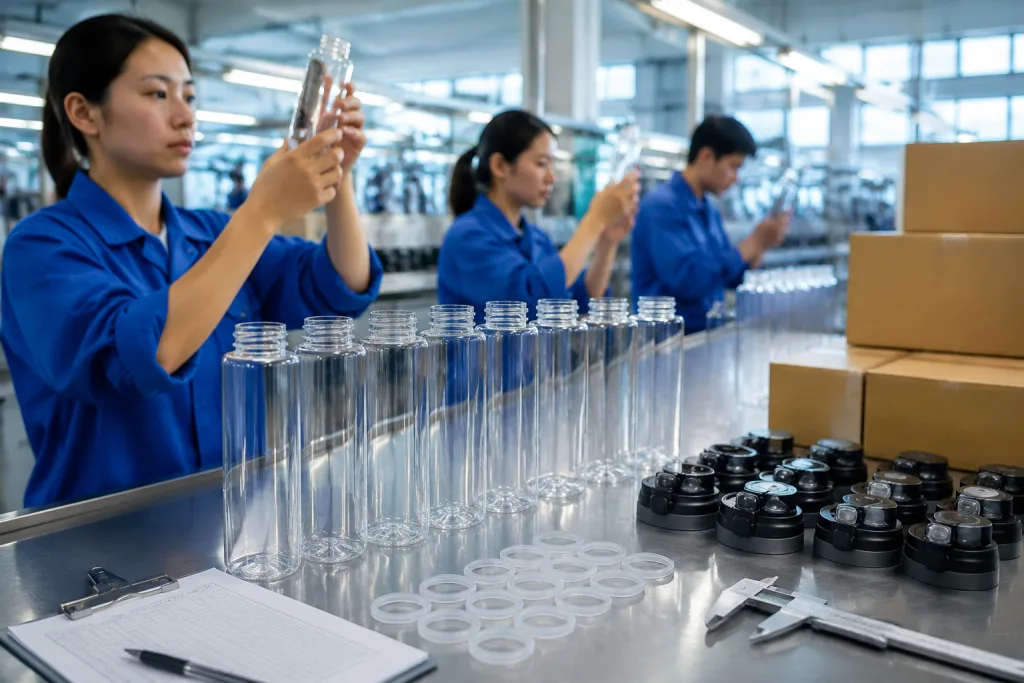
Buyers choose Tritan because the bottle looks clean on the shelf. Lose that clarity, and the carton is already too late. On our line, the first trouble usually shows up at the hopper dryer: resin held at the wrong temperature for 3-4 hours, a dusty regrind bin, or operators stacking naked bodies in a blue turnover crate without PE sleeves. Mold polish matters too. So does ultrasonic welding on lids and straps, where vibration dust can land inside the body. For a 20,000 pc bulk drinkware order, a 2% cosmetic defect rate means 400 bottles your retailer will not want to scan.
Put the visual standard in the contract. Spell out black spots, flow marks, scratches, bubbles, and gate marks with numbers, not soft words like “clean” or “premium.” A workable retail-grade standard for a clear bottle is no black spot over 0.3 mm on the main viewing surface, no scratch longer than 10 mm, and no visible oil mark under 600-800 lux inspection light at arm length. We run this check on a white inspection table, about 45 cm from the eye. Sounds fussy. It is not. We have seen a distributor reject 1 pallet because QC pulled the sample and found oil shadows near the shoulder.
Tinted bodies add another way to fail. Pantone matching on transparent Tritan does not behave like a printed carton, and this is the wrong question to ask if the buyer only sends a paper swatch. Wall thickness changes the color your eye sees. A 2.0 mm wall may read darker at the base and lighter at the shoulder, even with the same resin masterbatch. Approve the color on the actual bottle body from the production mold, under the same light box setting, not on a flat chip from the material supplier.
For wholesale drinkware programs with several SKUs, ask for color boundary samples: one approved bottle, one light limit bottle, and one dark limit bottle. QC needs something physical to hold against the line, especially when 6 cavities do not cool at the same speed. It also stops the usual argument after production, when the supplier says the color is “within normal tolerance” and the buyer has no sample, no Delta E target, and no signed limit photo to point to.

Decoration Peels Or Misregisters
Logo failure hurts because the buyer sees it before they test anything else. It is visible, brand-specific, and almost impossible to cleanly rework once the line has packed the cartons. We see buyers chase the lowest decoration price, then the buyer flagged a 0.8 mm logo shift on the curved shoulder during pre-shipment inspection. For Tritan, we run silk screen printing, heat transfer, UV printing, pad printing, sleeve labeling, and sometimes laser marking on metal lid parts, but the bottle shape and sales channel should decide the method.
Silk screen is the safe choice for simple 1-2 color logos on straight walls. Not on every bottle. It struggles on curved shoulders and tapered bodies because the screen frame cannot keep even contact across the surface. UV printing handles photo-style artwork and small gradients, but adhesion comes down to surface treatment, ink batch, and whether the operator cleaned the Tritan with IPA before printing. Heat transfer can look premium; bad pressure settings create edge lifting after a 30-minute soak. For best wholesale drink bottle retail projects, decoration testing belongs before bulk approval, not after the first 5,000 units are printed. We have seen this go sideways.
Specify the adhesion test on the PO. A basic cross-hatch tape test using 3M 600 or equivalent tape is worth more than a supplier rubbing the logo with a thumb beside the packing table. QC pulled the sample, cut a 1 mm grid with a cross-hatch cutter, pressed the tape for 90 seconds, then checked ink lift under a 600 lux inspection lamp. For sports and canteen wholesale orders, add a wet rub test: 100 cycles with a damp cotton cloth and 500 g pressure. If the product is dishwasher-claimed, test 10-20 wash cycles before approving artwork.
Decoration changes packing, too. A printed Tritan body needs enough curing time before polybagging; on our line, UV ink normally gets 24 hours before the final AQL 2.5 check. If the factory bags too early, logos can mark the neighboring bottle, and the math does not work when 18 cartons fail because of a 12-hour curing shortcut. For drinkware wholesale orders with gift boxes, ask whether the bottle is fixed by pulp tray, EPE, or paper insert. Movement inside a box can scuff a printed logo during the sea freight vibration period from China to Europe or North America.
Wrong Product For The Channel
About 7 out of 10 sourcing mistakes we see start with one messy RFQ that lumps every hydration SKU together. A Tritan bottle, bulk canteen, alcohol flask bulk item, beer tumbler bulk program, and wholesale growler are not the same product. Different closures. Different abuse points. Different buyer complaints. Last month QC pulled a 650 ml Tritan sample with a good body weight at 118 g, but the same PO also asked us to quote a stainless flask and a beer growler on one line item. The math doesn't work if you only compare unit price; you will buy at least one item wrong.
For canteen bulk orders, buyers usually need a wide mouth around 55-65 mm, carry loop, firm cap retention, and drop resistance from 1.2 m. For alcohol flask wholesale bulk projects, the hard checks are metal grade, weld polishing, odor after hot-water rinse, and cap seal on the torque tester. For beer growler wholesale bulk, pressure and carbonation expectations need a straight answer; decorative growlers with thin walls are a bad fit for pressurized beer storage beyond short carry-home use. A beer tumbler wholesale bulk order needs insulation performance, coating adhesion by cross-cut tape test, and rim comfort checks, not Tritan clarity checks.
If you want one vendor for mixed wholesale drinkware, split the RFQ by product family. We run separate spec sheets for Tritan bottles, stainless tumblers, glass bottles, growler bulk items, and flask programs because the line leaders read different drawings and QC uses different gauges. Put capacity, lid type, logo method, packing, and test request on each sheet. It saves arguments later. It also helps the China factory quote correctly and lets you compare suppliers without fake savings hiding in the wrong material or missing inspection item.
MOQ also changes by process. A standard Tritan bottle with stock mold may start at 1,000 units with one-color printing. A custom mold can require 8,000-20,000 units depending on cavity count and size. A powder-coated stainless beer tumbler in bulk may start around 2,000 units per color. We have seen this go sideways when a buyer pushed for 600 pcs per color, then flagged the 18-day lead time after the PO typo showed “assorted coating” instead of “single PMS color.” If a supplier offers every SKU at the same MOQ and lead time, ask more questions.
Cartons Fail After Inspection
A drink bottle can pass final inspection and still land with cracked lids or rubbed bodies. We see this most on wholesale drinkware orders where the buyer pushes hard on FOB unit price, then leaves the carton spec as “factory standard” on the PO. Bad idea. That carton still has to sit in a container for 30-45 days by sea, then move through 2-4 warehouses before retail or FBA-style fulfillment. Last April, QC pulled 3 cartons from a 5,000 pcs Tritan bottle lot after packing; the bottles were clean, but the outer carton corners were already crushed by 18 mm on the pallet. Good goods turned into a claim risk.
For Tritan bottles, lock the individual protection first. A thin polybag keeps dust off, but it does not stop scuff marks from a glossy body rubbing against a PP lid. If the bottle has printed decoration, we run tissue wrap or a molded PET tray, not loose packing. Gift boxes should be at least 300-350 gsm paperboard for light bottles, and heavier if the bottle includes a large lid, straw, or infuser. Master cartons should use 5-ply corrugated board for export shipments, with edge crush strength matched to the stacking height. The math does not work if a buyer saves USD 0.06 per set on packing and then gets 2% breakage at receiving.
Ask for a carton drop test before mass packing starts. A practical export test is 10 drops from 76 cm for cartons under 10 kg, covering faces, edges, and corners. For larger cartons, reduce the height but keep the method written on the QC checklist. We use a simple drop tester and mark each impact point with a black Sharpie, because “passed packing” means nothing without a record. If your distributor requires ISTA testing, add that cost and 5-7 working days to the order plan. Do not wait until 200 cartons are sealed with tape.
Labeling is another place cartons fail after inspection. For North American e-commerce, FNSKU or carton barcode placement matters; one buyer flagged a 12 mm barcode shift because their warehouse scanner missed the side panel. For European retail, recycling marks, country of origin, and language claims must match your importer obligations. If you are ordering alcohol flask in bulk, beer growler in bulk, or beer tumbler in bulk alongside Tritan bottles, give each SKU its own carton label file and revision code. We have seen this go sideways when a PO typo used “500ml clear” for both clear and smoke bottles, and the receiving team charged back the whole mixed pallet.
Inspections Catch What Specs Define
Final inspection is not a rescue job. It only works when the purchase order says what a failure is. AQL inspection has teeth only after the buyer and factory agree on major, minor, and critical defects before the line starts. For most tritan glass bottle wholesale orders, we suggest AQL 2.5 for major defects and 4.0 for minor defects. Critical defects such as sharp edges, contamination, broken parts, or unsafe materials stay at zero tolerance. QC pulled one sample last month with a 0.6 mm burr on the drinking spout; the PO did not define edge limits, so the buyer argued it was “cosmetic.” That is the wrong question to ask at final inspection.
Your inspection checklist should cover capacity check with a graduated cylinder, weight check on a 0.1 g scale, wall thickness at shoulder and base, lid fit, leak test, odor check, color match against the approved sample, logo position in mm, barcode scan, carton dimension, gross weight, and packing method. For a 750 ml Tritan bottle, a 3-5% capacity tolerance is normal unless you sell with a regulated fill mark. Wall thickness around 1.8-2.4 mm is common for many retail bottles, but shape and mold design decide the risk. Thin shoulders deform in the drop test. Heavy bases look premium, but we have seen sink marks show up after the first 8 hours of injection.
Pre-shipment inspection should happen when at least 80% of goods are packed and 100% are produced. For repeat wholesale canteen or drinkware bulk orders, we also run an inline inspection at 20-30% completion. Inline checks catch lid fit, print drift, and color mismatch while the line can still be stopped. On one 12,000 pcs order, the buyer flagged a 2 mm logo shift after seeing inspection photos; fixing it at 25% output cost 6 hours, not 6,000 rejected bottles.
Our standard export lead time from Zhejiang, China is 25-35 days after approved sample and deposit for stock-mold custom logo orders. New mold development usually adds 30-45 days. If your launch date is fixed, put sample approval, packaging approval, inspection date, and vessel cutoff into one working schedule. We ship from Ningbo or Shanghai depending on space, and a missed SI cutoff can turn a 28-day plan into 41 days. A cheap order that misses a retail season is not cheap. The math does not work.
Send Your Tritan Bottle Spec For Review
Share capacity, lid type, logo method, target market, and order quantity. Our Zhejiang team will flag weak specs before sampling.
Frequently asked questions
Is a Tritan glass bottle actually made from glass?
No. The phrase usually means a Tritan bottle with glass-like clarity. Tritan is a copolyester, not glass. It is lighter and more impact-resistant than glass, which is why buyers use it for sports, school, outdoor, and corporate wholesale drinkware. If you need real glass, say borosilicate or soda-lime glass in the RFQ. For Tritan, ask for BPA-free resin documentation, food-contact compliance for your market, and approved colorant records. A normal 500-1000 ml Tritan bottle often has a wall thickness around 1.8-2.4 mm, depending on shape.
What MOQ should I expect for tritan glass bottle wholesale?
For a stock mold with custom logo, a practical MOQ is usually 1,000-3,000 units per color. If you need a custom bottle shape, custom cap, or exclusive mold, expect 8,000-20,000 units depending on mold cavity count and projected unit price. Packaging customization may have its own MOQ; printed gift boxes often start around 1,000-2,000 pieces. At our Zhejiang, China export operation, standard lead time is typically 25-35 days after sample approval for stock-mold orders.
Can one supplier handle Tritan bottles, canteens, growlers, and flasks?
Yes, but you should not treat them as one product. A bulk canteen order needs drop resistance and cap retention checks. A wholesale growler or beer growler wholesale project needs careful review of pressure, seal, and intended use. Alcohol flask wholesale orders usually focus on stainless steel grade, welding, polishing, and odor. Tritan bottles focus on clarity, resin compliance, and thread accuracy. Send separate spec sheets and ask for separate AQL checklists. That makes drinkware wholesale sourcing cleaner and reduces arguments after inspection.
Which logo method works best on Tritan bottles?
For simple logos on straight bottle walls, silk screen printing is usually cost-effective and reliable. For multi-color branding or gradients, UV printing or heat transfer may be better, but adhesion testing becomes more important. Ask for a cross-hatch tape test, wet rub test, and at least 10 dishwasher cycles if you plan to claim dishwasher safety. Logo setup costs vary, but a one-color screen print is often far cheaper than full-wrap heat transfer. Always approve decoration on the actual production bottle, not just a digital mockup.
How do I avoid receiving leaking bottles?
Define the full closure system in the purchase order: cap material, gasket material, thread fit, torque range, and leak-test method. A practical test is filling to 95%, closing the lid, inverting for 30 minutes, then shaking for 30 seconds. For wholesale canteen and sports bottles, add open-close cycle testing, such as 500 cycles on flip lids. During inspection, set leaks as a major defect under AQL 2.5 or stricter. Also ask the factory to check first articles from every injection cavity before full production.