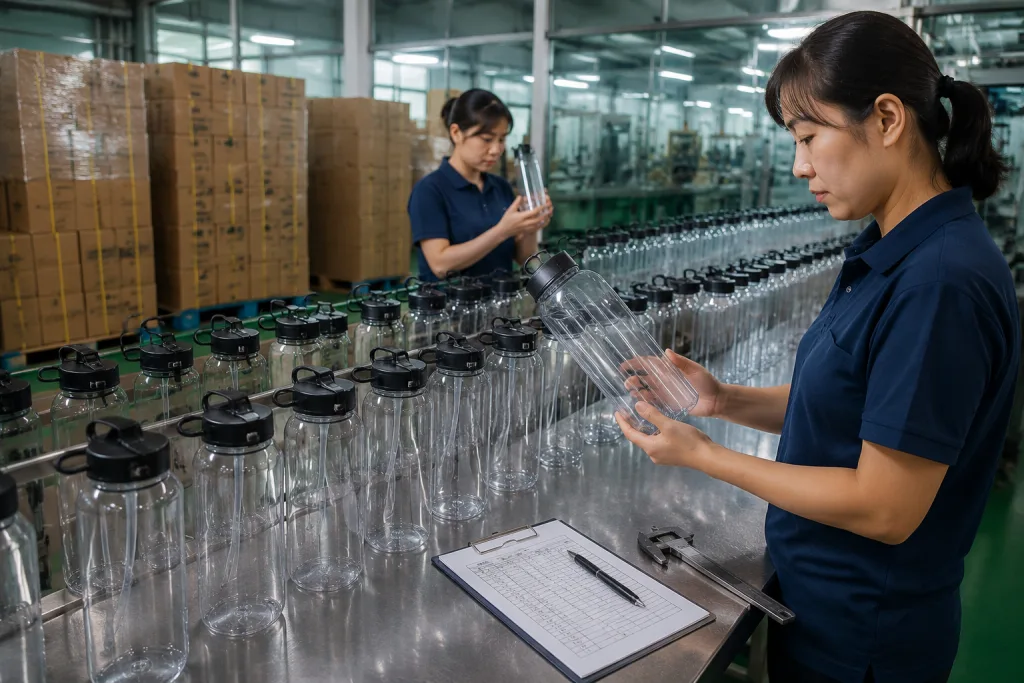
Key Takeaways
- Standard Tritan bottle MOQ is usually 1,000 pcs/color; custom mold projects often start at 10,000 pcs
- Tritan is not glass, but it gives glass-like clarity with better impact resistance for distributor drinkware
- Ask for FDA, LFGB, REACH, and BPA-free documentation before approving a canteen manufacturer
- Normal production lead time is 25-35 days after sample approval and deposit
Buyers ask us for a “Tritan glass bottle” when they want glass-level clarity without glass breakage in cartons, school bags, gym lockers, or a 90 cm drop test. Fair request. The wording still matters. Tritan is copolyester, not glass. If the RFQ says only “glass bottle,” a canteen supplier in China might quote soda-lime glass, PETG, PC, or Tritan, and we have seen the same 650 ml bottle swing from USD 1.18 to USD 2.05 because the material line on the PO was wrong.
At our Hangzhou, Zhejiang drinkware factory, this procurement issue lands on my desk 4 or 5 times a week: the buyer needs a safe bottle, a clean logo, color matching that stays inside ΔE 1.0 to 1.5, and no surprise mold charge after sampling. We run 300,000 drinkware units/month across plastic, stainless steel, and mixed-material lines, with typical MOQ from 1,000 pieces per color for standard Tritan models. Last month QC pulled the sample because the cap thread measured 0.22 mm off on the digital caliper; small miss, big leak risk. That is why “Tritan glass bottle” is the wrong term to leave loose in a supplier brief.
First, confirm the material
Buyers ask us this every month: “Is Tritan glass?” No. Tritan is a BPA-free copolyester resin, not glass, and we run it for clear reusable bottles, kids bottles, shaker bottles, and canteen promo orders. The reason buyers keep choosing it is simple: glass-like clarity, low odor hold, and better drop resistance than soda-lime glass. QC pulled a 650 ml sample last week after a 1.2 m drop test on the line; the cap cracked before the Tritan body did. If your program needs a transparent bottle for outdoor use, school, corporate gifting, or retail shelves, Tritan is the practical middle ground.
The phrase “tritan glass bottle supplier” shows up in search, but your PO should not say that. Write “Tritan copolyester bottle” or “Tritan body with PP lid and silicone seal.” We have seen this go sideways when a buyer’s PO only said “clear plastic bottle,” and the vendor shipped PETG to save USD 0.18 per unit. That wording protects you from material substitution. A serious canteen factory should confirm resin grade, food-contact test scope, and whether the bottle body is injection molded, extrusion blow molded, or injection stretch blow molded. Ask for it before the mold deposit, not after the first carton is packed.
For most custom drinkware projects, check these points before asking for a price. The math does not work if the quotation is built on the wrong resin, lid, or seal. On our side, the merchandiser usually marks these specs on the sample card with calipers, a Shore A durometer, and the buyer’s logo artwork stapled to the job bag.
- Body material: Tritan, not PC, PET, PETG, or acrylic. Ask the supplier to print the resin name on the PI, not only in chat.
- Lid material: PP, Tritan, stainless steel, or ABS outer shell depending on design. Flip lids and straw lids usually need different hinge testing.
- Seal: food-grade silicone, usually 50-60 Shore A hardness. We check this with a durometer because soft seals can leak after 3 dishwasher cycles.
- Wall thickness: common Tritan bottle walls run about 1.2-2.0 mm depending on capacity and molding process. A 0.2 mm change can affect both weight and drop-test results.
- Temperature use: Tritan bottles are often suitable around -10°C to 96°C, but dishwasher performance depends on design and lid parts. The buyer should test the full bottle, not only the body.
If a canteen vendor quotes 20-30% below the market, ask which material is being used. Cheap clear plastic can look acceptable in a photo, then fail odor, impact, or dishwasher testing. We had one inspection where the bottle passed visual AQL 2.5, but QC flagged a plastic smell after a 24-hour warm-water hold. Once 312 cartons are already in North America or Europe, that mistake is expensive.
What should the RFQ include?
Buyer question we hear every week: “What do you need to quote this properly?” Send a tight RFQ. “Price for customized canteen” leaves too much guessing, and the math doesn’t work if we quote blind. Capacity, lid type, Pantone color, packing, test standard, and shipping term can move the FOB price more than the logo. Last month QC pulled a 650 ml sample where the buyer’s PO said “blue,” but the approved swatch was Pantone 2925 C. That small miss stopped the line for 6 hours.
For a standard 600-750 ml Tritan bottle, a realistic FOB China range might be USD 1.20-2.80 depending on cap design, straw mechanism, silicone sleeve, carton packing, and order quantity. A simple one-color logo may add USD 0.05-0.12 per piece. A full silicone grip, gift box, or metal carrying ring can push cost faster than new buyers expect. We run these numbers off actual BOM sheets, not a catalog guess; one stainless carry ring can add 18-25 g of material plus a second assembly step.
Send your canteen supplier this checklist:
- Capacity: 350 ml, 500 ml, 650 ml, 750 ml, 1 L, or custom size with target bottle height in mm.
- Target market: EU, UK, USA, Canada, or mixed distribution, with FDA or LFGB test need stated if required.
- Logo method: silk screen, pad print, heat transfer, UV print, or laser on stainless accessory; attach artwork in AI or PDF.
- Color requirement: Pantone code for bottle, lid, sleeve, and strap, not “light green” or “Amazon blue.”
- Packing: bulk pack, white box, color box, kraft box, or retail hang tag, with carton weight limit if your warehouse caps it at 15 kg.
- Inspection: AQL level, drop test request, barcode scan, and carton marking; tell us if the buyer checks barcode grade with a scanner.
- Trade term: FOB Ningbo, FOB Shanghai, EXW Zhejiang, DDP, or CIF, with destination port or ZIP code for DDP.
For distributor canteen programs, include forecast volume too. A first PO of 2,000 pieces is not the same job as a 40,000-piece annual program with 4 split shipments. If we see that early, the factory can quote a smarter mold route, carton size, spare lid ratio, and price ladder. We’ve seen this go sideways when a buyer asks for the lowest 2,000-piece price, then comes back 12 days later asking why the 40,000-piece repeat order still uses the same expensive small-run packing.
Standard model or private mold?
Buyers usually ask, “Do we need custom tooling?” Wrong first question. We usually tell them to start from a standard model unless the shelf shape is part of the selling point. A standard Tritan bottle lets you check logo position, cap feel, carton drop strength, and buyer feedback before you spend mold money. Last month QC pulled a 750 ml sample from the line because the pad-print logo sat 2 mm too close to the grip recess; that kind of issue is cheap to fix on a public mold, not after steel is cut. Private mold makes sense for a distinct silhouette, a special cap function, patent-sensitive design, or a distributor line you plan to run for at least 2-3 seasons.
For a canteen built from an existing bottle, we can adjust the logo, body color, lid color, strap, silicone sleeve, retail box, and sometimes the ml scale. Standard model sampling normally takes 7-10 days if artwork is ready. Bulk production is usually 25-35 days after sample approval and 30% deposit. Before summer and Q4 gifting, add 7-14 days. We run these jobs through a Pantone card check, lid torque test, and carton weight check; one buyer once sent PO color “navy blue” with no Pantone code, and that added 3 days before the sample room could even mix resin.
Private mold work is a different bill. A new Tritan bottle body and cap set may need USD 3,000-12,000 tooling cost depending on cavity count, lid complexity, slider button, straw system, and mold steel. Development normally takes 35-60 days before pilot samples. The practical MOQ is often 10,000-20,000 pieces because material color matching, machine setup, and mold amortization need volume. The math does not work for a 2,000-piece trial order; the injection machine still needs setup time, the mold still needs fitting, and the first pilot run still gets checked with calipers at the parting line.
Our opinion: do not pay for a new mold just to move the logo area by 8 mm. Use tooling money when the product function or shelf identity actually changes.
If you are a canteen distributor testing a new category, choose a proven standard bottle, request two logo options, and check sell-through first. Ask for 3 pre-production photos too: logo close-up, cap assembly, and packed carton mark. If the line works, then move to a customizable canteen shape with your own cap architecture and packaging system. We’ve seen this go sideways when a buyer starts with private mold, then the local chain flags the handle feel after the first 5,000 pieces ship.

Logo and packaging decisions
Question buyers ask: “Which branding method lasts?” This is the wrong question to ask first. For Tritan, we choose the logo process after checking MOQ, artwork line width, wash claim, and the surface area on the bottle or lid. Silk screen works for 1- or 2-color logos on straight walls; our screen master usually rejects strokes under 0.3 mm. Pad printing is better for small curved lid spots where the jig holds only 6 lids at a time. Heat transfer gives fuller color, but QC pulled samples last month where the edge lifted after the hot-water soak. UV printing looks sharp, but we still run a rub test and dishwasher simulation before mass approval.
For custom canteen orders, we run logo adhesion checks with 3M tape pull, alcohol rub using a cotton swab, and wet cloth rub for 50 passes on the printed area. Simple test. If the product claims dishwasher safe, test the printed bottle and the lid assembly, not just the raw Tritan body. We have seen this go sideways: a logo passed hand wash, then faded after 20 dishwasher cycles because the ink system was matched to PP, not Tritan. The buyer flagged it during pre-shipment, and the line had to stop for 2 days.
Packaging is not decoration only. It controls breakage, freight, retail acceptance, and Amazon or distributor warehouse handling. A 650 ml bottle in bulk pack may use a 55 x 38 x 48 cm export carton for 50 pieces, while a color box version may reduce the carton quantity to 24 or 30 pieces. That can change freight cost per unit by USD 0.08-0.25 depending on route and season. On our packing table, the carton scale often tells the real story: 13.8 kg gross weight passes easier than an overfilled 17 kg carton with crushed corners.
For canteen promotional programs, bulk pack with individual polybag is often enough if the buyer accepts plain shipping marks. For retail, we usually need color box, UPC/EAN barcode, warning text, recycling marks, FNSKU label, and carton side marks with PO number and item code. Check the PO carefully. We once received artwork with the right barcode but the wrong capacity, 600 ml printed for a 650 ml bottle. If you sell through canteen distributors in the EU, ask early about language requirements. If you sell in the USA, check state-level labeling concerns and retailer packaging rules before artwork approval.
Compliance questions worth asking
Question buyers ask: “What certificates do we need?” This is the wrong question to ask. “Certificate” gets thrown around on POs and WeChat threads until nobody knows whether we mean a lab report, a declaration, or an audit file. For a customized drinkware order, you need test reports tied to the exact material, product type, and sales market. A BPA-free PDF from 2021, pulled from another bottle shape, will not carry a 30,000 pcs retail program. Last March, QC pulled the sample folder for a smoke-gray Tritan bottle and found the report named “clear cup,” which the buyer flagged before we even booked the carton printing.
For Tritan bottles, ask your canteen manufacturer for current food-contact files before tooling starts. For the USA, buyers usually ask for FDA food-contact compliance and a BPA-free declaration. For Europe, LFGB, EU 10/2011, REACH, and specific migration testing should match the bottle body, lid, straw, gasket, and any printed area. For children’s products, CPSIA in the USA or EN-related requirements may apply based on age grade and shelf claim. If the bottle includes paint, coatings, metal parts, or silicone, those parts need coverage too. We run silicone gaskets at 0.8 mm compression in the lid groove; if that gasket changes supplier after sampling, the old report is no longer clean enough for a cautious importer.
Factory audits matter for larger retailers. BSCI, Sedex/SMETA, ISO 9001, or retailer-specific audits do not make the bottle automatically compliant, but they show whether the line has control beyond a nice sample room. At our Hangzhou, Zhejiang operation, incoming Tritan resin lots are checked against purchase records, and production QC includes visual inspection, leak testing at 100% on the water-fill station, cap torque checks with a digital torque meter, and carton drop checks from 76 cm. Typical final inspection uses AQL 2.5 for major defects and AQL 4.0 for minor defects, unless the buyer specifies otherwise. We have seen this go sideways when a retailer approved a factory audit but skipped the migration report on a colored lid.
Ask one direct question: “Will the test report list the same material, color, and product structure as my order?” If the answer is no, budget for fresh testing. Third-party lab testing may cost USD 200-800 per SKU depending on scope, which still beats a rejected shipment sitting 18 days at destination instead of clearing in 3 days. On one PO, the buyer wrote “TRITAN blue lid” but approved artwork for a PP lid; that one typo forced a new lab submission and 12 days of schedule loss.

How pricing really moves
Buyer question we hear a lot: “Why did the price change after sampling?” Most times, the first quote was built on missing details. Tritan resin grade, bottle weight, cap structure, packaging, logo process, and inspection level all move the number. A transparent 750 ml bottle weighing 110 g will not price like a 150 g body with a locking lid and silicone boot. Last month QC pulled the sample after weighing it on a 0.1 g bench scale; the approved body was 14 g heavier than the RFQ drawing. The math changed.
For a canteen vendor, the cost sits in material grams, injection cycle time, assembly labor, scrap rate, carton volume, and testing. Color bites too. Clear and standard smoke run smoother on the line. Custom Pantone colors can need 2-3 kg of color masterbatch trials and a higher scrap allowance, especially when the buyer wants high transparency and no visible flow marks. We have seen this go sideways when a buyer approved a color by phone photo, then flagged faint flow lines under a D65 light box during pre-shipment inspection.
Here is a practical price checklist:
- MOQ: 1,000 pcs/color for standard Tritan bottles we run often; 3,000 pcs/color when color matching needs extra purge time and sample approval.
- Sample cost: USD 50-150 for logo samples, often refundable against bulk order once the PO matches the approved artwork file.
- Tooling: USD 3,000-12,000 for private mold bottle and lid projects, with steel choice and lid sliders changing the mold quote fast.
- FOB terms: Ningbo or Shanghai are common for Zhejiang and east China factories; we ship both, but carton CBM can swing the local charge.
- Payment: 30% deposit, 70% before shipment is still standard for new buyers, especially before we book resin and cartons.
If you are comparing canteen suppliers, normalize the quote first. Same capacity. Same material. Same logo size, carton quantity, test requirement, and shipping term. The cheapest quote may just leave out the silicone boot, LFGB test, or 5-ply export carton you will pay for later. We once had a PO typo listing 48 pcs/carton instead of 24 pcs/carton; the buyer flagged the freight jump only after the packing test failed at 18.6 kg.
Distributor checklist before deposit
Buyer question we hear before every deposit: “What should we lock before paying?” Lock the boring details. That is where the money leaks. On 8 of 10 dispute files we checked last year, the PI missed one line: material grade, capacity tolerance, Pantone or RAL color reference, logo process, inner bag and carton spec, inspection standard, lead time, Ningbo or Shanghai port, or replacement terms for confirmed defects. We run PI review with a caliper, a 500 ml measuring cylinder, and the sealed sample on the desk.
For distributor growler, distributor canteen, and wider customizable drinkware programs, keep two approved golden samples: one in your office, one on the China factory line. Sign the label. Seal the lid with tape. If the buyer flags a dispute 60 days later, nobody is arguing from a blurry WhatsApp photo. For color, approve under D65 light if you can; our QC room uses a light box before mass spray checks. For logo placement, write the measurement from a fixed point, such as 35 mm below the shoulder line, not “centered nicely.” That wording has gone sideways before.
Before deposit, run this final checklist:
- Approve the physical sample for bottle body, lid fit, silicone seal compression, logo rubbing test, and retail box print.
- Confirm carton drop test height, usually 76 cm for export carton checks, and ask who signs the test sheet.
- Set AQL level and define critical defects: leakage after inversion, wrong material, sharp edge on the mouth, plastic odor after hot-water rinse, or barcode that the scanner cannot read.
- Confirm spare parts plan, such as 0.5-1% extra silicone seals or lids for large orders, packed in a marked carton instead of mixed into bulk goods.
- Book inspection 5-7 days before the planned shipment date, because booking it 24 hours before loading gives QC no room to pull cartons properly.
A reliable tritan glass bottle supplier should not push back on this paperwork. Good canteen manufacturers like clear standards because the line chief knows what to check and the merchandiser knows what not to promise. If a canteen factory refuses to document material grade, testing scope, or inspection terms, the math doesn't work. That is not tough negotiation; it is a risk signal, and we have seen buyers lose 12 days vs 2 days when these points were left vague.
Send your Tritan bottle RFQ for a clean quote
Share capacity, target market, logo artwork, MOQ, and packing plan. Our Zhejiang sales engineers will return practical options, not vague catalog pricing.
Frequently asked questions
Is Tritan better than glass for a promotional canteen order?
For most canteen promotional orders, yes, Tritan is easier to ship and safer in daily use than glass. It has glass-like clarity but better impact resistance, so breakage during carton handling is lower. Real glass still feels heavier and more premium, but it increases freight weight and needs stronger packaging. A 650 ml Tritan bottle may weigh around 100-140 g before lid, while a similar glass bottle can be 250-400 g. For schools, gyms, outdoor events, and distributor drinkware programs, Tritan is usually the more practical choice.
What MOQ should I expect from a Tritan canteen supplier in China?
For standard models, expect around 1,000 pieces per color from many China canteen suppliers, especially if you use existing mold shapes and standard lid colors. If you need custom Pantone resin, special silicone sleeve color, or a complex retail box, 3,000 pieces per color is more realistic. Private mold projects normally start around 10,000 pieces because tooling setup, resin trials, and production efficiency need volume. If a supplier accepts 200 pieces with full customization, check whether they are printing on stock goods rather than manufacturing to order.
Can I make a customized growler using Tritan instead of stainless steel?
You can make a customized growler-style Tritan bottle, but it depends on the use case. Tritan is good for water, cold drinks, sports, and general hydration. It is not the right choice for hot vacuum insulation or beer pressure retention unless the design is specifically engineered and tested for that purpose. A custom growler in stainless steel is better for insulation and premium outdoor positioning. A customizable growler in Tritan can work for lightweight retail, camping accessories, or non-carbonated beverage use, usually in 1 L to 2 L capacities.
How do I compare canteen vendors without choosing the wrong cheap quote?
Build a comparison sheet with the same assumptions for every canteen vendor: capacity, Tritan grade, lid material, silicone seal, logo size, packaging, test reports, AQL level, FOB port, and lead time. Ask each vendor to quote 1,000, 3,000, and 5,000 pieces. A USD 0.18 difference may be reasonable if one quote includes LFGB testing, color box, and barcode labeling while another is bulk packed with no testing. The problem is not low price itself; the problem is an incomplete quote that shifts costs to you after sample approval.
How long does a canteen customized order take from artwork to shipment?
For a standard Tritan model, plan 7-10 days for logo sample production after artwork confirmation, then 25-35 days for mass production after approval and deposit. Add 3-5 days if you need a third-party pre-shipment inspection. Sea freight to North America or Europe can add roughly 25-45 days depending on port and season. Private mold projects need longer: usually 35-60 days for tooling and pilot samples before bulk production starts. If your retail launch date is fixed, start at least 90 days before the required warehouse arrival.