Key Takeaways
- Tritan bottles usually fit 3,000-5,000 pcs MOQ; glass often starts at 2,000-3,000 pcs per SKU
- Borosilicate glass feels more premium, but Tritan wins on impact resistance and freight loss control
- For canteen promotional programs under USD 4.50 FOB, Tritan is usually easier to control
- AQL 2.5/4.0 inspection, REACH checks, and 24-hour leak testing should be fixed before deposit
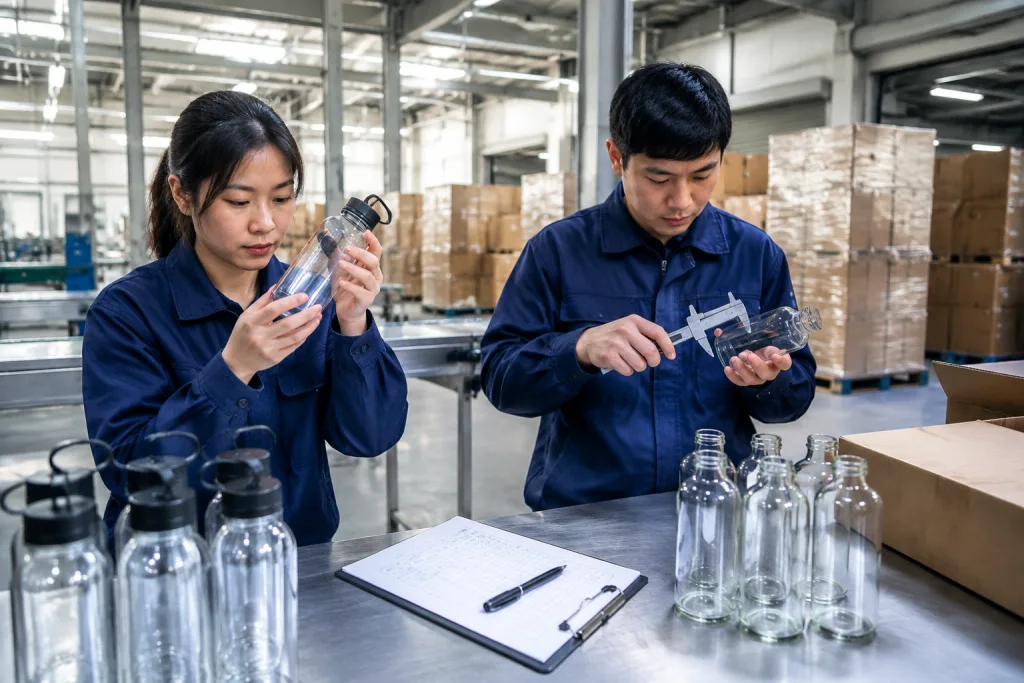
If you searched for a tritan glass bottle manufacturer, your RFQ is probably mixing two materials: Tritan copolyester and borosilicate glass. They both look clear on a sample table. They do not run the same on the line. Tritan can take a 1.2 m carton drop better; borosilicate glass needs tighter inserts, usually 5-layer export cartons, and QC will check rim chips with a 10x loupe before packing.
We ship from Zhejiang, and we’ve seen this go sideways when a buyer writes “Tritan glass” on the PO without naming the use case. A 750 ml gym bottle, a 500 ml office giveaway, and a kids canteen are not the same job. The wrong question is “which material is better?” Ask which one fits your retail channel, target FOB, logo process, and compliance file. Last month QC pulled the sample because the buyer wanted full-wrap printing on a tapered bottle; the artwork stretched 3 mm at the shoulder, and the math didn’t work for a 3,000 pcs MOQ.
Tritan And Glass, Side By Side
Buyers tell us “Tritan glass bottle” about 6 times a month because the finished bottle looks clear like glass. Small wording issue, big sourcing issue. Tritan is a BPA-free copolyester, not glass. Borosilicate glass is a mineral material, so the weight, breakage rate, heat tolerance, and logo process all change. If your brief says tritan glass bottle manufacturer, this is the wrong question to ask; a proper canteen supplier should stop the quote, confirm the material, and check the cap drawing in mm before the line opens a mold file.
Here is the head-to-head view we run with new B2B buyers after QC pulled the sample and weighed the 650 ml body on a 0.1 g bench scale:
| Spec | Tritan copolyester | Borosilicate glass |
|---|---|---|
| Typical capacity | 500 ml, 650 ml, 750 ml, 1,000 ml | 350 ml, 500 ml, 750 ml, 1,000 ml |
| Body weight, 650 ml | 95-135 g | 260-380 g |
| Impact risk | Low in normal drops | Medium to high without sleeve |
| Heat resistance | Usually up to 80-100°C by grade | Often 120-150°C thermal shock range |
| Retail perception | Sport, outdoor, school, corporate orders | Office, wellness, gift, kitchen sets |
| Decoration | Silkscreen logo, heat transfer wrap, sleeve, insert card | Silkscreen logo, decal, frosting, sleeve |
| FOB range | USD 2.20-5.80 | USD 2.60-7.50 |
The table comes from production headaches, not brochure copy. In China export orders, margin disappears in packaging damage, carton cube, and inspection failures; we have seen 3 cracked glass bottles in a 200-piece pre-shipment check turn into a full repack. Tritan lets you pack more units per CBM and usually brings fewer breakage claims. Glass gives a heavier hand-feel and a cleaner material story, but the math doesn't work unless you price silicone sleeves, dividers, stronger K=K cartons, and extra care during inland trucking.
Where Each Material Fits
Start with the selling channel, not the bottle shape. This is the wrong question to ask first. A school campaign canteen gets dropped on concrete and kicked under bus seats; a boutique wellness bottle sits on a 900 mm retail shelf with a hang tag. If you ship through Amazon FBA or a national drinkware distributor, damage rate counts beside unit cost. We had QC pull 80 glass samples from a pilot carton run last May, and 3 showed rim chips after a 76 cm drop test. A 1.5% breakage rate on glass can wipe out the saving from a cheaper mold.
Tritan fits these projects better:
- Sports bottles and kids bottles for gym, campus, and travel orders where the buyer expects 500 ml or 750 ml capacity and low break claims.
- Custom canteen runs with color-matched lids, flip straws, carry loops, and freight that works at 12 kg per export carton instead of heavier glass packing.
- Canteen distributor assortments that need 6-10 colors, repeat reorders, and fewer emails about cracked bodies after delivery.
- Customizable drinkware programs where inserts, silicone sleeves, or retail bands change by customer, often at 1,000 pcs per SKU MOQ.
Glass fits these projects better:
- Office gifting and tea infuser bottles for spa retail or premium homeware channels, where the buyer accepts foam trays and slower packing on the line.
- Customized drinkware where perceived purity and weight matter, especially when a 420 g bottle feels better than lightweight plastic in hand.
- Custom growler or customized growler concepts where the buyer wants shelf-stable presentation and a clean logo area checked with a 0.5 mm print tolerance gauge.
Do not be embarrassed to choose the less “premium” material if the end user throws the bottle into a backpack. Tritan is the practical pick for canteen vendors serving events, schools, and outdoor retailers; we ship those orders with fewer replacement cartons and fewer angry photos from receiving docks. Glass is right when the customer uses it at a desk, kitchen counter, yoga studio, or hotel room. We have seen this go sideways: one PO typo changed “Tritan” to “glass” on a 3,000 pcs outdoor promo order, and the buyer flagged the freight quote before deposit. If a canteen manufacturer says one material fits every project, they are moving inventory, not engineering the order.
Cost, MOQ, And Lead Time
For a Zhejiang factory, the stable production window decides whether your PO ships clean or keeps moving on the schedule board. At BottleForge Industrial, we run about 420,000 drinkware units each month across stainless steel, Tritan, and glass lines. For new private-label bottles, our practical MOQ is 3,000 pcs per color for Tritan and 2,000-3,000 pcs per design for glass, based on open mold slots and decoration process. We can do smaller pilot runs. The math usually does not work. Last month a buyer asked for 800 pcs in 4 colors, and the pad-printing plate fee plus color-change loss pushed the unit cost above their retail target.
A normal timeline from approved artwork is 25-35 days for existing Tritan molds and 30-45 days for borosilicate glass with custom sleeves or multi-color printing. Add 7-12 days if you need a new lid color by injection molding. Add 15-25 days if you need a new bottle mold. For China export buyers, the faster route is using a proven body mold and customizing the lid, sleeve, print, hangtag, and carton. QC pulled one Tritan sample this week because the logo sat 2 mm too low against the grip line; catching that before mass printing saved 5,000 pcs from rework.
FOB Ningbo or Shanghai pricing usually breaks down like this:
- 650 ml Tritan bottle with one-color logo: USD 2.20-3.40 at 5,000 pcs.
- 750 ml Tritan with straw lid and color sleeve: USD 3.10-5.20 at 5,000 pcs.
- 550 ml glass infuser bottle with silicone sleeve: USD 3.30-6.20 at 3,000 pcs.
- 1,000 ml glass or Tritan custom growler style: USD 4.80-8.90 depending on cap type, wall thickness, and inner box spec.
Watch quotes that hide packaging. A single-wall export carton looks cheap on a spreadsheet, but a distributor growler or glass bottle needs a 5-ply carton, egg-crate divider, or molded pulp tray. That can add USD 0.18-0.55 per unit, but it costs less than returns. We have seen this go sideways: the buyer flagged 37 cracked bottles after a drop inspection because the supplier used a 3-ply carton and skipped the divider.
Decoration Choices That Actually Hold
Custom branding is where 6 out of 10 canteen customized projects get messy. A logo that looks sharp on a flat PDF fails fast on a curved, tapered, or textured bottle. Ask your canteen vendor for the printable area in millimeters before you approve samples, not only a mockup. We run a flexible ruler around the body and mark the limit with a 0.5 mm liner pen. A 55 mm wide logo works on a 650 ml straight Tritan bottle, but it pulls out of shape near the shoulder of a glass infuser bottle. Pretty mockups lie.
For Tritan, silkscreen is still the workhorse. One-color printing keeps the unit price sane, holds steady on the line, and suits corporate canteen promotional orders with 3,000 pcs MOQ. Heat transfer is better for gradients or a 180-degree wrap graphic, but QC should pull the sample for abrasion testing because gym bags are rough. We use a 1 kg rub weight on printed Tritan before we sign off. Full-body shrink sleeves work well for retail launches when a canteen distributor wants seasonal graphics without touching the mold.
For glass, silkscreen gives a clean look, but curing temperature and ink choice decide whether it survives real use. Our oven log is checked at 180°C because one weak cure batch will come back as a complaint. Decals look premium on customized canteen or wellness bottles, but they add hand labor and rejection risk. Frosting gives a high-end finish, yet fingerprints and scratch marks need checking under a 6000K inspection lamp. Laser engraving is less common on glass drink bottles than on stainless steel, and the contrast often disappoints brand owners.
Use a simple test matrix before mass production. This is the wrong place to save 2 days. We have seen a buyer approve artwork on Monday, then flag logo peeling after the pilot run because nobody did the tape pull at cure stage.
- 3M tape test after printing cure.
- 50-cycle hand rub test with damp cloth.
- Dishwasher simulation only if you plan to claim dishwasher safety.
- Logo registration check on 20 random pre-production units.
Customizable canteen programs often need fast artwork swaps, sometimes 12 SKUs in one reorder. If that is your business model, keep the bottle body standard and change the sleeve, carton, insert card, or lid color. The math works better: 12 days for artwork and packing changes vs 18 days when the body decoration changes. We ship cleaner that way, and the line has fewer chances to mix PO-104 blue lids with PO-140 green artwork.
Compliance Is Not Optional Paperwork
European and North American buyers should treat compliance as a product feature, not a PDF sitting in the shipment folder. For Tritan and glass, we run the checklist by market: LFGB or EU food-contact testing for Europe, FDA food-contact suitability for the U.S., California Prop 65 screening when the selling state or retailer asks for it, REACH for restricted substances, and CPSIA or ASTM checks if the bottle is sold to children. If a canteen supplier cannot say which parts went into the test beaker, assume the lab only checked the bottle body. QC pulled one 750 ml Tritan sample last year where the report named “cup body” only; the buyer flagged it before Target review, and the math did not work after retesting 6 lid colors.
The lid assembly is often where the order goes sideways. A Tritan body can pass food-contact testing while the silicone gasket, PP lid, straw, pigment, or spray paint fails migration or heavy metal limits. For glass bottles, colored sleeves and printed inks need the same attention, especially when the sleeve touches the mouth area after packing. Ask for a bill of materials that lists body, cap, gasket, straw, sleeve, coating, ink, and packaging contact surfaces, with material grade and color code beside each line. On our line, one wrong Pantone note on the PO, 186C typed as 185C, changed the ink batch and added 12 days vs 18 days to the approval schedule.
Quality control belongs inside the purchase order, not in a WeChat message after production starts. We normally recommend AQL 2.5 for major defects and AQL 4.0 for minor defects, with critical defects set to zero tolerance. Leak testing should cover 24 hours inverted at room temperature, plus a pressure or shake test for straw and flip lids. For glass, add drop testing on the retail pack from 60-80 cm, depending on carton weight and channel requirements. We use a torque meter on screw lids and mark failures at 0.8-1.2 N·m when the buyer has not given a spec; loose lids look small in the sample room, then turn into wet cartons in a 40HQ.
Factory audits depend on the sales channel. BSCI, Sedex, ISO 9001, or retailer-specific audits may be required by your customer before shipment. Zhejiang and wider China have plenty of capable canteen manufacturers, but paperwork quality varies from clean to painful. A clean quotation should state standards, test lab, sample quantity, and who pays if a test fails because of factory material substitution. This is not a polite detail. We ship orders where SGS needs 3 finished samples per color, and if the quote hides that cost, the buyer sees a surprise charge right when the balance payment is due.

Spec Table For Buyer Decisions
Put every canteen quote into one spec sheet before you compare FOB. We run this check in Hangzhou with a 0.01 mm digital caliper: a 0.8 mm silicone sleeve and a 1.5 mm sleeve are two different bottles. Same issue with packing. If Supplier A includes a 350 gsm retail box and Supplier B lists only one polybag, the cheap price will come back as carton damage or buyer chargebacks.
| Buying scenario | Recommended choice | Why | Watch point |
|---|---|---|---|
| School or youth campaign | Tritan | Light weight, fewer breakage claims, easy PMS color matching | Confirm CPSIA/ASTM if child-targeted, and ask for the test report before deposit |
| Premium wellness gift | Glass | Heavier hand feel and a cleaner material story for retail buyers | Add a sleeve, 5-layer carton, and corner drop check |
| Outdoor retail bottle | Tritan | Better impact resistance during shelf handling and courier delivery | Check UV yellowing after 48 hours and lid hinge durability |
| Tea infuser bottle | Glass | Better heat feel and taste perception with tea or fruit water | Test thermal shock and strainer fit; QC pulled 3 loose strainers last month |
| High-volume promotional order | Tritan | Lower freight weight and fewer after-sale claims | Keep print simple if you need 12 days instead of 18 days |
| Distributor growler concept | Case by case | Tritan works better for transport; glass sells better on shelf | Confirm cap seal and carton drop test before sales samples ship |
For a canteen factory, the best spec is the one the line can repeat. Simple wins. A buyer may ask for a special cap, smoked body, matte sleeve, metallic print, and individual kraft box; we have built those, but the math often does not work on a 1,000 pcs trial order. Each added process gives QC another place to pull a sample: sleeve dust, cap color drift, logo pinholes, or a PO typo like “mat black” instead of “matte black.” For first orders, I push for an existing mold, 1-2 body colors, a proven lid, one decoration method, and packaging that already passed a 76 cm carton drop test.
This matters more for canteen distributors handling 6 or 8 end customers at once. A modular range sells cleaner: one 650 ml Tritan bottle, one 750 ml glass bottle, three lid colors, two sleeve colors, and standardized master cartons at 24 pcs per carton. We ship fewer mixed cartons that way, and reorders do not turn into fresh development jobs. We have seen this go sideways when every customer gets a “small change” and the warehouse ends up with 14 slow-moving lid SKUs.
How To Brief The Factory
A useful RFQ does not need 6 pages, but it must give the factory something we can price against. Send target capacity in ml, material choice such as Tritan or glass, sales channel, target FOB price, destination market, annual volume, decoration method with logo size, packing format, and compliance standard. If you are a distributor canteen buyer, tell us whether the goods go to retail shelves, FBA, event handout, or warehouse replenishment. Packing changes fast: FBA needs a drop-test carton, retail needs a clean color box, and event orders often need 24 pcs/master carton for fast picking. Last month the line stopped for 40 minutes because the PO said “single box” while the buyer’s artwork showed a hang tag.
A strong brief looks like this: 750 ml Tritan bottle, BPA-free, one-color logo at 45 mm wide, flip straw lid, 5,000 pcs first order, 20,000 pcs annual forecast, FOB Ningbo, EU market, LFGB and REACH required, individual white box, barcode sticker, AQL 2.5/4.0 inspection, target USD 3.80. Good brief. With that, a canteen manufacturer can quote honestly and check whether the mold is open, whether the lid color needs new resin, and whether the pad-printing plate is already on file. Without it, you will receive a low number that changes after sampling. We have seen this go sideways: QC pulled the sample, the straw was 3 mm short, and the buyer flagged it only after the freight booking.
For glass, include whether hot liquid use is expected and the fill temperature, such as 60°C tea or 95°C boiling water. Do not assume every glass bottle is suitable for boiling water. Borosilicate handles heat better than soda-lime glass, but cap materials, sleeves, infusers, and glue can still limit the safe temperature. If you want a customized growler or customizable growler with carbonation, say that clearly; pressure retention is a different test from normal leak resistance. This is where the math does not work: a normal leak tester at 0.3 bar tells us nothing about a carbonated sample sitting in a warehouse at 38°C.
Ask your canteen vendors for production photos, mold list, previous test reports, and packaging drawings before paying for tooling. A reliable China canteen supplier will not be offended by this. We ship better when buyers ask early. They will usually ask sharper questions back, like whether the barcode sticker goes on the white box short side or bottom panel. That is a good sign. The cheapest quote is rarely the safest quote; the clearest spec sheet usually wins, especially when the tooling invoice says USD 1,200 and the drawing still has a wrong neck diameter.
Send your bottle spec before you choose material
Share capacity, channel, target FOB, compliance market, and logo method. We will recommend Tritan, glass, or a safer hybrid spec.
Frequently asked questions
Is Tritan actually glass, or is it plastic?
Tritan is not glass. It is a BPA-free copolyester used for clear reusable bottles. Buyers call it “Tritan glass” because it looks transparent like glass, but the performance is closer to durable plastic. For a 650 ml bottle, Tritan may weigh 95-135 g, while borosilicate glass can weigh 260-380 g. Tritan is better for sports, school, travel, and canteen promotional orders where drops are likely. Glass is better when weight, premium feel, and heat perception matter. A proper tritan glass bottle manufacturer should clarify the material before quoting, because tooling, decoration, packing, freight, and compliance tests are different.
What MOQ should I expect for customized drinkware?
For existing molds, a realistic MOQ is 3,000-5,000 pcs per color for Tritan and 2,000-3,000 pcs per SKU for glass. If you need a custom canteen lid color, expect 3,000 pcs or more because injection molding color change has setup waste. New molds can push the MOQ to 10,000 pcs depending on body shape and cap design. For a canteen distributor testing a new range, we usually suggest using a standard mold first, then customizing logo, sleeve, hangtag, and carton. That keeps sampling around 7-12 days and mass production around 25-45 days after artwork approval.
Which is better for distributor drinkware: Tritan or glass?
For distributor drinkware, Tritan is usually easier to manage because it has lower breakage risk, lighter cartons, and broader use across school, sport, outdoor, and event channels. Glass can sell at a higher perceived value, but you need stronger packaging and more careful handling. If you ship mixed pallets to multiple retailers, a 1-2% glass breakage claim can hurt margin quickly. A canteen distributor often does best with both: Tritan for high-volume promotional and travel programs, glass for wellness and office gifting. Compare by landed cost, not just FOB. Packaging and freight can add USD 0.30-0.90 per unit.
What tests should I require before shipment?
At minimum, require food-contact testing suitable for your market, such as LFGB for Germany/EU or FDA-related food-contact checks for the U.S. Add REACH screening for EU restricted substances and Prop 65 review if selling in California. For quality inspection, use AQL 2.5 for major defects, AQL 4.0 for minor defects, and zero tolerance for critical defects such as sharp edges, contamination, or leaking seals. Leak testing should include 24 hours inverted and a shake test. For glass, add retail-pack drop testing from 60-80 cm. For kids bottles, discuss CPSIA and ASTM requirements before sampling, not after production.
Can I make a custom growler or customizable canteen from existing molds?
Often, yes. Existing molds are the fastest way to build a custom growler, customizable canteen, or customized canteen program without paying full tooling. You can change the lid color, silicone sleeve, logo, carton, barcode label, instruction sheet, and sometimes the carry handle. A new body mold usually adds 20-35 days for development and may require USD 2,000-8,000 tooling depending on size and complexity. For a first order under 5,000 pcs, existing molds are usually more sensible. Once annual volume reaches 30,000-50,000 pcs, a dedicated mold becomes easier to justify.