Key Takeaways
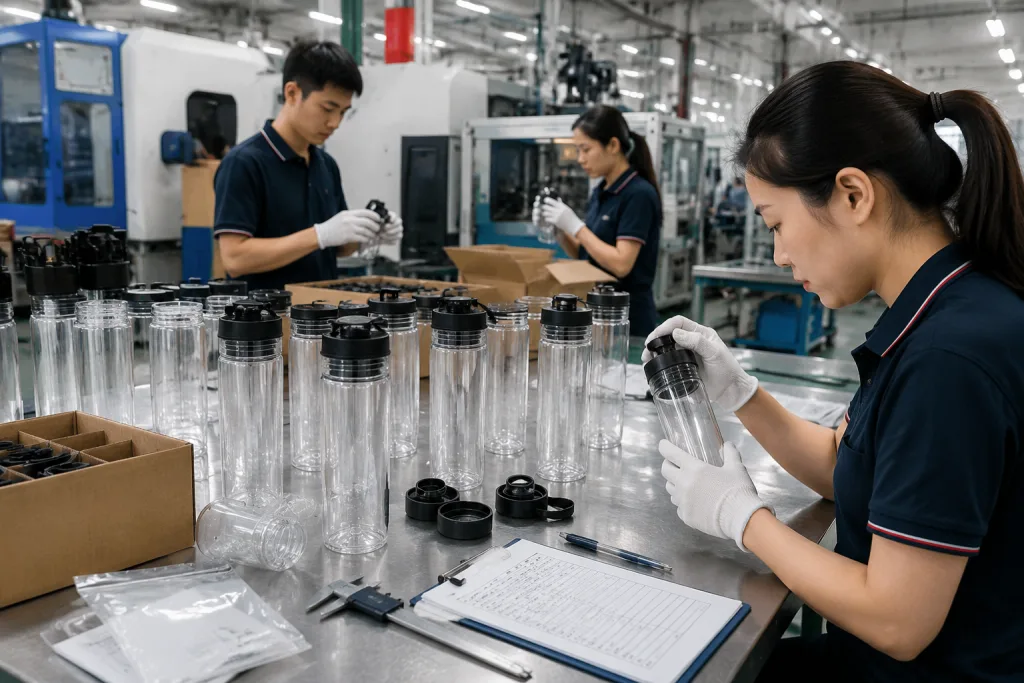
- Set 3,000 pcs per color as a realistic MOQ for most Tritan custom canteen orders
- Specify Tritan grade, wall thickness, cap torque, and leak test method before sampling
- Use AQL 2.5 for major defects and AQL 4.0 for minor cosmetic defects on bulk inspections
- Plan 25–35 days production plus 7–10 days for PP sample confirmation on custom drinkware
A Tritan bottle looks simple until QC opens the first 40HQ and finds cloudy bodies, caps leaking at 0.6 bar, logo ink failing the 3M tape test, or cartons crushed after a 76 cm drop test. Then the distributor margin is gone. Your customer asks for replacements, and the factory says the golden sample was “only for reference.” We’ve seen this go sideways.
If you are sourcing from a tritan glass bottle factory in China, the wrong question is “what is your best price?” You need to buy the failure modes first: resin grade, cap torque, print adhesion, carton strength. At BottleForge Industrial in Hangzhou, Zhejiang, we quote Tritan canteen projects from 3,000 pcs per color, with normal production at 25–35 days after PP sample approval. Before the line runs, we lock the drawing in mm, weigh the PP sample on a 0.1 g scale, and turn your custom drinkware idea into specs the injection, printing, packing, and shipping teams can actually check.
The wrong resin ruins everything
The first failure is also the one buyers miss in photos: resin substitution. Buyers write “Tritan glass bottle” because they want glass-like clarity with fewer cracked cartons after transit. In our quotes, that means Eastman Tritan copolyester or a written equivalent with test files, not PC, PETG, AS, or a no-name copolyester from a cheaper bag. We have seen this go sideways: QC pulled the sample under a D65 light box, and the body had a blue-gray haze the buyer flagged within 10 seconds. A weak canteen supplier may cut USD 0.08 per 750 ml bottle, then switch resin to protect margin.
Put the resin requirement on the quotation, proforma invoice, artwork sheet, and inspection checklist. Not WhatsApp. We run into this every season: the PO says “clear bottle,” the chat says “Tritan,” and the factory clerk copies only the PO into the production order. For EU and North American buyers, ask for food-contact documents tied to your market: FDA 21 CFR for the United States, LFGB or EU 10/2011 where applicable, and REACH/SVHC declarations for Europe. If the bottle is for kids, discuss ASTM F963 and CPSIA testing before mold deposit, because the silicone straw, PP lid insert, printed carton, and hang tag can all trigger questions during inspection.
On the factory side, the practical control is batch traceability. A serious canteen factory in Zhejiang or elsewhere in China should record resin batch number, injection date, machine number, and operator shift on the production traveler. Simple stuff. On our line, one 25 kg resin bag lot gets logged before drying, and the shift leader signs it beside the injection machine number. That does not stop every defect, but it gives you a clean way to isolate 3,000 bottles if haze, odor, or impact cracking shows up after packing.
For most 600–1000 ml Tritan bottles, we like body wall thickness around 1.5–2.2 mm, depending on shape and mold design. Too thin saves resin but creates flex, oval deformation near the thread, and weak drop results from 1.2 m. Too thick raises cost and cycle time, and sink marks show up fast if the cooling channel layout is lazy. The wrong question is “can you make it cheaper?” Ask about wall thickness, gate location, and shrinkage. If a canteen manufacturer cannot answer those with a caliper in hand, you are probably buying from a trading layer, not the people controlling the mold.
Leakage starts at the drawing
Most leaking bottles do not fail because someone forgot to tighten the lid. They fail because the cap, gasket, thread, and drinking spout were drawn as separate parts, not as one sealing stack. We see this on custom canteen and customized growler projects around the first 3D print stage, when the buyer says, “just use our old lid,” and the math doesn’t work.
Before opening a mold or changing a cap color, define the closure performance. A basic leak test is simple: fill to rated capacity, close to specified torque, invert for 30 minutes, then shake horizontally for 30 seconds. We run this on the bench with a torque meter and a white tissue under the cap; one wet ring is a fail. For sports lids, add a pressure or squeeze test because users throw bottles into gym bags and backpacks. If the bottle ships with a straw lid, check upright leakage and side leakage. Straw vents are only 1.2–1.8 mm on some lids, but they still cause chargebacks.
Cap torque should be written in the QC file. For many Tritan bottles, a practical hand-tight range is around 0.8–1.2 N·m, but the final number depends on thread design and gasket hardness. Too low, and consumers overtighten until the threads chew up. Too high, and the lid feels cheap. QC pulled the sample on one distributor canteen job at 1.6 N·m, and the buyer flagged it after 12 users in their office complained within 2 days. Small feel issue. Big repeat-order problem.
Gasket material should also be specified. Food-grade silicone is common, usually 50–60 Shore A hardness for flexible sealing. TPE works in some designs, but confirm odor and compression set after heat aging; a 70°C dishwasher cycle can make a soft gasket take a permanent flat spot. Test the whole assembly, not only the bottle body. We have seen this go sideways: resin passed, while the printed logo faded, the cap spring rusted, and the gasket smelled like rubber after 10 cycles.
Ask your canteen suppliers for exploded drawings and replacement part codes. If they cannot identify gasket size, cap material, and thread standard, they cannot control leakage consistently at 20,000 pcs. On our line, the drawing needs the gasket ID/OD in mm, the cap resin grade, and the thread callout before tooling; “same as sample” on a PO is where leakage starts.
Clarity and color drift fast
Tritan gets picked because it can look clean, bright, and close to glass. The problem shows up on the line fast: 5,000 pcs later, the same bottle can turn a little gray, smoky, or yellow from carton 12 to carton 38. We’ve seen this go sideways after resin sat in the dryer 45 minutes short, or when a 0.8% smoke masterbatch lot was changed without a purge sheet. Regrind, dirty barrels, and rushed machine setup all leave fingerprints.
If your brand sells a clear bottle, set the visual standard before mass production. Approve a physical PP sample, then keep 1 pc at your office, 1 pc at the factory, and 1 pc with the inspection company. Photos are not enough. Our QC once pulled the sample under a 6500K light box and the buyer’s “clear blue” looked green beside the office window. For transparent colors, use Pantone as a guide, but judge transparent amber, smoke, blue, or pink against the physical sample, not Pantone alone.
For customized drinkware, control regrind in writing. Some factories run internal regrind from sprues and rejected parts; that is not automatically wrong if it stays below a fixed ratio and the material is clean. The math doesn’t work for premium canteen customizable programs if clarity and drop strength both matter, so we recommend 100% virgin resin unless the recycled-content claim is part of the project and backed by documents. Do not mix sustainability language with undocumented scrap material. EU buyers flagged 3 vague “eco” claims for us last year before artwork approval.
Color drift hits lids and silicone parts too. Black is easy. Matched beige, sage green, or translucent smoke is where buyers start pushing back. Ask for Delta E tolerance if color matching matters; 12 of our B2B buyers use ΔE ≤ 1.5 for strict visible color match and ≤ 2.0–2.5 for forgiving plastic parts. For promotional canteen orders, this is often overkill. For retail shelf sets, it is the right question to ask, especially when the lid, straw, and silicone gasket sit together in one blister tray.
A capable Tritan bottle line in China should run first-piece checks, mid-line checks every 2 hours, and final carton inspection. In our Hangzhou, Zhejiang workshop, QC checks clarity, black spots, flow marks, weld lines, and cap color against the retained PP sample before packing starts. We run it under the light box, then pull 3 pcs from the conveyor and 3 pcs from packed cartons. If carton 1 and carton 26 do not match, packing stops.

Decoration fails after the sample
The printed sample usually passes. Trouble starts at 5,000 pcs, when ink viscosity drifts from 18 seconds to 24 seconds on the Zahn cup, the operator shortens tunnel curing to catch the line, or the curved bottle body shows a 1.5 mm registration shift. Customizable drinkware is decoration-sensitive. Pick the wrong logo method and a good bottle becomes 600 rejects before QC pulls the sample.
For Tritan bodies, we usually run silk screen printing, pad printing, heat transfer, UV printing, or sleeve packaging. Laser engraving is not our first pick on transparent Tritan because the mark often looks pale, with patchy frosting where the wall thickness changes. For a custom growler or large bottle with a stainless cap, laser works better on the metal cap at 20–30 mm logo size, while the body gets printed branding. We’ve seen this go sideways when the buyer asks for the same laser look on both parts.
Put artwork limits in writing. A practical silk screen logo width on a curved 750 ml bottle may be 60–90 mm depending on diameter, and our screen room will usually ask for the dieline before burning the mesh. Fine lines below 0.25 mm and small reversed text often fill in after 2,000–3,000 strokes. Tiny legal copy on a curved plastic wall is the wrong fight. If your brand guide needs 5 pt warning text, use a label, insert card, or carton print.
Adhesion testing belongs in approval, not after the container is booked. At minimum, use a 3M tape test after curing; our QC team marks the pull angle and checks for flaking under the inspection lamp. For higher-risk retail orders, add alcohol rub testing, dishwasher cycle testing if claimed, and abrasion checks. If the logo is metallic gold or silver, ask whether the ink is food-contact safe for the intended location and whether it passes REACH heavy metal limits. Bottle-body compliance does not automatically cover decoration.
Canteen manufacturers often quote decoration separately: one-color silk screen may add roughly USD 0.08–0.18 per piece, while full-wrap heat transfer can add USD 0.35–0.80 depending on coverage and quantity. The math does not work if a canteen vendor gives one blended price without method, print size, color count, and MOQ. We had a PO once that said “full color logo” but the attached artwork was 7 colors plus gradient; the buyer flagged it only after the pre-production sample, which cost 9 days.
Packaging breaks the landed margin
Packaging is where canteen distributors lose 3–6% margin without seeing it on the unit price. The bottle passes factory QC, then the master carton caves in after 28 days on the water, retail boxes scuff, or Amazon FBA labels sit 15 mm off the scan window. We have had QC pull a clean Tritan bottle from the mold room and still see the buyer reject the shipment in the warehouse. Wrong failure point.
Decide the sales channel before confirming packaging. A wholesale distributor growler or distributor canteen order usually runs fine with a polybag, egg-crate divider, and 5-layer export carton if the carton stays under 13 kg. A retail customized canteen needs the color box worked out piece by piece: EAN barcode size, warning copy, language version, hang-tag hole position, and whether the buyer wants the logo facing front when the lid is closed. An e-commerce order needs drop-test thinking, suffocation warnings, FNSKU labeling, and carton weight below the warehouse limit. We once saw a PO typo list “24 sets/ctn” while the artwork file said “12 pcs/ctn”; that mistake costs more than the carton.
For Tritan bottles, we usually recommend a 5-ply K=A or K=K export carton for heavier orders, especially above 12 kg gross weight. Carton edge crush and tape quality matter more than buyers expect; our packing line uses 48 mm BOPP tape, and thin tape fails first on humid Ningbo load-outs. If your product has a flip lid or protruding carry loop, add a top-and-bottom insert or individual paper wrap so caps do not rub during vibration. Transparent bottles show every scratch. The buyer flagged this twice last year on clear 750 ml bottles with black lids.
Carton quantity should be calculated around shipping damage and handling, not just container loading. Packing 48 pcs per carton may look efficient until warehouse staff hate lifting 17 kg boxes off a pallet. We’ve seen this go sideways. Most 600–800 ml bottles ship better at 24 pcs per carton, depending on box style and accessories, and the line can still stack 7 layers cleanly on a 1.2 m pallet. Ask for gross weight, carton dimensions, CBM, and loading quantity before you issue the PO.
If you need FBA preparation from China, define label placement with a diagram. A canteen distributor should not accept “factory will handle it” as a spec. Put carton marks, inner barcode, FNSKU, polybag warning, and mixed-SKU rules into the packing instruction, including which panel gets the label and the minimum 30 mm clearance from carton seams. It saves arguments later. We ship FBA orders every month, and the fastest disputes to settle are the ones with a marked PDF and signed packing sample.
Inspection catches only written defects
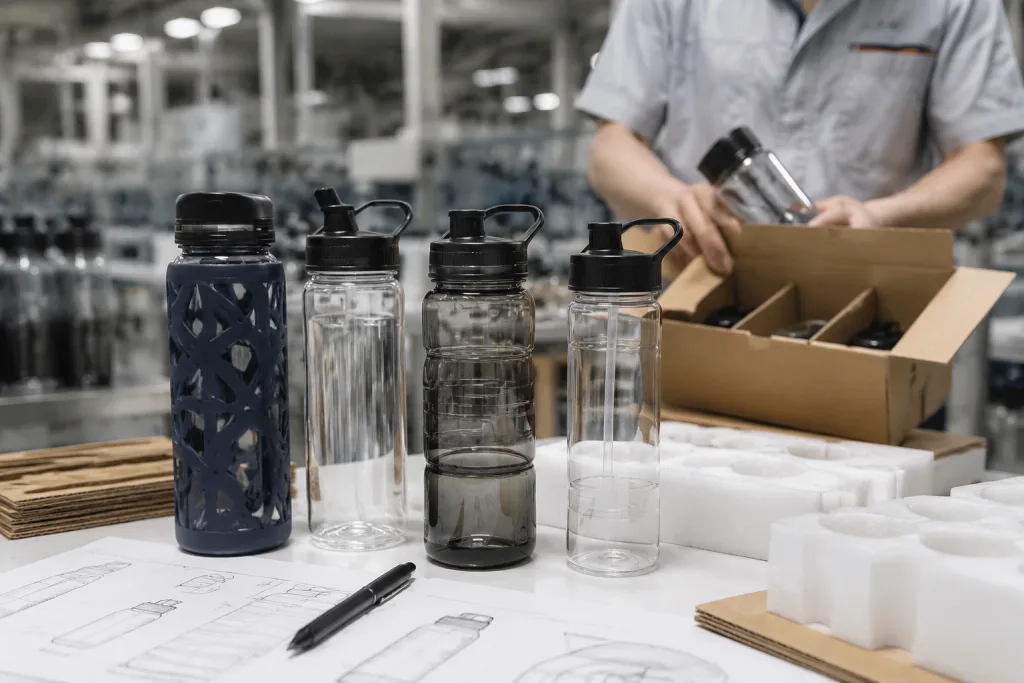
AQL inspection is useful, but it is not magic. Inspectors check against the written standard in your PO and artwork file. If the PO only says “good quality,” cloudy walls, a 0.4 mm gasket gap, weak logo adhesion after a 3M tape pull, and a crushed 5-ply export carton turn into arguments instead of defects. We have seen this go sideways.
For most B2B Tritan bottle orders, a reasonable final random inspection uses ISO 2859-1 sampling with AQL 0 for critical defects, AQL 2.5 for major defects, and AQL 4.0 for minor defects. Critical defects include unsafe sharp edges, contamination inside the bottle, wrong material, or a cap that creates a choking hazard on kids’ products. Major defects include leakage, wrong logo, severe scratches, wrong color, missing accessories, or barcode failure; QC pulled 13 leaking samples from one 5,000 pcs run after the cap liner was changed without approval. Minor defects include small scuffs, slight color variation within agreed tolerance, or minor carton printing issues such as a PO number typed as 23071 instead of 23017.
You should require functional tests during inspection, not only visual checks. For a canteen customized order, we run capacity measurement with a digital scale, leak test after 30 minutes upside down, cap open-close cycle test, torque check in kgf·cm, logo tape test, odor check after warm water fill, barcode scan, carton drop check, and packing quantity verification. For insulated stainless products the list differs, but for Tritan the body clarity and sealing system are the big risks. Pretty photos do not catch a bad silicone ring.
Pre-shipment inspection should happen when at least 80% of goods are packed and 100% are produced. If the factory invites inspection at 50% packed, defects can still sit in WIP baskets beside the injection line. If they invite it 6 hours before vessel cutoff, the math does not work; a 2,000 pcs gasket rework takes 12 hours vs 18 hours if cartons must be reopened and resealed. That is how buyers end up accepting discounts instead of receiving sellable product.
A transparent canteen factory will not resist inspection. They may debate defect classification, which is normal, but they should not block your inspector from checking warehouse stock, retained samples, and packing lines. If the buyer flagged a retained gold sample from April, we bring it to the QC table and compare logo position in mm, not by eye from across the room.
Price gaps need a teardown
Send the same RFQ to five canteen vendors and the lowest price is the wrong question to ask. We’ve seen quotes miss resin grade, logo screen charge, individual polybag, spare gasket, testing, inland freight, or 5-layer export carton. Last month QC pulled a 700 ml sample and the carton burst at 14 kg on the drop test table. FOB Ningbo and FOB Shanghai also need checking line by line, especially when one supplier writes EXW in 8-point text on the PI and another quotes real FOB.
For a 700 ml Tritan bottle with one-color logo, a realistic FOB China range might be roughly USD 1.40–2.60 per piece at 5,000–10,000 pcs, depending on mold ownership, lid complexity, resin grade, packaging, and decoration. A simple canteen promotional bottle sits at the low end. A premium canteen customizable program with custom color lid, silicone boot, retail box, and compliance testing sits higher. If someone quotes USD 1.08, ask what disappeared. The math doesn’t work after Tritan resin, injection cycle time, silk-screen ink, and a 38 x 32 x 45 cm export carton are counted.
Separate one-time costs from unit price. New mold tooling for a fully custom canteen can run from USD 6,000 to more than USD 25,000, depending on cavities, cap complexity, and whether you need multiple sizes. Logo screens, heat-transfer plates, or color matching fees are smaller, usually USD 50–300 per design, but they still belong in the cost sheet. We run these through the tooling sheet before sampling; if the PO says “blue” but the buyer meant Pantone 2925 C, the line stops and nobody wins.
Check capacity too. BottleForge Industrial can support around 450,000 plastic and stainless drinkware units per month across our Zhejiang production network, but capacity is scheduled by injection machine, mold, color, and decoration line. A canteen supplier who promises 100,000 pcs in 12 days during peak season is either sitting on open machines or hiding the real plan. We’ve seen this go sideways when a 4-cavity mold was booked for another lid and the buyer only found out after the pre-production sample.
Your best protection is a boring RFQ: 2D drawing, target capacity, resin grade, Pantone color, lid type, logo method, packaging, testing, MOQ, delivery term, inspection standard, and target ship date. Boring specs make reliable custom drinkware. Put AQL 2.5 and carton marks on the RFQ too; QC should not be guessing from a WhatsApp screenshot at 9 p.m.
Send your Tritan bottle RFQ for a factory teardown
Share capacity, lid type, logo artwork, packaging, and target market. We will return a practical spec, MOQ, lead time, and FOB quote.
Frequently asked questions
Is Tritan the same as glass for a bottle buyer?
No. Tritan is a copolyester plastic with glass-like clarity, not mineral glass. Buyers use it when they want a clear bottle with better drop resistance and lighter weight. A 750 ml Tritan bottle may weigh 120–180 g depending on wall thickness, while a comparable glass bottle is much heavier and more fragile. Tritan can still scratch, haze, or deform if the resin, mold, or dishwasher claim is poorly controlled. When talking to a tritan glass bottle factory, specify Tritan resin or approved equivalent, food-contact compliance, wall thickness, and test conditions. Do not approve a quote that only says “plastic bottle” or “eco material.”
What MOQ should I expect for customized drinkware?
For standard molds with logo printing, 3,000 pcs per color is a practical MOQ at many China factories, including our Hangzhou, Zhejiang operation. For custom cap colors or silicone parts, 5,000 pcs is more realistic because color matching and machine setup take time. For a fully custom canteen or customized growler with new tooling, 10,000 pcs per first production run is a better planning number, even if the factory accepts less. Small MOQs are possible, but the unit price, setup cost, and color control usually suffer. Ask whether MOQ is per design, per color, per lid type, or per shipment.
How long does a Tritan bottle order take?
For an existing mold with standard cap and one-color logo, plan 7–10 days for artwork and PP sample approval, then 25–35 days for mass production after deposit and sample sign-off. Add 3–7 days if custom color matching is required. New mold development is much longer: 30–45 days for tooling is common, then sampling, adjustment, and production. Ocean freight to Europe or North America may add 25–45 days depending on port and season. A canteen distributor should build the calendar backward from the retail delivery date, not from the purchase order date.
Which logo method works best on Tritan bottles?
For most custom drinkware orders, silk screen printing is the best balance of cost and durability for simple 1–2 color logos. Expect roughly USD 0.08–0.18 per piece for a basic one-color print at normal B2B quantities. Heat transfer is better for full-color graphics or larger wraps but can add USD 0.35–0.80 per piece. UV printing is useful for short runs or complex artwork, but adhesion must be tested carefully on curved Tritan. Always approve a physical printed sample and require a 3M tape test. If the product claims dishwasher safe, test the printed bottle after multiple wash cycles.
What should I ask a canteen manufacturer before paying a deposit?
Ask for resin grade, food-contact documents, MOQ by color, sample lead time, production lead time, decoration method, packaging specification, AQL standard, and export term such as FOB Ningbo or FOB Shanghai. Also ask who owns the mold, whether regrind is used, and what happens if leakage exceeds the agreed defect limit. A serious canteen manufacturer or canteen supplier should answer with numbers, not vague promises. For example: 3,000 pcs MOQ, 25–35 days production, AQL 2.5 major defects, 24 pcs per export carton, and 5-layer carton. If they avoid written specs, do not treat the low price as real.