Key Takeaways
- Treat Tritan as glass-like plastic: typical bottle wall thickness is 1.2-1.8 mm, not fragile glass
- A realistic custom MOQ is 1,000-3,000 pcs per color depending on cap, logo, and packaging
- Budget 25-35 days for bulk production after artwork and pre-production sample approval
- Require AQL inspection, food-contact test reports, and carton drop testing before final payment
You searched for tritan glass bottle custom, so let’s fix the wording first. Tritan is not glass. It is a clear copolyester we run when buyers want glass-like clarity, fewer breakage claims, and lighter cartons—one 650 ml Tritan bottle usually packs about 30% lighter than glass in our export cartons. The buyer flagged this exact term on a PO last month, because their retail team wrote “glass” while the test request said “Tritan.” That mismatch slows artwork approval fast.
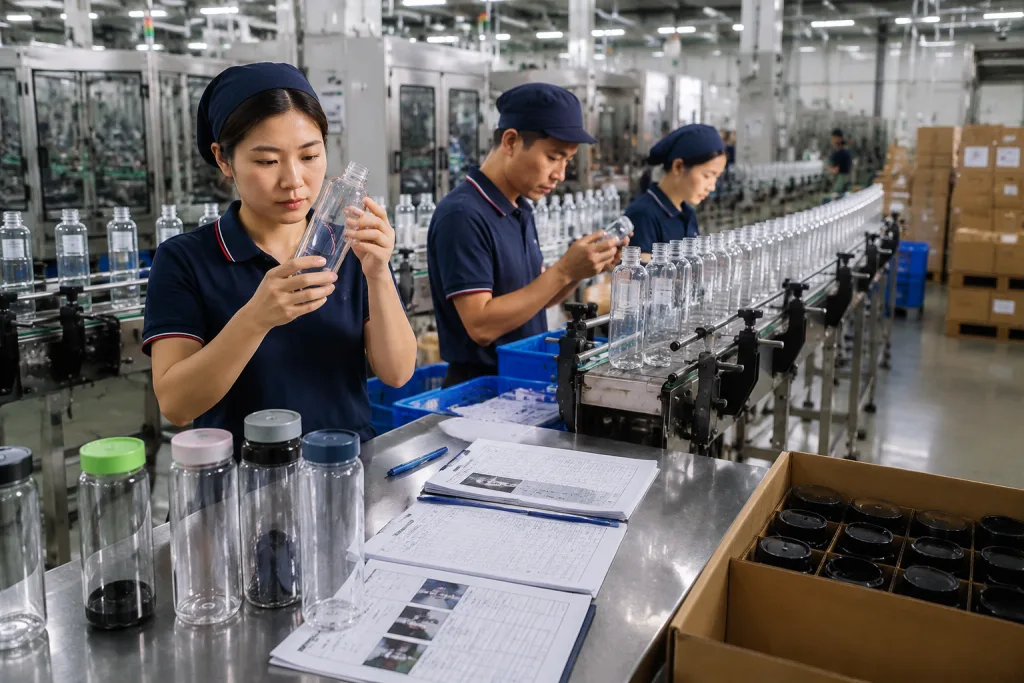
From our Hangzhou, Zhejiang factory network in China, nice 3D renderings are not the buying risk. The real checks are REACH or LFGB test scope, cap leak rate after a 1.2 m carton drop test, MOQ by color, and how logo decoration changes the production slot. BottleForge typically handles 80,000 to 120,000 Tritan bottle units/month, with practical custom MOQ starting at 1,000 pieces per color for repeatable production. We’ve seen this go sideways when a buyer asks for 6 colors at 500 pcs each; the math doesn’t work on the injection line.
Start with the material question
Procurement teams often write “Tritan glass bottle” because the bottle looks like glass in a product photo. The correct technical name is Tritan copolyester water bottle. This is not wordplay. Last quarter we saw a PO line say “glass bottle,” while the resin declaration and carton mark both showed Tritan plastic; the buyer flagged it during document review, and the file had to be corrected before booking space.
Tritan works well for custom drinkware because it gives a clear glass-like look, survives normal drop handling better than glass, and is BPA-free by formulation. A common 650 ml bottle weighs about 120-160 g before cap, much lighter than a comparable borosilicate glass bottle. On a 10,000 pc distributor canteen order, that weight gap affects carton weight, pallet loading, and ocean freight cost per unit. We run this check on the packing table with a 0.1 g scale, not by guessing from the catalog photo.
You still need to specify the resin grade and test requirement. For European buyers, we normally discuss EU 10/2011, LFGB sensory testing, REACH SVHC screening, and specific migration with the lab before the pre-production sample is sealed. For North American buyers, FDA food-contact suitability and California Proposition 65 review may apply. Do not accept a one-line “food grade” claim as your only document; we have seen that go sideways when QC pulled the sample and the BOM did not match the submitted test report.
A practical buyer specification should include capacity tolerance, resin declaration, wall thickness, cap material, silicone seal material, temperature range, and odor requirement. Write it like an inspection sheet: 650 ml ±5%, body wall in mm, cap resin named, silicone ring color listed, and no strong plastic smell after washing. For most Tritan bottles, we suggest testing with water at 70°C for use simulation, but we do not position the item as a boiling-water thermos. Tritan performs well. It is not stainless steel vacuumware, and asking it to behave like one is the wrong question to ask.
Buyer checklist: ask your canteen manufacturer for the resin brand/type declaration, migration test reports, and a signed bill of materials before you approve mass production; we usually attach these to the golden sample file before the line starts.
What customization actually changes
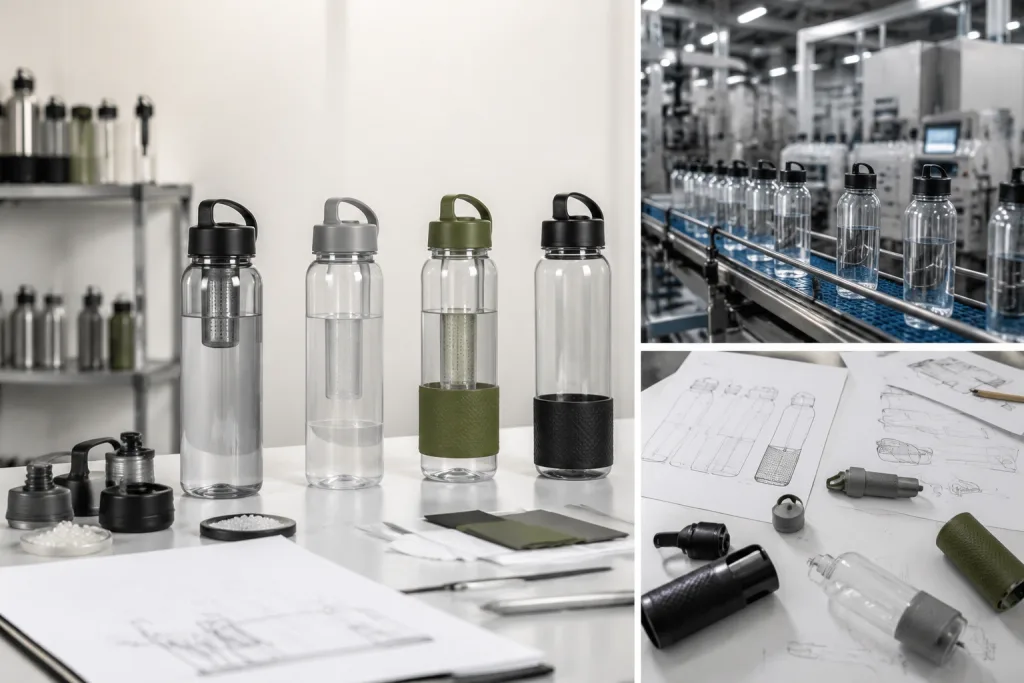
A custom canteen program can stay clean, or it can get bloated fast. The basic version we run is a stock clear Tritan bottle, one-color silk screen logo, and neutral 5-layer export carton. The heavy version adds a private mold, Pantone cap, printed strap, retail box, barcode labels, and mixed-color assortment packing. Both sell. They do not quote the same, and they do not ship on the same clock. Last month QC pulled a 650 ml sample because the buyer’s PO said “matte black lid” while the approved sample had a glossy PP lid.
For most B2B orders, customization falls into five buckets:
- Logo decoration: silk screen for 1 to 2 solid colors, pad print for small curved cap areas, heat transfer for wrap graphics, UV print for sharper retail artwork, or laser marking on stainless cap parts.
- Body color: clear transparent Tritan for the safest stock run, smoke gray or light blue for low-risk tinting, amber for outdoor and wellness SKUs, or Pantone-tinted Tritan when the MOQ and color tolerance are written clearly on the PO.
- Cap system: screw cap for fewer leak complaints, flip lid for gym channels, straw lid for kids and sports, carry loop for hiking sets, locking button for bag use, or stainless cap shell when the buyer wants a higher shelf price.
- Packaging: egg-crate export carton for bulk shipments, white box for distributor repacking, color box for retail shelves, hang tag for club stores, insert card for instructions, or FNSKU sticker for Amazon receiving.
- Mold changes: custom shape with new blow mold work, grip ribs that need hand-feel checking, embossed logo that must release cleanly, special capacity marked at the fill line, or custom growler-style wide mouth with a separate cap fit test.
If you are a canteen distributor testing a new SKU, custom mold tooling is the wrong place to start. Use an existing bottle and spend the money on decoration accuracy and retail packaging. Tooling for a new Tritan bottle can run from USD 4,000 to USD 18,000 depending on cavity count, shape, and cap complexity. A custom cap surprises buyers because the leak path must be engineered, not just drawn; we pressure-test with water at the line, then invert samples for 24 hours before packing approval.
For a canteen promotional campaign, silk screen printing is enough 8 times out of 10. For premium retail, UV print or wraparound heat transfer gives wider visual coverage, but the artwork file needs tighter control. A good canteen supplier should push back when the design is risky. Fine white text below 0.8 mm line width fills in during screen printing on curved bottle walls; we’ve seen this go sideways when a buyer approved a PDF but never checked the actual film positive on the print table.
MOQ and price you can plan around
MOQ is where 7 out of 10 buyer calls start to drift. We can print 300 pieces on the pad-print line, sure, but the math does not work after setup sheets, logo film, 2 spare cartons, and QC time are counted. For BottleForge in Zhejiang, China, a workable MOQ for a standard tritan glass bottle custom order is usually 1,000 pcs per logo and color. For custom Pantone body resin, expect 3,000-5,000 pcs because the injection machine needs a full color purge, and QC pulled 18 kg of off-shade resin on one small run last spring.
FOB Ningbo or Shanghai pricing for a 500-750 ml Tritan bottle often sits around USD 1.20-2.80 per piece for standard models, depending on cap design, wall thickness, print method, and packaging. A basic screw-cap bottle with one-color logo and bulk packing sits near the lower end. Add a locking flip lid, silicone straw, retail box, and UV print, and the quote can move above USD 3.00 fast. The buyer usually flags this part first. We check it with a digital caliper on the 1.2 mm wall sample, not from a catalog photo.
For distributor growler or customized growler projects, capacity changes the cost sheet. A 1.5 L or 2 L Tritan growler-style bottle uses more resin and needs stronger carton protection. If the cap is heavy, the drop-test risk climbs; we have seen corner cracks after a 1.2 m carton drop when the divider was too soft. The price gap is not just resin weight. The line runs slower, the cooling time stretches by about 6-9 seconds per shot, and QC rejection can climb if the neck finish is not stable.
Here is the planning range we give new buyers after we check the logo file, cap type, and packing method on the PO:
- 1,000 pcs: standard model, one logo, 2-3 stock color options, usually bulk packing.
- 3,000 pcs: tighter color control, custom packaging, mixed carton planning with carton marks checked before mass packing.
- 5,000-10,000 pcs: better price negotiation, custom cap color, retail-ready packing with barcode label checks.
- 20,000 pcs and above: reserved production slot, better freight planning, possible mold investment discussion after sample approval.
If a canteen vendor quotes far below the range, check resin grade, net weight, cap seal, and inspection terms. Cheap bottles usually save money where you cannot see it. We once caught a 22 g weight gap on a “same model” sample, and the buyer’s PO even had the logo color typed as Panton 286C. Small typo. Big problem.
Compliance buyers should not skip
For Europe and North America, compliance is not a decorative PDF. Paper is not protection. A retailer, marketplace, or corporate buyer can ask for proof 6 months after the container leaves Ningbo. If your canteen suppliers cannot trace the Tritan resin lot, silicone seal batch, pigment code, and ink MSDS, the claim lands on your desk. We run resin intake against lot stickers before molding; one missing label on a 25 kg bag is enough for QC to hold the line.
For a Tritan bottle, ask for a current test report on the finished product or a materially identical product. Resin-only documents help, but they do not cover UV ink on the logo, PP lids, silicone gaskets, or color masterbatch. If you are selling into the EU, REACH and food-contact migration are normal checks. For Germany, LFGB sensory expectations are stricter, especially odor and taste transfer; QC pulled a sample last quarter after a new gasket smelled like rubber at 40°C. For the U.S., FDA food-contact basis, CPSIA if children are involved, and Prop 65 screening should be settled before mass production.
If you are buying kids’ bottles, be more conservative. A kids-bottle cap can include a 6 mm vent plug, a straw valve, or a spring push button, and those parts change the testing job. That can trigger ASTM F963, CPSIA lead and phthalate testing, and choking hazard review. This is where we have seen orders go sideways: the buyer approved an adult canteen customized with cartoon printing, then the listing team called it a children’s bottle. The math doesn’t work without testing.
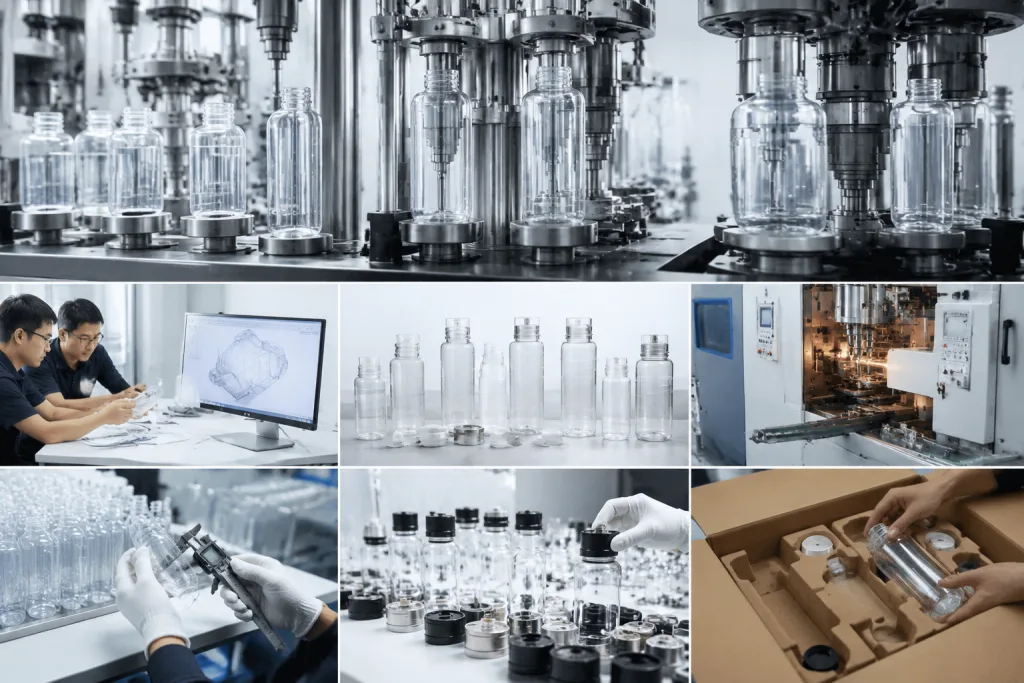
Quality inspection should be written into the purchase order. We recommend AQL 2.5 for major defects and AQL 4.0 for minor defects on most drinkware export orders. Critical defects, such as leakage, sharp edges, severe odor, wrong material, or contamination, should be zero tolerance. A normal inspection protocol includes 500 ml capacity check with a graduated cylinder, barcode scan by handheld scanner, logo rub test with 3M tape, inverted leak test for 30 minutes, drop test from 1.2 m, carton measurement in mm, and packing count against the PO. Put it in writing; a typo on one PO once turned “matte black lid” into “matte black body.”
For Amazon or 3PL shipments, add FNSKU label verification and carton label accuracy. QC should scan 32 cartons per SKU before sealing, not just look at the print by eye. A good distributor drinkware program can lose money quickly if 5% of cartons arrive with wrong SKU labels. The buyer flagged it once after mixed FNSKU rolls were loaded beside the packing table; that mistake costs more than the label check.
Production timeline without fantasy dates
A serious canteen factory will not book the line before the artwork file, approved sample, resin choice, and cap details are fixed. Fixed launch date? Work backward from warehouse arrival, not from the PO issue date. Last March, one buyer sent a PO with “clear blue” in one line and “smoke grey” in the attachment; our merchandiser caught it before the injection team opened a 25 kg color masterbatch bag.
For an existing Tritan model, the timing is easy to check. Artwork proof takes 1-2 working days after we receive your AI or PDF vector file with Pantone code. A printed pre-production sample usually takes 5-7 days. If you require a new cap color or custom tinted body, sample timing may move to 10-14 days because resin matching and injection trials are involved; we run the first shot on the injection machine, then QC checks color under a D65 light box, not just office lighting. Bulk production typically takes 25-35 days after sample approval and deposit. Peak season before summer or Q4 gifting can add 7-15 days, and the math doesn’t work if the buyer approves the sample on Friday and asks us to ship 12,000 pcs the next week.
Ocean shipping from Ningbo or Shanghai to Europe often takes 30-45 days port to port, while U.S. West Coast may be 18-25 days and U.S. East Coast 30-40 days depending on routing. Air freight is possible for urgent canteen promotional orders, but the freight cost can exceed the bottle value. Use air for 300-500 launch pieces if the event date is fixed, not the full order, unless your margin can take the hit. We’ve seen this go sideways: one promo buyer approved air on 60 cartons, then flagged the bill when the chargeable weight came out higher than the carton scale weight.
Custom mold projects are a different job. Expect 30-45 days for tooling, 7-10 days for T1 samples, then revisions if leakage, shrinkage, or cap fit is off. For a customized canteen with a new lid mechanism, allow at least 90 days from design confirmation to bulk shipment. Anyone promising 30 days for new tooling plus mass production is probably skipping validation. On the factory floor, QC pulled one T1 sample where the cap thread was short by 0.4 mm; it looked fine in photos, but it leaked after a 3-minute inverted water test.
Our practical advice: approve the physical sample, not just a rendering. This is the wrong question to ask if the question is only “Can you meet my launch date?” Ask what has already been locked. Renderings do not show cap torque, odor, print edge sharpness, or whether the bottle rocks on a flat table; we check that with a torque meter, a nose test after hot-water rinse, and a glass inspection plate.
Checklist before paying the deposit
Before you pay the 30% deposit, lock the commercial sheet and the technical sheet in writing. We see 8 out of 10 deposit-stage arguments start from loose words on the PO: “matte finish,” “standard box,” or “logo bigger.” Wrong question to ask: “Can you make it?” The better question is: “Is it written on the PI, sample tag, and artwork approval sheet?” QC pulled one Tritan bottle sample last month where the buyer expected a 42 mm logo, but the PO only said “front logo.” The line followed the file, not the memory.
Use this checklist for a standard customizable drinkware order:
- Confirm model number, capacity, net weight, and bottle dimensions in mm.
- Confirm Tritan body, PP or ABS lid parts, and food-grade silicone seal.
- Confirm MOQ by color, not just total order quantity. 3,000 pcs total can still fail if the factory MOQ is 1,000 pcs per color.
- Approve Pantone references for cap, strap, print, and packaging, then match them under a D65 light box.
- Send vector artwork in AI, EPS, or PDF format with logo size in mm.
- Define packing: polybag or no polybag, inner box, master carton, carton marks.
- List compliance requirements: REACH, LFGB, FDA, Prop 65, ASTM, or CPSIA.
- Agree inspection standard: AQL level, leak test method, drop height, sample size.
- Confirm Incoterm: FOB Ningbo, FOB Shanghai, EXW, CIF, or DDP.
- Confirm payment terms, usually 30% deposit and 70% balance before shipment.
If you work with 3 or 4 canteen vendors, compare quotations line by line. We ship quotes every week where one price includes a color box and the next price is bulk packing in a 5-layer master carton. One supplier may include third-party testing, while another attaches a 2022 factory report that does not match the new Tritan resin batch. The math goes sideways fast: a USD 0.06 cheaper bottle can cost more after box printing, test fees, and carton repacking at the warehouse.
For canteen distributors building a catalog, standardize neck sizes and cap families where the design allows it. Boring, but it works. A 58 mm neck across 6 bottle models means fewer spare gasket SKUs, fewer replacement-cap emails, and cleaner warehouse slots. We have seen buyers lose 12 days sorting mixed caps because two lids looked the same in photos but used different silicone ring thicknesses, 1.8 mm vs 2.3 mm. Repeat orders are where this discipline pays.
When to choose another material
Tritan works, but it is the wrong answer for some custom drinkware projects. If the buyer asks for hot coffee retention for 6-12 hours, we quote stainless vacuum insulation and show the lid gasket test sheet. If they want a premium desk bottle with better scratch resistance, borosilicate glass is usually the cleaner fit; our QC once pulled a Tritan sample after a 3H pencil test because the buyer flagged hairline scuffs under a 600 mm light box. If the brief is a low-cost festival giveaway under USD 1.00 FOB, the math doesn't work. PP or AS plastic will hit that shelf price faster.
Choose Tritan when the brief is tight: a transparent body that shows drink color, lower carton weight for air freight, impact resistance for school bags, a retail look that does not feel cheap, and a mid-range unit price. We run Tritan for gyms, schools, outdoor clubs, wellness brands, and corporate gift orders where the buyer wants 3 logo versions on the same 500 ml body. It also fits a customizable canteen line because we can change Pantone lids and silk-screen artwork without opening a new mold for every client; last month the line changed from black lids to PMS 5483C in 42 minutes after the PO had the color code typo fixed.
Choose stainless when drop resistance and thermal performance beat transparency. Choose glass when the brand story is clean taste for home or office shelves, but expect more breakage claims and heavier freight; a 24 pcs carton can move from 9 kg to 14 kg fast. Aluminum is only worth quoting if your market accepts the internal coating and dent risk. For a custom growler or customizable growler, stainless usually beats Tritan if carbonation, beer, or long outdoor use is involved, and we've seen this go sideways when a buyer tried Tritan for a brewery promo after asking for “no pressure issue” in the PO notes.
A good canteen supplier should say no to Tritan when the application is wrong. BottleForge works from Hangzhou, Zhejiang with partner production across China, so we compare Tritan, stainless steel, glass, and PP options without pushing one material into every inquiry. Send the target retail price, compliance market, and use case, and the first quote round normally tells the truth; our sample room keeps 12 bottle bodies on the bench for side-by-side weight checks with a 0.1 g scale before we advise the buyer.
Send your Tritan bottle brief for a real quote
Share capacity, logo, quantity, market, and packaging needs. We will reply with MOQ, FOB price range, sample timing, and compliance notes.
Frequently asked questions
Is a Tritan glass bottle actually made from glass?
No. Tritan is a clear copolyester plastic, not glass. Buyers use the phrase “Tritan glass bottle” because it has glass-like clarity, but your product specification should say Tritan copolyester. This matters for customs documents, compliance files, retailer listings, and recycling claims. A 650 ml Tritan bottle often weighs 120-160 g, while glass can be two to three times heavier. Tritan is also more impact resistant, which helps for sports, school, and distributor canteen programs. If your brand positioning depends on real glass, choose borosilicate instead. If you want transparency with fewer breakage claims, Tritan is usually the practical custom drinkware option.
What MOQ should I expect for a custom Tritan bottle?
For a standard model with one logo, plan on 1,000 pcs per color as a practical starting MOQ. If you need a custom Pantone body color, special cap color, printed retail box, or mixed SKU packing, 3,000-5,000 pcs is more realistic. A fully custom mold normally only makes sense from 10,000-20,000 pcs or when you have repeat annual demand. Small canteen promotional jobs below 1,000 pcs can be done sometimes, but setup cost pushes the unit price up. Ask your canteen vendor to separate bottle cost, logo cost, packaging cost, and testing cost so you can see what is driving the MOQ.
How long does a customized canteen order take from China?
For an existing Tritan bottle model, allow 5-7 days for a printed sample and 25-35 days for mass production after sample approval and deposit. Add 30-45 days for ocean freight to many European ports, 18-25 days to the U.S. West Coast, and 30-40 days to the U.S. East Coast. If your order needs custom resin color, a new lid, or retail packaging artwork, add another 7-15 days. New tooling is much slower: 30-45 days for mold work before bulk production even starts. Zhejiang and other China production areas move fast, but they cannot remove curing, testing, and inspection time.
Which logo method is best for Tritan bottles?
For most B2B custom canteen orders, one-color silk screen printing is the safest and cheapest option. It works well for logos with solid shapes and line widths above about 0.8 mm. UV printing is better for full-color artwork or gradients, but it costs more and needs careful adhesion testing on curved Tritan. Heat transfer can give larger coverage, although it may be overkill for basic distributor drinkware. Laser engraving only applies to metal cap parts, not the Tritan body. Before approving bulk production, request a rub test and dishwasher-positioning advice. Many printed Tritan bottles are hand-wash recommended unless the ink system is specifically tested.
How do I compare canteen suppliers without getting fooled by price?
Compare the full specification, not only the FOB unit price. Check bottle capacity, actual net weight, wall thickness, cap type, silicone gasket quality, print method, packaging, test reports, and inspection terms. A USD 1.45 quote with 105 g body weight is not the same product as a USD 1.85 quote with 145 g body weight and a better locking lid. Ask each canteen supplier for AQL standards, production lead time, carton size, MOQ by color, and whether third-party testing is included. Also confirm Incoterm. FOB Ningbo and EXW Zhejiang are not the same landed cost for a North American or European buyer.