Key Takeaways
- Typical tritan glass bottle bulk MOQ starts at 3,000 pcs per color for custom logo and 5,000 pcs for custom mold
- Ask for resin grade, LFGB/FDA food-contact reports, AQL level, and cap leak test method before deposit
- A realistic OEM lead time is 25-35 days after artwork approval, plus 7-10 days for pre-production samples
- Carton drop tests and barcode control matter as much as bottle clarity for retail and Amazon FBA orders
You are not buying “a bottle.” You are buying a repeatable supply chain: resin grade on the COA, cap fit checked with a go/no-go gauge, logo adhesion after 3M tape pull, carton drop strength, compliance files, and a factory that answers hard questions before the deposit is paid.
For tritan glass bottle bulk projects, the name causes trouble. Tritan is not glass; it is a glass-like copolyester. That changes impact resistance, heat limits, dishwasher claims, and EU or North American testing. We run these jobs in Zhejiang, China, and we’ve seen buyers lose 20-30 days because the RFQ says “glass” while the PP bag spec, LFGB test plan, and USD 1.20 price target all point to Tritan. The math doesn’t work.
First question: is it really Tritan?
Procurement teams search for tritan glass bottle bulk about 40 times a month in our inquiry logs because end customers call Tritan “glass bottle, but lighter.” Fine for a consumer brief. Bad for a PO. Tritan is a BPA-free copolyester, chosen for clear body, drop resistance, and lower carton weight than real glass. Last April, QC pulled a 650 ml sample after a buyer wrote “glass Tritan” on the PO; the line stopped for 22 minutes while sales confirmed resin, because real glass would mean different tooling, egg-crate packing, breakage allowance, and freight math.
For a bulk drinkware RFQ, specify the material by grade, not by shine. Use a line like this: “Tritan copolyester body, food-contact grade, transparent, 650 ml, wall thickness 1.8-2.2 mm, PP or stainless cap, silicone seal.” Calipers matter. If you need a bulk canteen shape, say flat-sided, military-style, hiking-style, or round sports bottle, then attach a front-view drawing with width in mm. For a bulk growler or beer growler bulk program, this is the wrong question to ask: Tritan can look like a growler, but we will not quote it for pressurized beer storage unless the closure, thread, and drop test are validated for that use.
Here is the practical checklist before you ask for pricing. We run this before opening a mold file or quoting MOQ:
- Confirm Tritan, PETG, PC, glass, or stainless steel; do not let the supplier guess from a product photo.
- Give capacity tolerance, such as 1,000 ml ±3%, and tell us if the mark is brimful or usable fill.
- Confirm heat claim: room temperature, 70°C warm-fill, or dishwasher top rack, because the test jig and cycle time change.
- State whether the bottle touches alcohol, juice, carbonated drinks, or only water; the buyer flagged this twice in 2024 after samples smelled fine but failed the beverage test.
- Ask for current FDA, LFGB, REACH, and California Proposition 65 reports if selling into North America or Europe.
In China, the right answer is usually not the cheapest resin. It is the resin that passes your market test without claims you cannot defend. We have seen this go sideways when a factory swaps to PETG to save USD 0.18 per bottle, then the buyer’s lab rejects 32 cartons after a 70°C warm-fill check.
What MOQ should you expect?
MOQ is where 7 out of 10 wholesale drinkware RFQs get fuzzy. In our Hangzhou, Zhejiang production network, a normal tritan glass bottle bulk order starts at 3,000 pcs per color for an existing mold with one-color logo. Simple job. If you need a custom Pantone body color, we quote 5,000 pcs because the injection line has masterbatch setup, barrel cleaning, and purge loss; last month QC pulled 38 kg of transition material before the color settled. For a new mold, 8,000-10,000 pcs is the more honest starting point, with mold cost usually USD 3,500-8,000 depending on cap structure and body complexity.
For drinkware bulk buyers, MOQ is the wrong question to ask by itself. The real spread sits between sample cost, unit price, carton quantity, and freight cube. A 750 ml Tritan bottle may pack 48 pcs per master carton. A wider canteen wholesale design may pack only 24 pcs, and we have seen buyers flag this only after the forwarder sent the CBM calculation. That carton difference can move landed cost more than a USD 0.06 unit-price fight.
Use this RFQ format to keep the line and the quotation sheet talking the same language:
- Quantity: 3,000 / 5,000 / 10,000 pcs price breaks, separated by color if your PO has mixed Pantone codes.
- Incoterm: FOB Ningbo or FOB Shanghai, not just “shipping included,” because local charges are not the same on both routes.
- Logo: silk screen, heat transfer, UV print, or laser on stainless cap, with artwork size in mm.
- Packaging: bulk pack, color box, kraft box, belly band, or retail insert, plus carton drop-test requirement if your retailer asks for it.
- Inspection: AQL 2.5 major / 4.0 minor, with leak testing defined, including test time and water level.
If a supplier offers canteen bulk or wholesale canteen pricing at 500 pcs with custom color, custom box, and full compliance documents, ask what got cut. The math doesn't work. Usually it is production control, valid testing, or margin honesty; we have seen this go sideways when a PO even had “LFGB” typed as “LFGD” and nobody checked before pre-production sample approval.
How should pricing be compared?
A low EXW price is not a sourcing win if the bottle lands with weak caps, cloudy Tritan, or retail cartons crushed on the sea leg. We’ve seen this go sideways. For tritan glass bottle bulk, a realistic FOB China unit range for an existing 600-800 ml mold is often USD 1.35-2.40, depending on Eastman resin grade, cap structure, logo method, carton spec, and AQL level. On our Hangzhou line, QC pulled a 720 ml sample last month where the cap torque dropped below 8 kgf.cm after the dishwasher cycle. Cheap quote. Bad math. A simple bulk-pack sports bottle sits near the lower end. A premium bottle with 304 stainless lid, 1.5 mm silicone boot, retail box, and four-color insert moves higher.
Compare drinkware wholesale quotes by breaking the bottle away from the add-ons. Ask the factory to price the body, cap, logo, packaging, and testing as separate lines, with MOQ and lead time beside each line. This shows where the money is hiding. A USD 0.18 silicone sleeve, USD 0.22 color box, and USD 0.06 barcode label can make two quotes look mismatched when the base bottle is within USD 0.03. We run this split in Excel because buyers often flag the wrong item; one PO even typed “silicon” sleeve, and the supplier priced a cheaper soft PVC band.
Related categories need their own pricing logic. A growler wholesale project may need stainless steel or glass if the customer expects beer storage, and the neck finish must match the closure drawing in mm, not just “standard cap.” A beer tumbler wholesale program may need 304 stainless steel, powder coating, and vacuum insulation instead of Tritan; the line checks vacuum loss after 24 hours, not by shaking the cup at the packing table. An alcohol flask bulk order usually requires stainless steel, leak-proof screw caps, and market-specific alcohol-contact testing. Do not force one factory quote sheet to cover every material family. The buyer will compare apples with kettles.
Good sourcing is not finding the lowest line item. It is knowing which line item will fail first under real use.
For best wholesale drink bottle evaluation, request a landed cost worksheet. Include FOB price, inspection fee, inland freight, ocean or air freight, duty rate, carton dimensions, pallet plan, and defect allowance. Finance needs that number, not the prettiest EXW cell. We ship 24 pcs per export carton on most 600-800 ml Tritan bottles, and a 2 cm carton height change can move the CBM enough to change the landed cost by USD 0.04-0.07 per unit. This is the wrong question to ask if the buyer only says, “Can you beat USD 1.30?”

Which logo method survives use?
Logo choice starts with the bottle wall and how the buyer will wash it, not with the prettiest artwork file. On clear Tritan, one-color silk screen is still what we run most for drinkware bulk orders: clean cost, fast setup, fewer rejects when the lines stay above 0.25 mm. Typical print area is 60-90 mm wide on a round 650 ml bottle, depending on curvature; our fixture usually holds ±1.5 mm registration on that size. For a wraparound design, heat transfer or UV printing gives stronger color coverage, but the math doesn't work on a tapered body if the buyer expects zero distortion.
For a tritan glass bottle bulk order, do not approve a logo from a flat PDF only. Ask for a digital mockup and a pre-production sample made with the real print process; last month QC pulled a sample because the PO said Pantone 186C, while the artwork file showed 185C. If you are buying wholesale drinkware for retail, check the sample after 20 hand-wash cycles with a normal sponge, not just a rinse under the tap. If you plan to claim dishwasher-safe decoration, you need a formal wash test report. A salesperson’s promise will not protect your listing.
Here is the practical decoration checklist:
- Silk screen: good for 1-2 colors and simple logos; we usually see lower MOQ and fewer pinholes under AQL 2.5.
- UV print: good for gradients and full color, but setup is sensitive; one dirty jig can shift the image by 2 mm.
- Heat transfer: good coverage on straight walls, but QC should tape-test the edge adhesion on curved bodies.
- Laser engraving: only applies to stainless components, not the Tritan body; check cap material before quoting.
- Embossed mold logo: clean result, but requires custom tooling and about 18 days lead time versus 12 days for standard printing.
For canteen wholesale and wholesale growler projects, the logo location affects handling more than buyers expect. A large print area near the grip zone scratches faster; we have seen black silk screen lose gloss after 30 rubs with a wet cloth in the lab. If the bottle is for gyms, outdoor retail, or corporate gifting, put the brand where fingers do not constantly rub it. Small change. Fewer complaints.
What quality controls matter most?
With Tritan bottles, the failures are usually small and irritating. Cap seepage after 10 minutes upside down. A silicone ring popping out when QC pulls it with a tweezer. A cloudy body, injection gate mark, 2 mm color drift, warped threads, weak straw fit, or a retail carton that fails the first drop. The buyer does not care that the bottle still “works” if 23 customers send photos to Amazon support.
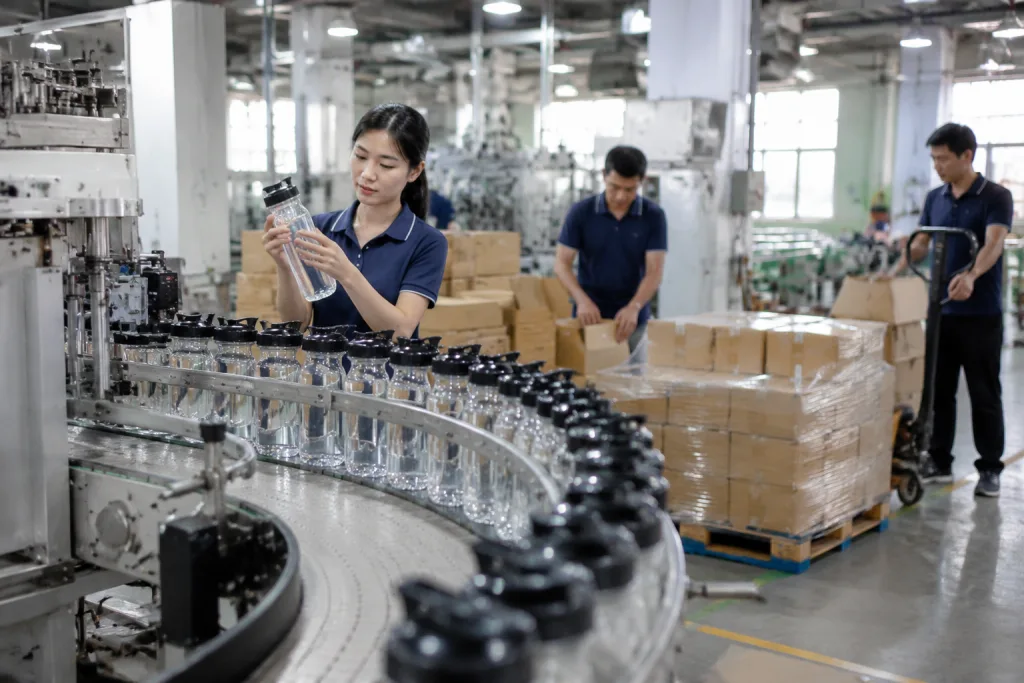
Our China factory line can produce about 180,000 Tritan bottles per month across standard molds, but capacity is not control. This is the wrong question to ask. Before we run mass production, approve one golden sample, lock the resin grade on the BOM, set a Pantone tolerance, and confirm cap torque by hand and torque meter. We usually check closure feel around 8–12 kgf·cm, depending on cap design. For mass inspection, use AQL 2.5 for major defects and AQL 4.0 for minor defects unless your brand has stricter rules. For premium retail, 7 out of 10 buyers we handle move critical defects to zero tolerance.
Ask for these factory checks in writing:
- 100% visual check under the LED inspection lamp for black spots, bubbles, obvious scratches, and gate whitening over 1 mm.
- Leak test with inverted bottle for 30 minutes, or pressure-assisted test for sports caps when the buyer flagged straw-cap seepage on the PP sample.
- Cap thread gauge or fit check every production hour, with the line recording mold cavity number and any tight-thread finding.
- Random capacity check with water fill, recorded in milliliters; QC should use a marked cylinder, not a guess from bottle height.
- Carton drop test from 76 cm on corner, edge, and face for retail packs, especially if the PO says 12 pcs/carton but the artwork file shows 24 pcs/carton.
- Barcode scan test for UPC, EAN, or FNSKU labels, with at least 20 scans before packing starts.
If your order includes alcohol flask wholesale, beer tumbler in bulk, or beer growler wholesale bulk items in the same shipment, inspect them separately. We have seen this go sideways when a buyer asked for one combined report. The math does not work. Stainless vacuum items need insulation tests, usually 95°C water checked after 6 hours. Glass growlers need breakage and annealing checks. Tritan bottles need clarity, fit, and chemical compliance focus, so QC should pull those samples from the Tritan line, not from the mixed final pallet.

How do you manage compliance?
Handle compliance before artwork release, not after the line has packed 312 cartons. For Europe, buyers usually ask for LFGB food-contact testing, REACH screening, and sometimes BSCI or SMETA factory social audit documents. For the United States and Canada, FDA food-contact suitability, California Proposition 65 review, CPSIA if children are involved, and ASTM references may apply depending on product age grade and claim. If the bottle is for kids, don’t treat it like a standard adult sports bottle; QC pulled one sample last month where the straw length was 6 mm over the buyer’s drawing.
A tritan glass bottle bulk order sold as a reusable water bottle carries different risk than a beer growler in bulk listing, alcohol flask in bulk promotion, or beer tumbler bulk gift set. Alcohol contact and hot liquid claims need separate checks; carbonation claims and children’s use change the test plan again. Send the supplier your sales market, product claim, age group, and liquid use before sample approval. Short list. Clear wording. If a Zhejiang supplier says “all certificates available” but cannot match reports to the exact material code and Pantone color, push back; we’ve seen this go sideways when a buyer flagged a cap seal report that covered silicone, not TPE.
Your compliance checklist should include:
- Report holder name and factory relationship.
- Material description matching the bottle body, cap, seal, straw, and coating.
- Test date within your retailer’s acceptable window, often 12-24 months.
- Lab name and accreditation, such as SGS, Intertek, TÜV, or Bureau Veritas.
- Market-specific warning label review before carton printing.
Do not rely on a generic “BPA free” statement. It works on a sell sheet, but it does not replace food-contact migration testing or retailer documentation. The math doesn’t work if your PO says “Tritan TX2001 body” and the report only says “plastic bottle”; our document desk will kick that back before carton mark approval.
What should your PO lock?
The PO is where sourcing discipline stops being talk. For tritan glass bottle bulk, price and quantity are not enough. Lock the material, mold number, Pantone color, logo file version, packaging drawing, inspection standard, shipment terms, and defect remedy. If the spec sits only in WeChat or email, QC cannot inspect against it; last month QC pulled a 750 ml sample on the line and found the cap seal color matched the chat screenshot, not the buyer’s PO.
For a normal OEM order from China, allow 7-10 days for pre-production samples after artwork confirmation, then 25-35 days for mass production after sample approval and deposit. Peak season before summer retail and Q4 gifting can add 10-15 days. We’ve seen this go sideways when a buyer asks for a 20-day ship date after approving artwork on day 6; the math doesn’t work once injection molding, logo printing, 24-hour leak testing, and carton packing hit the same line. If you need Amazon FBA prep, add time for FNSKU labeling, carton weight control under 23 kg where required, and carton dimension checks with a tape measure before booking.
Use this PO checklist before deposit:
- Product: 750 ml Tritan bottle, mold code, cap type, silicone seal color, and approved PP sample photo.
- Quantity: 5,000 pcs, with over/under tolerance such as ±3%, so the warehouse does not argue over 4,870 pcs at loading.
- Price: FOB Ningbo, including one-color logo and kraft box; state whether the logo film charge is included.
- Quality: AQL 2.5/4.0, critical defects zero, leak test required, with QC checking 80 pcs per lot if that is your agreed plan.
- Documents: commercial invoice, packing list, test reports, certificate of origin if needed; check buyer name spelling before we issue originals.
- Shipment: carton marks, pallet requirement, FNSKU or retail barcode position, plus carton weight and size confirmed before sealing tape runs.
The same PO discipline applies to alcohol flask wholesale bulk, beer tumbler wholesale bulk, wholesale canteen, and growler bulk orders. Different products fail in different ways. Flasks dent at the shoulder, tumblers show powder coating pinholes, and growlers get thread leaks after torque testing. Loose specifications create the same fight every time: the buyer flagged it after the goods were already packed, and nobody wants to reopen 312 cartons.
Send your Tritan bottle RFQ for factory review
Share capacity, quantity, logo method, target market, and packaging. We will reply with MOQ, FOB pricing, lead time, and compliance notes.
Frequently asked questions
Is a Tritan bottle the same as a glass bottle?
No. Tritan is a clear copolyester, not glass. Buyers use the phrase tritan glass bottle bulk because the product has glass-like clarity, but the sourcing details are different. Tritan is lighter, more impact resistant, and usually cheaper to ship than glass. It also has heat limits, so you should avoid vague boiling-water or dishwasher claims unless tested. For most 600-1,000 ml bottles, we suggest specifying Tritan body wall thickness around 1.8-2.2 mm, PP or stainless cap, and silicone sealing ring. If your project is for juice, water, or gym use, Tritan is often practical. If it is for carbonated beer growler wholesale use, real glass or stainless may be safer.
What is the MOQ for custom Tritan bottles from China?
For an existing mold, a workable MOQ is usually 3,000 pcs per color with a simple logo. Custom body color often starts at 5,000 pcs because the factory needs to control resin color mixing and machine setup loss. A new private mold normally starts at 8,000-10,000 pcs, with tooling cost around USD 3,500-8,000. If you only need wholesale drinkware for a test launch, use an existing mold and spend your budget on better packaging, logo samples, and inspection. Very low MOQ offers can be useful for blank stock, but they rarely support custom Pantone color, retail packaging, and full compliance paperwork at the same time.
Can I combine Tritan bottles with canteens, growlers, and flasks in one order?
Yes, but treat them as separate product families. A canteen bulk order may use Tritan, stainless steel, or aluminum. A beer growler bulk order is usually glass or stainless, especially if customers expect carbonation resistance. An alcohol flask wholesale order is commonly 304 stainless steel with a screw cap and different food-contact concerns. Combining products can reduce shipping admin, but it does not reduce the need for separate QC checklists. For example, Tritan bottles need leak and clarity checks, stainless beer tumbler in bulk needs vacuum insulation testing, and glass growlers need breakage-focused packaging. Put each SKU on its own specification sheet.
How long does a bulk Tritan bottle order take?
A normal timeline is 7-10 days for pre-production samples after artwork is confirmed, then 25-35 days for mass production after sample approval and deposit. Add 3-5 days if you need third-party inspection, and longer if the inspection fails and rework is needed. Ocean freight from Ningbo or Shanghai to Europe or North America can add 25-45 days depending on port and season. Air freight is faster but often makes no sense for bulky drinkware wholesale orders because the carton volume is high. If your retail launch date is fixed, start the RFQ at least 75-90 days before the warehouse deadline.
What should I check before paying the deposit?
Before deposit, ask for the exact mold photo or drawing, resin grade, cap material, seal material, MOQ, FOB price, packing method, carton size, lead time, and available test reports. Confirm whether the quote includes logo setup, color box, barcode labels, and export carton marks. Ask the factory to define AQL, leak test method, and what counts as a critical defect. For a 5,000 pc tritan glass bottle bulk PO, you should also approve a digital mockup and require a real pre-production sample before mass production. If the supplier cannot give clear written answers, the risk is not price; it is execution.