Key Takeaways
- A practical Tritan canteen MOQ starts at 3,000 units per color for standard molds
- Use LFGB, FDA, REACH, and ASTM checks depending on your sales market
- Plan 7-10 days for samples and 30-40 days for mass production after approval
- AQL 2.5/4.0 inspection catches decoration, leakage, and packaging defects before FOB shipment
You are not buying “a plastic bottle.” You are buying a retail-ready, logoed, food-contact SKU that has to pass carton drop tests, barcode scans, customs paperwork, and 1-star review risk. A solid tritan drinkware supplier should pin down the resin grade, mold cavity count, logo method, inner/outer carton specs, and AQL inspection points before the PO lands; we’ve seen this go sideways when a buyer sends only a mood board and asks for “same as photo.” QC pulled a 750 ml sample last month with a 0.4 mm flash on the lid thread, and that small edge was enough to fail our fit check.
Let’s run one real B2B-style order from brief to shipment: a 750 ml Tritan canteen for a North American outdoor distributor, packed 24 pcs per export carton with a printed UPC sticker. Simple product. Tight details. BottleForge Industrial is based in Hangzhou, Zhejiang, and we manufacture in China for importers who need clear answers before they issue a purchase order; one buyer flagged a PO typo where “matte black lid” became “mate black lid,” and the line stopped it before mass production.
Start With The Buyer Brief
The first email usually looks like this: “We need a custom canteen for spring promotion, 750 ml, clear body, logo, retail box, target FOB under USD 3.20.” Good start. Not enough for a responsible quote. A serious tritan drinkware supplier will ask for the missing lines on the RFQ sheet because those lines change resin usage, cycle time, print scrap, and packing cost. Last month QC pulled a 750 ml sample with a 1.6 mm shoulder wall after the buyer had only approved the front photo. The math didn’t work from day one.
For this case, the buyer is a canteen distributor selling to outdoor shops and corporate gift programs. The product is a 750 ml Tritan bottle with screw lid, silicone gasket, carry loop, one-color print, and individual kraft box. The target order is 5,000 units, split into two transparent colors. For our Zhejiang team, that is a standard custom drinkware project. We run this on an existing mold, usually with a 2-cavity injection tool for the lid and a separate stretch-blow line for the body.
The brief should lock these points before sampling: Tritan grade and supplier code, capacity tolerance in ml, wall thickness in mm, lid material, gasket material, exact printing area, carton drop height, barcode format, and destination port. For a canteen promotional order, confirm whether the logo must pass dishwasher testing, not just a 3M tape pull. We’ve seen this go sideways: the buyer flagged print rub-off after delivery, then sent back a PO where “dishwasher safe” had been typed into the retail box artwork but never listed on the sample approval.
A realistic FOB Ningbo range for this configuration is USD 2.45-3.10 per unit at 5,000 pieces, depending on lid complexity and packaging. If you ask for a custom growler shape or customized growler cap mold, the cost moves fast because the mold fee, CNC time, and first trial scrap all land before mass production. Standard mold custom canteen work is where you get speed and price control. We ship that kind of order in about 28-35 days after artwork approval, assuming the kraft box dieline and barcode scan pass on the first check.
Translate Ideas Into Factory Specs
Once the commercial target passes the first cost check, the canteen factory has to turn your sketch into a production spec the line can build. We have seen this go sideways when a buyer writes “canteen customizable” and expects a new silhouette, new lid, and new straw slot from a stock mold. Wrong question. A standard mold can take body color, lid color, logo, insert card, box artwork, and carton marks; the mold number on our rack decides the shape. A new body needs tooling, 2D/3D drawings, CNC electrode work, trial shots, and a fresh round of tests.
For the 750 ml order, we would write the spec sheet with values QC can measure: body material Eastman Tritan or equivalent copolyester, body weight 115-130 g checked on a 0.1 g scale, body wall thickness 1.6-2.0 mm with a digital caliper, lid PP, gasket food-grade silicone, capacity tolerance ±3%, heat resistance 0-90°C, and leak test at 45° and inverted positions for 30 minutes. That spec beats a nice rendering every time. The inspector cannot reject a vague picture.
Decoration needs numbers too. A one-color silk screen logo might allow a 70 x 90 mm print area on a cylindrical body, but our print master still checks the curve with a film template before the sample run. Laser engraving does not behave on clear Tritan like it does on 304 stainless, so do not copy a stainless-steel decoration brief and expect the same result. UV print can handle gradients, costs more, and needs abrasion testing; last month QC pulled the sample after 200 rubs because the blue edge started lifting.
If you are a canteen vendor or distributor drinkware buyer, ask the canteen manufacturer for a pre-production spec sheet before paying the balance. It should match your PO line by line, including color code, logo size, packing ratio, and shipping mark; we once caught a PO typo that changed “matte black lid” to “metal black lid.” Our China production line can handle about 600,000 plastic drinkware units per month across standard items, but capacity will not save a loose spec. Clear specs do.
Sampling Before Purchase Order
Samples should settle production risks, not give the sales team pretty photos. For this order, we would run three sample types: 1 blank stock sample for grip and lid fit, 1 color chip or molded cup to approve the transparent tint, and 1 printed pre-production sample for logo position and packaging. Do not squeeze these into one rushed round if your launch date is locked. We have seen this go sideways when QC pulled the sample and the logo sat 4 mm off the center line.
From our Hangzhou, Zhejiang office, timing is 2-3 days for stock samples, 5-7 days for color matching on standard resin, and 7-10 days for printed samples after artwork confirmation. Courier time to Europe or North America is usually 3-5 working days. For a custom canteen from a new mold, add 25-35 days for tooling and first trial shots. The line cannot cheat mold steel. Last month a buyer asked for trial shots in 18 days; the real schedule was 32 days after the CNC shop confirmed the insert drawing.
For color, send Pantone references, but transparent Tritan will not read like coated stainless steel or opaque PP. A “smoke gray” body can look darker in a 3 mm thick base than on a 1.8 mm side wall. Approve the physical sample under normal retail lighting, not a phone photo from China. This is where the wrong question is “does it match the screen?” We check it with a light box and a 6500K lamp, then mark the approved resin batch on the sample label.
For packaging, check the boring parts: FNSKU or EAN placement, choking warning if needed, country of origin, carton dimensions, master carton weight, and whether the inner box protects the bottle from lid scuffing. Canteen distributors often stare at the bottle and skip the box. Retail buyers do not skip the box when it arrives crushed. On one PO, the buyer typed 12 kg carton weight, but the packed master carton came out at 14.6 kg on our floor scale, so the freight quote had to be corrected before shipment.

Price, MOQ, And Payment Reality
A reliable tritan drinkware supplier should be able to show where the price comes from. No guessing. For the 750 ml canteen customized order, the MOQ is normally 3,000 units per color for standard transparent colors and 5,000 units if you need a special resin match. For a canteen promotional project with one stock color and one logo, 3,000 pieces can work; we run that on the line with one logo fixture and a standard cap bin. For a full customized canteen with special cap, box insert, and matched accessories, 5,000-10,000 pieces is more realistic because the packing table, color resin purge, and accessory counting all add labor.
Cost drivers are simple: resin weight, lid parts, gasket design, decoration method, packaging, inspection level, and shipment terms. If the bottle wall moves from 2.1 mm to 1.8 mm, the price changes, and QC can feel it with a caliper before the drop test even starts. A basic FOB China quotation should state unit price, mold fee if any, sample fee, carton quantity, carton size, gross weight, HS code suggestion, payment terms, and quote validity. If your quote only says “USD 2.80 each,” the math is not complete.
Payment terms for new buyers are usually 30% deposit and 70% before shipment after inspection. Larger distributor canteen accounts with repeated orders may negotiate staged payment or credit insurance, but first orders rarely start that way; the buyer flagged this last month after writing “net 60” on the PO by habit. You should budget for sample courier fees, lab testing, and inspection separately. Those are not waste. They are cheaper than a rejected container sitting at Ningbo port with 420 cartons waiting for a decision.
Be careful with prices that are 15-20% below the market for the same specification. Tritan resin is not the cheapest plastic, and this is the wrong question to ask if the spec sheet is still loose. A canteen supplier cutting too hard may reduce wall thickness, use unapproved resin, skip gasket QC, or pack too tightly. We have seen this go sideways: QC pulled the sample, the silicone ring had flash, and 32 pcs out of 200 leaked in the upside-down test. In China manufacturing, low price only works when the spec and inspection are locked.
Quality Checks During Production
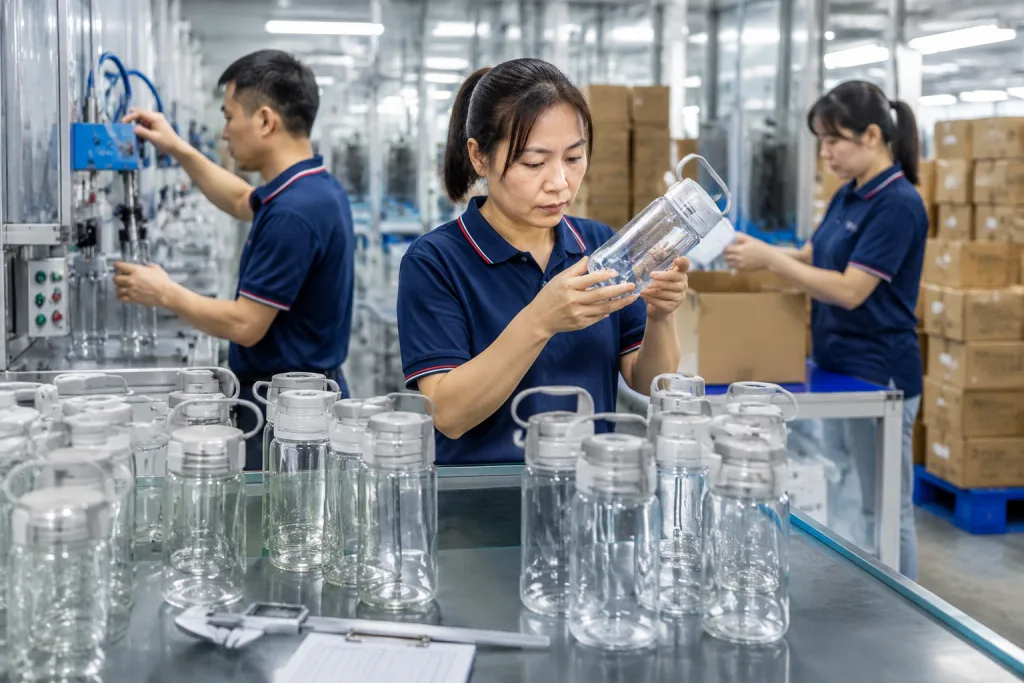
Good QC starts before the final inspection. At BottleForge, we run 4 checkpoints: incoming material check, first-article approval, line inspection, and final AQL sampling. For this Tritan order, incoming QC scans the resin lot on the sack, checks the lid material against the BOM, bends 20 silicone gaskets by hand, and counts packaging parts against the PO. The first-article check locks capacity, gram weight, Pantone color, lid fit, logo position, and box print before the line is allowed to run another 5,000 pcs.
The line needs leak testing every 2 hours, visual checks under a 6000K light booth for black dots and flow marks, cap torque checks with a digital torque meter, and print adhesion checks after curing. For Tritan bodies, we watch for gate marks at the injection point, trapped bubbles near the shoulder, scratches from the conveyor rail, uneven tint, lid thread mismatch, and stress whitening around the neck. This is where orders go sideways. A canteen manufacturer that cannot name these defects is probably not measuring them.
For final inspection, about 9 out of 10 B2B buyers we ship use AQL 2.5 for major defects and AQL 4.0 for minor defects under ANSI/ASQ Z1.4 general inspection level II. Major defects include leakage, wrong logo, severe scratches, broken lid, missing gasket, or wrong barcode; QC pulled one sample last year because the barcode sticker had a 1-digit typo against the PO. Minor defects include small print specks under 0.3 mm, light carton rub, or slight color variation within the approved range. The math does not work if a buyer asks for zero cosmetic marks on a low-MOQ color run.
Lab testing depends on the sales market. For the EU, discuss LFGB, REACH SVHC, and food-contact migration, then match each report to the Tritan body, PP lid, silicone gasket, or ink. For the US, FDA food-contact compliance and California Proposition 65 review may be relevant. For children’s drinkware, ASTM and CPSIA questions enter the conversation, and we usually need the age grade printed clearly on the test request form. A canteen vendor should not promise compliance in one sentence; ask which test report covers which material and which market.

Shipment Handoff And Reorder Control
Inspection pass is not the finish line. We still run a shipment handoff sheet at packing: each bottle into a polybag or paper wrap, then one individual kraft box, 24 units per master carton. On a 650 ml Tritan bottle, we often land around 54 x 38 x 42 cm with gross weight under 12 kg, but QC checks the packed carton with a tape measure and platform scale before carton marks are locked. If your channel is e-commerce, send the 76 cm drop-test requirement before carton printing starts; we have seen buyers flag this after 3,000 cartons were already printed, and the math does not work.
FOB Ningbo or FOB Shanghai are common for Zhejiang drinkware exports. For North America, about 8 out of 10 buyers choose sea freight for 5,000 units unless the promotion date is inside 18 days. Air freight hurts. For Amazon-style routing, the line can apply FNSKU labels, carton labels, and pallet labels, but the buyer must send the latest routing guide, not last season’s PDF. Last month QC pulled a carton sample because the PO said “FNSKU on short side” while the warehouse guide required the long side.
The best reorder work starts before the first order leaves our dock. Keep the approved sample, color chips, artwork file, carton mark file, test reports, and inspection report under one item code, then share that code on every PO. Simple habit. If you are a distributor growler or distributor drinkware buyer managing 12 SKUs, this stops the slow mistakes we see six months later, such as a Pantone chip copied from a photo instead of the signed color card.
For reorders, a canteen supplier can usually cut lead time to 25-30 days if materials and packaging are unchanged. If you change color, logo size, or retail box, treat it as a controlled revision, not a casual note in WeChat. We run a revision table with date, file name, and buyer approval screenshot; without it, the line may follow the old screen-print film because that is what sits beside the fixture. Customizable drinkware stays efficient when revision history is boring and traceable.
Send Your Tritan Canteen Brief For Review
Share target capacity, quantity, logo method, market, and delivery date. We will return a practical MOQ, FOB range, and QC plan.
Frequently asked questions
What MOQ should I expect from a Tritan drinkware supplier?
For standard mold Tritan bottles, expect 3,000 units per color as a practical starting MOQ. Some canteen suppliers will quote 1,000 units, but the unit price is usually high and color options are limited. If you need a special transparent color, matched lid, retail box, and printed logo, 5,000 units is a safer planning number. For a new custom canteen mold, the MOQ often moves to 10,000 units or more because tooling, trial production, and resin setup need volume. At BottleForge in Zhejiang, we usually separate sample MOQ, color MOQ, and production MOQ so you can see where the cost really comes from.
Is Tritan better than stainless steel for promotional canteens?
Tritan is better when you want a lightweight, transparent, lower-cost promotional bottle with strong retail visibility. A 750 ml Tritan canteen may land around USD 2.45-3.10 FOB China at 5,000 units, while a vacuum insulated stainless bottle is usually higher because of double-wall construction and welding. Stainless steel wins on temperature retention and premium feel. Tritan wins on weight, color clarity, and simple logo programs. For canteen promotional campaigns, schools, outdoor events, and fitness bundles, Tritan is often the practical choice. If your product claim involves keeping water cold for 12-24 hours, choose stainless instead.
How do I check if a canteen manufacturer uses real Tritan?
Ask for the resin brand or equivalent grade, material declaration, and food-contact test reports tied to the bottle body, not a generic old report. During production, you can require resin lot photos and incoming material records. For serious orders, send samples to a third-party lab for FDA, LFGB, or REACH-related testing based on your market. Real Tritan has good clarity, impact resistance, and no BPA, but you should not rely on appearance alone. A low-price canteen vendor may use cheaper copolyester or PC-like material if the spec is loose. Put “Tritan copolyester, BPA-free, no substitution without written approval” directly into the PO.
What quality issues are most common with customized drinkware?
For customized drinkware in Tritan, the common issues are leakage, scratched clear bodies, color variation, logo misalignment, weak print adhesion, missing silicone gaskets, and crushed retail boxes. The final inspection should include water leakage tests, cap torque checks, visual defect sorting, barcode scanning, carton quantity checks, and drop-test review if required. Use AQL 2.5 for major defects and AQL 4.0 for minor defects unless your retailer requires a stricter plan. For a 5,000-unit order, an inspector may check roughly 200 units under general level II, depending on the sampling table. That is much cheaper than discovering 300 leaking bottles after distribution.
Can one supplier handle canteen, growler, and bottle programs?
Yes, but only if the supplier has the right material and process range. A tritan drinkware supplier may handle plastic canteens very well but outsource stainless custom growler production. That is not automatically bad, but you need transparency. Ask which items are made in-house, which are partner-produced, and who controls QC. For customizable growler or customized growler projects, stainless steel welding, vacuum testing, and powder coating are different from Tritan injection or blow molding. If you are a distributor canteen buyer building a broader line, choose a China supplier that can provide one spec sheet, one inspection standard, and one shipment plan across the program.