Key Takeaways
- Standard Tritan MOQ is usually 3,000 units per SKU, with lower pilot runs only on existing molds
- Ask for LFGB, FDA, REACH, and BPA-free documentation before paying tooling
- AQL 2.5 for major defects and AQL 4.0 for minor defects is a practical inspection baseline
- Plan 28-40 production days plus 7-10 days for pre-production samples and carton testing
You are not buying a bottle. You are buying repeatable supply. Tritan drinkware bulk orders look clean on a quote sheet, then the cost shows up when a flip lid leaks at the silicone gasket, the Pantone color drifts after injection, or the master carton fails a 76 cm drop test on the corner. QC pulled samples from one 5,000-unit run last year and found 14 lids with weak snap fit after the first tooling adjustment. By then, artwork was approved, the PO had “matte blk” typed two ways, and the buyer still wanted the shipment on the original vessel date. The math does not work.
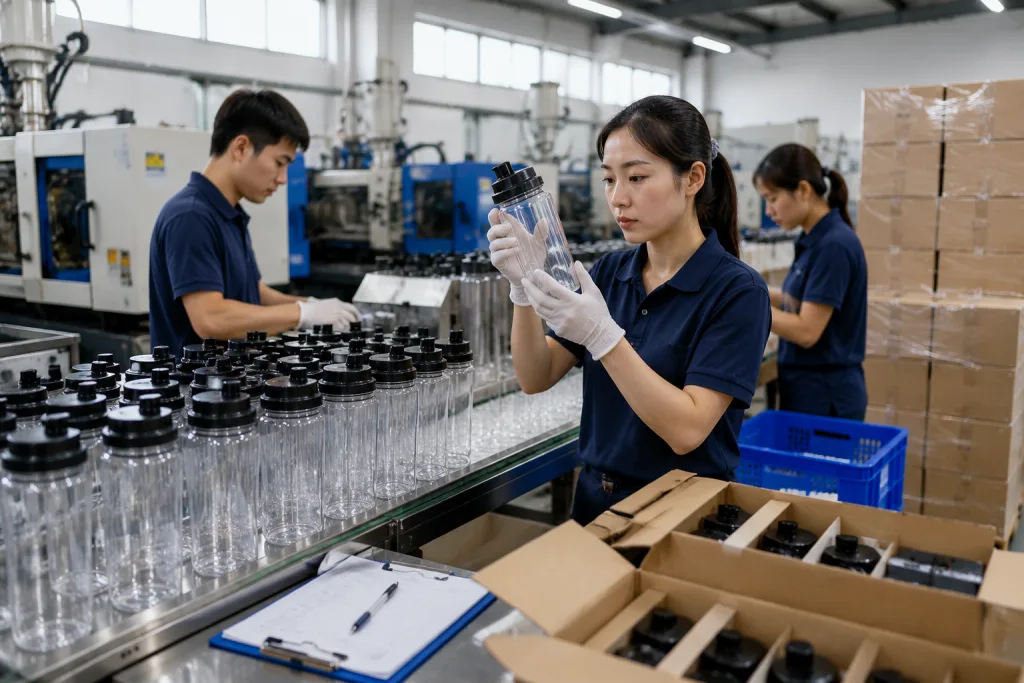
BottleForge Industrial manufactures drinkware in Zhejiang, China for B2B buyers who need stable wholesale drinkware programs, not showroom-only samples. Our Hangzhou team runs Tritan bottles, bulk canteen projects, beer tumbler bulk packaging, and related drinkware bulk lines with factory output around 480,000 units/month, standard MOQ from 3,000 units per SKU, and typical production lead time of 28-40 days after deposit and artwork approval. On the line, we check lid torque with a digital torque meter, confirm straw length in mm against the signed sample, and pack by export carton spec before we ship. Buyers push back on MOQ all the time; fair enough, but below 3,000 units per SKU the resin color changeover and carton printing cost start eating the savings.
Start With Use Case, Not Shape
The first sourcing mistake is sending a supplier a photo and asking for “best price.” For Tritan drinkware bulk, shape is only one variable, and honestly this is the wrong question to ask first. Define the use case: who fills it, how often it gets washed, and which sales channel has to handle complaints. On our line in Hangzhou, a gym bottle spec and a school canteen PO already split before tooling review, because cap torque, wall thickness, and label position are checked with different gauges. A gym bottle, a school canteen bulk program, and a beer growler in bulk shipment should not share the same drawing just because the outline looks close.
For a sports bottle, most buyers choose 650 ml, 750 ml, or 1,000 ml capacity with 1.8-2.2 mm average wall thickness. For kids and school canteen wholesale projects, 450-600 ml is safer because the filled weight stays manageable in a backpack. QC pulled a 600 ml sample last month at 2.1 mm wall and 146 g empty weight; the buyer still flagged it as “too heavy for Grade 2 students.” Fair point. For a bulk growler or beer growler wholesale program, you may need 1.2 L to 2 L volume, but be careful with Tritan if the product will hold carbonated beer under pressure. Tritan is tough and clear, but it is not a pressure-rated keg.
Ask this before RFQ: will the product sell as wholesale drinkware for daily hydration, as promotional drinkware bulk, or as a specialized container such as alcohol flask bulk or beer tumbler wholesale bulk? Each route changes the compliance file and the carton test we run. We have seen this go sideways when a PO says “sports bottle,” but the artwork says “beer growler” and the destination market asks for a different warning label.
- Retail hydration: prioritize lid sealing and color consistency; then check dishwasher wording against the actual test cycle, not the catalog claim.
- Promotional use: prioritize logo durability and lower MOQ; a 3,000 pcs order with one-color silk screen should not carry the same setup burden as a retail launch.
- Food or alcohol use: confirm local regulations before marketing it as alcohol flask wholesale or beer growler bulk, especially if the buyer wants alcohol wording printed on the box.
If you cannot describe the use case in one sentence, the factory cannot engineer the right product. A good Zhejiang supplier will push back here. We do. That is not being difficult; it is how you avoid buying a good-looking bottle that fails in your channel after 12 days of customer use instead of surviving the 18-day complaint window your distributor expects.
What MOQ Actually Means
MOQ is not a sales trick, though some suppliers hide behind it. For Tritan drinkware bulk, the number comes from resin lots, injection machine setup, color masterbatch minimums, labor changeover, and printed packaging plates. At BottleForge Industrial in Zhejiang, China, our normal MOQ is 3,000 units per SKU for existing molds and 5,000-10,000 units when the color, lid, sleeve, or packaging is heavily customized. On the line, a color change on a 600T injection machine usually burns 25-40 kg of purging material before QC signs off the first clean pieces.
A SKU means one capacity, one color, one lid configuration, and one packaging method. If you order 3,000 units split across 6 colors, you are asking us to run 500 units per color. The math doesn't work unless the color is stock or you accept a surcharge of USD 0.18-0.45 per unit for color changeover and material waste. We had one PO last spring that said “assorted blue” in the remarks column; QC pulled the sample, the buyer flagged it, and the order sat 4 days while both sides agreed on one Pantone code.
For wholesale canteen or canteen bulk projects, MOQ can be easier if the lid and body come from existing molds. A 600 ml Tritan canteen in clear, smoke gray, or transparent blue may quote at 3,000 units. A custom Pantone body with a matching flip lid may need 5,000 units because the color tolerance is tighter, often within ΔE 1.0-1.5 on our color meter. For growler wholesale or wholesale growler programs, MOQ often starts higher because larger molds run slower cycles, and 12-carton stacks take more warehouse space than slim bottle cartons.
Do not compare MOQ without comparing the SKU definition. “3,000 units” can mean one clean production run, or it can mean six tiny runs pretending to be one order.
If you are testing a new brand, ask for a pilot on existing tooling. If you are building the best wholesale drink bottle for a major retail line, pay for proper sampling and accept the MOQ needed for stable color and fit. We ship better orders when the buyer locks the sample, artwork, and carton mark before resin is booked; changing a logo after pad-print film output is where we’ve seen this go sideways.
Material Claims Buyers Should Verify
Tritan sells well because it looks close to glass, survives carton-drop abuse better than glass, and avoids the metal-taste complaint we hear on some stainless bottles. Still, “BPA-free” on a catalog page is thin cover. Ask for documents that match the resin, factory name, mold item, and production batch. For North America, request FDA food-contact compliance and a BPA-free declaration. For Europe, request LFGB or EU 10/2011 migration testing where applicable, plus REACH and sometimes RoHS if the product has accessories. Last month QC pulled a clear 650 ml sample from the line and the report showed a different item code by 1 digit; the buyer flagged it, and they were right.
The resin grade matters. A supplier worth buying from should state the Tritan copolyester grade used, the heat resistance range, and whether the product is dishwasher safe. Around 7 out of 10 Tritan bottle RFQs we get ask for top-rack dishwasher use, but lids with silicone seals, printed logos, or plated trim often fail before the cup body. We run lid checks after 20 dishwasher cycles at 70°C because warped seals turn into refund photos fast. If you sell wholesale drinkware with a wide dishwasher-safe claim, the math doesn't work; your warranty bill can beat the product cost.
For alcohol flask in bulk, alcohol flask wholesale bulk, beer growler wholesale bulk, or beer tumbler in bulk projects, watch the marketing copy. Tritan can be food-contact safe, but alcohol percentage, storage time, filling temperature, and local labeling rules change the risk. Short-term serving is one use. Six-month alcohol storage is another. If the drinkware is intended for short-term serving, say that. If it is for long-term alcohol storage, test that exact use. We've seen this go sideways when a buyer used a generic 500 ml water-bottle report for a 32 oz beer growler, then asked why the lab rejected the claim.
- Request test reports dated within the last 12-24 months, and check the lab name, item photo, and material line.
- Check that the tested material matches the quoted product, including clear, tinted, or frosted Tritan.
- Ask whether color masterbatch was included in the migration test; a 2% color load can change the result.
- Keep all compliance files linked to PO number and batch number, not just the factory’s internal SKU.
China suppliers can produce strong Tritan drinkware, but paperwork discipline still sits on your desk. Importers, not factories, usually carry the biggest legal exposure in your market. We ship cartons with batch stickers beside the outer-carton mark, because a PO typo like “TR-760” vs “TR-706” can waste 3 days during customs document checks.

Customization Without Creating Defects
Customization sells, but it is also where the line usually gets into trouble. For Tritan drinkware bulk, we run the lowest-risk options first: single-color screen printing, laser marking on a metal badge or cap part, silicone sleeve color changes, or printed paper inserts with a locked dieline. Full-body gradient color and complex 360-degree artwork look nice on the sample table; at 10,000 units, QC pulled samples with ghosting at the mold seam and 2-3 mm artwork drift. Soft-touch coatings are another one we push back on. The math doesn't work if the buyer expects a promo price and a retail-grade hand feel.
For drinkware wholesale buyers, logo placement should be fixed after checking the mold parting line, curved surface distortion, and hand contact area with the actual bottle body in hand. A 40 mm wide logo may print cleanly on a flat panel but stretch badly on a curved growler bulk body, especially when the screen jig is off by 1 mm. For canteen wholesale, avoid fine text near the shoulder because the radius makes registration unstable. We have seen this go sideways on FNSKU labels too: the buyer flagged 18 cartons because the barcode sat too close to the grip zone and rubbed after a simple 3M tape test. Legal marks such as capacity, recycling code, country of origin, or FNSKU should stay away from high-wear grip zones.
Typical decoration costs are not mysterious. One-color silk screen printing often adds USD 0.08-0.18 per unit, and two-color printing may add USD 0.15-0.32 once the second screen and alignment time are counted. A silicone sleeve can add USD 0.35-0.80 depending on size and thickness; our sleeve supplier checks thickness with a digital caliper, usually 1.5 mm to 2.5 mm on common sports bottles. Custom color matching usually needs a USD 80-150 lab dip fee, sometimes refundable after bulk order confirmation. Watch the PO wording here. We once received “Panton 186C” instead of Pantone 186 C, and that typo cost 2 extra days before the lab could start.
Checklist before approving artwork
- Confirm Pantone code under D65 light source, not under warehouse lighting.
- Approve print size in millimeters, not only visual mockups.
- Request tape test and 3M rub test for printed logos.
- Check barcode scan rate on final packaging, especially for Amazon FBA.
- Approve a pre-production sample from production material, not hand-made sample plastic.
If your brand needs a premium retail feel, spend money on mold texture and cap fit before adding another print color. Buyers notice leaks faster than they notice a fancy graphic. On our floor, a 0.3 mm cap gap gets rejected before anyone argues about whether the logo blue is a little warmer than the approved swatch.
Pricing, Incoterms, And Hidden Cost
For a standard 750 ml Tritan bottle in bulk drinkware, we quote FOB China around USD 1.45-2.60 when the job uses regular Eastman Tritan, a single-color flip lid, 1-color logo, and 48 pcs per master carton. A larger bulk growler runs USD 3.80-7.50. Beer tumbler wholesale items with straw lids, two accessories, or retail boxes usually land at USD 2.20-4.80. Use these ranges for a first check only. Last month QC pulled a 750 ml sample because the lid gasket was 0.4 mm loose, and that small fix changed the lid mold insert cost.
Ask first: is the quote EXW, FOB Ningbo, FOB Shanghai, or delivered duty paid? Zhejiang factories like ours ship from Ningbo or Shanghai, and FOB terms give experienced importers a cleaner comparison. EXW looks cheaper on the PO, then local trucking, export declaration, and warehouse handling show up as separate bills. We had one buyer flag a USD 0.09 gap between EXW and FOB Ningbo; after adding a 620 kg truck pickup and declaration fee, the math did not work. For North American and European procurement teams, FOB is the better baseline.
Hidden cost sits in small lines: retail box upgrade, extra inner polybag, desiccant, barcode sticker, FNSKU label, master carton printing, spare parts, palletization, and inspection fees. For Amazon or retail distribution, a USD 0.12 packaging omission can turn into a USD 1.00 warehouse handling problem. We have seen this go sideways when the PO said “color box” but the artwork file named “white box_v3.pdf”; the line packed 6,000 pcs before the buyer caught it.
For beer growler wholesale, beer tumbler wholesale bulk, alcohol flask wholesale, or wholesale canteen orders, carton size matters as much as the unit price. A cheap item becomes expensive when it wastes container space. Ask for units per carton, carton dimensions, gross weight, and estimated CBM before approving the quote. A 40HQ container holds roughly 68 CBM usable volume; bulky packaging burns that volume fast. On the packing table, a 3 mm thicker EVA insert can drop a carton from 24 pcs to 18 pcs, and freight per bottle jumps.
The best quote is not the lowest number. It is the quote with complete assumptions. Resin, MOQ, packing, inspection standard, lead time, and Incoterm must be written down. If a supplier cannot define those points, you do not have a real price yet. We run AQL 2.5 final inspection on drinkware orders, and if the quote does not say who pays reinspection after a failed carton drop test, expect an argument later.

Inspection Plan Before Final Payment
Do not wait until the cartons land in your warehouse to argue about “acceptable.” For Tritan drinkware bulk, we write the inspection standard into the purchase order before the mold room books the line. A practical baseline is AQL 2.5 for major defects, AQL 4.0 for minor defects, and zero tolerance for critical defects such as sharp edges, contamination, cracked bodies, or unsafe materials. For higher-risk retail launches, use AQL 1.5 major. We had one buyer push back after QC pulled 13 scratched samples from 500 pcs packed cartons; the PO only said “good quality,” so the math didn’t work.
Common Tritan defects include black spots, flow marks, sink marks, color variation, cap thread mismatch, silicone seal deformation, leakage after shaking, and print scratches. For canteen bulk or wholesale growler programs, check cap torque with a torque meter and run drop resistance checks because larger filled products hit harder. Simple point. A 1.0 L bottle dropped from 1 meter behaves very differently from a 450 ml bottle, and we have seen 38 mm caps pass on small bottles but leak on 1.0 L bodies after 20 shakes.
Your pre-shipment inspection should include functional tests, not only appearance checks. We normally recommend a leak test with 100% water fill, 30 seconds inverted, then 20 shakes. For flip lids, test at least 80-125 pieces depending on lot size, and make QC record which cavity number failed if the lid has cavity marks. For cartons, perform a 76 cm drop test on export packaging when products ship by courier or mixed container. For dishwasher claims, run a small durability test before mass marketing the claim; we run 10 cycles first because a pretty print can still peel at the rim.
PO quality checklist
- Approved sample sealed and signed before bulk production, with date, item code, and color name matching the PO.
- AQL level written into the PO.
- Critical and major defects defined in plain language, including leakage, cracked body, wrong resin, sharp edge, and visible contamination.
- Spare lid and seal percentage agreed, usually 0.5-1.0%.
- Inspection timing set at 80-100% packed, before balance payment.
China production stays consistent when the standard is clear. Vague quality wording starts arguments. Written tolerances stop most of them before final payment, especially when the buyer flagged a typo like “Tritan 304 stainless” on the PO and nobody caught it until packing day.
Supplier Questions Worth Asking
A procurement manager does not need a plastics degree. You do need questions that show whether the supplier has run export orders without drama. Start with capacity and control: monthly output by SKU, which steps stay in-house, which steps go outside, how many injection machines are on the line, and the mold maintenance record. Ask to see the BSCI, ISO 9001, or other audit files, not just a logo in a PDF. In our Hangzhou plant, QC pulled 6 Tritan samples last month because one cavity showed a 0.35 mm lip variation after polishing; that is the kind of answer you want from a factory. BottleForge Industrial in Hangzhou manages drinkware bulk programs from existing molds and custom tooling, with standard sample lead time of 7-10 days and production lead time of 28-40 days after approval.
Then get specific by product. For Tritan bottles, ask the resin grade, wall thickness target in mm, lid material, silicone hardness, temperature range, and whether the seal can be removed for cleaning. Small part. Big complaint risk. For beer tumbler bulk and beer tumbler wholesale, ask whether the lid is splash-resistant or leakproof; those are not the same, and we have seen buyers flag this after a 1.2 m carton drop test. For alcohol flask bulk, ask whether the product is built for short-term carrying or long-term storage. For beer growler in bulk, ask whether Tritan, stainless steel, or glass fits your pressure and carbonation requirement; if the supplier says all 3 work the same, the math does not work.
Ask the commercial questions before samples, not after the PO typo becomes everyone’s problem. Who owns the mold? How many years is it stored? What happens if annual volume drops from 50,000 pcs to 8,000 pcs? Will the factory protect your custom design, or will the same lid show up in another buyer’s catalog next season? If you are ordering alcohol flask wholesale bulk or beer growler wholesale bulk for a private label, add a simple NNN agreement and keep logo files in one controlled folder; we once received 3 AI files with different Pantone numbers for the same brand mark.
The strongest supplier answers with limits. If every product, every MOQ, every certification, and every delivery date is “no problem,” that is not engineering advice. It is a sales reply. A good China supplier should say what we can run now, what needs new tooling cost, and what should not be promised to your retail customer. We have seen this go sideways when a buyer sold “leakproof” online before the lid passed 24-hour inverted testing.
Send Your Tritan Drinkware RFQ For Review
Share capacity, quantity, market, artwork, and packaging needs. We will return a practical MOQ, FOB quote, and sampling path.
Frequently asked questions
What is a realistic MOQ for Tritan drinkware bulk orders?
For existing molds, 3,000 units per SKU is a realistic starting MOQ. A SKU means one capacity, one body color, one lid style, and one packaging setup. If you need 4 colors at 750 units each, expect a surcharge or a higher minimum. Custom Pantone colors, new lids, silicone sleeves, or retail boxes often push MOQ to 5,000-10,000 units. For first-time buyers, the practical route is to test with an existing 600 ml or 750 ml mold, one or two colors, and simple one-color logo printing.
Is Tritan suitable for beer growler bulk or alcohol flask wholesale projects?
Tritan can work for short-term beverage serving and display, but you should not assume it is suitable for every beer growler bulk or alcohol flask wholesale use. Carbonation pressure, alcohol percentage, storage time, and local labeling rules all matter. For beer growler wholesale bulk, confirm whether the product needs to hold pressure; if yes, stainless steel or glass may be safer. For alcohol flask in bulk, ask for specific migration testing and define whether the product is for temporary carrying, not long-term storage. Generic BPA-free paperwork is not enough for alcohol-positioned products.
How long does production take after sample approval?
For standard Tritan drinkware bulk orders from existing molds, plan 28-40 days after deposit, artwork approval, and confirmed pre-production sample. Add 7-10 days for sample making, longer if you need custom color matching or new packaging. Custom tooling can add 25-45 days before production, depending on mold complexity. Shipping is separate: ocean freight to North America or Europe often takes 25-40 days port-to-port, while air freight is faster but usually too expensive for bulky drinkware wholesale orders.
What quality standard should we put on the purchase order?
Use AQL 2.5 for major defects and AQL 4.0 for minor defects as a normal wholesale drinkware baseline. Critical defects should be zero tolerance: cracked bodies, sharp plastic edges, contamination, unsafe material, or products that cannot close. Define functional tests too. For example, fill with water, invert for 30 seconds, shake 20 times, and check leakage. For retail cartons or Amazon FBA, add barcode scan checks, carton drop testing from 76 cm, and FNSKU placement rules. Quality arguments are much easier to solve when these details are written before production.
What should be included in a complete supplier quote?
A complete quote should list unit price, MOQ, Incoterm such as FOB Ningbo or FOB Shanghai, resin grade, capacity, wall thickness target, lid material, decoration method, packaging details, carton size, gross weight, CBM, sample cost, tooling cost if any, lead time, and payment terms. For canteen wholesale, growler wholesale, beer tumbler in bulk, or alcohol flask wholesale bulk programs, ask for compliance reports before deposit. A quote that only says “750 ml Tritan bottle, USD 1.85” is not enough for procurement approval.