Key Takeaways
- Standard Tritan bottle MOQ usually starts at 3,000 pieces per model and color
- Realistic FOB China pricing for custom Tritan bottles is often USD 1.35-3.80 per unit
- Allow 35-55 days for repeat orders and 55-85 days for new molds or custom caps
- Logo, packaging, inspection, and carton specs can shift landed cost by 12-28%
Buying Tritan bottles for a brand launch, retail shelf, campus order, or distributor catalog is not hard because China lacks suppliers. The hard part is checking whether the USD 1.15 quote, 3,000-piece MOQ, and 35-day ship date survive real order details. We have seen that USD 1.15 bottle land closer to USD 2.10 once the buyer adds PMS color matching, a flip cap with silicone plug, 5-layer export carton, AQL inspection, and freight. The math doesn’t work if the quote was built on a blank bottle only. QC pulled one sample last month with a 0.6 mm parting-line flash on the lid, and that small finding still stopped packing for 2 days.
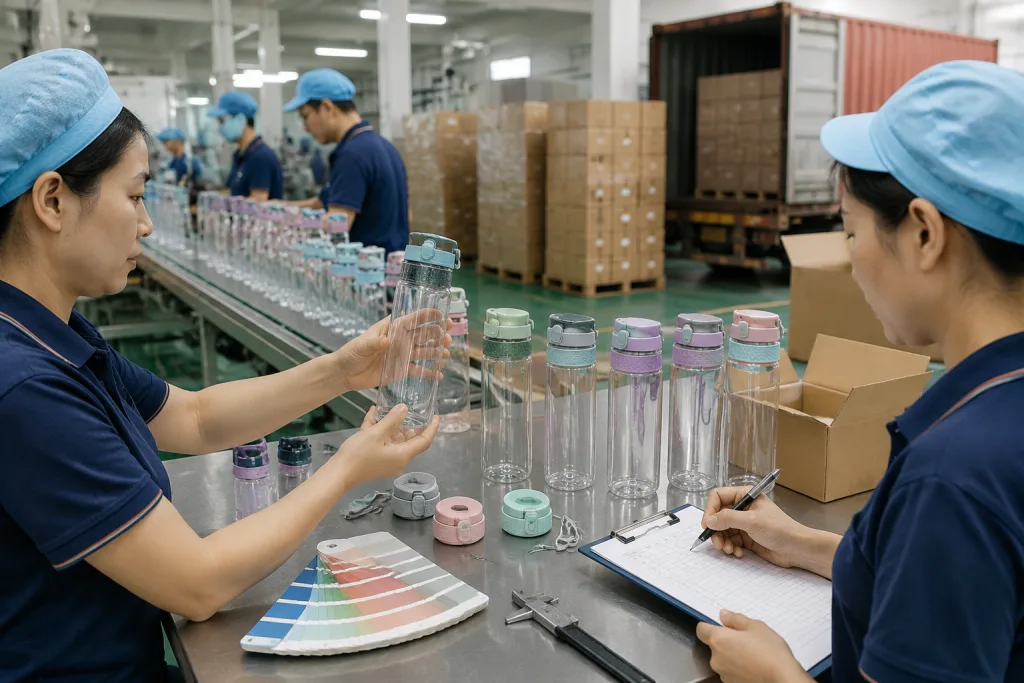
At BottleForge Industrial in Hangzhou, Zhejiang, we run into the same sourcing mistakes every month: capacity guessed from a brochure, custom packaging priced like plain bulk pack, and timelines that forget mold trials. Our Zhejiang production network supports about 600,000 plastic and stainless drinkware units per month, with standard Tritan MOQ from 3,000 pieces per model. On the line, a new Tritan mold usually needs T0 and T1 sampling before mass production, and a cap leak test at 30 minutes upside down is where weak designs show up. We’ve seen this go sideways when a PO says “blue” instead of a Pantone code, then the buyer flags the color after 8,000 units are already molded.
Start With The Real Unit Cost
For tritan drink bottle wholesale, the bare bottle price is the wrong number to chase. We quote FOB China in layers: resin and color masterbatch, cap set with silicone seal, logo work, retail box, export carton. Tritan resin sits above PP and PETG on our material sheet; last week our warehouse team checked 25 kg bags against the Eastman code before the line started. Buyers still pay for it because the bottle stays clear, survives drop tests better, is BPA-free, and fits reusable drink bottle programs.
For a 500-750 ml standard Tritan bottle using an existing mold, we usually see FOB Ningbo or Shanghai at USD 1.35-2.60 for 3,000-10,000 pieces. A 1,000 ml sports bottle with carry handle, silicone sleeve, flip straw, or time marker print moves to USD 2.40-3.80. Retail packaging is where the math can go sideways. Add USD 0.18-0.55 per unit based on box gauge, printing, insert card, and barcode label; QC pulled one 350 gsm color box sample last month because the barcode was 2 mm too close to the fold line.
Logo cost gets missed on too many POs. One-color silkscreen may add USD 0.05-0.12 per unit. Multi-position UV print may add USD 0.18-0.45. Laser engraving is less common on clear Tritan because it does not pop like it does on stainless steel. For wholesale drinkware buyers, don’t accept one lump-sum price. Ask for a line-by-line FOB cost sheet showing bottle body, cap, logo, packaging, carton, and inspection assumptions; we’ve had a buyer flag a PO typo where “1C logo” became “4C logo,” and that small line changed the run cost before mass production.
MOQ Tiers That Change Pricing
MOQ is not a supplier trick. It is the point where the injection machine, Pantone color dosing, lid assembly, and export carton packing stop wasting time. For standard Tritan drinkware wholesale, 3,000 pieces per model and color is a workable starting point. At 5,000 pieces, we run the line with fewer purge shots after color change; QC usually pulls the first 20 bottles for color, flash, and lid fit before mass packing. At 10,000-20,000 pieces, resin purchasing, screen-printing setup, and carton production work better, often cutting unit price by 4-12% compared with the 3,000-piece tier.
If you split 3,000 pieces into six colors, the math doesn't work. You are not giving the factory one 3,000-piece production run; you are giving it six 500-piece runs, with six color changes and six QC checkpoints. Scrap risk goes up. For a first order, two colors at 1,500 pieces each is easier to control, and the packing table will not be stopping every 40 minutes to swap inner boxes. For canteen wholesale or wholesale canteen programs, the same logic applies: fewer colors and deeper quantities bring cleaner pricing.
Custom molds change the conversation. A new bottle body mold can cost USD 3,000-9,000 depending on cavity count, wall geometry, and texture. A custom cap can cost USD 1,200-4,500. If your brand wants the best wholesale drink bottle for a unique retail shelf, tooling can be worth it, but this is the wrong question to ask at 3,000 pieces. One buyer once flagged a 0.6 mm logo embossing detail after T1 samples, and that small change still meant another mold adjustment. Most brand owners should plan 10,000-30,000 pieces across the first two purchase orders before custom tooling makes financial sense.
Lead Time By Order Type
A repeat order on existing molds usually runs 35-55 days after deposit and artwork approval. We count resin drying, injection molding, logo printing, assembly, internal QC, carton packing, and export booking in that window. On the line, one 650ml Tritan body mold can run about 8,000-12,000 pcs per day if the hot runner behaves and the color masterbatch matches the signed Pantone chip. If a supplier promises 20 days for a custom color and custom box order in peak season, ask which step they plan to skip. We have seen that go sideways.
For a new Tritan bottle project, give the calendar more room. Industrial design and DFM review can take 5-10 days. Prototype sampling by CNC or 3D print can take 7-15 days. Mold manufacturing normally takes 25-40 days. Trial injection, mold adjustment, and first article approval can add 7-14 days. Mass production then takes another 25-35 days for a mid-size run around 10,000-30,000 pcs. QC pulled one first-article sample last year where the flip lid gap measured 0.8mm over spec, and that single steel adjustment cost 3 days. A realistic total is 55-85 days before shipment for new body or cap tooling.
China holidays matter. Before Chinese New Year, Zhejiang factories and other China plants often stop taking complex custom orders 30-45 days before the holiday. After the holiday, labor return and material queues can delay production by 7-14 days; the math does not work if the PO arrives on January 10 with a new lid drawing attached. If you are buying drinkware bulk for spring retail, place the PO before November. If you need summer delivery in Europe or North America, finalize tooling no later than February. Ocean freight to the US West Coast may add 18-28 days port-to-port, while Europe often needs 30-40 days depending on route and congestion.
What Packaging Really Adds
Packaging is where bulk drinkware budgets drift first. We see it on about 7 out of 10 Tritan bottle RFQs. A plain polybag and master carton keeps the unit price low, but it will not always survive retail shelf handling or a 76 cm e-commerce drop test. A color box with 350 gsm paperboard, four-color print, barcode, and inner divider changes the costing sheet fast. For Amazon-style or marketplace orders, you also need FNSKU labeling, suffocation warnings, carton drop-test performance, and carton weight limits the warehouse will accept. Last month QC pulled the sample after the buyer flagged a missing suffocation warning on a 0.03 mm polybag. Cheap packaging was not cheap anymore.
For most Tritan bottles, a safe export carton uses 5-ply corrugated board, often 44-48 ECT equivalent depending on bottle weight and packing method. Cartons over 15 kg are unpopular with warehouses and can trigger handling issues. This is the wrong question to ask if you only compare FOB. If you ship 1,000 ml bottles, ask the supplier for carton dimensions before confirming the PO; we run a tape measure across L×W×H on the packed carton, not the empty one. A 62×42×54 cm carton may look fine on paper, then the LCL chargeable volume kills the saving. Oversized cartons can push air freight or LCL costs up quickly, even when the FOB price looks good.
Retail packaging can add USD 0.20-0.70 per unit, especially if you require matte lamination, foil stamping, window boxes, molded pulp trays, or multilingual instruction sheets. The math does not work for every channel. For wholesale drinkware distributors, we often recommend a two-tier packaging plan: simple bulk packing for B2B replenishment and retail color boxes only for channels that need shelf presentation. On the line, we usually pack 24 pcs per master carton for bulk orders, then switch to 12 pcs when color boxes and dividers increase carton size. We have seen this go sideways when a PO says “white box” but the approved artwork file says “color box.” One typo can add 12 days vs 18 days to the packing schedule.
Compliance And QC Cost Money
Tritan bottles for Europe and North America should have the compliance target locked before we open the mold file or quote the carton CBM. For the EU, buyers usually ask for LFGB or EU food-contact testing, plus REACH screening for restricted substances. For the US, FDA food-contact compliance is normal, and children’s bottles can bring CPSIA or ASTM-related review into the job. The lab will not test “a bottle” as one simple item; they split the bottle, cap, straw, gasket, ink, and coating, then charge by material and market. A full third-party test package can cost USD 350-1,200 per SKU depending on lab and markets. We’ve had buyers push back on this line item, but the math doesn’t work if a USD 0.08 silicone gasket fails migration after 30,000 pieces are packed.
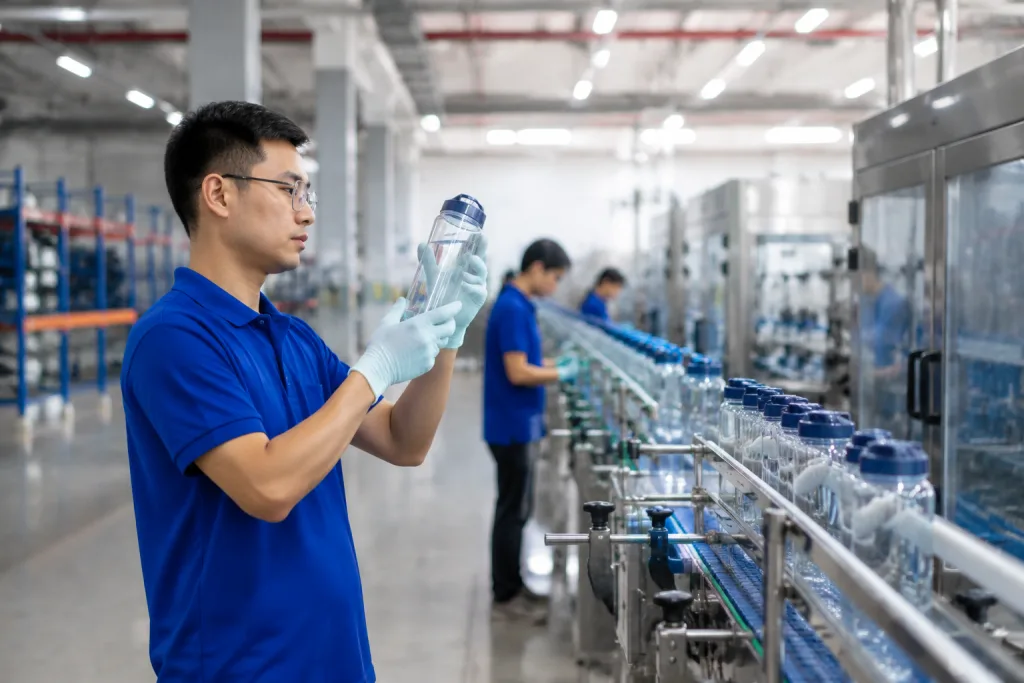
QC needs a plan before production, not after 5-layer cartons are taped and stacked on pallets. AQL inspection is standard for drinkware wholesale. A common setup is AQL 2.5 for major defects and 4.0 for minor defects, with critical defects not accepted. For Tritan bottles, inspectors should check capacity, wall consistency, cap torque, leakage, odor, color deviation, logo adhesion, drop performance, and barcode scan rate. We run cap torque with a digital torque meter, then QC pulls the sample for 30-minute inverted leakage testing, because straw lids that pass upright can still drip through the air hole. If you use silicone seals or straw lids, leakage testing should cover both upright and inverted positions.
Factory audits matter if you sell to chain retailers. BSCI, ISO 9001, or customer-specific social compliance audits can affect supplier choice and lead time. BottleForge Industrial works from Hangzhou, Zhejiang with audited partner lines in China, but you still need to state your required standard on the RFQ. Say it early. We’ve seen this go sideways when the buyer flagged BSCI after production started; the line was fine, but the selected workshop did not match their vendor manual, so shipment moved from 12 days to 18 days while the team changed packing and rechecked documents.

Adjacent SKUs Need Different Math
About 6 out of 10 buyers who ask us for tritan drink bottle wholesale are also quoting nearby SKUs: bulk canteen, growler wholesale, beer tumbler wholesale, or alcohol flask wholesale. Don’t push one price formula across them. The math doesn’t work. Tritan bottles come off an injection line, usually light enough that carton CBM matters more than unit weight. Stainless canteen bulk and alcohol flask bulk jobs sit on steel gauge, TIG welding, polishing wheels, leak testing, and finish yield. A 0.5 mm wall flask and a 0.7 mm wall flask can look the same in a sales photo, but QC pulled samples from a 2024 shipment where the 0.5 mm body dented after a 76 cm drop test.
For growler bulk or beer growler wholesale bulk, capacity and insulation set the cost base. A single-wall beer growler in bulk is a different route from a vacuum insulated wholesale growler: fewer welding stations, no vacuum chamber hold, no copper coating pass. Vacuum drinkware needs weld integrity checks, vacuum testing, and often copper coating or reflective lining. Beer tumbler bulk and beer tumbler wholesale bulk orders need tighter surface control because the buyer flags rim feel, powder coat orange peel, and print drift fast. We run a 2 mm alignment tolerance on logo placement; beyond that, the line stops before packing.
If your catalog includes alcohol flask in bulk, beer tumbler in bulk, beer growler bulk, and Tritan sports bottles, split the RFQ by material and process. Ask for separate MOQ, tooling cost, sample days, testing plan, and mass production timing by SKU family. Simple. On our side, a Tritan mold trial might need 7 days, while a vacuum growler sample with laser logo and leak test can take 14 days. One buyer once sent a PO with “same MOQ for all bottles” typed across 5 SKUs; we pushed back because the risk was being averaged into one blended quote. For serious wholesale drinkware programs, that split is what keeps launch timing clean and margin surprises off the table.
RFQ Details That Prevent Requotes
A good RFQ saves 5-10 days because the factory is not pricing from guesses. For tritan drink bottle wholesale, put the target capacity, fixed dimensions, lid style, straw requirement, color count, logo size, packaging method, test market, shipping term, and target delivery date in one sheet. If you have a target FOB price, say it. We run the first cost check against wall weight, cap structure, carton size, and packing labor; last month QC pulled a 650 ml sample that was 18 g over target because the buyer only wrote “sturdy bottle” on the RFQ. A serious supplier should tell you where the cost comes out: thinner wall, simpler cap, fewer colors, or cheaper packaging.
Send artwork as AI, PDF, or high-resolution vector files, not a screenshot from a WhatsApp thread. Confirm Pantone references for bottle body, lid, silicone parts, and print. For transparent Tritan, color matching is touchy because wall thickness changes the look. A 2.0 mm wall can appear darker than a 1.4 mm wall using the same masterbatch. Ask for color chips or pre-production samples before mass production approval; we usually cut 3 chips per color and check them under a D65 light box. Do not approve color from a phone photo. We have seen this go sideways.
Payment terms are usually 30% deposit and 70% before shipment for first orders. Established buyers may negotiate against shipment documents or after inspection, but open credit on a new wholesale drinkware account is the wrong question to ask; the math does not work for a factory buying Tritan resin, silicone rings, cartons, and printing screens upfront. For FOB terms, clarify whether the quote is FOB Ningbo, FOB Shanghai, or another China port. Port choice affects trucking cost, booking space, and vessel cutoff; from our Hangzhou line, Ningbo trucking is often 1 day tighter than Shanghai when the forwarder books late. The cleaner the RFQ, the more useful the first quote will be.
Send Your Tritan Bottle RFQ For A Real Cost Check
Share capacity, color, logo, packaging, and delivery target. We will return a practical MOQ, FOB price, and lead-time estimate.
Frequently asked questions
What is a normal MOQ for tritan drink bottle wholesale?
For existing molds, a realistic MOQ is 3,000 pieces per model and color. Some suppliers may accept 1,000-2,000 pieces for stock colors, but the unit price is usually higher and customization is limited. If you need custom Pantone color, logo printing, and retail packaging, plan around 3,000-5,000 pieces. For a new mold, 10,000 pieces is a more practical starting point because tooling, sampling, and setup costs need enough volume to make commercial sense.
How much should I budget per Tritan bottle FOB China?
Most custom Tritan bottles from China fall between USD 1.35 and USD 3.80 FOB, depending on capacity, cap design, wall thickness, logo, and packaging. A simple 650 ml bottle with one-color print may sit near USD 1.50-2.10 at 5,000 pieces. A 1,000 ml bottle with straw lid, silicone sleeve, time marker, and color box can exceed USD 3.20. Always ask whether the quote includes carton, barcode label, logo setup, and pre-shipment inspection support.
How long does a custom Tritan bottle order take?
Repeat orders using an existing mold usually need 35-55 days after deposit and artwork approval. New tooling projects normally need 55-85 days before shipment because design review, mold making, trial injection, sample approval, and mass production all take time. Add ocean freight separately: about 18-28 days to the US West Coast and often 30-40 days to Europe. Around Chinese New Year, add a buffer of 2-4 weeks.
Can I combine Tritan bottles with canteens, growlers, or flasks?
Yes, but quote them as separate SKU families. Tritan bottles use injection molding, while wholesale canteen, growler wholesale, beer tumbler wholesale, and alcohol flask wholesale projects often use stainless steel forming, welding, polishing, and leak testing. MOQ, tooling, and QC points are different. A mixed container can reduce freight cost, but do not assume one lead time fits all. Stainless items may need 45-65 days even when Tritan bottles are ready in 35-45 days.
What files and details should I send for a fast quote?
Send capacity, target dimensions, lid type, color count, logo size, packaging type, destination market, annual forecast, and required delivery date. Artwork should be AI, PDF, EPS, or another vector format. If you need EU, US, or Canadian compliance, state that before quotation so the supplier can include LFGB, FDA, REACH, CPSIA, or other testing where relevant. With complete details, a factory can usually return a useful quote within 2-4 working days.