Key Takeaways
- Set Tritan body wall thickness at 1.2-1.8 mm for most 500-1000 ml bottles
- Typical MOQ is 3,000 pieces per color and 35-45 days after sample approval
- Ask for LFGB, FDA, REACH, and dishwasher test terms before tooling starts
- Logo cost can range from USD 0.03 for one-color print to USD 0.35 for sleeve packaging
A Tritan bottle looks simple on a product page. On a PO, it gets messy fast. A 750 ml mark can pass at 742 ml or fail at 731 ml, depending on the tolerance you wrote down. Lid resin, silicone ring hardness at 50 Shore A, wall thickness around the shoulder, carton drop at 1.2 m, logo method, and FDA or LFGB test scope all hit returns, lead time, and landed cost. If you only ask a tritan drink bottle supplier for “750 ml with my logo,” this is the wrong question to ask. The line will fill in the blanks for you, and we have seen that go sideways when QC pulled the sample and found the straw lid resin did not match the buyer’s test request.
BottleForge Industrial is based in Hangzhou, Zhejiang, and we quote custom drinkware for buyers who need repeatable specs, not showroom guesses. Our Zhejiang partner lines can run about 280,000 plastic drink bottles per month, with typical MOQ from 3,000 pieces per color for custom canteen projects. We run specs through a simple checklist before sampling: cavity count, target gram weight, Pantone code, logo artwork size in mm, and carton packing. One buyer once sent a PO with “matte black” typed as “mate black”; the buyer flagged it only after the pre-production sample photos landed in their inbox. Read the spec sheet before you approve the sample.
Material line: Tritan is not enough
The first line on the spec sheet should not stop at Tritan. Put the resin grade, clear or tinted condition, food-contact claim, and virgin or recycled-content status in writing. We run most B2B bottle bodies in copolyester because buyers want glass-like clarity, better drop performance, and BPA-free labeling, but the quote still needs checking. Last month QC pulled 12 samples from the line and found one “Tritan bottle” using a cheaper PP lid with a light yellow cast under the D65 light box. The buyer flagged it. Fair point. A lower canteen price often comes from mixed resin, a 0.8 mm wall instead of 1.1 mm, or lid material that ages faster than the bottle body.
For Europe and North America, ask the tritan drink bottle supplier to confirm FDA 21 CFR food-contact suitability for the US and LFGB or EU 10/2011 migration testing for European programs. REACH also shows up on distributor POs; we see it on about 7 out of 10 EU repeat orders. If your channel includes schools, gyms, or outdoor retail, add an ASTM-related impact target or a simple drop test, such as 1.2 m onto concrete with the bottle filled to 90%. Certificates matter, but this is the wrong question to ask if nobody defines the abuse test. We have seen clean paperwork fail after the third corner drop.
Buyer impact is simple: unclear material control turns into a claims problem later. If the bottle body is Tritan but the straw is PE, the gasket is silicone, and the lid is PP, each part needs its own control line on the BOM. For canteen promotional orders, 8 of 10 buyers spend more time on the printed logo than the mouthpiece. That is where odor complaints start. On one 20,000 pcs order, the artwork was approved in 2 days, but QC held shipment because the mouthpiece had a plastic smell after hot-water soaking at 60°C for 30 minutes.
Our China production recommendation is plain: specify virgin Tritan body, PP or Tritan lid as quoted, food-grade silicone gasket at 50-60 Shore A, and no recycled resin unless your compliance team approves the exact declaration. For a customized canteen sold at retail, ask for a pre-production material list with part names, resin type, colorant, and supplier batch record. We attach this to the golden sample bag before tooling sign-off, usually with the color chip and cavity number written on the label. It is not excessive. It is how you avoid arguing after 18 cartons are already loaded and the goods are on water.
Capacity, dimensions, and hand feel
Capacity is the line we see misquoted on POs at least 6 times a month. A bottle sold as 750 ml might read 780 ml when filled to overflow on a 1 L graduated cylinder, 730 ml at the shoulder, or 750 ml at a molded fill mark. Carton count, freight cube, shelf fit, and the first complaint from a consumer all change with that definition. We run distributor drinkware projects with capacity defined as usable volume below the thread or drinking interface, with tolerance of ±3% unless the buyer pays for tighter control and QC checks every 30 minutes on the line.
Common Tritan sizes are 500 ml, 650 ml, 750 ml, 850 ml, and 1000 ml. For sports and school channels, 650-750 ml gives a good grip without making the bottle look cheap on shelf. For outdoor canteen customized programs, 1000 ml sells well, but the math gets ugly when it is full: 1 kg of water plus cap and body weight means more cracked lids in a 1.2 m drop test. A narrow waist feels better in hand, but the mold needs extra sliders and the label panel can lose 8-12 mm of flat area. If you are building a custom growler or customizable growler concept in plastic, check the wording with your buyer first; we have seen 3 retail buyers push back because their category team keeps “growler” for stainless steel or glass.
Diameter is not decoration. A 72-74 mm body fits many car cup holders; 78-82 mm feels stronger in hand but gets flagged fast in US retail reviews. Height above 260 mm can cause shelf and dishwasher trouble, and QC pulled the sample last season after it touched the top spray arm in a Bosch test unit. Mouth opening also matters: 45-55 mm handles ice cubes and brush cleaning, while a small spout drinks cleaner during running or cycling.
For a canteen distributor, send the RFQ like this: usable capacity 750 ml, body diameter 74 mm maximum, height 245 mm maximum, mouth opening 52 mm, assembled weight target 145-165 g, and body wall thickness 1.4 mm nominal. Simple numbers. They give the canteen factory enough room to tune the mold, set injection weight, and pass incoming AQL checks, while protecting the promise printed on your carton and hangtag.
Wall thickness and drop claims
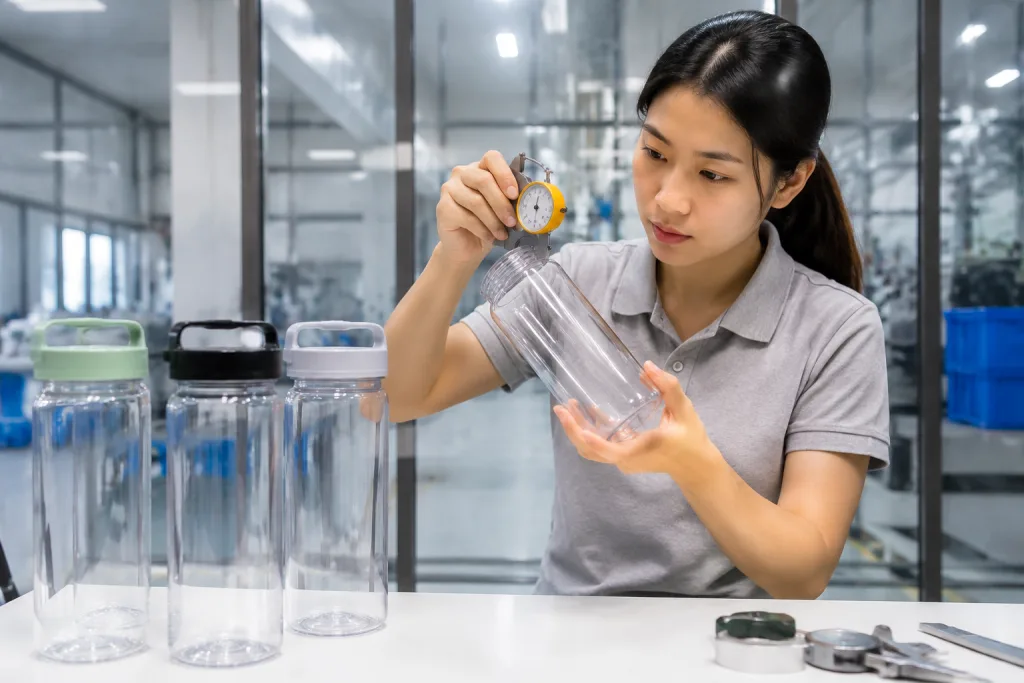
Wall thickness is where cheap quotes hide. A Tritan bottle body can pass a quick photo review at 1.0 mm, but in hand it feels light, the sidewall flexes, and the base corner is usually where QC pulls the cracked sample. For most 500-1000 ml drink bottles, we run 1.2-1.8 mm nominal wall thickness, checked with a Mitutoyo caliper after cutting the body at 4 points. Shape matters. Flat panels and sharp corners need more resin than a round cylinder. A canteen manufacturer quoting only bottle weight is avoiding the real question; we have seen 12 g moved into the base while the sidewall stayed weak.
Drop testing should match real use, not a nice lab story. For a customized drinkware order, a fair test is a 1.0 m drop onto concrete or a steel plate, bottle filled to 95% with room-temperature water, with hits on the base, the side panel, and the lid corner where straps often pull. Passing means no cracking, no lid separation, and no functional leakage after we wipe the seam with tissue. Cosmetic scuffing is normal. For kids or outdoor retail, 1.2 m testing makes sense, but the math does not work if the buyer also wants the thinnest wall, cheapest lid, and no tooling change.
Toughness costs money, but not always as much as buyers think. Adding 15 g of resin to a bottle may add only USD 0.03-0.06 in material cost, but across 50,000 pieces that is real money and the buyer will flag it on the cost sheet. Still, one return shipment from a North American retailer can wipe out the saving from cutting resin. We have seen this go sideways. If your target FOB is unrealistic, a good canteen vendor should say so before the mold trial, not after cartons are already stacked at the Hangzhou warehouse.
Ask for the supplier's internal QC plan, and ask who signs it. At BottleForge in Zhejiang, we usually set pre-production sample approval with sealed golden samples, first-article inspection before the line runs full speed, in-line checks every 2 hours with torque and leak checks, and final AQL inspection before shipment. For plastic bottles, AQL 2.5 for major defects and 4.0 for minor defects is a common baseline. Critical defects such as contamination, sharp edges, or leakage should be zero tolerance; last quarter QC stopped 3 cartons because one lid gasket was seated 1.5 mm off-center.
Lid system and leak performance
The lid usually decides the complaint rate, not the bottle body. We see buyers spend 2 weeks on a custom canteen body shape, then pick a lid from a catalog in 3 minutes without checking the gasket seat, thread engagement, hinge pin diameter, vent hole, or carry loop pull strength. Bad move. On our line, QC once pulled 12 samples from a PP flip lid lot and found 3 gaskets sitting 0.4 mm high in the groove; that bottle looked fine in the carton, then leaked in a backpack by day 7.
For a flip lid, check hinge cycle life. A practical target is 3,000 open-close cycles without hinge cracking or lock failure, tested on a simple bench jig before mass production. For a screw lid, thread engagement should feel stable after half a turn and seal fully without over-tightening; if the buyer has to crank it with two hands, the math doesn't work for daily use. For straw lids, ask whether the straw is removable, whether spare straws are available in the same PO, and whether the bite valve can pass odor and migration testing. A canteen customizable program with 6 lid colors needs tighter assembly control because colorant can shift shrinkage by about 0.2-0.5 mm on some parts.
Leak testing belongs in the spec sheet. Do not assume it. We run two shop-floor checks often: fill the bottle to rated capacity, invert it for 30 minutes on absorbent paper, then shake it 20 times at normal hand force. For distributor canteen programs with gym, school, or outdoor channels, add pressure or vacuum testing based on the lid design; one buyer flagged this after a 1,200 pcs trial order came back with wet inner cartons. Carbonated drinks are a separate issue. Most Tritan water bottles are not designed for carbonation unless the lid has a tested pressure-release design.
Silicone gasket hardness is a small number with a big impact. Around 50-60 Shore A works for many water bottle seals, measured with a Shore A durometer before assembly. Too soft can deform and pop out during washing; too hard can leak unless the thread tolerance is tight, usually within about 0.15 mm on the sealing area. If you sell replacement lids, define compatibility by mold number and production version. Canteen manufacturers in China can revise a lid mold after 8 or 10 production runs, so version control belongs in your purchasing file, not in a WeChat message after the buyer complains.
Decoration area and brand durability
Logo decoration belongs on the spec sheet, not in a loose email. For a low-cost canteen promo order, we run one-color silk screen at USD 0.03-0.08 per piece, depending on logo size, mesh count, and ink type. Multi-color printing, heat transfer, UV printing, sleeve inserts, and full-body wraps need separate plates or fixtures, so sampling time often moves from 3 days to 7-10 days. Flat PDFs lie. For customizable drinkware going into retail, ask for a printed bottle sample; on a 72 mm diameter Tritan body, curvature can make a 45 mm logo read closer to 38 mm from the front.
For Tritan, silk screen is still the normal choice for simple logos. UV print gives cleaner small text and gradient work, but QC should pull the sample for cross-hatch adhesion after curing; we have seen good-looking UV fail at the first tape pull. Heat transfer can carry strong retail graphics, but the math does not work if the surface treatment is weak and returns start after shelf handling. Laser engraving is not our standard recommendation for clear Tritan bodies. It makes more sense on stainless steel, especially for a customized growler or distributor growler where the buyer wants a permanent mark. For Tritan, test first.
Durability needs a number. We use 3M tape pull after 24 hours curing, then 50 cycles of wet cloth rubbing with a 500 g hand pressure jig. For dishwasher-positioned products, run 20-50 dishwasher cycles before claiming dishwasher safe for decoration. We have had buyers flag this exact wording on carton marks: the bottle passed, the print did not. Those are two claims, and mixing them is how a clean PO turns into a chargeback.
Artwork files should be vector AI, EPS, or PDF with Pantone references. For transparent colored bottles, logo color shifts against tea, juice, or even a dark retail shelf; QC pulled one blue Tritan sample last month where Pantone 185C looked brown through cola. White underbase may be needed, adding cost and one more print pass. Good canteen suppliers say this before sampling. Weak suppliers wait until the sample looks dull, then blame the artwork.
Packaging, barcode, and freight cube
Packaging is not just “how it looks.” It is cost, breakage control, and retail compliance on the same PO line. Bulk pack is the low-cost choice: one polybag per bottle, 24-48 pieces per export carton, usually sealed with 48 mm BOPP tape on the carton line. We run this for giveaways, school canteen programs, and simple promo orders where the buyer does not need shelf display. Retail orders need a color box, belly band, hang tag, or kraft tube, and each one changes carton size and packing labor. The buyer often asks, “Can we keep the same carton?” Sometimes the math doesn’t work.
Typical packaging adders from China are about USD 0.04-0.08 for a simple hang tag, USD 0.12-0.25 for a printed color box, and USD 0.20-0.35 for more protective retail packaging. For online orders, especially FBA-style warehouses, lock FNSKU labeling, carton labels, suffocation warnings where needed, and drop-test-ready cartons before mass packing starts. QC pulled one sample last month where the barcode scanned on an iPhone but failed on the Zebra scanner at 300 dpi print setting. That became a re-label job. For North American distributor drinkware, UPC placement and scannability matter. For Europe, language requirements and recycling marks can hold artwork approval for 3-5 days if the file is missing the right icon.
Freight cube sounds boring. It changes landed cost. A 750 ml bottle packed 24 pieces per carton may ship in a carton around 58 x 40 x 28 cm, depending on bottle shape and packaging. That is roughly 0.065 cbm per carton. Across 10,000 pieces, a slim bottle versus a bulky handle design can add 4-7 cbm, which shows up fast on an LCL quote. We have seen a FOB price look USD 0.06 cheaper, then lose the saving because the master carton was 35 mm wider than planned.
Ask your tritan drink bottle supplier for carton dimensions, gross weight, net weight, HS code suggestion, and packing method before you approve the order. Do it before deposit. For fragile display packaging, request ISTA-style carton drop checks or at least a 5-side carton drop from 76 cm; our QC team marks corner crush, cap scuffing, and color-box split seams on the inspection sheet. A canteen manufacturer that can talk about packing density usually understands export reality better than one that only sends glamour photos.
MOQ, tooling, and approval timing
MOQ comes down to resin color, mold ownership, decoration method, and retail pack. For existing molds, we usually quote 3,000 pieces per color for a canteen customized order; 1,000 pieces is possible on some SKUs, but the math gets ugly because the resin mill does not like small color lots. We have had buyers push for 800 pcs in smoke gray, then reject the first injection trial because the color drifted 1.5 Delta E between bags. For a new mold, expect tooling from USD 3,500-12,000 for standard Tritan bottle bodies and lids, with flip lids costing more when the design needs a spring pin, silicone plug, or one-hand lock.
A normal timeline from Zhejiang, China runs like this: 7-10 days for artwork and spec confirmation, 10-15 days for pre-production samples on an existing mold, 35-45 days mass production after deposit and sample approval, then shipping time. New tooling adds 25-40 days before the line can start. Simple point. If the launch date is fixed, do not spend 21 days arguing over Pantone 2925C vs 2935C after we have booked 1,200 kg of Tritan resin and opened the color masterbatch PO.
Payment terms for new buyers are commonly 30% deposit and 70% before shipment, with FOB Ningbo or FOB Shanghai often used from Zhejiang factories. Larger canteen distributors with 3-5 repeat orders and clean payment records can ask for different terms, but first orders usually follow standard export practice. Inspection should be booked when production is 100% complete and at least 80% packed, using AQL levels agreed in the PO. QC pulled one sample last month where the carton mark had the buyer’s SKU typo from the PO, so lock artwork, carton print, and barcode files before packing starts.
The cleanest RFQ package includes target FOB price, annual forecast, first order quantity, bottle capacity, body color, lid color, logo method, packaging, test market, compliance needs, and delivery window. Send that to canteen manufacturers and you will see fast who understands B2B supply. A good canteen factory answers with trade-offs: 3,000 pcs for stable color, 5,000 pcs for better resin cost, or stock lid tooling to save 18 days. A risky one only says yes. We’ve seen this go sideways.
Send us your Tritan bottle spec sheet
We will review capacity, lid, logo, packaging, MOQ, and compliance gaps before you commit to sampling or tooling.
Frequently asked questions
What MOQ should I expect from a Tritan drink bottle supplier?
For an existing mold, expect 3,000 pieces per color as a practical MOQ from many China factories. Some suppliers quote 1,000 pieces, but the FOB price may rise by 10-25% because resin coloring, printing setup, and packing labor are spread across fewer units. If you need a custom body mold, the first production run is usually 5,000-10,000 pieces to make tooling worthwhile. For a canteen distributor testing a new account, we often suggest starting with one body color, one lid color, and one logo method to keep MOQ and QC manageable.
Is Tritan better than stainless steel for custom drinkware?
It depends on the channel. Tritan is lighter, transparent, impact resistant, and usually lower cost for sports, school, gym, and promotional programs. A 750 ml Tritan bottle may land at a lower FOB price than a double-wall stainless bottle, especially when decoration is simple. Stainless steel is better for vacuum insulation and premium perceived value. If your brief says custom growler or customized growler for cold beer or long temperature retention, stainless may be a better fit. If your brief says canteen promotional, clear hydration tracking, and lighter shipping weight, Tritan is often the practical choice.
What compliance documents should I request before ordering?
Ask for food-contact test reports that match your sales market, not just a generic certificate. For the US, FDA food-contact suitability is commonly requested. For the EU, ask for LFGB or EU 10/2011 migration testing, plus REACH where applicable. If the bottle is for children, ask whether any ASTM or CPSIA-related requirements apply to your design and packaging. Also request a material declaration listing Tritan body, PP or Tritan lid, silicone gasket, straw material, and colorants. Reports should be recent, ideally within 12-24 months, and tied to the same material family used in production.
How long does a custom Tritan bottle order take?
For an existing mold with custom logo and packaging, plan on 35-45 days for mass production after sample approval and deposit. Sampling usually takes 10-15 days once artwork and Pantone references are confirmed. If you need new tooling for a custom canteen shape, add 25-40 days for mold design, machining, trial shots, and adjustments. Ocean freight then adds roughly 25-40 days to North America or Europe depending on port and season. Buyers who need a launch in 90 days should lock the spec sheet quickly and avoid late changes to lid color or packaging size.
Can I use one supplier for canteen, growler, and tumbler programs?
Yes, but check the supplier's real production base. A canteen supplier may be strong in Tritan injection and blow molding but weak in stainless vacuum products. A stainless tumbler factory may not control plastic bottle tooling well. BottleForge coordinates plastic, stainless, glass, and packaging projects from Zhejiang, China, but we still separate specs by material and process. For distributor growler or customizable canteen programs, ask which parts are made in-house, which are outsourced, monthly capacity, MOQ, and inspection points. One sales contact is useful; one uncontrolled factory chain is not.