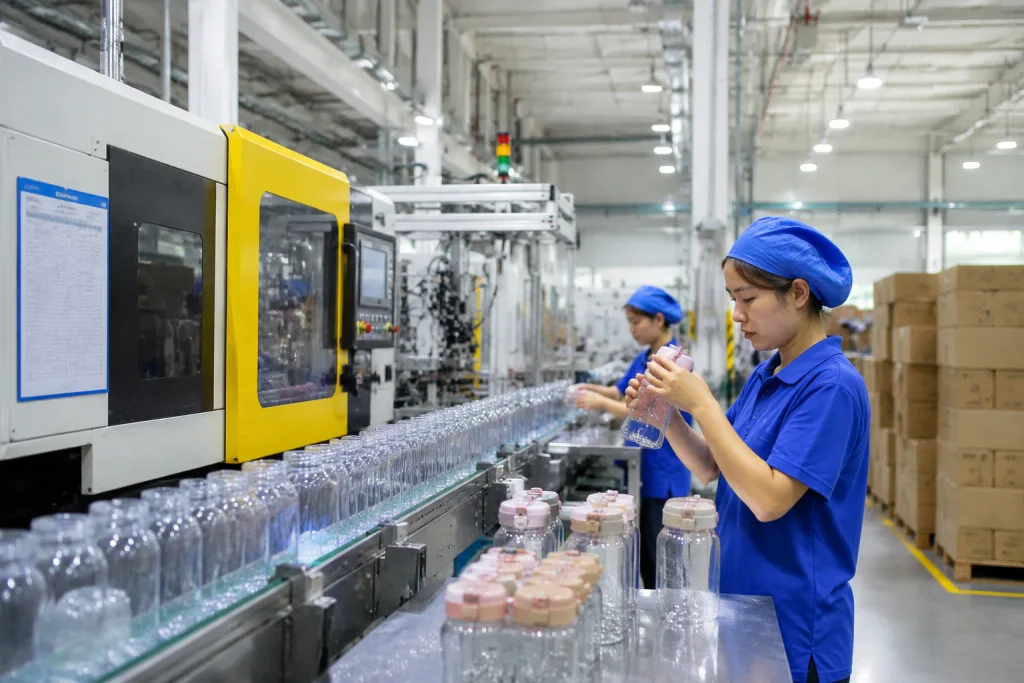
Key Takeaways
- A practical Tritan MOQ is usually 3,000 pieces per color, with 35-45 day mass production after sample approval
- Specify Tritan resin grade, cap material, silicone hardness, and wall thickness before confirming pricing
- Logo method should match the sales channel: silk screen, heat transfer, laser on metal parts, or molded branding
- Use AQL 2.5/4.0 inspection, REACH/LFGB/FDA checks, and carton drop testing for export orders
Buying from a tritan drink bottle manufacturer is not difficult. Buying the right bottle at the right landed cost is where buyers get burned. The risk is not the 3D rendering. It is resin grade, cap sealing torque, wall thickness at the shoulder, print adhesion after 3M tape pull, carton drop strength, and whether the line can repeat the approved sample on day 12 of production. Last month QC pulled 32 bottles from a 6,000 pcs run and found two caps leaking at 0.6 bar; that is the kind of detail that decides whether the math works.
If you are sourcing custom drinkware for retail, promotion, Amazon, or distributor programs, start with four decisions: bottle construction, decoration method, compliance requirement, and order economics. Colors come later. From our base in Hangzhou, Zhejiang, we see European and North American buyers win when they lock the mouth diameter, Tritan grade, logo process, test standard, MOQ, and carton spec before artwork. We have also seen this go sideways when a PO says “clear blue” but the approved Pantone is 2925C, so the buyer flagged it only after the first 1,200 pcs were packed.
Start With The Bottle Architecture
The first decision is not logo position. Start with the bottle architecture: the shoulder shape, usable fill capacity, lid stack, grip area, and the way people drink from it. Tritan works well for clear, lightweight bottles because it is impact resistant and BPA-free, but a weak cap will still kill the product. For a 600 ml to 1000 ml sports bottle, we normally check for a body wall around 1.4-2.0 mm, depending on shape and mold flow. On the line, QC pulls the first shots with a digital caliper and checks the shoulder area first, because thin walls make the quote look cheap and then bring deformation, stress whitening, and breakage during a 1.2 m carton drop test.
You also need to choose the drinking system early. Is your custom canteen a squeeze-free hydration bottle, a straw lid bottle, a flip-top gym bottle, or a wide-mouth outdoor canteen built for ice cubes and powder scoops? Each choice changes the tooling, leak test, and packing method. A wide-mouth lid with carry handle may need PP, ABS, TPE, and silicone parts in one assembly. Normal enough. The catch is control: every extra material adds one more supplier, one more incoming inspection record, and one more chance for the buyer to flag a smell, color mismatch, or loose handle after we run the pilot batch.
For distributor drinkware, start with 2-3 core sizes instead of 8 shapes. Eight shapes is the wrong question to ask if your warehouse team is already pushing back on slow-moving colors. A canteen distributor can carry a 650 ml daily bottle, 800 ml sports bottle, and 1000 ml outdoor bottle without tying up too much inventory; we usually see MOQ start around 3,000 pcs per color for a custom Tritan body. If you plan a custom growler or customizable growler line, keep it separate. Growlers usually involve stainless steel or heavier plastic construction, different sealing expectations, and freight math that changes fast once the carton passes 12 kg.
Define Customization Before Quoting
A canteen customizable program can mean 6 different jobs on our quote sheet, so vague wording gives you a bad price. Say the print method and size first: one-color silk screen, wraparound heat transfer, UV print, laser engraving on a metal badge, embossed logo in the mold, or color-matched lid components. A promotional bottle with a 40 mm logo is a 1-screen setup on the line; a retail bottle with a 360-degree graphic and Pantone-matched cap needs film output, fixture checking, and a color chip under the D65 light box. Different job.
Silk screen still works best for most canteen promotional orders under tight cost control. It is economical and stable for simple logos, especially when we run 1,000-5,000 pcs on existing Tritan molds. Heat transfer gives wider coverage and richer color, but artwork setup and reject control matter more; QC pulled one sample last month because the seam shifted 2 mm near the bottle rib. Molded branding looks premium, but you pay tooling and lose flexibility. For a new customized canteen, a small molded logo insert can cost around USD 300-800, while a full custom body mold may run USD 6,000-18,000 depending on structure and cavities.
Do not load the first order with every idea from the mood board. We have seen this go sideways. A custom drinkware buyer may ask for translucent body, glitter effect, two lid colors, custom silicone strap, retail sleeve, and individual barcode all at once, then the buyer flags the PO because the barcode position says 35 mm on one page and 38 mm on another. It is possible, but the approval cycle stretches fast. In Zhejiang, China, our practical sample route is 7-10 days for existing molds with logo, and 25-40 days for new mold sampling. If your sales launch is fixed, keep the first canteen customized version close to an existing proven mold.
Check Compliance By Sales Market
The third decision is compliance. “Food grade” on a quotation is not proof; we reject that wording on buyer files unless a lab report sits behind it. For Europe, ask for REACH, LFGB or EU 10/2011 migration testing where the bottle will be sold. For the United States, buyers usually ask for FDA food-contact compliance, and 3 out of 10 retail programs we see also add California Proposition 65 screening. For children’s bottles, ASTM and CPSIA can enter the discussion when the design uses paint, loose accessories, or cartoon graphics; QC once pulled a 420 ml kid bottle because the charm ring failed the small-parts gauge.
A serious canteen manufacturer should split material declarations by component: Tritan body, PP lid, silicone gasket, straw, TPE grip, stainless pin, and printing ink. No shortcuts. The test report must match the actual resin, color family, and surface treatment. A clear Tritan body report does not cover a dark smoke body, metallic print, or soft-touch coating; we have seen this go sideways when a buyer asked for documents 6 days before ETD. The right time to check is before the PO, not after the line has packed 48 cartons.
For brand owners, factory audits also matter. BSCI, Sedex, ISO 9001, or retailer-specific audits may be required before shipment. BottleForge Industrial is based in Hangzhou, Zhejiang, and our China export process normally includes pre-production sample sign-off, incoming material checks, in-line inspection, final AQL inspection, and loading photos. For most B2B drinkware orders, AQL 2.5 major and 4.0 minor is a reasonable baseline; on a recent Tritan order, the buyer flagged a PO typo where “matte black” became “matt back,” so we froze artwork before mold trial. If the product is sold as leakproof, run a 100% leak test at assembly with water and air pressure, not only random inspection.

Price The Order Like A Buyer
Do not buy off the FOB unit price alone. A USD 1.42 bottle can cost more landed than a USD 1.55 bottle if the carton fails a 60 cm drop test, the reject rate runs 3.8% instead of 1.2%, or the master carton wastes space in a 40HQ. We check this with a tape measure on the packing table, not a spreadsheet. For a 750 ml Tritan bottle from an existing mold, a realistic FOB China range is USD 1.20-2.40: simple flip lid and one-color pad print sits near the low end; lockable lids, silicone seals, Eastman resin requests, gift boxes, or smaller order quantity push it up. Retail packaging can add USD 0.10-0.45 per unit before freight.
Ask your canteen supplier to show the main cost drivers: body gram weight, lid assembly parts count, logo process with print area in mm, inner bag or color box spec, FDA or LFGB testing, and tooling charge if the lid is not existing. You do not need every factory margin line. You do need to know what moves the price. Last quarter QC pulled a 750 ml sample that looked fine, but the wall at the shoulder was 1.05 mm against the agreed 1.25 mm. If the canteen vendor will not talk about wall thickness, resin source, or packing specification, the math does not work; the low price is hiding a change you will find after deposit.
MOQ needs context too. At our Zhejiang facility, standard existing-mold Tritan bottle MOQ is typically 3,000 pieces per color, with monthly capacity around 450,000 plastic drinkware units across normal schedules. Custom colors below 3,000 pieces are hard because one injection molding color change can burn 18-25 kg of purge resin and take the line down for 45-70 minutes. We run the numbers every week. For canteen distributors placing mixed SKUs, a consolidated PO can help when colors share the same resin and lid set, but one color at 500 pieces rarely gives stable factory economics. We have seen this go sideways when a buyer wrote “blue” on the PO and expected Pantone 299C after production started.
Match Factory Type To Program
Not every canteen manufacturer fits every buyer. A promotion agency usually needs a 12-day sample window, clean logo placement, and carton marks that match the PO; last month QC pulled 3 cartons because the side mark said “Tritan botle.” A retail brand cares more about finish consistency, FDA or LFGB files, and packaging that survives a 1.2 m drop test. A distributor canteen program needs repeat inventory, spare lids, and the same SKU available 6 months later. Similar requests. Different pressure points.
A trading company makes sense when you are buying 8 small SKUs at 300 pcs each, but a direct canteen factory is the better fit when you need engineering changes, mold ownership, or fast QC feedback from the line. Direct does not always mean cheaper; it means the technical conversation has fewer handoffs. If you are developing customizable drinkware with a new lid, hinge, gasket, or carry loop, you need engineers who can talk through 1.5 mm draft angle, gate marks, ultrasonic welding settings, and torque testing, not just forward a sales sheet.
For distributor growler and distributor drinkware buyers, continuity is where the money is. You need a canteen supplier that keeps mold records, Pantone records, packaging dielines, and inspection criteria in the same job folder, not scattered across 4 WeChat chats. Changing canteen suppliers every season to save USD 0.03 is the wrong question to ask; we have seen this go sideways with color drift, lid mismatch, and 2% warranty noise. A good factory relationship still needs sharp pricing, but the math has to include returns, delayed shipments, and customer complaints.
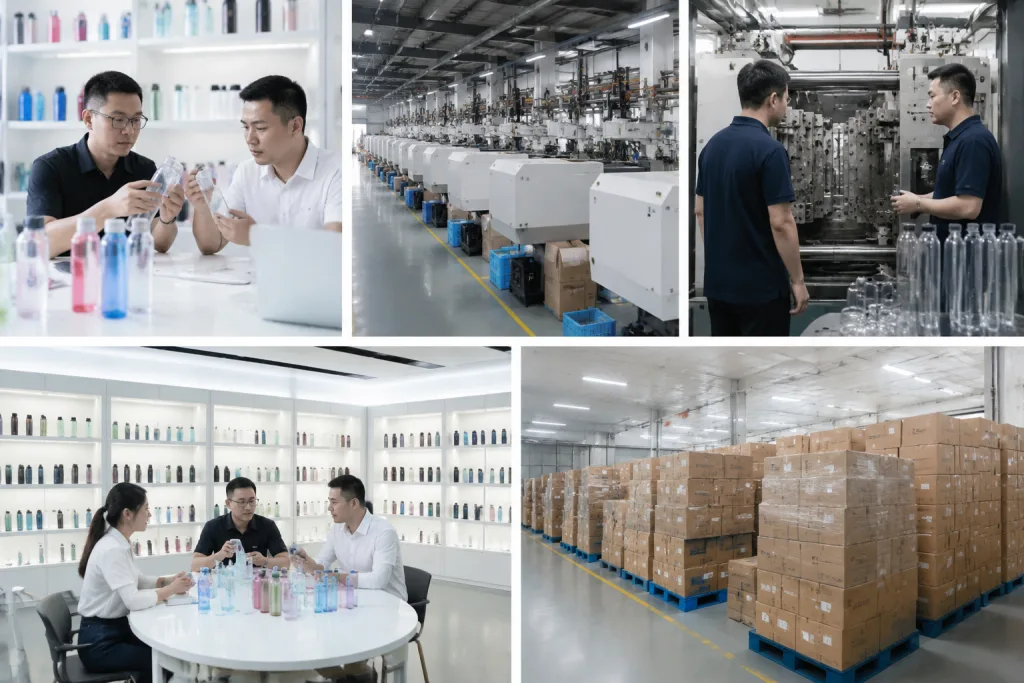
Control Samples And Production Risk
Sampling sets the production standard. Approve one golden sample with body color, logo size in mm, cap fit, gasket position, straw length, carton marking, and packing method written on the sample card. Don’t approve by photo if color or transparency matters. For translucent Tritan, a 0.3% pigment shift can pass under our line lights and look smoky on a Target-style retail shelf; we’ve seen buyers flag this after QC pulled the sample from a sealed carton.
For a normal customized drinkware order, the working sequence should be clear: quotation, artwork confirmation, sample, sample approval, deposit, pre-production sample, mass production, in-line inspection, final inspection, balance payment, shipment. Mass production for existing mold orders is usually 35-45 days after deposit and sample approval. New mold projects add 18-25 days for tooling, T1 trial shots, mold adjustment, and sometimes a second test report if the lid thread or straw hole changes. The wrong question is “How fast can you ship?” Ask when the approved PPS reaches the line.
Inspection should be written into the PO. Common checks include capacity tolerance, appearance, logo adhesion, barcode scan, leak test, odor check, lid opening force, drop test, carton compression, and FNSKU placement for Amazon FBA orders. We run leak testing with water filled to the rated capacity, then invert samples for 30 minutes; if 2 pieces fail under AQL 2.5, the math doesn’t work. If your canteen promotional order is event-dated, book inspection 5-7 days before the cargo-ready date, not the day before vessel cutoff. China export logistics can absorb a 12-hour truck delay, but not a logo adhesion problem found after 180 cartons are taped shut.
Build A Practical Buying Brief
A tight RFQ saves more money than beating up the price later. Send the canteen manufacturers a brief with capacity, bottle height and diameter in mm, target FOB price, annual forecast, launch date, sales market, compliance needs, logo files, Pantone colors, packaging type, carton weight limit, and shipping terms. Share the target retail price if you have it. We run the quote through mold room, printing, packing, and carton test; one missing detail, like “matte blue” without a Pantone code, can add 2 days of email and still end with the wrong sample.
For canteen custom programs, mark what is fixed and what can move. The 750 ml capacity, leakproof lid, and REACH compliance might be locked, while grip texture and gift box style can change. That gives your canteen vendors room to quote like adults. If every line is “must have,” the math does not work. Last month QC pulled a tritan bottle sample where the buyer wanted a silicone sleeve, color box, spare straw, and 18 kg carton limit, but the PO target was still set for a basic bulk-pack item.
The cleanest buying brief is a short decision table: existing mold or new mold with a 3D file, print logo or molded logo with draft angle checked, retail box or bulk pack with carton size limit, FOB Ningbo/Shanghai or DDP, standard AQL or stricter inspection. Lock those choices before chasing prices. Once they are clear, a tritan drink bottle manufacturer can give a price and a timeline that production can live with. That beats collecting ten low quotes that fall apart when the line starts.
Send your Tritan bottle brief for factory review
Share capacity, logo, target price, market, and timeline. We will reply with MOQ, tooling route, lead time, and practical risks.
Frequently asked questions
What MOQ should I expect from a Tritan drink bottle manufacturer?
For an existing mold, expect about 3,000 pieces per color for most Tritan drink bottles. Some canteen suppliers may accept 1,000-2,000 pieces for stock colors, but custom Pantone colors usually need higher volume because injection molding color changes waste resin and machine time. If you need several lid colors or separate logo versions, count each version carefully. A canteen distributor ordering 12,000 pieces across 4 colors is easier to support than 12 colors at 1,000 pieces each. For new mold projects, MOQ often starts at 5,000-10,000 pieces because tooling setup, trial shots, and QC work are heavier.
Is Tritan better than stainless steel for custom drinkware?
Tritan is better when you need a clear, lightweight, impact-resistant bottle at a lower FOB cost. Stainless steel is better for insulation, premium weight, and hot/cold retention. A 750 ml Tritan bottle may land around USD 1.20-2.40 FOB China from an existing mold, while an insulated stainless bottle is usually much higher. Tritan also works well for canteen promotional programs because users can see water level and the bottle is light for shipping. If you need a custom growler or customized growler for beer, coffee, or long temperature retention, stainless steel is usually the safer construction.
Can I make a fully custom canteen shape?
Yes, but treat it as a product development project, not a simple logo order. A full custom canteen body may require CAD work, prototype review, injection mold tooling, trial production, leak testing, and compliance testing. Tooling can range from about USD 6,000 to USD 18,000 or more, depending on size, cavities, lid complexity, and surface finish. Sampling can take 25-40 days before you are ready to approve mass production. If your first order is below 5,000 pieces, an existing mold with customized drinkware branding is usually the better financial decision.
What tests should I require before shipment?
At minimum, require material compliance for your sales market, a final AQL inspection, leak testing, logo adhesion testing, and carton drop testing. For Europe, ask about REACH, LFGB, or EU 10/2011 depending on the product and buyer requirement. For the United States, FDA food-contact documentation is common. For leakproof claims, use 100% leak testing during assembly plus random verification during final inspection. For printed logos, a 3M tape test and rub test help catch weak ink curing. For Amazon FBA, also verify FNSKU labels, carton weight, carton dimensions, and scannability before loading.
How long does production take after I approve samples?
For existing mold Tritan bottles, plan for 35-45 days after deposit and final sample approval. Simple one-color logos can move faster than wraparound heat transfer or retail gift box packaging. New mold projects add design, tooling, trial shots, and revisions, so 60-90 days is more realistic from concept to shipment-ready goods. Around Chinese New Year, add at least 2-3 extra weeks because factories in Zhejiang and other China manufacturing regions close or run with reduced staff. If you have a fixed promotion date, approve artwork and packaging before you negotiate the last USD 0.02.