Key Takeaways
- Start with 3,000-5,000 pcs if you need Pantone color, logo, and retail packing control
- Tritan body wall thickness should usually sit around 1.8-2.5 mm for reusable canteen programs
- Pre-production samples normally take 7-12 days after artwork and cap color approval
- Use AQL 2.5 for major defects and AQL 4.0 for minor defects on export inspections
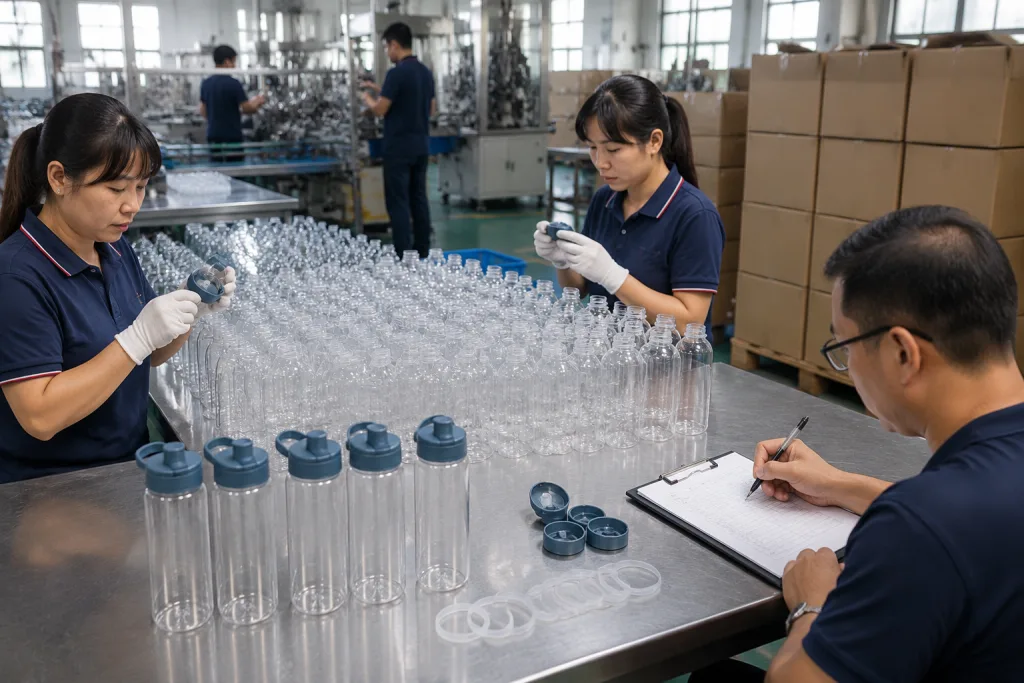
Your buyer brief looks simple on the PO: clear Tritan bottle, custom logo, leakproof cap, carry strap, campaign delivery date. Then QC pulled the sample on the line and the “same” tritan drink bottle custom spec split into 20 builds once we checked resin grade, cap mold, 0.3 mm gasket fit, silk-screen rub test, 1.2 m carton drop, and retailer compliance.
This is how we run a real B2B order through our Hangzhou, Zhejiang export process. No catalog talk. Picture a distributor placing 5,000 units for a fitness, school, or outdoor program; the buyer flagged “logo cannot scratch off after 50 rubs,” and we need the print method, packing, sample approval, and mass-production timing locked before China production starts. Surprises cost money.
The buyer brief is too vague
A typical inquiry says, “We need a tritan drink bottle custom, 750 ml, logo printed, quote EXW or FOB.” That is not enough to price cleanly. We can run a rough number from a photo, but we have seen this go sideways: QC pulled 32 pcs from a pre-shipment sample lot last April because the lid looked fine on the sales render and leaked after 20 seconds on the vacuum leak tester.
For this case, define the order like a buyer brief, not a WhatsApp note. You are buying 5,000 pcs for a European distributor canteen program. The bottle is 750 ml, clear Tritan body, flip lid, silicone seal, PP cap, wrist strap, one-color logo, individual opp bag, and export carton. Target FOB Ningbo price is around USD 2.10-2.85 depending on cap complexity and packing. MOQ for a standard mold with custom color cap is usually 3,000 pcs. If you need a new body mold, the math changes fast; one buyer asked for a 6 mm taller shoulder after artwork approval, and the mold quote moved from a color change to a full tooling discussion.
The first decision is simple. Are you selling a premium reusable bottle or a low-cost canteen promotional item? A promotional run can accept a lighter cap, simple silkscreen logo, and a standard 48 pcs export carton. A retail customized drinkware project needs barcode labels, warning text, carton marks, and tighter cosmetic inspection under AQL 2.5. If you sell to canteen distributors or outdoor retailers, decide this before quoting your customer, not after; the buyer flagged it once when the PO said “retail pack” but the artwork file only showed a logo.
Ask your canteen manufacturer for a specification sheet, not only a price. It should list body material, cap material, seal material, capacity tolerance, net weight, dimensions, packing, logo process, MOQ, sample time, mass lead time, and FOB port. A serious canteen factory in Zhejiang can send this in one working day if the request is clean, and we usually attach a caliper photo for height and diameter so nobody argues later over 2 mm.
Lock the material before color
Tritan sells because it stays clear, takes drops better than PC, and is BPA-free, but the material claim must be locked before anyone talks Pantone. For North America, we ask buyers to confirm FDA food-contact wording on the PO; for Europe, we check EU food-contact, LFGB when the channel asks for it, and REACH for restricted substances. Kids’ bottles need this even earlier. QC once pulled a pre-production sample where the carry strap buckle measured 7.4 mm and the buyer flagged small-part risk before we even sprayed the first color chip.
For the bottle body, we run 1.8-2.5 mm wall thickness on most 600-1,000 ml custom canteens. Go thinner and the bottle may pass a desk drop, but it starts to feel like a giveaway item and can oval under stacked carton pressure; our caliper check at the shoulder usually tells the truth fast. Go heavier and the hand feel improves, but the math can turn ugly. On a 5,000 pc order, a 25 g weight difference adds 125 kg to the shipment, which changes freight quotes and makes the outer cartons harder to handle on the line.
The cap matters as much as the body. Most complaints on Tritan bottles are not about the cylinder; they come from leaks, hinge fatigue, mouthpiece odor, or a silicone ring sitting 0.3 mm proud after assembly. A canteen vendor should confirm food-grade silicone for the seal, spare gasket availability, and cap testing after repeated opening. For sports and school channels, we run at least 100 open-close cycle checks during development, and I push for a leak test with the bottle inverted for 30 minutes because we have seen this go sideways after air shipment.
If you are comparing canteen suppliers in China, “Is it Tritan?” is the wrong question to ask. Ask for the resin grade, test reports, and a clear statement that production uses virgin material; we have seen POs with “Tirtan” typed in the material line, and that typo still caused a two-day document cleanup before mass production. Recycled claims for plastic drinkware need careful documentation. If the chain cannot be verified, do not print sustainability language on the bottle.
Logo choice affects failure risk
For a tritan drink bottle custom order, decoration is where buyers get too brave. A 220 mm wraparound logo can look clean on a PDF, then scratch at the shoulder radius, distort near the grip ribs, or fail a 75% alcohol rub test after 30 strokes. We see this on the line. Safer choices are one-color silkscreen on the straight wall, pad print on a flat 45 x 60 mm panel, laser marking on a stainless badge if the bottle has one, or heat transfer when the graphic has gradients and small text.
Silkscreen is still the right answer for simple branding. For 5,000 pcs, a one-color print may add roughly USD 0.08-0.18 per unit depending on logo size, ink coverage, and whether the fixture needs a new jig. Two-color printing means tighter registration; QC pulled 37 bottles from a 1,200 pcs trial last month because the second color drifted 0.8 mm. If your brand color is strict, send Pantone C or U references, then approve the color on the actual translucent Tritan wall, not on white paper. The paper match lies.
A customizable canteen with cap color matching is easier than full body tinting. Cap color MOQ may start at 3,000 pcs per color using standard PP, and we can usually run it after a hopper purge and a 30-minute color check. Custom body tint often needs higher MOQ, commonly 5,000-10,000 pcs, because the injection barrel cleaning and color stability take time. For a canteen promotional project, I would keep the body clear or smoke gray and use cap color plus logo for branding. Less dramatic, yes. The math works better, and we ship with fewer rejects.
Do not approve artwork only by email mockup. Ask for a physical pre-production sample, especially if you are a canteen distributor selling to retailers. Check logo position, opacity, adhesion, cap color, and barcode readability; we once had a buyer flag a barcode that scanned on the flat label file but failed after the sticker wrapped around a 72 mm bottle curve. A good Zhejiang canteen manufacturer will photograph the sample under normal light and send a courier sample before mass production. That 3-5 day courier delay is cheaper than reworking 5,000 pcs.

Samples must answer real questions
A sample is not a souvenir. It is a buying tool. For this kind of Tritan bottle project, we ask buyers to approve two plain stock samples first, then one pre-production sample with the final logo and packing. Stock samples answer hand feel, cap function, drinking angle, usable capacity, and carton fit; the pre-production sample answers print position, Pantone match, barcode scan, and shelf look. QC pulled one 750 ml sample last month where the straw touched the bottom by 2 mm, and the buyer flagged the sip angle right away. Good catch.
Normal stock sample dispatch from our Hangzhou, China office is 2-4 days if the model is available. Printed pre-production samples usually take 7-12 days after AI or PDF artwork approval. If a buyer asks for a custom growler, customizable growler, or customized growler in stainless steel at the same time, split the sample schedule on the PO. Stainless steel vacuum items need separate tooling, laser welding, and 24-hour insulation checks; the line cannot treat them like Tritan bottles. We have seen this go sideways when a buyer planned both items for one 18-day launch window. The math doesn't work.
When the sample arrives, fill it with water and invert it for 8 hours. Then shake it 30 times and check around the hinge, spout, and seal ring. Use a 0.1 g scale for filled capacity, not a quick look at the mold line. We usually accept a practical capacity tolerance of about ±3%, but the marked capacity must match your market claim. If you sell 750 ml, the user should be able to fill close to that without water sitting in the threads. One small detail: weigh the empty bottle first, then filled bottle, or your numbers will drift by 5-8 ml.
Test odor too. Tritan itself should not smell strong, but caps, inks, opp bags, and cartons can. Wash the bottle, leave it closed overnight, and check again in the morning before coffee or perfume gets near the desk. If the odor comes from packing materials, your canteen vendors need to air parts for 24 hours before packing or change the bag specification. If the odor comes from the cap material, stop and fix it before mass production. We run a simple sniff check after the heat-seal machine because one PE bag batch once made clean bottles smell like ink.
Production control starts before deposit
After the sample is approved, the PO should lock the spec. Do not write “750 ml customized canteen as sample.” Write Tritan grade, Pantone color, logo size in mm, printing process, packing method, carton marks, AQL 2.5 inspection standard, FOB port, and shipment date. If the order goes to Amazon or a retailer DC, put FNSKU or barcode label rules on the PO before deposit. We had one buyer send label artwork 9 days after deposit; the line was ready, but packing sat because QC pulled the sample carton and the barcode scanned to the wrong SKU.
For a standard tritan drink bottle custom order at BottleForge Industrial, mass production usually runs 25-35 days after deposit and sample approval. Our Zhejiang drinkware production network can handle about 300,000 reusable plastic bottle units per month across standard models, depending on season and color mix. April-July gets tight because summer promo orders hit the same line as back-to-school programs. Book early. A color change on a 160-ton injection molding machine is not just “change the resin”; we clean the barrel, purge material, and check the first 20 pcs for black dots or flow marks.
New B2B buyers usually work on 30% deposit and 70% balance before shipment, or before document release if the account has a credit arrangement. FOB Ningbo is cleaner than EXW for most overseas buyers because export customs and local trucking stay under China-side control. If you ask for DDP, ask who answers when customs requests FDA, LFGB, or material declaration files. The math often doesn’t work if a supplier quotes DDP too cheap; we’ve seen this go sideways when the buyer flagged a duty bill after the container had already reached Los Angeles.
A canteen factory should send production photos at key stages: material arrival, injection molding, logo printing, assembly, leak testing, and final packing. Photos do not replace inspection. They catch blunt mistakes early. If the cap color is wrong on day 5, we stop the line and swap the batch before ultrasonic welding. If you find it after carton sealing, the cost jumps: workers reopen cartons, recheck 12 pcs per inner box, and QC has to update the packing report before release.

QC should be written, not assumed
For this order, we run final random inspection under ANSI/ASQ Z1.4 with AQL 2.5 for major defects and AQL 4.0 for minor defects. Critical defects stay at zero tolerance. On 5,000 pcs, the inspector pulls samples by inspection level, then checks appearance, function, dimensions with a digital caliper, packing, carton marks, and basic abuse tests. Write it down. If the checklist only says “standard QC,” the buyer will read that one way and the line will read it another.
Major defects include leakage, broken hinge, missing silicone ring, wrong logo, sharp edges, severe scratches, wrong capacity marking, or failed barcode scan. Minor defects include slight print dust, small flow marks, tiny color variation, or carton scuffs within agreed limits. QC pulled the sample on one tritan bottle order and found 7 caps with the silicone ring seated half outside the groove; that is not a small cosmetic issue. The aim is not to punish the canteen manufacturer. It is to stop the 18-day email fight after goods land in Rotterdam, Hamburg, Los Angeles, or Toronto.
Leak testing should be simple and written into the inspection sheet. Fill the bottle to the marked capacity, tighten the cap, invert for 30 minutes, then shake 10 times and inspect the tissue under the lid. For flip lids, check that the latch does not pop open during normal bag movement; we usually swing the filled bottle in a sample tote before carton sealing. Drop testing can be done on packed cartons from 76 cm, depending on carton weight and buyer requirement. If you sell through canteen distributors, packed carton strength is not a detail. Weak cartons collapse in mixed warehouses, and we have seen 12 kg cartons arrive with corner crush before the buyer even opened the master.
For custom drinkware with retail packaging, add checks for instruction sheets, suffocation warnings on polybags, country-of-origin marking, barcode readability, and carton assortment. Scan 20 barcodes with the actual warehouse scanner, not just a phone app. If your project includes a canteen customized for multiple branches or events, separate each SKU clearly on the PO, including logo file name, Pantone code, lid color, and carton mark. The buyer flagged one PO typo where “Branch 03” and “Branch 08” shared the same artwork code; the math does not work once those cartons are sealed. Mixed logos in the same master carton are a classic avoidable mistake.
Shipping decisions change landed cost
A 750 ml Tritan bottle is light, but it eats carton space fast. Freight usually bills by volume, not actual kg. On our line, a 24 pcs export carton for this size often lands near 58 x 40 x 45 cm after the carton gauge is confirmed with the packing tape test. For 5,000 pcs, expect roughly 9-11 CBM. Small choices bite later. A USD 0.10 insert tray looks harmless on the quote sheet, then the buyer sees higher warehouse handling and ocean freight because the carton count went from 209 to 232.
If you are a canteen distributor or distributor growler buyer mixing drinkware SKUs in one shipment, lock the consolidation plan before bulk packing starts. Tritan bottles and glass bottles do not fail the same way. A custom canteen in Tritan takes impact better than glass, but silk-screened logos still rub if the polybag is too thin; QC pulled the sample last month because black print showed scuff marks after a 1.2 m drop test. Do not stack 13 kg stainless steel tumbler cartons over lightweight plastic bottle cartons until compression strength is checked.
FOB Ningbo or Shanghai works for most Europe and North America shipments from Zhejiang. Air freight is for samples, urgent launch stock, or a small replenishment run; the math doesn't work for full production. We ship sea freight for normal bulk orders. If the campaign date is fixed, count backward with real days: 35 days production, 3-5 days inspection and export handling, 25-40 days ocean transit depending on destination, then customs and inland trucking. One PO typo on the consignee name can add 2 days at document correction stage.
Good canteen suppliers will push back when the timeline is fantasy. That is export experience, not bad attitude. If a canteen vendor accepts every date without checking production slots, AQL 2.5 inspection timing, and the next sailing, they are handing the risk back to you. We've seen this go sideways: the buyer flagged a retail launch on June 1, but the booking cut-off was already missed by 4 days. For customized drinkware, the cheapest quote is not cheap when the goods arrive after the retail window.
Send your Tritan bottle brief for factory review
Share capacity, quantity, logo file, market, and deadline. We will return a practical MOQ, FOB price range, and sample plan.
Frequently asked questions
What MOQ should I expect for a tritan drink bottle custom order?
For a standard mold with one-color logo, MOQ is usually 1,000-3,000 pcs, but 3,000 pcs is a more practical starting point for stable pricing. If you want a custom cap color, plan for 3,000 pcs per color. If you want a tinted Tritan body or special lid construction, MOQ can move to 5,000-10,000 pcs. New private tooling is a separate discussion and may only make sense above 20,000 pcs per year. A canteen supplier in China can quote lower trial quantities, but unit price, setup cost, and sample cost will be higher.
Is Tritan better than stainless steel for custom drinkware?
It depends on the channel. Tritan is clear, lighter, usually lower cost, and good for school, fitness, corporate, and canteen promotional programs. Stainless steel is better for insulation, premium gifting, and long outdoor use. A 750 ml Tritan bottle may land around USD 2.10-2.85 FOB, while a vacuum stainless bottle of similar volume often costs more because of steel grade, welding, polishing, and insulation testing. If your buyer wants visible water level and light weight, Tritan is practical. If they need hot/cold performance, choose stainless.
Can one canteen manufacturer handle multiple logo versions?
Yes, but the PO must control it clearly. For example, 5,000 pcs split into five logos of 1,000 pcs each may be possible if the base bottle and cap color stay the same. Expect extra screen setup charges, more line change time, and a higher risk of mixed cartons. Each logo version should have its own SKU, carton mark, barcode, and packing list line. For distributor drinkware orders, we recommend one approved artwork file per SKU and a signed layout sheet before printing starts.
What inspections are most important before shipment?
Focus on leakage, logo accuracy, cap function, material confirmation, capacity, odor, and packing. AQL final inspection is the normal export method. For many B2B orders, AQL 2.5 for major defects and 4.0 for minor defects is acceptable, with zero tolerance for critical safety issues. The inspector should fill and invert bottles, scan barcodes, check carton marks, compare production to the approved sample, and review random units across finished cartons. If the order goes to a retailer, add label and country-of-origin checks.
How long does a customized canteen order take from China?
For a standard Tritan model, allow 7-12 days for pre-production samples and 25-35 days for mass production after approval and deposit. Add 3-5 days for inspection, booking, local trucking, and export handling. Ocean transit from China to Europe or North America commonly takes 25-40 days depending on port and season. If you need retail labels, FNSKU stickers, or mixed SKU cartons, add several days to be safe. A realistic calendar for a new buyer is often 8-11 weeks door to port.