Key Takeaways
- Set Tritan wall thickness at 1.2-1.6 mm for most 500-1000 ml bottles
- Use AQL 2.5 major / 4.0 minor for bulk drinkware inspections
- Plan 35-45 days production after artwork and pre-production sample approval
- Ask for resin traceability, migration testing, and 24-hour leak testing
A tritan drink bottle bulk order can look safe on the PO. BPA-free material, clear samples, decent impact feel, unit price inside margin. Then the line starts. QC pulled 12 pieces last month and found 0.8 mm cap warp on 3 pieces, plus one silicone gasket that leaked after a 30-minute upside-down test. Logo adhesion, cloudy bodies, carton crush, and sample-room colors can all change once 5,000 bottles are molded instead of 6 showroom samples.
If you buy bulk drinkware from China, write the order around failure points, not catalog photos. Our Hangzhou, Zhejiang team sees the same issues repeat across sports bottles, canteen bulk programs, kids ranges, and mixed wholesale drinkware shipments; the buyer often flags “same as approved sample,” but the math does not work unless the spec names resin drying at 80°C for 4 hours, cap torque, gasket hardness, logo test method, carton kg limit, and AQL level. We run the spec before pellets hit the dryer.
Clear Plastic Still Fails
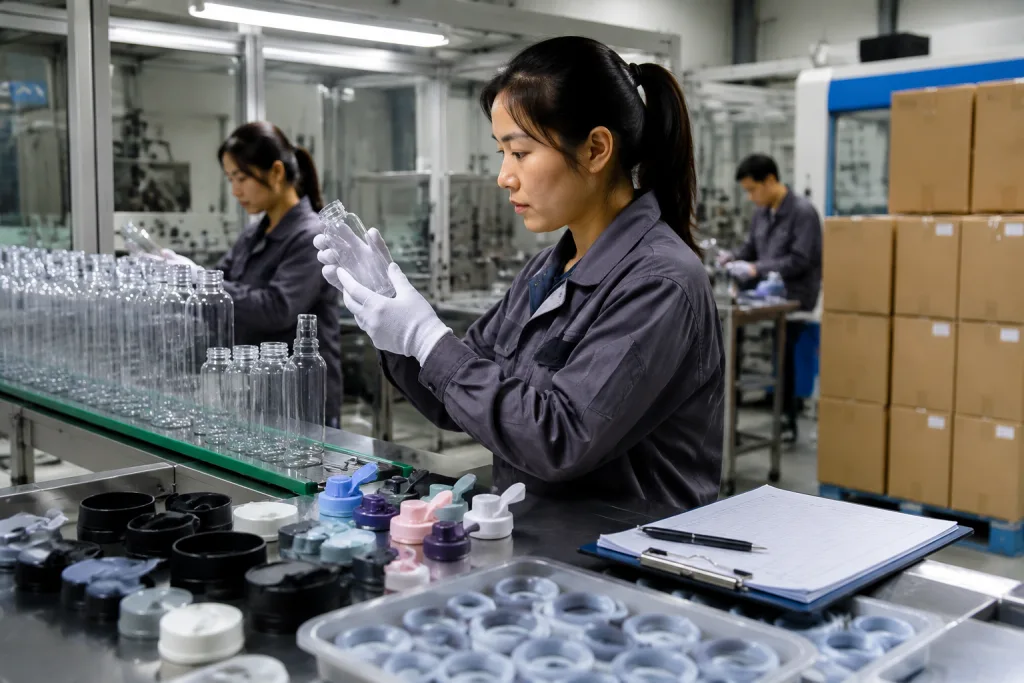
Tritan sells because it looks close to glass and does not shatter when a carton gets dropped off a pallet. Fair. But clear plastic still fails. On the line, QC usually pulls the first bad sample for visual defects: haze under the light box, black specks from a dirty hopper, sink marks near the base, or a yellow cast that makes a new bottle look like it sat in a warehouse for 18 months. We have seen buyers flag this at pre-shipment inspection with 3 bottles out of 80 samples already showing streaks.
The problem often starts before the mold closes. Tritan resin must be dried correctly, commonly around 80-90°C for 4-6 hours depending on grade and moisture level. We run a hopper dryer with a dew-point check, not just a hot-air blower, because wet resin gives bubbles and silver streaks fast. If a supplier cuts drying from 6 hours to 3 hours to catch a vessel date, the math does not work. If recycled or mixed resin gets into production, clarity changes from batch to batch and impact performance becomes a guess. For Europe and North America, require virgin copolyester resin and written material traceability by batch, with the resin lot number matching the PO and injection record.
For a tritan drink bottle bulk order, “BPA-free” is the wrong spec to stop at. Ask for the exact resin grade, food-contact declaration, and test scope tied to your selling market. Common buyer documents include EU 10/2011 migration testing, LFGB if you sell into Germany, FDA food-contact compliance for the U.S., and REACH or California Proposition 65 screening where relevant. For kids products, ASTM or CPSIA-related requirements may apply depending on design and market. One buyer once sent a PO saying “Tritan or similar”; QC pulled the sample, and purchasing had no legal basis to reject the cheaper copolyester the vendor tried to ship.
Wall thickness needs a number on the drawing. For most 500 ml to 1000 ml bottles, 1.2-1.6 mm is a practical range. Go thinner and the bottle flexes too much in a squeeze test or deforms when a container sits at 55°C in summer transit. Go much thicker and your landed cost rises quickly, especially once the carton weight jumps past a courier bracket. If you also source a bulk canteen or wholesale canteen style with a wide body, check the base and shoulder with calipers; uneven cooling can leave a 1.5 mm wobble that looks small in the factory but looks sloppy on a retail shelf.
Leak Claims Start At The Cap
Buyers love to argue about wall thickness and Tritan clarity. Fine, but 8 out of 10 leak complaints we see start at the lid. Last month QC pulled 32 samples from a 12,000 pcs run: the bottle bodies passed the 1.0 m drop test, while 5 caps seeped because the silicone gasket sat 0.4 mm too low in the groove. One leaking bottle in a retail carton can turn a clean drinkware bulk order into debit notes, photo claims, and 1-star reviews.
Spec the sealing system like an engineer, not a catalog buyer. The gasket needs a fixed material, usually food-grade silicone, with hardness around 40-60 Shore A depending on the lid structure. We run a Shore A durometer check before the line starts, and the thread engagement gets checked on both sample and production parts with a go/no-go gauge. For screw caps, we want smooth closure without cross-threading after 20 open-close cycles. For flip lids, the hinge pin and locking latch need cycle testing. The cheap latch is the trap; it feels fine at sample stage and starts missing after 300 cycles.
For bulk drinkware orders, use a simple leak test and write it on the PO: fill to 95% capacity, tighten the lid to the agreed torque, invert for 24 hours, then shake horizontally for 30 seconds. We usually set torque with a digital torque meter, not by “hand tight,” because that phrase causes arguments during inspection. For sports bottles, add a side-pressure test because soft bodies can push liquid through a weak spout seal. If you are buying canteen wholesale products for outdoor or school channels, require testing after a 1.0 m drop onto plywood or a rubber mat, not concrete unless the design is sold as rugged.
Do not mix lid designs casually in the same purchase order. We have seen this go sideways when a buyer combined Tritan bottles, beer tumbler bulk items, and a growler bulk program to fill a 40HQ, then used one shared QC line on the inspection sheet. Wrong question. The buyer flagged the leak rate, but the real issue was that every lid system needed its own checklist. A beer growler wholesale bulk lid with a carry loop is not tested like a straw cap for gym bottles. Treat each closure as its own risk item.
Decoration Looks Cheap When Underspecified
Logo problems are avoidable, but only if you stop approving artwork as a PDF only. We ask for AI or CDR artwork, a 1:1 logo position drawing, and one marked bottle sample from the line. Tritan decoration usually means screen printing, pad printing, heat transfer, sleeve labels, or laser marking on stainless or coated parts in a mixed design. Each method has limits. Fine white text on a curved transparent bottle looks clean on a render; QC pulled 12 samples last month where the same text looked gray and thin after printing.
For screen printing, define Pantone codes, print size in millimeters, placement tolerance, and adhesion test. A reasonable placement tolerance for 600 ml and 750 ml bottles is ±2 mm, but curved shapes and tapered bodies need more room. For adhesion, we run a 3M tape test after 24 hours curing. If the logo lifts, the surface treatment, ink system, or curing time is wrong. For dishwasher-safe claims, be careful. This is where we have seen buyers push too hard. Many decorated Tritan bottles survive hand washing but lose print quality after 20-50 dishwasher cycles, especially with aggressive detergent; the math doesn't work if the target price already leaves no space for better ink and longer curing time.
Brand owners looking for the best wholesale drink bottle often ask for a large wraparound logo, measurement scale, matte finish, and 500 pcs MOQ. That mix can be done, but not at the lowest price point. A matte texture hides small scratches, but it can blur logo edges by 0.2-0.4 mm. A full-body print raises rejection risk because one dust dot from the screen table becomes visible on the clear wall. We ship retail jobs only after the buyer approves a pre-production sample under store-style lighting, not just under the bright inspection lamps in our Zhejiang workshop.
Decoration also matters when you combine ranges: alcohol flask bulk, beer tumbler wholesale, and Tritan sports bottles may share one brand theme, but the decoration process is not the same. An alcohol flask wholesale bulk order on 304 stainless steel can use laser engraving from a fiber laser machine, while Tritan needs ink adhesion validation and a checked curing record. Do not force one artwork rule across all drinkware wholesale categories. We have seen this go sideways when a PO says “same logo process for all items” and the buyer flagged peeling print on the Tritan bottle after first wash.
Capacity And Fit Are Not Cosmetic
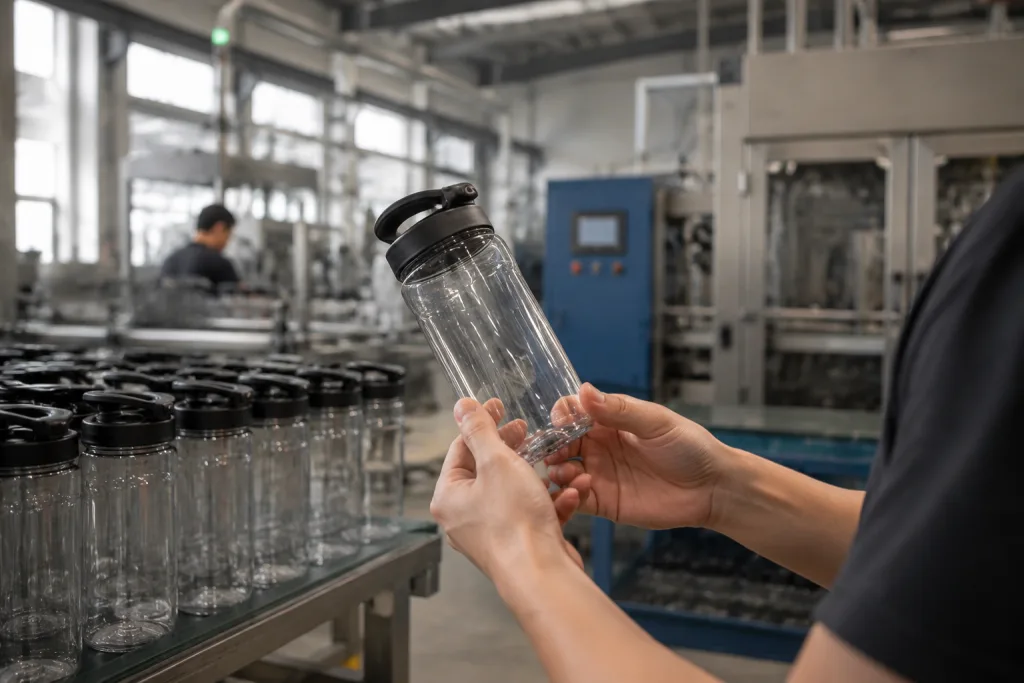
Capacity arguments usually start with a measuring cup. We run into this on 750 ml Tritan bottles all the time: 750 ml brimful on the bench, about 700 ml at the printed fill line after QC pulls the sample and checks it with a 1,000 ml graduated cylinder. Retail customers do not drink from a brimful bottle. Define the claim on the PO as brimful, nominal, or fill-line capacity, then write the tolerance as ±3%. Miss that line and the buyer flagged it later, not the factory.
Fit failures show up after the carton is already booked. Bad timing. A bottle that looks fine in a render may miss a car cup holder by 4 mm, rattle in a bicycle cage, or sit too tall for a backpack side pocket. If your channel sells sports, school, or outdoor accounts, send target dimensions in millimeters: total height, body diameter, mouth diameter, cap height with thread, and handle clearance measured with calipers. For a bulk canteen or canteen bulk order, we also check shoulder width and strap slot size because outdoor buyers attach clips or paracord. For a beer growler in bulk program, neck finish and cap compatibility matter more than body clarity; chasing clarity first is the wrong question to ask.
MOQ moves when tooling and color change. At BottleForge Industrial in Hangzhou, Zhejiang, a normal custom-color Tritan bottle order starts around 3,000 pieces per color for existing molds, while a private mold can require 20,000-50,000 pieces to justify tooling and setup. Our practical monthly capacity for plastic and stainless mixed drinkware is about 450,000 units/month, but color batching still controls the line. If one PO splits into smoke grey, pink, navy, and clear, we set four resin batches, four color checks under the light box, and four chances for a 2 mm cap shade mismatch. The math gets tighter fast.
For FOB China pricing, a plain 650-750 ml Tritan bottle with a standard lid often lands around USD 1.45-2.80, depending on cap parts, packaging, resin grade, and decoration method. A premium lid with lock, silicone grip, and carry handle can add USD 0.35-0.90. When a quote comes in 20% below the market, do not celebrate yet. Check the resin spec, lid gasket thickness, carton strength in kg, and inspection standard; we have seen this go sideways when the PO says AQL 2.5 but the supplier packed soft cartons to save USD 0.06 per unit.
Cartons Break Quietly First
Packaging failure looks boring until the claim hits your inbox. Tritan bottles are light, so buyers sometimes approve a thinner carton to save USD 0.03-0.08 per unit. Bad trade. We’ve seen 1x40HQ arrive with 600+ crushed retail boxes after the forwarder stacked heavy kitchenware on top during ocean freight. The bottles were fine, but the Amazon photos were not. A container from China to Europe or North America can take 25-45 days, with humidity, vibration, compression, and 8-12 handling touches before final delivery.
For export cartons, specify 5-ply corrugated for most retail-packed orders and lock the carton size, gross weight, and drop-test rule on the PO before artwork approval. We run a simple 76 cm corner-edge-face drop check on packed cartons when the buyer asks for it. A carton above 15 kg gets messy fast; warehouse staff stop placing it cleanly and start dragging it. For retail boxes, ask for at least 350 gsm paperboard if the box needs shelf presence. If you sell through marketplace fulfillment, confirm barcode placement, FNSKU labels where required, suffocation warnings for polybags, and master carton markings before mass packing starts. One buyer once sent “FNSK” on the PO instead of “FNSKU”; QC pulled the sample, and that typo saved a relabeling bill.
Do not assume one packaging method works for every category. Beer tumbler in bulk with stainless walls needs dividers or PE sleeves, because abrasion marks show up after 12 hours on the vibration table. Beer growler bulk shipments need thicker inserts around the neck and handle, where impact concentrates. Alcohol flask in bulk ships compactly, but polished surfaces scratch if the line packs them bare. Tritan bottles need cap and body protection, especially glossy finishes; we’ve seen the buyer flag hairline scuffs under 600 lux inspection lamps.
A pre-shipment inspection should include carton drop checks, barcode scanning, carton count, gross weight, and packaging conformity. Use AQL 2.5 for major defects and 4.0 for minor defects as a baseline. If your buyer has strict retail packaging rules, add a special inspection level for labels and barcodes; the normal visual check misses too much. Packaging errors are not fixed cheaply after the goods leave Zhejiang. The math doesn't work.
Compliance Files Must Match Shipment
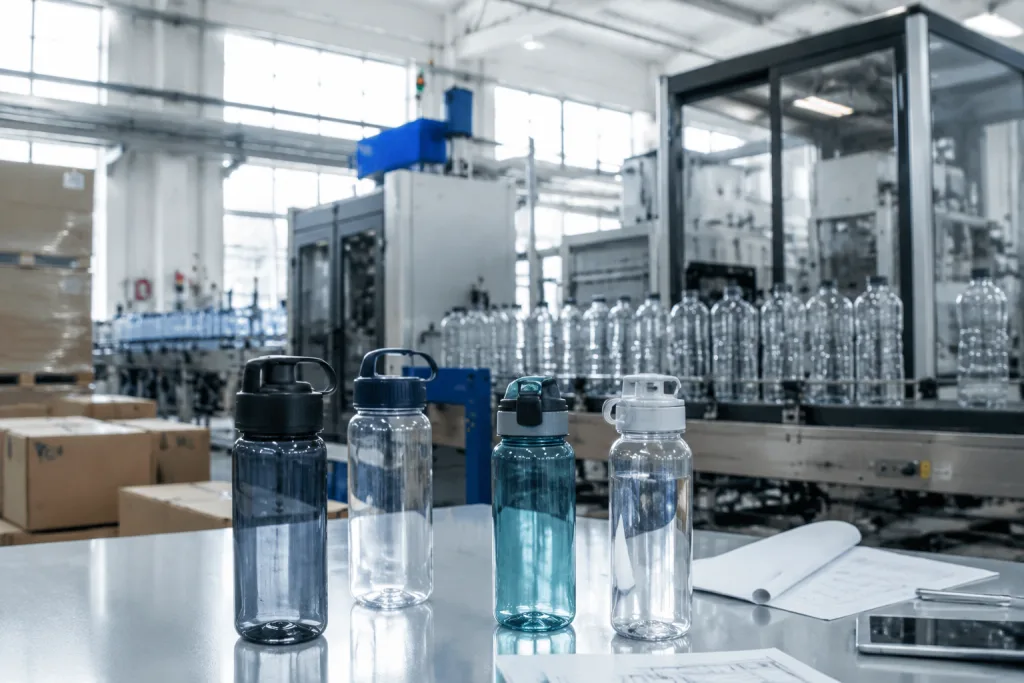
The riskiest compliance mistake is using an old test report like a blanket pass. A report for one Tritan bottle, one Pantone color, and one lid does not cover a new pigment, gasket, coating, or resin supplier. We have seen this go sideways: QC pulled a 750 ml sample from the line, but the file showed model T600 with a PP lid from 14 months earlier. The buyer flagged it after deposit because the factory had sent a generic BPA-free report, and nobody matched the model number, material name, resin lot, and report date against the actual shipment.
For tritan drink bottle bulk sourcing, build the compliance folder before the 30% deposit. We run it as a checklist: resin declaration with the supplier name, food-contact report tied to the bottle model, pigment confirmation for colored bodies, silicone gasket declaration with Shore hardness if available, packaging notes for inks or stickers when the retailer asks, and audit files only when the buyer’s vendor manual requires them. BSCI, ISO 9001, or Sedex documentation does not prove food-contact safety. It shows whether the supplier has audit discipline, which still matters when the PO has a typo like “TR-800” but the carton mark says “TR800-BK.”
If you sell into the EU, migration testing has to match the material and use condition. Cold-water bottle? Test it as a cold-water bottle. Do not let the factory test weak claims just to cut the schedule from 18 days to 12 days; the math does not work if your packaging later says hot-fill or dishwasher-safe. Once those claims are printed, you need evidence in the file. North American programs often ask for FDA-related documentation, Proposition 65 review, and retailer restricted-substance checks, and we usually see the buyer’s lab reject files when the coating code on the report does not match the spray room record.
This goes past Tritan. A wholesale growler or beer growler wholesale order can involve 304 stainless, silicone seals, powder coating, and pressure wording on the gift box. Beer tumbler wholesale bulk programs need coating or paint reports when the customer’s hand touches the outside all day. Alcohol flask wholesale items need inner surface review and cap material confirmation. Simple rule: every material touching liquid or hands must be named, controlled, and documented, or QC should stop the sample before we ship 3,000 pcs with the wrong file.
Sampling Should Try To Break It
A sample is not a souvenir. It is a small stress test for mass-production trouble. We have seen 3 buyers approve a glossy hand-picked bottle, then push back when the 20,000-piece bulk run showed a 0.4 mm lid gap. Ask if the sample came from existing stock, pilot production, or the same mass-production tooling we will run on the line. A CNC sample or polished display piece can hide sink marks, rough parting lines, and gasket tolerance problems.
Use sampling in stages. First, use a reference sample to lock the structure and target price. Then approve color, logo position, and packaging with a pre-production sample; QC should measure the print with a caliper, not just say it “looks close.” Keep one sealed golden sample at the factory and one in your office. The golden sample should include bottle with final wall thickness, lid with fitted gasket, straw if used with its cut length, retail box with barcode, carton mark with shipping text, and instruction leaflet. For custom drinkware bulk orders, this stops arguments during final inspection when the buyer flags a logo 2 mm too low.
Lead time should be written plainly on the PI. For existing molds, expect 7-10 days for sampling after artwork confirmation, then 35-45 days for mass production after sample approval and deposit. Private mold programs can add 25-40 days for tooling and trial corrections, especially when the first T1 shot shows whitening near the shoulder or a lid thread that binds after 6 turns. During peak months before summer or Q4 promotions, add 10-15 days of buffer. China factories do not become faster because your retailer changed a launch date. The math doesn't work.
When comparing suppliers, watch how they answer failure questions. A serious factory will discuss torque in N·cm, wall thickness in mm, AQL, resin grade, and carton compression on a 32 kg master carton. A weak supplier will repeat “no problem” and push for deposit before checking the drawing. We’ve seen this go sideways: QC pulled the sample, the lid leaked after 30 seconds upside down, and the supplier still called it acceptable. Whether you source Tritan bottles, canteen wholesale stock, wholesale growler programs, beer tumbler wholesale items, or alcohol flask wholesale bulk orders, the supplier’s willingness to define defects beats a glossy catalog.
Send your Tritan bottle spec for factory review
We will check MOQ, resin, lid risk, packaging, and realistic FOB pricing before you lock the purchase order.
Frequently asked questions
What MOQ should I expect for tritan drink bottle bulk orders?
For existing molds, a realistic MOQ is 3,000 pieces per color for a custom Tritan drink bottle. Some China suppliers quote 1,000 pieces, but pricing is usually higher and color control may be weaker. If you need a private mold, expect 20,000-50,000 pieces over the first project to make tooling worthwhile. Mixed drinkware bulk orders can combine Tritan bottles with canteen wholesale or beer tumbler bulk items, but each model and color still has its own setup cost. Always ask whether MOQ is per SKU, per color, or per total PO.
Is Tritan better than stainless steel for wholesale drinkware?
Tritan is better when you need lightweight, clear, BPA-free bottles at a lower landed cost. A 650-750 ml Tritan bottle often costs about USD 1.45-2.80 FOB China, while insulated stainless drinkware usually starts higher because of vacuum construction. Stainless is better for hot drinks, insulation, and premium weight. Tritan is better for gyms, schools, hydration tracking, and visible liquid level. Many brand owners run both: Tritan sports bottles for volume, stainless tumblers for margin, and wholesale growler or beer growler wholesale programs for specialty channels.
What quality tests should be included before shipment?
At minimum, include visual inspection, capacity check, 24-hour inverted leak test, cap open-close cycling, logo adhesion test, barcode scan, carton drop check, and carton count. Use AQL 2.5 for major defects and 4.0 for minor defects unless your retailer demands stricter limits. For Tritan, confirm clarity, black specks, flow marks, wall thickness, lid fit, gasket position, and odor. If the bottle is sold for kids or food-contact use in Europe or North America, require matching test reports before production ships from Zhejiang or any other China origin.
Can I combine Tritan bottles with growler bulk or alcohol flask bulk items?
Yes, but treat them as separate product families. Tritan bottles, beer growler in bulk orders, alcohol flask in bulk items, and beer tumbler in bulk programs use different materials, tooling, decoration, and QC tests. Combining them in one container can reduce freight cost, but it does not remove individual MOQs or compliance requirements. A stainless alcohol flask wholesale order may need inner surface checks and laser engraving approval, while Tritan needs resin traceability and ink adhesion testing. Shared branding is fine; shared inspection criteria are not.
How long does a custom Tritan bottle project take?
For an existing mold, plan 7-10 days for samples after artwork and color confirmation, then 35-45 days for mass production after deposit and sample approval. Add 5-10 days for testing if you need new food-contact reports, and longer if the lab queue is full. Private tooling usually adds 25-40 days before production can start. If your launch depends on retail delivery dates, build a 2-week buffer for inspection, rework, or vessel delays. A rushed wholesale drinkware project usually fails at packaging, color, or lid testing.