Key Takeaways
- Standard Tritan bottle MOQ is usually 3,000 units per SKU; custom color starts around 5,000 units
- BottleForge capacity is about 350,000 Tritan and plastic drinkware units/month in Zhejiang
- Realistic FOB China pricing for 600-750 ml Tritan bottles is USD 1.10-2.40 depending on cap and logo
- Use AQL 2.5/4.0 inspection plus leak, drop, and odor checks before balance payment
You do not buy a Tritan bottle by asking for “a clear plastic water bottle.” That RFQ gets you 3 quotes that look close, then QC pulls the pre-production sample and finds different resin grades, cap seal hardness, and 0.8 mm versus 1.1 mm wall thickness after the deposit is paid. For tritan bottle wholesale, the spec sheet is the commercial document, not decoration.
From our Hangzhou, Zhejiang export desk, the cleanest RFQs define the bottle line by line: resin code, capacity in ml, lid structure with silicone ring size, decoration method, packaging drop test, testing files, Incoterm, and delivery window. We had one PO last month with “TRIAN” typed in the material field, and the buyer flagged it only after artwork approval; small typo, big risk. China can ship cheap bottles fast, but the math doesn't work if you let the line decide which corners to cut.
Resin Grade And Buyer Risk
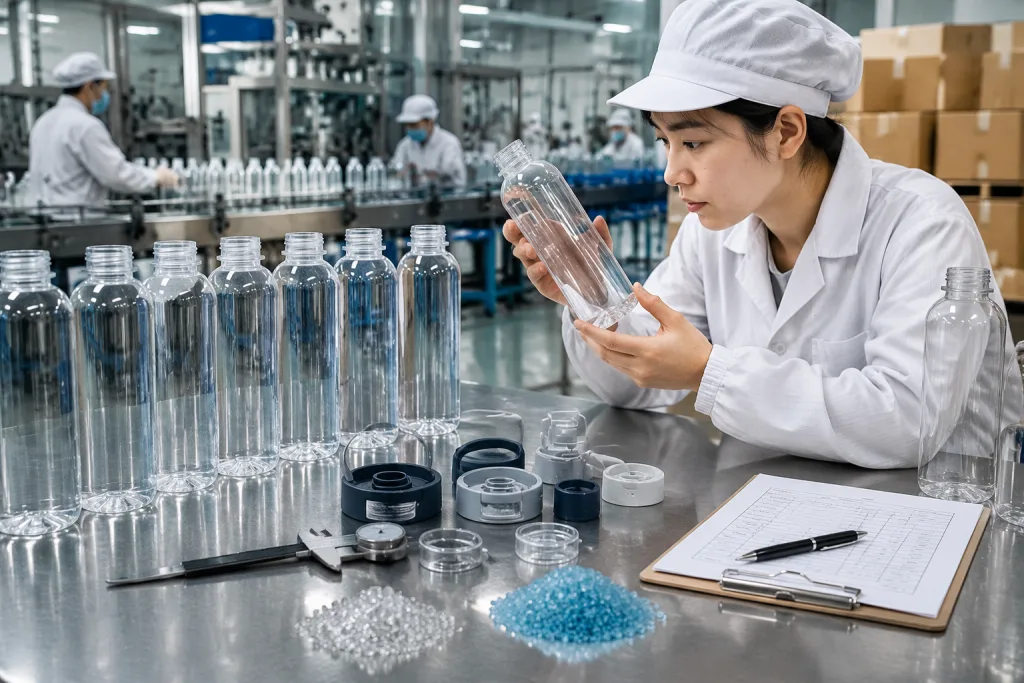
The first spec line should name the resin grade, not just “Tritan.” Tritan is a copolyester family, so we ask the resin trader for the Eastman lot number, COA, and resin declaration before the mold trial starts. For most sports bottles and daily hydration bottles, we quote Eastman Tritan TX1001 or a buyer-approved equivalent when the brief calls for BPA-free clarity and drop resistance with a glass-like look. On our line, QC records the resin bag label before drying; one missing batch sticker on a 25 kg bag is enough for us to hold the lot.
The buyer risk is simple: unclear resin means unclear compliance. For EU sales, ask for food-contact declarations aligned with EU 10/2011, LFGB where needed, and REACH/SVHC screening. For the U.S., ask for FDA food-contact compliance plus California Prop 65 review if your distributor requires it. A proper China factory will not push back on this; we run these document checks before PP sample approval. If a supplier writes “Tritan style” or “same as Tritan” on the PI, treat it as another material and price it separately. We have seen this go sideways when a buyer flagged the wording at final AQL 2.5 inspection.
For tritan bottle wholesale programs, keep resin natural-clear unless brand color matters more than inspection risk. Clear resin makes black specks easy to catch under a light box, and flow marks show up before 30 cartons are packed. QC pulled the sample faster last month because one 650 ml bottle had a burnt dot near the shoulder, about 1.5 mm wide. Tinted smoke, amber, and gradient colors look premium, but loose color control can hide contamination and add 1-3% rejects. The math does not work on a 3,000 pcs MOQ if the brand is chasing a small color effect and then rejects cartons at shipment.
Do not specify Tritan for boiling-water use. Wrong question. Tritan works for cold and warm drinks, not tea filled at 100°C. If your assortment also includes beer tumbler wholesale, beer tumbler bulk, or alcohol flask wholesale items, split those into stainless steel or glass specs with their own wall thickness, lid fit, and packing tests. We ship Tritan hydration bottles for outdoor and gym channels; we do not sell it as the universal answer for every drinkware bulk SKU.
Capacity, Wall, And Mold Tolerance
Capacity is where RFQs get messy. We see about 6 out of 10 first inquiries write only “750 ml,” then the buyer flags a mismatch after the first carton layout. Write both nominal and brimful capacity. A 750 ml bottle may hold 770-790 ml to the brim, but your label, online listing, and carton mark need one commercial number. Common wholesale drinkware sizes are 500 ml, 600 ml, 750 ml, and 1,000 ml. For kids or gym channels, 500-650 ml usually sells faster. For outdoor kits and corporate wellness orders, 750-1,000 ml gives the buyer enough perceived value to defend the higher unit price.
Wall thickness matters more than buyers expect. A cheap 650 ml Tritan bottle may use a 1.3-1.5 mm wall. It feels light. The problem is flex: the body can dent visually, and the tap test sounds hollow on the QC table. For better shelf presentation, specify 1.8-2.2 mm average wall thickness, with no thin point under 1.5 mm at the shoulder. If the bottle is square or has grip grooves, ask for flow simulation or a pre-production sample; corners thin out first, and we have seen QC pull samples with 1.2 mm at the groove while the straight wall looked fine.
Mold tolerance also affects caps and labels. A threaded neck tolerance of plus or minus 0.15 mm is reasonable for stable sealing. Wider variation creates leak complaints that look like cap failure, but the issue often starts at the bottle neck. We run a go/no-go thread gauge before packing when the cap fit is tight. If you plan full-wrap labels, define the label panel diameter tolerance, usually plus or minus 0.3 mm, or the label artwork may creep across batches. The math does not work if the PO says “same as sample” but the artwork has a 1 mm join line.
When you compare tritan bottle wholesale quotes from China, ask whether the price is for an existing mold or a private mold. Existing mold sampling can be 5-7 days; on our line, that usually means cutting color chips first, then sending 2-3 molded samples by DHL. Private mold development is usually 25-35 days for first T1 samples, with tooling from USD 2,500-8,000 depending on body complexity and cap design. Private mold is not always the smarter choice. If your first order is below 3,000 pcs, the tooling payback can go sideways unless the shape protects your retail channel.
Lid Structure Defines Complaints
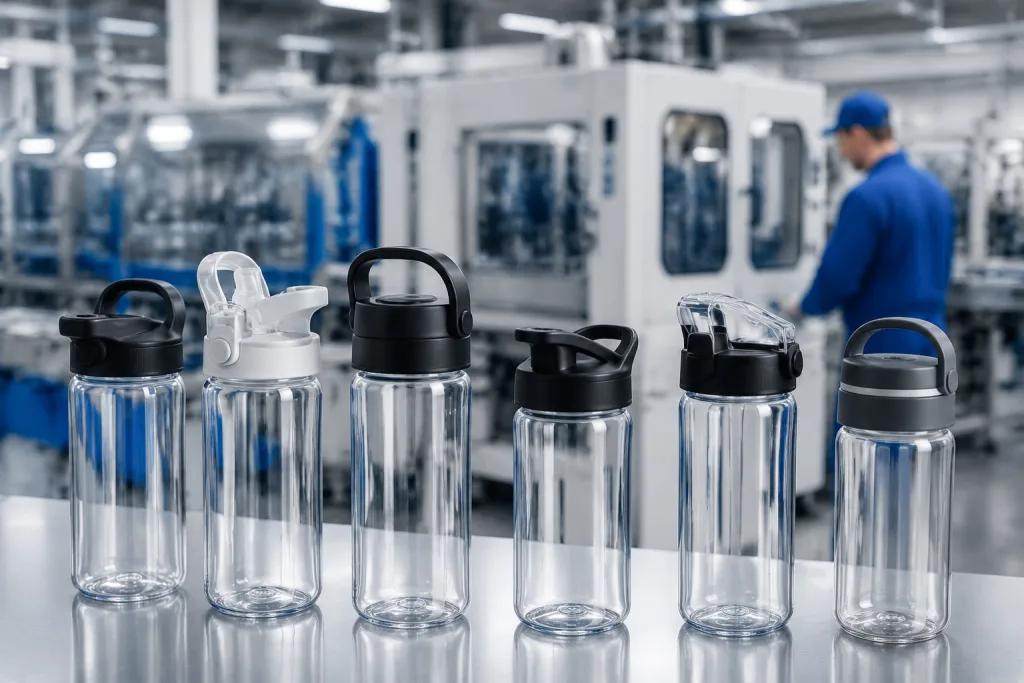
The cap is where warranty costs hide. On a wholesale drink bottle, the body can pass every visual check, then one weak hinge pin or a silicone ring sitting 0.3 mm proud gives you 200 leak complaints in week one. We run lid assembly with a go/no-go pin gauge on the hinge boss, and QC pulled the sample last month after the buyer flagged “water in backpack” photos from Amazon reviews. Your spec should name the lid type: screw cap, flip straw, chug lid, push-button lid, handle lid, or locking sports lid. Then lock the materials: PP cap, food-grade silicone gasket, Tritan or PP straw, and stainless steel hinge pin if applicable.
A basic screw cap is still the safest cheap option, often adding only USD 0.18-0.35 compared with a naked bottle body. Simple wins. A flip straw lid can add USD 0.45-0.90 depending on spring spec, lock tab thickness, dust cover fit, and straw cut length. For e-commerce, I prefer a locking chug lid over a complicated straw lid unless the brand has a customer service team that answers within 24 hours. We have seen this go sideways: the line passed 3,000 pcs, but a 0.6 mm flash on the button made shoppers think the lid was broken. Fewer moving parts means fewer returns.
Leak testing belongs in the PO, not in a WeChat note after production starts. We use 100% air-pressure or water-fill leak checks for selected lid structures, plus random inverted testing for 4 hours during QC. For sports lids, add a 1.0 m drop test on a filled bottle at room temperature. QC should test the bottle full, cap closed, and lid facing down on the concrete pad; an empty drop tells you almost nothing. A lid that survives an empty drop but cracks when full is not ready for wholesale drinkware distribution.
If your range also includes canteen wholesale, bulk canteen, canteen bulk, or wholesale canteen SKUs, do not reuse the same cap logic blindly. This is the wrong question to ask. A canteen may need a tethered cap, wider mouth, and glove-friendly handle, and we normally check handle pull with a 12 kg load for bigger outdoor SKUs. The same warning applies to bulk growler, growler bulk, growler wholesale, and wholesale growler projects. Larger liquid volume increases stress on threads and handles, especially in transit, and one loose master carton insert can turn a good cap into a cracked-return problem.
Decoration Line On The Spec
Do not write “logo printed” on the spec sheet. Too loose. For tritan bottle wholesale, the decoration method changes the quote and the reject rate on the line. We run one-color silk screen, multi-color screen, heat transfer, UV print, sleeve label, and laser marking on a stainless accessory, but transparent Tritan usually behaves best with one-color silk screen for B2B orders. MOQ can be 3,000 units with a setup charge of USD 50-120 per color, and QC will check the first 30 bottles with a 3M tape test before we release bulk printing.
Multi-color logos look clean in a mockup, but registration is where jobs get messy. If your logo has thin lines under 0.3 mm, expect distortion on curved bodies; the jig cannot fight the bottle radius forever. Heat transfer gives stronger color coverage, but it can peel if the surface treatment is weak or the user scrubs with a hard sponge. UV print handles detailed artwork, but it runs slower and often costs USD 0.20-0.60 more per unit. For promotional bulk drinkware, that math doesn't work unless the logo detail sells the item.
Ask the factory to confirm dishwasher positioning on the actual decorated bottle, not just the bare Tritan body. Some Tritan bodies tolerate dishwasher top-rack cycles around 70-80°C, but the ink may fail first. If your retail claim says dishwasher safe, test the decorated sample for 20 cycles before mass production; QC pulled one sample last year that passed the fingernail test, then faded after 8 alkaline detergent cycles. We’ve seen this go sideways.
Artwork files should be AI or PDF vector, with Pantone solid coated references for spot colors and a marked print area in millimeters. Do not approve a WeChat photo or email screenshot as the color standard. Use a signed pre-production sample. It slows the first order by 3-5 days, but it prevents arguments when 10,000 bottles arrive with a blue that looks too purple under warehouse lighting; one buyer flagged this after the PO typo listed 286C while the approved artwork showed 285C.
MOQ, Price, And Incoterm Reality
For BottleForge in Zhejiang, we run 3,000 units as the practical MOQ per existing bottle mold and per logo design. Custom body color starts at 5,000 units in most cases; the injection line has to purge the old Tritan resin, and we can lose 18-25 kg before the color chip matches the buyer’s Pantone target. Private mold projects should start at 10,000 units if you want the tooling math to work. Our monthly output for Tritan and related plastic drinkware is about 350,000 units, but peak-season slots still need booking 20-30 days ahead. Miss that window, and the line will not wait.
Typical FOB China pricing for a 600-750 ml Tritan bottle runs USD 1.10-2.40. The low end is a screw cap, one-color logo, and basic opp bag; the high end has flip lid, silicone boot, carry strap, color box, plus a heavier carton with better edge crush. Last month QC pulled a 720 ml sample where the “Tritan” quote was USD 0.65, and the resin certificate named a different copolyester grade. Ask for the resin certificate before talking freight. The math doesn’t work at that price.
Use FOB Ningbo or FOB Shanghai if your forwarder controls consolidation. Use EXW only if your team already handles China domestic pickup, export declaration, and VAT paperwork without chasing the factory for screenshots at 9 p.m. For Amazon or distributor DC delivery, quote DDP separately and confirm FBA carton labels, FNSKU labeling, and master carton limits. A good bottle packed in a 19 kg carton can still fail receiving if the carton is oversized or missing a side mark; we have seen DCs reject cartons because the PO number had one digit typed wrong.
Buyers mix keyword categories when building a line: drinkware wholesale, drinkware bulk, bulk drinkware, beer growler wholesale bulk, beer growler in bulk, beer growler bulk, beer tumbler in bulk, and beer tumbler wholesale bulk. Fine for market planning. For quoting, split them by material and process. Tritan hydration bottles need resin traceability and injection mold timing; stainless beer tumblers depend on 304 stainless thickness, vacuum yield, and powder coating loss. Glass growlers and alcohol flask bulk programs sit on different lines, so forcing them into one blended price is the wrong question to ask.

Quality Checks Before Shipment
Attach the inspection plan to the PO. Do not let anyone build it after the line has already packed 32 cartons. For tritan bottle wholesale, we run AQL 2.5 for major defects and AQL 4.0 for minor defects, with critical defects at zero tolerance. Critical defects include sharp plastic flash at the mouth, strong chemical odor, leakage, wrong resin, contaminated inner surface, and failed food-contact documentation. Last month QC pulled a sample where the PO said “Trian” instead of “Tritan”; small typo, big resin-risk conversation.
Functional tests should be dull. Good. Fill random bottles to nominal capacity, close the lid, invert for 4 hours, shake for 30 seconds, and drop selected filled samples from 1.0 m onto plywood or concrete depending on your retail claim. Check cap torque with a torque meter, straw fit with a go/no-go gauge, gasket seating, hinge movement, and carry handle strength. For a 1,000 ml bottle, a handle pull test of 10-12 kg for 60 seconds is a sensible baseline. We have seen buyers ask for “premium outdoor” copy, then refuse the concrete drop test. The math does not work.
Visual inspection should cover black specks, flow lines, gate marks, bubbles, scratches, logo position, color variation, and carton printing, but each item needs a written limit. For transparent bottles, black specks larger than 0.5 mm on the front view should be counted as major if your product is retail-facing. QC usually checks this under a 6000K light booth at about 30 cm, not beside a dusty packing table. For promotional giveaways, you can accept more minor cosmetic marks, but write that tolerance down before production. We have seen this go sideways when the buyer flagged 0.3 mm specks only after the goods reached the forwarder.
Packaging is quality too. Export cartons should normally use 5-ply corrugated board, 44-48 ECT equivalent if the bottle is heavy or packed with accessories. Ask for a carton drop test from 76 cm on one corner, three edges, and six faces if the goods will move through parcel networks. On our floor, the line weighs a packed carton with a 30 kg digital scale before sealing the master carton, because one missing straw bag shows up fast. In Zhejiang and across China, the better factories are not the ones promising zero defects. They measure defects early and send the numbers before shipment.
Send Your Tritan Bottle Spec For Quotation
Share capacity, cap type, logo method, target market, and quantity. We will return a practical FOB China quote and production timeline.
Frequently asked questions
What is a realistic MOQ for tritan bottle wholesale?
For existing molds, 3,000 units per SKU is realistic for tritan bottle wholesale in China. That usually covers one body color, one cap color, and one logo design. If you need a custom Pantone body color, expect 5,000 units because resin color matching creates purge waste and setup time. If you want a private mold, start planning around 10,000 units for the first production order plus USD 2,500-8,000 tooling. Very small orders under 1,000 units are possible only from stock bottles, and your logo options will be limited to basic silk screen, sticker, or sleeve packing.
How do I know the bottle is real Tritan and not cheaper plastic?
Ask for the resin grade, resin supplier declaration, and batch traceability record before deposit. The supplier should be able to state a grade such as Tritan TX1001 or an equivalent approved copolyester, not just “BPA-free plastic.” For EU sales, request EU 10/2011, LFGB if needed, and REACH/SVHC documentation. For U.S. sales, request FDA food-contact support and Prop 65 review if your retailer requires it. During inspection, odor, clarity, and impact feel help, but documents and batch records matter more. If the price is 30-40% below normal FOB China levels, verify material first.
What price should I budget for a custom logo Tritan bottle?
For a 600-750 ml Tritan bottle using an existing mold, budget roughly USD 1.10-2.40 FOB China. A simple screw cap, one-color silk screen logo, and bulk carton packing can sit near the low end. A flip lid, straw, silicone boot, carry strap, color box, and UV print can push the price above USD 2.00. Tooling, lab testing, FBA labels, inserts, and private packaging are usually quoted separately. If you compare this with stainless beer tumbler wholesale or alcohol flask wholesale bulk programs, do not expect the same price curve because metal forming and finishing drive cost differently.
Can I combine Tritan bottles with growlers, canteens, and flasks in one order?
Yes, but treat it as a mixed drinkware wholesale program, not one shared specification. A Tritan hydration bottle, beer growler wholesale item, wholesale canteen, and alcohol flask in bulk order may use different workshops, tooling, packaging, and compliance files. You can combine them under one purchase order and one container if schedules align. The risk is lead time mismatch: Tritan bottles may need 25-35 days, stainless canteens 35-50 days, and glass or growler wholesale items longer if decoration is complex. Ask your supplier to build a shipment matrix by SKU, ready date, carton size, and CBM.
What inspection standard should I put on the purchase order?
Use AQL 2.5 for major defects, AQL 4.0 for minor defects, and zero tolerance for critical defects. Critical defects should include leakage, sharp flash on drinking surfaces, wrong material, strong odor, unsafe contamination, and missing compliance documents. Add functional tests: 4-hour inverted leak test, 30-second shake test, 1.0 m filled drop test, cap torque check, gasket seating check, and handle pull test for larger bottles. For retail packaging, include carton drop testing from 76 cm and barcode scan verification. The PO should state that failed critical defects block shipment until rework and reinspection are completed.