Key Takeaways
- A practical Tritan bottle MOQ starts around 3,000 pieces per color for custom logo work
- For 750 ml bottles, expect 1.2-1.8 mm body wall thickness depending on shape and mold design
- AQL 2.5 for major defects and AQL 4.0 for minor defects is a reasonable export QC baseline
- Normal lead time is 25-35 days after artwork, sample approval, and deposit
You are not just buying a clear plastic bottle. You are buying a live SKU that has to pass a 1.2 m carton drop test, hold up to dishwasher wording on the retail box, keep the logo from rubbing off after 3M tape checks, scan cleanly at the barcode station, match customs paperwork, and answer the German or California buyer who asks, “Show me the BPA-free proof.”
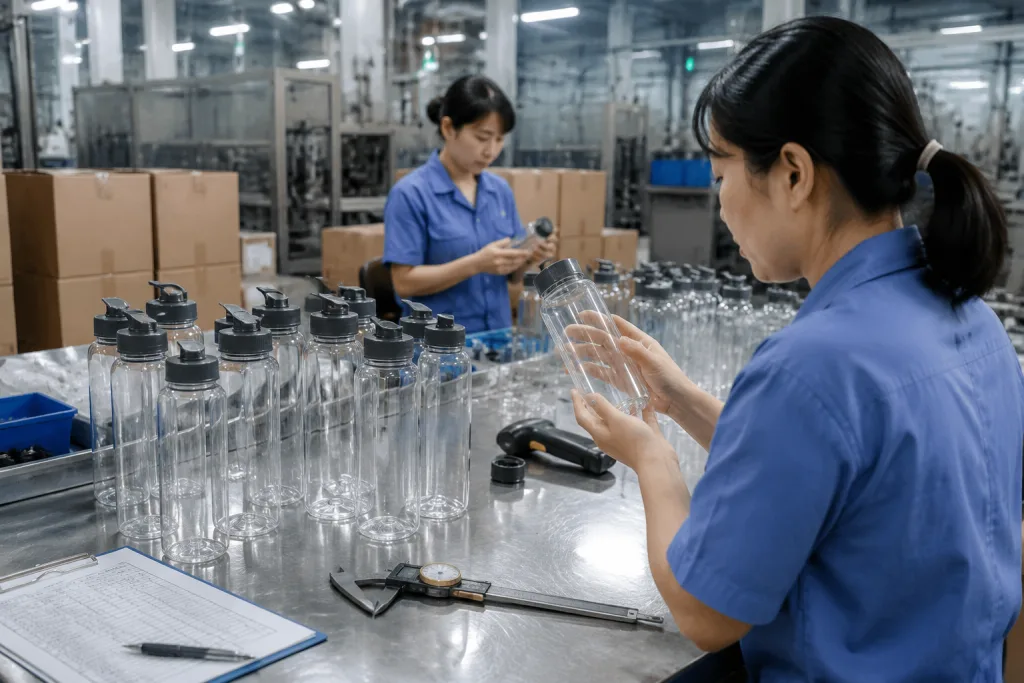
Here is a normal order we run: 5,000 pieces of 750 ml Tritan bottles for a European outdoor goods distributor. BottleForge Industrial in Hangzhou, Zhejiang handles this kind of custom drinkware project every month, with 300,000 units/month practical capacity across Tritan, stainless steel, and glass lines in China. Simple goal. Lock the spec tight enough that QC pulls sellable samples before packing, not 42 cartons of cheap stock with leaking lids or a PO typo on the color code.
Start With The Actual Sales Channel
The first mistake we see with tritan bottle vendors is asking for FOB price before saying where the bottle will sell. This is the wrong question to ask. A 750 ml bottle for a gym chain and a school fundraiser may share the same mold number on our quotation sheet, but QC checks them differently. Last month the buyer flagged a 0.6 mm logo shift on a retail sample; for a giveaway order, the same shift would probably pass.
For this buyer scenario, you are a canteen distributor serving outdoor retailers in Europe. You need a clear Tritan sports bottle with a carry loop, flip straw lid, one-color logo, retail carton, and GS1 barcode. You also want a second option for a canteen promotional campaign where the same body uses a cheaper polybag pack. On the line, that changes the packing table setup: color box orders run about 900 pcs per worker per day, while polybag packing runs closer to 1,600 pcs.
That channel detail changes the spec. Retail cartons need tighter print registration, usually within 1 mm, and we run a simple carton drop test from 80 cm before mass packing. Promotional bulk packs need faster packing speed and lower unit cost. If you sell through online marketplaces, ask early about FNSKU labeling, suffocation warnings on polybags, and carton dimensions, because a 2 cm mistake on the master carton can push you into a higher fulfillment fee bracket.
A reliable canteen supplier should ask about your channel before pushing a standard model. If they skip that, you need to control the specification yourself. Ask for bottle capacity, brimful capacity, net weight, lid material, gasket material, leak test method, carton quantity, master carton size, and HS code before you compare FOB prices. We run leak testing with the bottle inverted for 30 minutes; QC pulled the sample once because the silicone gasket was listed on the PO as “slicone,” and that typo followed the order into the packing list.
For Tritan, do not accept loose wording like “food grade plastic” on the spec sheet. The material should be listed as Tritan copolyester or an approved equivalent, with compliance documents available for LFGB, EU 10/2011, FDA food contact, or other destination-market requirements. China factories can provide these, but request them before deposit. After the container is booked, the math doesn't work: re-testing can take 7 to 12 working days, and nobody wants 10,000 pcs waiting in the warehouse because one PDF is missing.
Lock The Bottle Specification Early
Say you pick a 750 ml existing mold because launch is 60 days away. Good call. A new private mold can pay off later, but it usually adds USD 3,000-8,000 in tooling cost and 30-45 days before mass production. On a first PO, the math usually favors an existing mold with tight customization controls; last month our mold room checked a 750 ml Tritan body with a 78.2 mm caliper reading, and it was ready for sampling in 6 days.
Your working specification should look like something the line can run, not a mood board. Write it this way: 750 ml nominal capacity, 78 mm body diameter, 245 mm height, 1.4 mm average body wall thickness, Tritan body, PP lid, silicone gasket, flip straw, matte black lid, transparent smoke gray body, one-color silk screen logo, 60 x 45 mm print area, individual white box, 24 pieces per export carton. QC pulled the sample and measured the print window with a steel ruler before we released the screen plate.
This is where related canteen custom projects go sideways. Buyers approve a rendering, then skip physical color chips, logo size, or lid torque. The factory then runs what fits the line, not what your retail buyer had in mind. We once had a buyer flag a smoke gray bottle because the approved PDF looked closer to tea brown under office lighting; a 30 x 50 mm color chip would have stopped that argument.
For a canteen customizable program, split fixed elements from variable elements. Fixed elements might be the bottle body, lid structure, gasket, straw, carton strength, and compliance standard. Variable elements can be body color, lid color, logo method, barcode, hangtag, and carton artwork. This keeps repeat orders cleaner for canteen distributors, especially when you move from one SKU to six; our packing line needs one carton mark file per SKU, and a wrong barcode on a PO can burn half a day.
At BottleForge in Zhejiang, we normally treat 3,000 pieces per color as the practical MOQ for logo customization on Tritan bottles. Mixed colors can work at 1,000-1,500 pieces per color if the body color is stocked, but custom color injection needs higher volume because resin purging and color matching waste cost money. We run 25-35 kg of resin through the injection machine during a color change, and if the buyer wants Pantone matching under D65 light, one small trial batch rarely gives a clean answer.
Compare Prices Without Fooling Yourself
Ask three tritan bottle vendors for pricing and you might see USD 2.18, USD 2.63, and USD 3.05 for what looks like the same bottle on a PDF quote sheet. Same bottle? Usually not. On our line in Hangzhou, QC pulled two “same spec” samples last month and found one lid used a 1.6 mm silicone gasket while the other used 1.2 mm TPE. The price gap was not just margin; it was packaging, resin grade, printing method, inspection level, and export term.
For a 750 ml Tritan bottle using an existing mold, a realistic FOB Ningbo or FOB Shanghai range may be USD 2.10-3.40 per piece at 5,000 pieces, depending on lid complexity, logo, packaging, and resin cost. A basic single-wall bottle with screw lid and polybag can sit near the lower end. Add a flip straw lid, retail box, color body, and 45 mm logo print, and the cost moves fast because the line needs extra pad-print setup and more lid assembly labor.
Do not compare EXW from one canteen vendor with FOB from another canteen manufacturer. That is the wrong question to ask. EXW leaves inland transport, export declaration, and local handling to you or your forwarder; our truck from Hangzhou to Ningbo port is not free, and one buyer flagged a USD 186 local charge after the PO was already signed. FOB includes delivery to the port and export handling in China. For newer buyers in Europe and North America, FOB gives a cleaner comparison.
Ask every canteen supplier to quote the same structure:
- Product: model number, capacity, material grade, lid type, Pantone color, and logo method with print size in mm.
- Packaging: polybag, white box, color box, or display carton, plus carton quantity and carton thickness.
- Trade term: FOB Ningbo, FOB Shanghai, or DDP only if your team understands duty, VAT, and courier surcharge rules.
- MOQ: per order, per color, and per logo version, because 3,000 pieces split into 6 colors rarely runs like one color.
- Lead time: sample days and mass production days after deposit, with artwork approval date written on the PI.
If a quote is 18% lower than the others, ask what was removed. Sometimes it is harmless. Sometimes the supplier used a lower gasket grade, thinner carton, no drop test, or no third-party inspection allowance. We have seen this go sideways: a buyer saved USD 0.14 per piece, then AQL 2.5 inspection found cracked color boxes after a 76 cm drop test. Cheap works only when the specification is identical.

Approve Samples Like A QC Engineer
Your pre-production sample is not a souvenir. It is the order reference. We treat it like the control sample on the line, the one QC pulls when the inspector says the lid gap looks off or the buyer flags a leak photo from Amazon.
For this order, ask for two sample rounds. Round one: a stock bottle without logo, used to check hand grip, lid snap, straw draw, gram weight on a 0.1 g scale, and mold marks around the shoulder. If the mold is on our shelf, we ship this in 3-5 days. Round two: a pre-production sample with your body color, lid color, logo, and packaging. That usually takes 7-10 days after artwork approval, but the math does not work if the Pantone chip arrives 4 days late.
Test it like you expect trouble. Fill the bottle with room-temperature water, invert it for 30 minutes, shake it for 20 seconds, and leave it on its side overnight on white copy paper so a slow leak shows. Run the lid open-close cycle at least 50 times by hand. Rub the logo with a wet cotton cloth for 30 cycles, then with a dry cloth for 30 cycles. If you claim dishwasher-safe printing, ask for a written test method; a casual “no problem” from sales is the wrong answer.
For a custom canteen order, confirm the artwork file in AI or PDF format, Pantone color, logo position tolerance, and print size tolerance. A fair print position tolerance is often plus or minus 2 mm on curved bottles, measured from the mold parting line with a caliper. If your logo wraps around the body, ask the canteen manufacturers whether they use a rotary screen fixture or manual alignment. Manual alignment costs less, but we have seen it go sideways on 180 mm horizontal graphics when the operator chases the seam by eye.
Keep one signed golden sample at your office and one at the China factory. Write the date, PO number, model, color code, and approved packaging version on the sample tag; last month QC stopped a carton insert mistake because the PO said “blue box” and the tag said “kraft tray.” Small habit. Big savings.
Build Compliance Into The Purchase Order
Write compliance into the purchase order, not a WeChat or email thread that nobody can find during inspection. For Tritan bottles entering Europe, we usually see EU 10/2011 food contact, LFGB for Germany-focused programs, REACH for restricted substances, and packaging rules when the carton ink or hangtag makes a special claim. For the United States, FDA food contact expectations and California Proposition 65 screening depend on the sales channel. Put the exact standard in line 18 of the PO if needed. QC will check against that document, not a buyer’s message from 23 days ago.
Ask for current test reports that match the actual material family. A report for a random plastic kitchen item does not prove your customized drinkware order is compliant. The report should show the tested material, test standard, issuing lab, date, and supplier name or factory connection. Reports older than 2-3 years may still be useful, but 7 out of 10 retail buyers we deal with ask for newer files before they release artwork approval. We have seen this go sideways when the PO says Tritan, the report says PP, and QC pulled the sample from the wrong bin.
If you are a canteen distributor selling to schools or youth programs, ask about CPSIA and ASTM considerations when the bottle is marketed for children. If the bottle is clearly an adult sports bottle, the rules are different, but your packaging language matters. Don’t print cartoon characters and “kids” wording on a bottle without checking the applicable requirements. The buyer flagged one case because the bottle body was 650 ml, but the color box had a “back to school” icon and a child photo on panel 3.
Factory social audits can sit inside the deal too. Some North American and European buyers ask for BSCI, Sedex, or ISO 9001 documentation before onboarding a canteen factory. BottleForge works from Hangzhou, Zhejiang with export production partners in China that can support standard audit documentation depending on the product line and order size. For a 3,000 pcs trial order, the math often does not work for a fresh audit; for 30,000 pcs, we can usually plan the document pack before the line opens.
Put the compliance deliverables in the PO: material declaration, test reports, packing list format, carton marks, country of origin, and any retailer-specific documents. Better yet, attach the file list as Annex A and name the lab report number in the PO remarks. If you wait until final inspection, you can get the goods right and the paperwork wrong, which still delays your shipment. We ship containers, not excuses.

Inspect Production Before It Ships
For 5,000 pieces, final random inspection is not optional if you are building a serious distributor canteen program. The inspection bill is usually cheaper than one pallet of airfreighted replacements, and we have seen the math go sideways after a buyer flagged 300 leaking caps at receiving.
Use ANSI/ASQ Z1.4 sampling or the equivalent ISO 2859 approach. For drinkware, 8 out of 10 buyers we ship for set AQL 2.5 for major defects and AQL 4.0 for minor defects. Critical defects should be zero tolerance. A leaking bottle, sharp plastic burr near the mouth, wrong material, or serious contamination is not a minor issue; QC pulled one Tritan sample last month because a 0.6 mm burr sat right on the drinking lip.
The inspector should check function and appearance, not just take clean photos on a white table. Function checks include leak test with the bottle inverted for 30 minutes, lid fit, straw assembly, gasket presence, cap opening force, print adhesion by 3M tape, barcode scan, carton drop condition, and quantity count. Appearance checks include scratches, black dots, flow marks, color deviation, logo blur, carton printing error, and deformation. Small defects add up.
For this buyer scenario, a practical inspection plan would pull 200 samples from finished and packed goods if the lot size is 5,000 pieces under general inspection level II. You can also request special tests on 20-32 pieces, such as 1-meter drop testing, 60°C warm water exposure, or repeated lid opening. The exact sample size depends on the inspection standard and your risk tolerance, but asking for only 20 random checks on a 5,000-piece PO is the wrong question to ask; the line can hide a bad gasket batch in carton 37 just fine.
Do not let the canteen suppliers inspect only loose bottles before packing. Many problems appear after packaging: wrong barcode, weak carton, missing instruction leaflet, incorrect color box, or mixed logo versions. We once caught a PO typo where “blue lid” became “black lid” on 1,200 color boxes, after the bottles were already packed. If you are shipping to Amazon-style fulfillment, verify FNSKU labels, carton weight, carton dimensions, and “Made in China” marking before the goods leave the warehouse.
Plan Reorders Before The First Shipment
A good first order should make the second order easier. Before shipment, ask your canteen vendor for the production pack: approved artwork, Pantone color codes, carton dieline, barcode list, packing method, and 8–12 QC photos from mass production. We usually save the silk-screen film code and carton knife-line PDF with the PO file. You do not need their mold drawings. You do need enough records to repeat the SKU without asking the buyer to approve everything again from zero.
For customized canteen programs, track sales by color and channel, not just total cartons shipped. We have seen smoke gray move 2,400 pcs through retail, while clear body with blue lid did better in a 5,000 pcs canteen promotion because the logo showed cleaner under store lighting. Your reorder MOQ might drop if the factory still has 180 kg Tritan resin, matching lids, or printed cartons on hand, but the math does not work if storage sits unpaid for half a year. Ask how many days they keep leftover components and whether warehousing starts after 60 or 90 days. We tag those leftovers on a pallet card; if QC later pulls lids with dust marks, the buyer will flag it.
If the line expands, think in families. The same brand may need a 500 ml bottle, 750 ml bottle, custom growler, and customizable growler for outdoor retail, but do not copy-paste the same spec sheet across all sizes. A distributor growler program may switch to stainless steel rather than Tritan, while the QC logic stays close: material proof with batch number, leak testing at the cap, logo durability after 3M tape pull, carton drop strength, and AQL inspection. On the line, a 0.3 mm lid gap looks small until 20 cartons come back with seepage claims.
Reliable canteen vendors are not order takers. They should warn you when your logo has 0.2 mm lines that will break in silk screen, when a translucent color shifts between resin batches, or when your target price forces a thinner lid gasket. That practical pushback saves money. We have seen this go sideways when a supplier said yes to every line in the inquiry and then changed the lid material after the deposit. You want a canteen manufacturer that protects repeat business.
When you brief your next order, send the previous PO number, inspection report, defect notes, and sales feedback. Small details matter: one buyer typed “blue led” instead of “blue lid” on the reorder PO, and QC caught it only because the last approved sample was still in our sample room. A mature canteen customized supply chain improves by iteration. That is how we turn a one-off bottle shipment from China into a stable custom drinkware category.
Send Your Tritan Bottle Specification For Review
Share capacity, logo method, MOQ target, and destination market. We will check feasibility, pricing, compliance, and lead time before you commit.
Frequently asked questions
What MOQ should I expect from tritan bottle vendors?
For existing molds, a realistic MOQ is 3,000 pieces per color for a custom logo order. If you use stocked transparent bodies and standard lids, some canteen suppliers may accept 1,000-1,500 pieces per color, but the unit price will be higher. Custom body colors, custom lids, or retail color boxes usually push MOQ back to 3,000-5,000 pieces because resin setup, printing setup, and carton printing have fixed costs. For a first B2B test, 5,000 pieces is often a better balance: enough volume for stable FOB pricing, but not so much that you are overexposed if one color sells slowly.
Is Tritan better than stainless steel for custom drinkware?
Tritan is better when you need a lightweight, transparent, impact-resistant bottle at a lower price point. A 750 ml Tritan bottle may land around USD 2.10-3.40 FOB at 5,000 pieces, while a vacuum insulated stainless bottle often costs more due to double-wall construction and vacuum processing. Stainless steel is better for heat retention, premium gifting, and custom growler programs. Tritan is usually the right choice for sports, schools, outdoor retail, and canteen promotional orders where visibility of water level and lower shipping weight matter.
What compliance documents should a canteen distributor request?
At minimum, request a material declaration and food-contact test reports that match your destination market. For Europe, EU 10/2011 and LFGB are common. For the United States, ask about FDA food contact and Proposition 65 screening when relevant. If the bottle is marketed to children, discuss CPSIA and applicable ASTM requirements before printing packaging. Also ask for REACH-related documentation for restricted substances. The report should show the tested material, test date, laboratory, and a clear link to the supplier or production material. Put these documents in the PO checklist before paying the deposit.
Which logo method is best for a customized canteen order?
For Tritan bottles, one-color silk screen printing is the most common and cost-effective method, especially for 3,000-10,000 pieces. It works well for bold logos in a print area such as 60 x 45 mm. Heat transfer can handle more colors and gradients, but it costs more and needs careful adhesion testing. Laser engraving is normally used on stainless steel, not clear Tritan bodies. For a canteen customizable program with many small buyer logos, keep artwork simple, define Pantone colors, and require a printed pre-production sample before mass production.
How long does a custom Tritan bottle order take from China?
For an existing mold, plan 3-5 days for stock sample dispatch, 7-10 days for a pre-production sample with logo and packaging, and 25-35 days for mass production after approval and deposit. Add 3-7 days for final inspection, booking, and port delivery. Ocean transit from China to Europe or North America varies widely, often 25-40 days port to port depending on route and season. If you need a hard retail launch date, build a 10-day buffer for artwork revisions, color confirmation, or carton corrections.