Key Takeaways
- Tritan bottle MOQ usually starts at 1,000 units per SKU, while new mold work can require 5,000+ units
- A 650 ml Tritan bottle often lands around USD 1.85 to 3.20 FOB China depending on lid, print, and packaging
- Use Tritan for lightweight retail bottles; use stainless steel for insulation; use glass only when clarity beats breakage risk
- Ask for REACH, FDA/LFGB food-contact documents, AQL inspection terms, and carton drop-test details before deposit
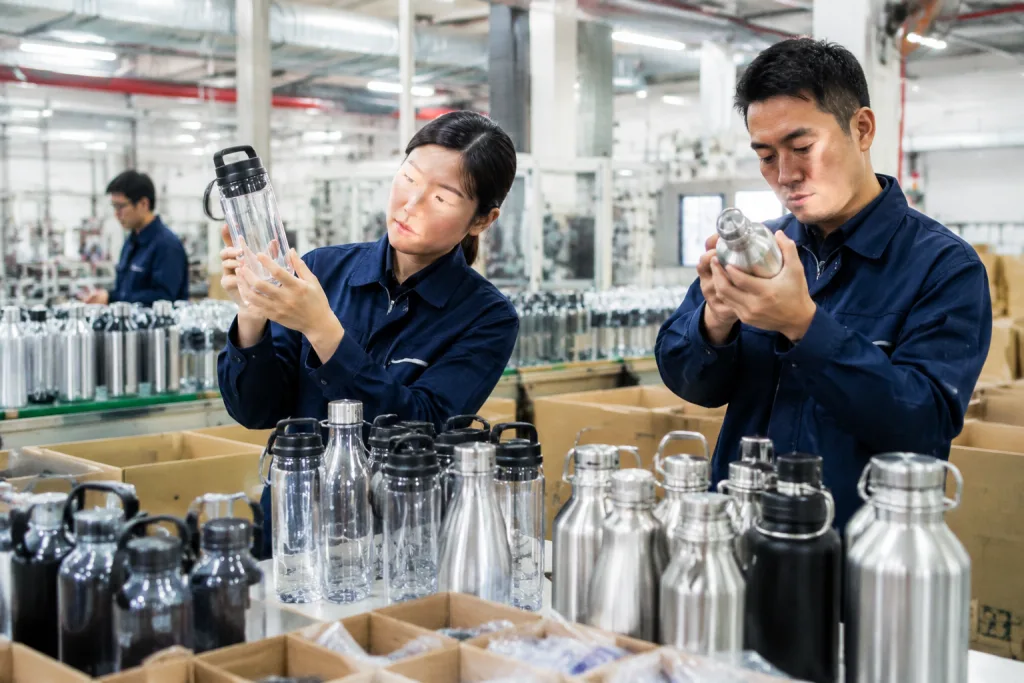
If you are looking for a tritan bottle vendor, you are not buying one bottle. You are checking lid tooling, print area in mm, resin grade, carton size, REACH paperwork, and whether the factory still replies after the 30% deposit lands. This is where custom drinkware projects go sideways. Last month QC pulled a pre-production sample with a 0.6 mm gap under the flip lid, and the buyer flagged it before we opened the mold for the full run.
Tritan looks simple from 2 meters away: clear plastic, low weight, no glass breakage. The wrong question is “can you make this bottle?” A canteen custom order for a sports brand needs different leak testing, logo positioning, and carton drop checks than a distributor growler program or a school bottle tender. BottleForge Industrial in Hangzhou, Zhejiang ships B2B drinkware from China with typical MOQs from 1,000 units per SKU and sample lead time around 7 to 10 days; on the line, we run the first 20 samples through a torque gauge and fill test before sending buyer photos.
The Short Spec Table Buyers Need
A tritan bottle vendor call should start with a spec table, not a mood board. Renderings look nice, but they do not show whether the flip lid seeps at a 45-degree tilt, whether a 5-layer K=A carton passes a 76 cm drop test, or whether your canteen distributor still has margin after Ningbo-to-LA freight is added.
Here is the head-to-head sheet we run with first-time buyers. Last month QC pulled a 650 ml sample because the silicone plug sat 0.4 mm proud of the lid groove; that tiny gap became a leak claim in the buyer’s test room.
- Tritan bottle, 500-750 ml: USD 1.85-3.20 FOB China, MOQ 1,000 units per color, 25-35 day mass production after artwork approval. We usually pack 48 pcs per master carton, and buyers often flag the carton cube before they flag the bottle price.
- Custom canteen in HDPE or PP: USD 1.10-2.10 FOB, MOQ 2,000 units, good for outdoor and school promotions where the target price is under USD 2 FOB. The line runs faster on single-color PP; mixed caps can add 3-5 days.
- Stainless steel canteen customized with logo: USD 3.20-6.80 FOB, MOQ 1,000 units, better perceived value with stronger dent resistance than plastic. Check logo size early, because a 38 mm round mark may need laser instead of pad print on a curved body.
- Customizable growler, 1.2-1.9 L: USD 6.50-13.50 FOB, MOQ 500-1,000 units, larger carton cube and higher freight cost per unit. The math gets ugly when the buyer asks for gift boxes; one 40HQ fills up faster than expected.
- Glass bottle: USD 1.60-3.80 FOB, MOQ 1,000 units, strong retail clarity but weaker for sports and kids programs. We have seen this go sideways after courier testing, with 7 broken inner boxes out of 50 in one pre-shipment check.
Tritan wins when the brief needs clear plastic, low carry weight, decent impact resistance, and a retail look without glass breakage. It loses the moment the buyer asks for vacuum insulation or hot-fill use. Simple. If your brief says the bottle must keep water cold for 12 hours, this is the wrong question to ask; you are not sourcing Tritan, you are sourcing stainless vacuum drinkware.
For European and North American programs, compare compliance cost before you approve colors. A basic food-contact test can cost a few hundred USD per material and color family, and the lab will not care that the PO had “light blue” typed as “lgiht blue.” If you use six translucent colors and three lid materials, the paperwork grows fast. A canteen manufacturer who quotes in 2 hours but skips testing is not saving you money; they are moving the risk to your warehouse.
Where Tritan Beats Other Materials
Tritan is a copolyester we spec when a buyer wants a clear bottle that will not punish freight like glass. A 650 ml Tritan bottle with a flip lid may weigh 110-160 g, depending on wall thickness and lid hardware. A comparable glass bottle can be 280-420 g before packaging. On one 8,000 pcs trial order, our carton weight dropped by 1.6 kg after the buyer moved from glass to Tritan, and the warehouse team stopped asking for extra corner protectors.
For customized drinkware, we usually place Tritan into 3 jobs. Fitness and office bottles work well when the buyer asks for a clear body, printed time markers, and a silicone carry loop; QC pulled the sample if the loop pin sat 0.3 mm off-center because it twisted during the drop test. School and youth programs also fit because breakage is the deal-killer, not the logo size. Retail private label is the third case, where the bottle needs to look cleaner on shelf than a low-cost PP bottle in a thin color box.
Compared with a customized canteen in PP or HDPE, Tritan looks more premium and takes transparent tints with fewer cloudy patches. Scratches are the catch. If the bottle will be dragged across rocks, packed in military-style kits, or washed by a rental fleet 40 times a month, this is the wrong question to ask. An opaque canteen factory design in HDPE may be more honest; we have seen glossy Tritan samples come back with rub marks after only 2 days in a buyer’s backpack test.
Compared with stainless steel, Tritan does not insulate. Do not let a canteen vendor tell you otherwise. A double-wall stainless bottle can hold cold performance for 12-24 hours depending on construction, while Tritan is basically an ambient water bottle. On the line, we run Tritan through cap-fit and leak checks, not vacuum insulation testing, because there is no vacuum wall to test.
In our Zhejiang production network, Tritan bottle projects typically suit 500 ml, 650 ml, 750 ml, and 1 L formats. Wall thickness often sits around 1.5-2.2 mm. Go too thin and the bottle feels cheap; go too thick and the material cost climbs with little gain unless the buyer needs extra drop resistance. For one 750 ml mold, the buyer flagged a 2.4 mm wall proposal because the math added USD 0.18 per piece at 10,000 pcs, and the sample did not feel better in hand.
Customization Compared By Real Cost
When buyers write “canteen customizable” on an RFQ, we usually pin it down to five buckets: color, logo, body shape, lid, and packaging. The costs do not move the same way. Last month one PO even said “Triton” instead of “Tritan,” and our merchandiser stopped it before artwork setup. A practical tritan bottle vendor should quote each custom drinkware item line by line, not hide everything inside one soft unit price.
Logo printing is the safest starting point. One-color silkscreen often adds USD 0.06-0.15 per unit depending on print size. Multi-color printing can add USD 0.18-0.45. We run a 30-piece print trial when the logo sits near a curve, then QC checks it with 3M tape and a 500g rub test block. Laser engraving is more common on stainless steel than Tritan; on plastic it can look pale unless the surface texture and bottle color are picked with care.
Body color is manageable if the buyer keeps the range under control. Standard transparent gray, blue, amber, pink, and clear are easy because the resin masterbatch is already stable on the line. A Pantone-matched translucent resin can require 1,000-3,000 units per color and extra color approval time. We’ve seen an eight-color launch go sideways because the buyer wanted 600 pcs per shade, and the math doesn’t work once injection purging waste hits 8-12 kg per color.
Lid customization is where costs jump. Changing a carry loop color is simple; changing the lid structure or gasket seat is a tooling discussion. Push button, straw route, and hinge changes need 2D drawings, 3D samples, and leak testing on our pressure jig before we talk about mass production. A small lid insert mold may start around USD 800-1,500. A new complete cap mold can be USD 3,000-8,000 or more. New bottle body tooling is higher and can push MOQ past 5,000 units.
Packaging gets underestimated. A white box may add USD 0.12-0.30. A printed gift box can add USD 0.35-0.80, depending on board grade and finish. For Amazon or retail distributor drinkware orders, barcode labels, FNSKU, suffocation warnings for polybags, and carton marks should be locked before mass production. We ship cartons through a drop test at 76 cm, and the buyer flagged one case where the FNSKU on the box did not match the PO SKU by one digit.
Cheap customization is usually printing. Expensive customization is geometry.
That rule is blunt, but it saves money. If the project is a promotional bottle for a 90-day campaign, use an existing mold and spend the budget on clean artwork, a better box, or faster shipment. If the buyer is building a multi-year private-label SKU, custom tooling may pay back after 2-3 repeat orders. QC pulled the sample on one private-label cap because the hinge gap measured 0.4 mm wider than the approved sample, and that is exactly the kind of small geometry issue buyers forget to price in.

Vendor Questions That Expose Risk
Any canteen vendor can email a 38-page catalog. The weak ones start talking in circles when you ask how the bottle is actually made. Before you choose a tritan bottle vendor in China, ask questions that need numbers, batch records, and a clear answer from the line.
- What is the exact resin grade? Ask for the material name, resin supplier, batch traceability, and food-contact declaration. “BPA free” is not proof. We once had a buyer flag a PO because the resin grade was written as “Tritan clear” instead of the supplier code on the test report.
- What is the leak test method? For flip lids and straw lids, ask about inverted testing, pressure testing, and sampling percentage. A normal factory check is 100% visual inspection, then functional testing on a defined sample set; on our line, QC usually pulls samples after lid assembly and checks them on a pressure jig before packing.
- What AQL level is used? B2B buyers often use AQL II with critical 0, major 2.5, minor 4.0. If you need tighter cosmetic control, say it before pricing. The math does not work if you ask for retail-shelf finish after the mold, pad print, and carton price are already approved.
- What is the monthly capacity? BottleForge can coordinate roughly 300,000 drinkware units per month across standard plastic and stainless categories, but your slot still depends on mold availability and decoration workload. A 2-cavity mold does not ship like an 8-cavity mold, and buyers forget this until the delivery date moves from 12 days to 18 days.
- Which tests are already available? For Europe, ask about LFGB, REACH, and EU 10/2011 where applicable. For North America, ask about FDA food-contact documentation and ASTM-related packaging or use requirements if children are involved. QC pulled one sample last season where the bottle passed material review, but the polybag warning print was missing from the packing spec.
Ask how defects are handled too. A canteen supplier should state whether replacement units ship with the next order, get credited, or go back into remake at once. “We will check” is not a policy. We have seen this go sideways on distributor canteen programs when nobody wrote down the tolerance for scratches, color deviation, logo placement in mm, and lid function before mass production.
Ask for carton specifications early. A 750 ml Tritan bottle might pack 24 units per carton with a gross weight around 5-7 kg, but a custom growler can cut units per carton sharply. Freight math changes when your carton cube doubles, and the buyer usually notices only after we send the 5-layer export carton size for booking.
Use-Case Fit For Buyers
The right bottle is not the fanciest bottle. It is the one that fits the sales channel, shelf price, and the complaints you can afford. We usually start with 3 checks on the sample table: target FOB, lid leak test at 100% for pilot cartons, and logo position in mm from the parting line.
For gym chains and corporate wellness orders, we run 650 ml or 750 ml Tritan bottles with a flip lid more than any other setup. Safe middle. The bottle has enough volume for daily use, stays light enough for courier cartons under 15 kg, and gives a clean print window for a 45-60 mm logo. For online retail, Tritan photographs better under a lightbox than PP; one buyer flagged PP as “too cloudy” after seeing the white-background shots.
For outdoor clubs and field programs, a custom canteen or stainless canteen often makes more sense. The flat body packs tighter in a backpack pocket, and it feels tougher in hand. A canteen manufacturer can add belt clips, shoulder straps, or screw caps, but each part adds one more failure point; QC pulled a sample last month because the strap rivet sat 1.5 mm off-center. Keep it simple if users throw gear into trucks.
For beverage brands and gift sets, a customizable growler or customized growler gives better shelf value. The freight math bites fast. A 1.9 L stainless growler may need a larger master carton, thicker egg-crate dividers, and a stricter 80 cm drop test before we ship. Distributor growler buyers should model landed cost before approving the sample; we have seen this go sideways when the first container quote landed 18 days after artwork approval.
For mass promotional use, canteen promotional programs need blunt cost control. A PP or HDPE canteen supplier may beat Tritan by USD 0.50-1.00 per unit. On 20,000 units, that is real money, and the math doesn't work if the giveaway budget is fixed. For retail packaging, Tritan can still earn the premium because the bottle looks clearer in a PET window box, and our line sees fewer “cheap-looking plastic” comments during buyer inspections.
If you are a canteen distributor serving several clients, keep two product lanes: one proven standard mold for fast 7-day sample orders, and one higher-spec private-label line for margin. Trying to make one bottle serve every channel is the wrong question to ask. It usually leaves you with a mediocre SKU, a messy PO, and 6 logo versions taped to the QC desk.

Sourcing From Zhejiang And China
Buying from China is not just a unit-price game. The real test is whether the supplier controls tooling, decoration, packing, AQL 2.5 inspection, and export documents without making your team chase every missing carton mark. Zhejiang works well for drinkware because within a 2-hour truck run from Hangzhou we can reach Tritan bottle molding shops, cap and gasket suppliers, silk-screen printers, color-box plants, and Ningbo or Shanghai port cut-offs. We see this go sideways when a buyer saves USD 0.03 on the bottle, then loses 6 days because the cap insert came from a supplier no one audited.
For a normal Tritan project from our Hangzhou office, we run a simple schedule: 3-5 days for quotation and CAD or catalog confirmation, 7-10 days for logo sample if using an existing mold, 25-35 days for mass production after deposit and sample approval, and 3-7 days for final inspection and export loading. QC pulled a sample last month where the logo was 2 mm too low against the artwork, so we stopped the line before 8,000 pcs were packed. Ocean freight to Europe or North America changes too fast to quote loosely, but the production plan should stay tight.
FOB Ningbo or FOB Shanghai is common. EXW looks cheaper on a spreadsheet, but it pushes inland trucking, export declaration, warehouse coordination, and loading photos onto you or your forwarder. For a first distributor order, FOB is cleaner; this is the wrong place to save face value cost. For smaller trial orders, some buyers use courier or air freight, but bulky bottle cartons eat space fast: 1 CBM can be gone after 250-350 pcs when each bottle has a retail box and PE bag.
Factory audits matter. BSCI, ISO 9001-style quality systems, and documented incoming material checks beat a polished showroom. A canteen factory that records resin batch numbers, gasket batch lots, and print ink codes gives you a better chance of tracing problems if a retailer flags odor, leakage, or color drift. On our incoming table, the caliper and 0.01 g scale catch more problems than the meeting room ever will. Ask audit questions before you send the PO.
China suppliers can move fast, but speed only works when your brief is complete. Send capacity, lid type, Pantone color, logo size in mm, packaging, compliance market, Incoterm, target price, and 3-month forecast. A vague request for “best price customized canteen” gets a vague quote; we once received a PO with “Tritan” typed as “Titan,” and that one typo held material confirmation for 2 days. A complete RFQ gets a real answer.
How To Choose The Final Vendor
Do not crown a canteen supplier just because the first quote is USD 0.18 lower. We have seen that saving vanish after QC rubbed the logo with 3M tape, opened a gasket that smelled like rubber oil, or found 5-ply cartons crushed on the bottom layer of a Yiwu distributor pallet. Cheap can get expensive fast. The vendor you want names the trade-offs before your warehouse team finds them.
Ask for a golden sample and keep it sealed after approval. Write the tolerances on the PI: capacity within about ±3%, logo placement within ±2 mm for most simple prints, and color checked against an approved physical swatch, not a laptop screen. For translucent Tritan, wall thickness changes color depth; our caliper might read 3.2 mm at the base and 1.6 mm on the sidewall, so the base will look darker. That is normal, not a color-matching failure.
For inspection, use a third-party team or your own QC checklist if the order matters to your sell-through. We run checks for odor, black spots, flow marks, scratches, lid fit, gasket seating, leak testing, barcode scan, carton drop condition, and quantity per carton; last month QC pulled the sample because 2 out of 80 lids showed a tilted silicone ring. If you sell through retail or online marketplaces, check packaging before the goods leave Zhejiang or another China production area. Relabeling 6,000 boxes overseas is where the math doesn't work.
A solid tritan bottle vendor should put MOQ, tooling ownership, replacement policy, lead time, and compliance documents in writing. You do not need perfect English. You need exact answers, even if the PO has a typo like “Trian” instead of Tritan and we have to confirm the resin grade again. If a canteen vendor avoids numbers, swaps material names, or refuses pre-shipment inspection, walk away.
For BottleForge, the best projects are not the biggest first orders. They are the buyers who know the channel, share a realistic annual forecast, and let us engineer the bottle around price and failure risk; 3,000 pcs with clear feedback beats a rushed 30,000 pcs order with no lid-torque target. We ship repeat SKUs when the line is built around real use, not guesswork. That is how custom drinkware stays on the shelf instead of turning into a purchasing headache.
Send Your Tritan Bottle RFQ For Review
Share capacity, lid style, logo method, MOQ, target market, and deadline. We will return a practical FOB China quote and risk notes.
Frequently asked questions
What MOQ should I expect from a tritan bottle vendor?
For existing molds, expect 1,000 units per SKU as a normal starting MOQ, with 1,000 units per color if you need custom resin color. Some simple logo-only orders can be discussed at 500 units, but the unit price and freight share usually rise. If you need new lid tooling or a fully custom bottle body, plan for 5,000 units or more to make the mold cost sensible. For canteen customized projects with straps, clips, or special caps, MOQ depends on the smallest component supplier, not only the bottle factory.
Is Tritan better than stainless steel for custom drinkware?
Tritan is better when you need a clear, lightweight, non-glass bottle at a mid-range price. A 650 ml Tritan bottle may cost USD 1.85-3.20 FOB China, while a stainless vacuum bottle often starts around USD 3.50 and can go much higher. Stainless steel is better for insulation, hot drinks, and premium gifting. Tritan is better for gyms, schools, office hydration, and retail bottles where visibility matters. If your brief requires 12-hour cold retention, choose stainless. If it requires clear body, time markers, and low shipping weight, choose Tritan.
What certifications should canteen distributors request?
For Europe, request LFGB or EU food-contact documentation, REACH declarations, and material traceability for Tritan, PP, silicone, and inks. For North America, request FDA food-contact support and any relevant ASTM considerations if the product is for children. You should also ask about BSCI or factory audit status if selling to retailers. Certification should match the exact material and color family where possible. A general “BPA free” statement is not enough for a serious distributor canteen or distributor drinkware program.
How long does a customized canteen order take?
Using an existing mold, allow 7-10 days for logo sampling and 25-35 days for mass production after sample approval and deposit. Add 5-10 days if you need complex packaging, barcode labels, or multiple Pantone approvals. New mold development can add 20-45 days before production starts, depending on lid complexity and testing. For urgent promotional campaigns, keep the design simple: existing mold, one-color logo, standard carton, and confirmed artwork. That is the fastest path to stable delivery from China.
Can I use the same supplier for canteens and growlers?
Yes, but check whether the supplier actually controls both categories. A canteen manufacturer focused on plastic bottles may outsource stainless growlers, while stainless factories may not be strong in Tritan injection or blow molding. Ask for production photos, previous inspection reports, and sample consistency across both product types. A custom growler or customizable growler has different risks: larger welds, vacuum performance, heavier cartons, and higher freight cost. It is fine to use one vendor if they manage QC across both lines, but do not assume the skill set is identical.