Key Takeaways
- A practical Tritan bottle MOQ is usually 1,000-3,000 units per color for stable factory pricing
- Ask for Eastman Tritan grade, wall thickness, cap material, and AQL level before comparing quotes
- Custom logo lead time is normally 25-35 days after artwork and sample approval in Zhejiang
- A canteen distributor should confirm carton size, barcode labels, and drop-test requirements before deposit
A Tritan bottle looks simple until it hits a purchase order. Then 14 lines need answers: resin grade, cap material, silicone ring hardness, leak test pressure, print area in mm, carton drop test height, FDA or LFGB, spare lids, barcode labels, and whether your canteen supplier quoted FOB Ningbo or EXW Zhejiang. Last month QC pulled 32 samples because the PO said “clear blue,” while the Pantone file showed 2925C.
You do not need a chemistry degree. You need a spec sheet that protects your margin before the line opens the injection mold. BottleForge Industrial is based in Hangzhou, Zhejiang, China, and we see the same buyer mistake in about 6 of every 10 new Tritan bottle inquiries: treating custom drinkware like a catalog item instead of a controlled production run. The math doesn’t work once a buyer flags leaking lids after AQL 2.5 inspection.
Material line: resin is not enough
The first line on a Tritan bottle spec sheet should not stop at "Tritan." Too loose. For B2B orders, we ask for the resin family, the food-contact declaration, the colorant compliance file, and a clear note on virgin material for the bottle body. On export orders from China, we normally document FDA 21 CFR for the U.S. market or EU LFGB for Europe. REACH and PAHs questions show up on at least 8 out of 10 EU RFQs when the bottle has soft-touch coating, silicone gaskets, or black PP lids. QC pulled one sample last month where the lid passed LFGB, but the black color masterbatch file was missing from the supplier folder.
Tritan sells well because it gives glass-like clarity, better impact resistance than PC, and no BPA. The buyer result still comes down to the drawing. A 650 ml bottle with a 1.6-1.8 mm body wall feels solid in hand; a 1.2 mm promo bottle feels light and sounds hollow when you tap it on the packing table. It drops differently too. We run a 1.2 m drop test on filled samples, and thin walls usually fail first at the base radius or shoulder. If you are buying canteen promotional items for a 30-day campaign, lighter weight can pass. For outdoor retail or a distributor canteen program, chasing USD 0.08 per unit is the wrong question to ask. The math does not work after returns.
Ask your tritan bottle suppliers to put the working details on the quote: resin grade with maker name, BPA-free statement tied to the test report, bottle weight in grams, wall thickness range from the 2D drawing, maximum fill temperature, and the dishwasher claim if they print it on the carton. Be careful with "dishwasher safe" unless the factory has tested 70-75°C cycles, not just dipped one bottle in hot water. We ship samples with a caliper reading sheet, and the line records bottle weight every 30 minutes during molding. A canteen manufacturer that cannot answer these points within 24 hours is probably quoting from a photo, not from a production spec.
Capacity, mold, and tolerance
Capacity is not a label trick; it decides whether the buyer gets complaints. A 600 ml bottle can mean brimful capacity on our graduated beaker, usable drinking volume below the neck, or the number engraved on the mold insert. For North American retail, buyers usually ask for 20 oz, 24 oz, or 32 oz. For Europe, 500 ml, 650 ml, 750 ml, and 1,000 ml move better. If you are a canteen distributor selling into 3 or 4 channels, confirm both ml and oz on the carton, color box, and barcode label, so one production run can cover more than one market. QC pulled a 650 ml sample last month that held 642 ml at the fill line; the buyer flagged it because the Amazon listing said 22 oz.
Mold ownership changes the cost fast. Open molds run sooner and cost less: MOQ can start around 1,000 units per color, with unit pricing often in the USD 1.20-2.80 FOB range depending on capacity, lid, and decoration. Private mold work is a different bill. A new Tritan bottle mold can cost USD 8,000-25,000, and development can take 45-70 days before mass production. We tell event buyers straight: the math doesn't work for a 3,000 pc one-time canteen order. For a brand owner building a 2-year line, it can make sense. On the line, one mold insert change can stop 2 injection machines for half a shift, so “small shape change” is not always small.
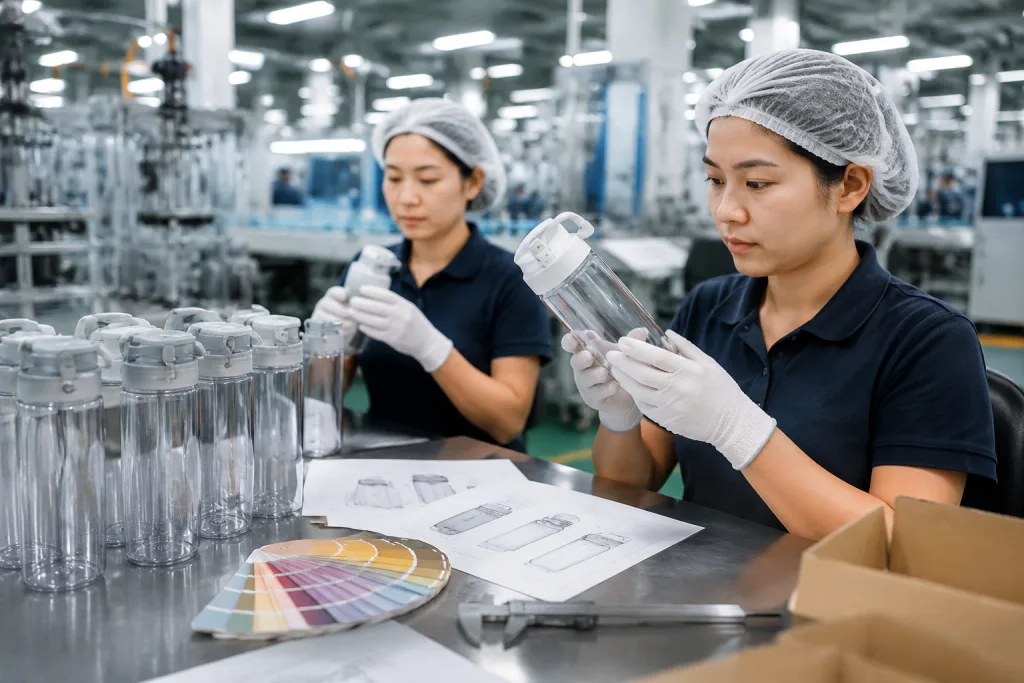
Write the tolerance on the spec sheet. Bottle height may vary ±1.0 mm, weight ±3%, capacity ±2%, and color difference should be checked against a Pantone chip or approved master sample. For threaded lids, the neck finish is the part we watch closest. A loose neck tolerance creates leakage, squeaking, or cap cross-threading. We run a digital caliper check on the neck OD every 30 minutes during injection or blow molding, not only at final inspection. We have seen this go sideways: 0.4 mm too much on the thread start, and 18% of caps felt rough during assembly.
If you want a custom canteen shape, ask whether the factory can provide 2D drawings, 3D rendering, and a CNC or 3D-printed sample before opening steel tooling. Better yet, ask who signs off the STL file and the 1:1 printed sample. It adds 5-7 days, but it prevents expensive arguments later. One buyer once approved the rendering and missed a 6 mm handle clearance issue; the PO even had “handel” typed wrong, and nobody caught it until the CNC sample was on my desk.
Lid system drives complaints
About 7 out of 10 complaints we see on Tritan bottles start at the lid, not the bottle body. The body passes drop and visual checks, then QC pulls the sample and finds a slow seep around the silicone gasket. A proper spec sheet should break the lid into parts: PP or ABS cap shell, silicone gasket, straw material, hinge pin, carry loop, push button, lock ring, and any metal spring. Each part carries a different failure point. If a canteen vendor only writes "leakproof lid," push back. That line is too thin for sourcing.
For sports bottles, buyers choose between screw cap, flip straw, chug lid, one-touch lid, or dual-opening lid. Screw caps cost less and behave well on the line, but retail buyers sometimes call them boring. Flip straws sell fast, yet we run tighter leak checks because the straw cut length can be off by 1.5 mm and still look fine in photos. One-touch lids look premium but add springs, buttons, and hinge wear. For customizable drinkware going to schools, gyms, or outdoor programs, the simplest lid that fits the user is often the smarter commercial choice. We've seen this go sideways.
Leak testing needs a written method, not a promise. At BottleForge, a typical production line check includes inverted static testing and random shake testing, with final inspection under AQL 2.5 for major defects and AQL 4.0 for minor cosmetic defects unless the buyer specifies tighter limits. On one 8,000-piece retail canteen order, the buyer flagged 6 lids after a 30-second shake test because the lock ring was not fully seated. For a high-value canteen customizable retail order, we can tighten the major defect level, but the math does not work unless inspection cost and rejection risk are priced before the PO is signed.
Ask for the spare gasket policy before artwork approval. For example, 1% spare silicone rings packed in bulk may add little, but it saves customer service calls when a distributor drinkware program ships to 40 store branches. We pack those rings in a separate PE bag, and the carton mark must match the PO; one buyer once sent a PO with "silicon" instead of "silicone," and their inbound team held the cartons for two days. If the bottle is for children, check ASTM F963 relevance, small parts risk, and whether the lid design creates pinch points.

Decoration must match usage
Logo decoration is where 6 out of 10 custom drinkware projects get over-sold during quotation. A flat one-color logo on a straight bottle is easy. A wraparound gradient on a tapered Tritan body is not. Match the branding method to the bottle surface, order volume, and where the bottle will be used; the retail price also sets the limit. We have seen this go sideways when a buyer approved artwork on PDF only, then QC pulled the sample and found the logo climbing 4 mm near the shoulder.
Silkscreen printing is still the workhorse for canteen promotional orders. It is economical and sharp, with one to three colors if the artwork is clean and the screen mesh is set right. A typical print area might be 70 x 100 mm on a 650 ml bottle, but the exact safe area depends on curvature; on the line we check it with a paper wrap and caliper before opening the screen. Heat transfer gives better full-color artwork, but we run tape tests and scratch checks before calling it safe. UV printing can handle detailed designs, yet the math does not work for every MOQ because setup time slows the schedule. Laser engraving is more common on stainless steel than Tritan, so do not assume it is the right method for plastic bottles.
For canteen customized branding, ask for artwork tolerance in writing. Logo position ±2 mm is realistic on 500 ml to 800 ml cylindrical bottles; tighter claims should be proven with samples, not sales talk. Also confirm ink compliance. For Europe, some buyers require EN 71-3 heavy metal migration for printed coatings even when the bottle itself already meets food-contact rules. Last spring a buyer flagged this after the PO was signed, and the extra coating test added 7 days to a 23-day production plan.
Color matching deserves its own line. Transparent Tritan colors shift with wall thickness and lighting. A Pantone reference helps, but the final translucent effect will not look exactly like a printed paper chip. A serious canteen factory will send a color chip or pre-production sample before mass production; we usually cut 2 chips at 2.0 mm and 3.0 mm thickness so the buyer sees the difference. For orders above 5,000 units, skipping that step is false economy.
Packing line protects margin
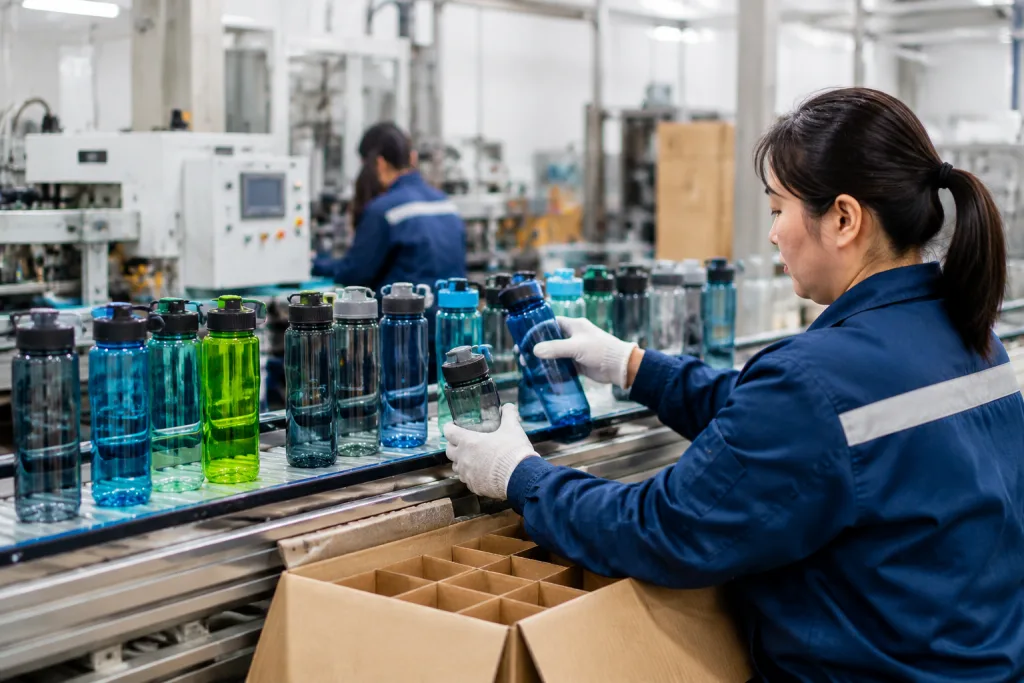
Packing is not an afterthought. It decides freight cost, warehouse touches, shelf look, and the claim rate after arrival. We run Tritan bottles in polybag, kraft box, color box, egg-crate divider, or retail-ready display carton, but each choice changes the line speed. For Amazon-style distributor growler or bottle programs, the buyer usually asks for FNSKU labels, suffocation warning text, carton labels, and master carton weight under 15 kg. QC pulled one 850 ml sample last month because the FNSKU was 3 mm too close to the box seam. Small miss. Big headache.
A standard export carton for 750 ml Tritan bottles might hold 24 units, with a gross weight of 8-10 kg depending on lid weight and packaging. If your carton is too large, ocean freight and courier dimensional weight punish you; we have seen a 2 cm height increase add 9% to courier cost on a 120-carton trial order. If the carton is too weak, you get crushed corners and retailer chargebacks. Ask for carton material, such as K=A or K=K corrugated board, and request a 76 cm drop test if your channel requires it. This is where cheap cartons go sideways.
For North America, UPC placement and retail box orientation matter. For Europe, multilingual warnings, recycling marks, and importer details may be needed. If you are a canteen distributor, confirm whether your customer wants individual barcodes on the bottle, the box, or both; the wrong question is “can we label later?” Relabeling in your warehouse at USD 0.20-0.50 per unit is usually more expensive than doing it correctly in Zhejiang. We had one PO typo where “label on bottle” became “label on box,” and the buyer flagged it during incoming inspection.
Gift packaging can lift perceived value, but it slows packing speed. Our Hangzhou-area partner lines can handle about 300,000 Tritan and plastic drinkware units per month under normal scheduling, but complex color boxes, EVA inserts, and mixed-SKU cartons reduce daily output. On a plain polybag job, one line may pack around 18,000 units per day; with window color boxes and insert cards, the same line can drop to 11,000-12,000. The math should show in the lead time, not appear one week before shipment when the booking is already cut.
Commercial terms and control points
Once the technical spec is fixed, the commercial sheet is easier to check line by line. Don’t compare tritan bottle suppliers by the first FOB price only. Ask what is included: mold charge, sample fee, logo setup, Pantone color matching under a D65 light box, inner box, carton label, inspection support, spare parts, export documents, and retail packaging. We had one 3,000 pcs order where the buyer liked the low quote, then flagged the missing color box on the PO; after revision, the “cheap” supplier was USD 0.18 higher per bottle.
For open-mold custom canteen orders, we run a simple structure: 30% deposit, 70% balance before shipment, with mass production starting after pre-production sample approval. Normal lead time is 25-35 days after approval for 1,000-10,000 units. Larger programs, mixed colors, or customized growler-style large capacity bottles need 40-50 days because the line changes resin color, lid gasket color, and carton marks separately. Book early. Before summer and Q4 retail, our injection machines can sit full for 12 days vs 4 days in March.
Inspection points should be named on the order sheet, not discussed later on WeChat. Pre-production sample approval locks color, logo, lid fit, and packing; QC pulled the sample last month because the silicone ring was 0.6 mm too loose after the first trial. During-production inspection checks whether the factory is following the approved sample. Final random inspection checks defects against AQL. For customized drinkware, I prefer final inspection after at least 80% packed and 100% produced. Inspecting too early hides packing defects, and we’ve seen this go sideways when carton labels were printed with the wrong SKU.
Clarify Incoterms before the deposit. FOB Ningbo or FOB Shanghai is common for Zhejiang factories. EXW looks lower, but you pay local trucking, export handling, and documentation separately; for one pallet of 1,200 bottles, Hangzhou to Ningbo trucking alone can erase the price gap. If you are new to China sourcing, FOB is cleaner. A reliable canteen supplier should explain the cost split in RMB and USD instead of using Incoterms as a trick.
Supplier fit is measurable
Supplier fit starts with the order type. A canteen promotional buyer usually needs 25,000 units out fast, clean logo registration within 0.5 mm, and an MOQ the budget can carry. A retail brand owner cares more about ΔE color control, stronger 5-layer export cartons, compliance files, and repeat runs that match the first PO. A distributor network needs reorder consistency and tight SKU discipline, because one wrong lid color in a mixed pallet creates 48 emails. One factory can cover these jobs, but the line has to be set up that way.
Ask for numbers. How many Tritan bottle units per month can the line produce? What is the minimum order per color? What AQL level is standard? Can the factory provide BSCI audit documents or ISO 9001 records? Does it have experience shipping to your destination market? How many days for a decorated sample: 7 days for pad print, 12 days for full-color wrap? If a canteen vendor answers every question with "yes, no problem," slow down. We have seen this go sideways when QC pulled the sample and the straw length was 4 mm short.
At BottleForge Industrial in Zhejiang, China, we normally start by turning your brief into a spec table: capacity, resin, lid, decoration, packing, compliance, MOQ, lead time, and target FOB price. Not fancy. It beats a nice rendering that hides the hard parts. Last month one PO had "matte black lid" in the email and "gloss black lid" in the attachment; the spec table caught it before mold trial. That table lets a distributor canteen buyer compare a custom growler, customizable growler, or customized canteen program without mixing technical cost with commercial guessing.
Good canteen suppliers are not the ones who accept every request. They tell you which request changes tooling, which one triggers testing, and which one only changes packing. If a buyer asks for a new one-hand flip lid at the same price as a stock screw cap, the math doesn't work. That honesty saves more money than a USD 0.03 discount, especially when the tooling room has already opened a 2-cavity lid mold.
Send your Tritan bottle spec for factory review
We will check resin, lid, logo, packing, MOQ, and FOB assumptions before you lock the purchase order.
Frequently asked questions
What MOQ should I expect from Tritan bottle suppliers?
For open-mold Tritan bottles, a realistic MOQ is usually 1,000-3,000 units per color with custom logo. Some canteen vendors will quote 500 units, but the unit price, color options, and packaging flexibility will be weaker. For custom color injection or special translucent colors, 3,000 units per color is more practical because resin mixing and machine setup create waste. Private mold projects should be planned at 5,000-10,000 units per first run if you want the tooling investment to make sense. If you are testing a distributor drinkware program, start with an open mold and spend budget on better packaging, inspection, and artwork approval instead of a new shape.
How much does a custom Tritan bottle cost FOB China?
Most open-mold custom Tritan bottles fall between USD 1.20 and USD 3.50 FOB Ningbo or Shanghai, depending on capacity, lid system, wall thickness, logo method, and packing. A simple 600 ml screw-cap bottle with one-color print may sit near the low end. A 1,000 ml bottle with flip straw, silicone boot, full-color transfer print, and color box can move above USD 3.00. Tooling, sample fees, barcode labeling, and third-party lab testing are usually separate unless stated. When comparing canteen manufacturers, ask for a line-by-line quote. A low headline price often excludes the exact packaging or compliance document your retail customer requires.
Can Tritan bottles be dishwasher safe?
They can be, but the claim should be tested, not assumed. Tritan handles heat better than many commodity plastics, yet lids may include PP, ABS, silicone, springs, or printed decoration that age differently. If you want a dishwasher-safe claim, ask the canteen factory for cycle conditions, such as 70°C for 20 cycles, and check for warping, leakage, print loss, odor, and lid fit after testing. Top-rack-only wording is safer for many retail programs. For promotional canteen orders, many buyers avoid dishwasher claims because the testing cost and claim risk are not worth it. If the claim will appear on packaging, treat it as a compliance item.
What logo method works best on Tritan bottles?
For most custom canteen and promotional bottle orders, silkscreen printing is the safest and most economical method. It works well for one to three solid colors and keeps setup cost controlled at 1,000-5,000 units. Heat transfer is better for full-color graphics, gradients, or larger coverage, but you should test adhesion and scratch resistance. UV printing can produce detailed artwork, though it is slower and may cost more on curved bodies. Before approving mass production, request a decorated sample using the actual bottle color and surface finish. Transparent Tritan changes the way ink appears, so artwork on a PDF is not enough.
What documents should a European or North American buyer request?
For North America, ask for FDA food-contact compliance and, when relevant, California Proposition 65 screening. For Europe, request LFGB or EU food-contact documentation, REACH information, and EN 71-3 if printed coatings or children’s use are involved. If your customer requires social compliance, ask for BSCI, Sedex, or equivalent audit status before deposit. You should also request a formal product specification, packing specification, and AQL inspection standard. For a canteen distributor importing under its own brand, keep the approved sample, test reports, and purchase order spec together. If a canteen supplier cannot match documents to the exact material and decoration, the paperwork is weak.