Key Takeaways
- Ask for Tritan resin grade, food-contact reports, and AQL 2.5/4.0 terms before comparing a USD 0.12 price gap
- A realistic MOQ for a custom Tritan bottle is usually 3,000 pieces per color with 35-45 days mass production
- Decoration method affects scrap rate: 1-color silkscreen is safer than full-wrap transfer on curved canteen bodies
- A useful supplier directory should separate factory, vendor, distributor, and trading company roles clearly
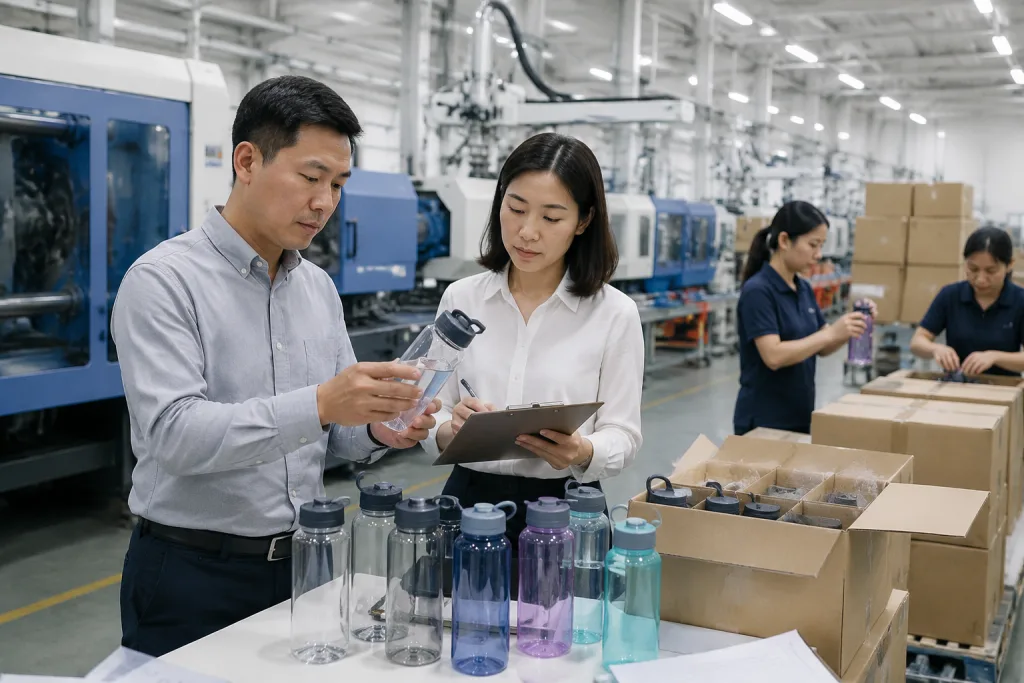
A tritan bottle supplier directory looks useful until you try to buy 20,000 pieces with a logo, carton marks, EU compliance documents, and a 28-day delivery window that cannot slip. Plenty of listings call themselves a canteen supplier, canteen manufacturer, or custom drinkware factory. The gap shows up when you ask for resin lot traceability, who owns the mold, AQL terms, and a production schedule tied to injection machine time. We run 380-ton and 450-ton machines for Tritan bodies, and QC pulled one sample last month because the cap thread was off by 0.35 mm.
We manufacture drinkware in Hangzhou, Zhejiang, and we see the same buying mistake about 6 times a month: buyers compare unit price first and supplier capability second. For Tritan, that is the wrong question to ask. Your bottle has to pass drop tests, dishwasher claims, color matching, cap leakage checks, and customs paperwork without turning the line into a guessing game. China has strong canteen suppliers, but your shortlist needs to cut out traders, weak assemblers, and vendors who promise 12 days when the mold shop already needs 18 days. We ship samples only after checking the Pantone chip under a D65 light box, because one buyer once flagged “transparent smoke gray” after the PO typo said “transparent smoky green.”
What should the directory prove?
A tritan bottle supplier directory should not look like a photo wall from a trade show booth. It should answer one blunt question: can this supplier make your bottle again and again, with legal paperwork, and ship before your launch date? If the listing only says “BPA-free,” “high quality,” and “OEM welcome,” keep moving. Those words cost nothing. We’ve had buyers send 14 directory links where only 3 could show a resin lot number and a dated migration report.
For B2B buying, ask for proof. Is the supplier a canteen factory, an export trader, a canteen vendor, or a regional distributor drinkware company? None of these roles is automatically bad, but the risk is not the same. A canteen manufacturer controls injection molding, cap assembly, leak testing, and final QC; on our line, QC pulled 32 samples from a 5,000 pcs run last month just to check cap torque and shoulder flash. A canteen distributor may ship local stock in 3 days, but they often cannot trace the Tritan resin batch or fix a logo color that drifts from Pantone 293C. A canteen vendor works for 300 pcs test orders. For a seasonal program, the math does not work.
At BottleForge Industrial in Zhejiang, China, we tell new buyers to build a supplier table with five columns: product scope, factory process, compliance files, decoration capacity, and export experience. Simple table. Hard answers. If one column is vague, the quote is not ready for comparison. We saw one PO typo last quarter, “matte black” written as “mate black,” and the buyer flagged it only after pre-production samples; that one word cost 6 days.
- Product scope: Tritan sports bottle, custom canteen, kids bottle, infuser bottle, or custom growler, with size range in ml and current mold availability.
- Process control: injection molding, blow molding if applicable, cap assembly, leak testing at the line, and packaging inspection before carton sealing.
- Compliance: LFGB, EU 10/2011, FDA, REACH, Prop 65, or ASTM documents depending on market, with report date and matching material name.
- Export terms: FOB Ningbo or Shanghai, carton dimensions, HS code, and lead time, including sample days and mass production days.
A directory earns its place when it helps you reject the wrong suppliers early. If you are buying for retail chains in Germany, a cheap canteen promotional item with no EU migration report is not a bargain; it is a claim waiting for a lab retest. We ship FOB Ningbo often, and carton drop strength still gets checked because a 12 kg master carton that splits at one corner becomes the buyer’s problem fast. If you sell through North American e-commerce, the listing must handle barcodes, FNSKU labels, carton drop tests, and color control within an agreed Delta E limit. We’ve seen this go sideways when a supplier treated packaging as an afterthought.
Questions before you request samples
Samples matter, but asking too early can burn three weeks and USD 80-150 in courier fees. Send a short technical question set first. A serious canteen supplier answers with numbers, test names, and photos from the line. A weak listing sends “yes, we can do all.” We see this every month; QC pulled one sample last quarter where the PO said Tritan, but the carton label only said “PC bottle.” Wrong question, wrong sample.
Start with the material. Tritan is a copolyester family, not a generic plastic word. Ask for the resin brand or approved equivalent, food-contact test reports, and a clear statement that the quoted price uses virgin material only. For bottles used as canteen customized programs, school bottles, fitness bottles, or outdoor promotional lines, recycled or unknown material is not acceptable unless the claim and target market allow it. We run incoming resin checks by batch, and the buyer should ask for the lot number format before paying for tooling.
Then ask for body data. You need capacity tolerance, wall thickness, cap material, silicone ring hardness, weight per piece, and the exact drop test method. A 650 ml bottle with a 1.2 mm wall behaves differently from one with 1.6 mm wall thickness; the math does not work if the buyer wants a lighter bottle and a tougher drop result at the same price. A flip lid may look fine in a sample photo but fail after 800 open-close cycles if the hinge pin is weak. On our bench, we check the hinge with a cycle tester and measure the pin with a 0.01 mm caliper.
For decoration, specify the real design. “Logo printing” is too vague. Tell the supplier whether you need 1-color silkscreen, laser on a stainless part, heat transfer, UV print, sleeve, or in-mold color. For customizable drinkware, artwork drives cost and defect rate. A wraparound mountain graphic on a curved canteen body is not the same job as a 45 mm front logo. We have seen this go sideways when the buyer approved a flat PDF, then flagged 2 mm registration drift on the curved bottle during AQL 2.5 inspection.
Good sample questions are boring. Boring questions protect your margin.
Our Hangzhou, Zhejiang facility typically quotes standard Tritan bottle MOQ at 3,000 pieces per color, with sample lead time of 7-10 days for logo samples and mass production of 35-45 days after deposit and artwork approval. Current practical FOB China pricing for common 500-750 ml custom drinkware programs often sits around USD 1.25-2.80 per piece, depending on cap complexity, packaging, and decoration. If a supplier quotes 40% below the range, ask what has been removed. Usually it is wall thickness, carton strength, inspection time, or a cheaper cap spring; we ship enough repeat orders to know where the shortcuts hide.
Checklist for factory capability
A directory might show 10 canteen manufacturers, but the shortlisting has to move faster than a certificate review. Do not stop at BSCI, ISO 9001, or Sedex. Those papers tell you the factory has been checked; they do not tell you whether the line can hold a 0.3 mm logo tolerance on your exact Tritan bottle. We run into this on factory audits: the certificate looks clean, then QC pulls a sample and the flip lid pin has 1.2 mm side play. Capability means machines, trained operators, controlled drawings, and the habit of recording problems before shipment.
Run this checklist during supplier qualification:
- Factory identity: business license name must match the quotation header, beneficiary bank account, and export documents; we once saw a PO typo where “Hangzhou” became “Hanzhou,” and the bank held payment for 2 days.
- Monthly output: ask for category capacity, for example 300,000 Tritan bottles per month on bottle lines, not a combined number including lunch boxes and PP cups.
- Mold control: confirm ownership for the body mold and cap mold, then check the straw mold and silicone seal tooling with mold numbers stamped on the base plate.
- QC line: check incoming resin COA, first-article approval with calipers, hourly line records, 100% leak test where required, and final AQL inspection.
- Decoration line: count the silkscreen stations and UV printers, then ask for daily output by logo size; a 45 mm one-color logo is not the same job as a wrap print.
- Packing control: confirm barcode scanning, carton compression strength, master carton labeling, and pallet pattern if the buyer needs 1.2 m export pallets.
A canteen factory making 80,000 pieces per month can be a good fit for one distributor program. It is the wrong question to ask if your launch needs 250,000 pieces across four colors in 45 days. The math does not work once you add resin drying time, color change cleaning, and 24-hour leak-test staging. A bigger canteen manufacturer quoting 500,000 units per month can still fail if the packing line cannot build mixed cartons or if the carton label printer only reads one SKU at a time.
For a directory, tag each supplier as factory-direct, trader-managed, or distributor-supported. Factory-direct gives the cleanest route for custom canteen development because engineering, costing, and the injection line sit under one roof. Trader-managed supply is acceptable only when the trader has technical staff who can read a 2D drawing and take responsibility for a failed hinge test. Distributor canteen sourcing fits smaller replenishment orders; local stock matters more than shaving USD 0.08 off FOB Ningbo.
Ask who signs the golden sample. This small step saves arguments. If the sales contact uses a PDF rendering, the production manager follows a scratched sample from the mold room, and QC checks against a different bottle in the sample cabinet, we’ve seen this go sideways: color drift, logo position disputes, and carton marks printed on the wrong side. Get all three signatures on one approved sample with the date, color code, and logo placement measured in mm.
Compliance questions buyers forget
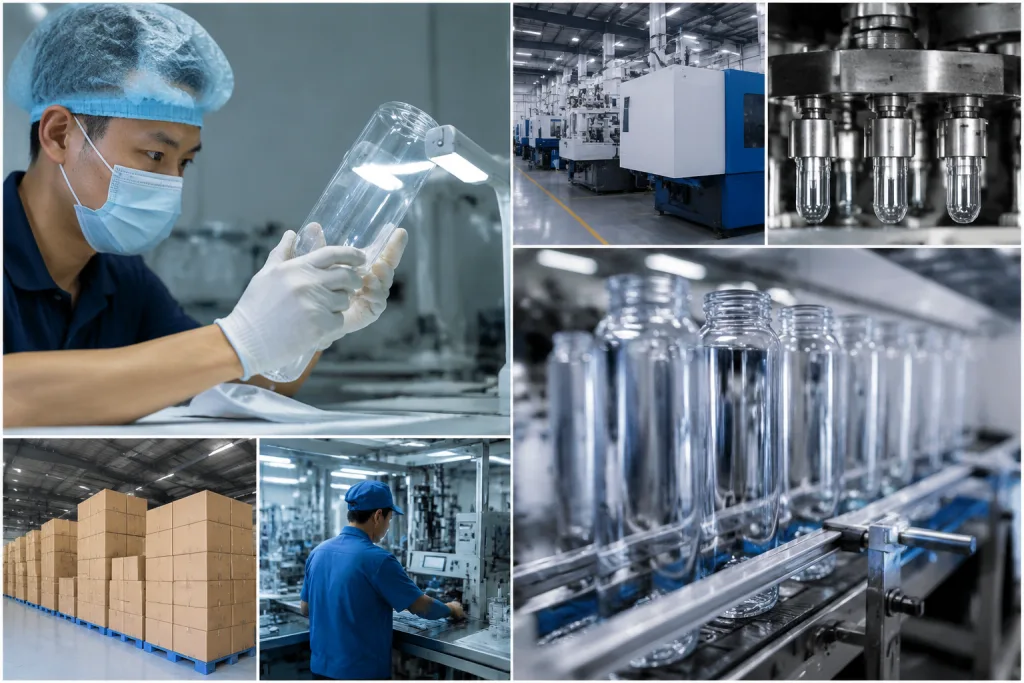
Tritan bottle sourcing is not just a BPA-free sticker on the carton. If you import into Europe or North America, the test files must match the sales copy and the actual BOM. We run this check line by line: Tritan body, PP lid, silicone gasket, nylon strap, printed ink, and 350 gsm color box all sit in different compliance buckets.
For Europe, ask for EU 10/2011 and LFGB food-contact migration reports for the food-contact parts. If your buyer is a German chain or a French supermarket, add REACH SVHC screening and packaging heavy metal compliance to the file before sampling. For the United States, FDA food-contact suitability, California Prop 65 assessment, and ASTM-related physical safety checks depend on user age and sales channel. For children’s bottles, CPSIA-related requirements enter fast. We have seen SGS ask for the exact PP resin grade on the lid before they would issue the final report.
Do not accept a test report only because it says “bottle.” Check model number, material description, applicant name, report date, lab name, and sample photos against your PO. Small detail, big risk. QC pulled one sample last year where the report covered a clear Tritan bottle, but the production item had a black printed logo and a new 2.8 mm silicone gasket. A 2021 report for that clear bottle does not cover a 2026 customized canteen with colored ink and a changed sealing part.
Promotional buyers ask for canteen promotional pricing first and remember documentation during shipment week. The math does not work. If a retailer rejects the file, the supplier cannot create a missing migration test overnight while 128 cartons wait near the packing line. Budget 7-12 working days for new testing after final material and color are confirmed. Third-party testing for one full bottle set may cost roughly USD 250-900 depending on test scope and lab.
China suppliers ship huge drinkware volume, but export experience changes by market. A factory used to FOB Ningbo shipment to Canada might still miss German retailer paperwork. Ask for anonymized examples of previous export cartons, inspection reports, and compliance indexes. You do not need their customer list. You need proof that their team can read the file, spot a wrong model code, and fix a PO typo before the buyer flags it.
How pricing really changes
Custom drinkware quotes are rarely one clean number. They are a stack of choices. If you compare only the FOB unit price, you can end up picking the factory that left out the work. We see this in Hangzhou quotations all the time: one supplier prices a plain bottle, while the buyer’s PO later shows a retail box, FNSKU label, and 12-carton drop test.
The body size is the first driver. A 500 ml Tritan bottle uses less resin and packs tighter than a 1,000 ml outdoor canteen; on our line, the larger body also needs a longer cooling window after injection, usually about 18 seconds vs 12 seconds for the smaller shell. Cap complexity comes next. A simple screw cap costs less than a flip lid with lock, carry loop, straw, silicone valve, and dust cover. Every extra part means another cavity, another assembly step, another QC checkpoint. QC pulled 200 lids last month because the silicone valve sat 0.4 mm proud and leaked during the upside-down test.
Decoration changes both cost and risk. A single front logo may add USD 0.05-0.12 per piece. Full-color UV or heat transfer can add USD 0.18-0.45 per piece. Custom color matching can require minimum resin or masterbatch quantities, often 3,000-5,000 pieces per color. For a canteen customizable program with six colors and two logos, setup charges bite harder than buyers expect. We once had a buyer flag “Pantone 3125C” on the artwork, while the PO said “312C”; that typo stopped the order for 2 days before resin mixing.
Packaging moves the price too. Bulk polybag packing is not the same job as a retail color box with instruction sheet, hang tag, silica gel, FNSKU label, and Amazon carton requirements. If you need e-commerce-ready cartons, ask for 5-ply outer cartons, drop-test assumptions, and carton weight under 15 kg where possible. The cheap carton is the wrong place to save money. We have seen this go sideways: the bottle passed AQL 2.5, then the outer carton crushed at the corner after a 76 cm drop test.
Here is the quoting format we run with buyers: FOB port, unit price, MOQ per color, sample cost, mold cost if any, decoration cost, packaging cost, inspection standard, payment term, and lead time. For customized drinkware, ask what happens if the approved Pantone color misses tolerance after mass production starts. A professional canteen manufacturer will define approval steps, usually lab dip, pre-production sample, then sealed golden sample with buyer signature. A weak quote says “color same as sample” and hopes you do not ask again.
Directory red flags and green flags
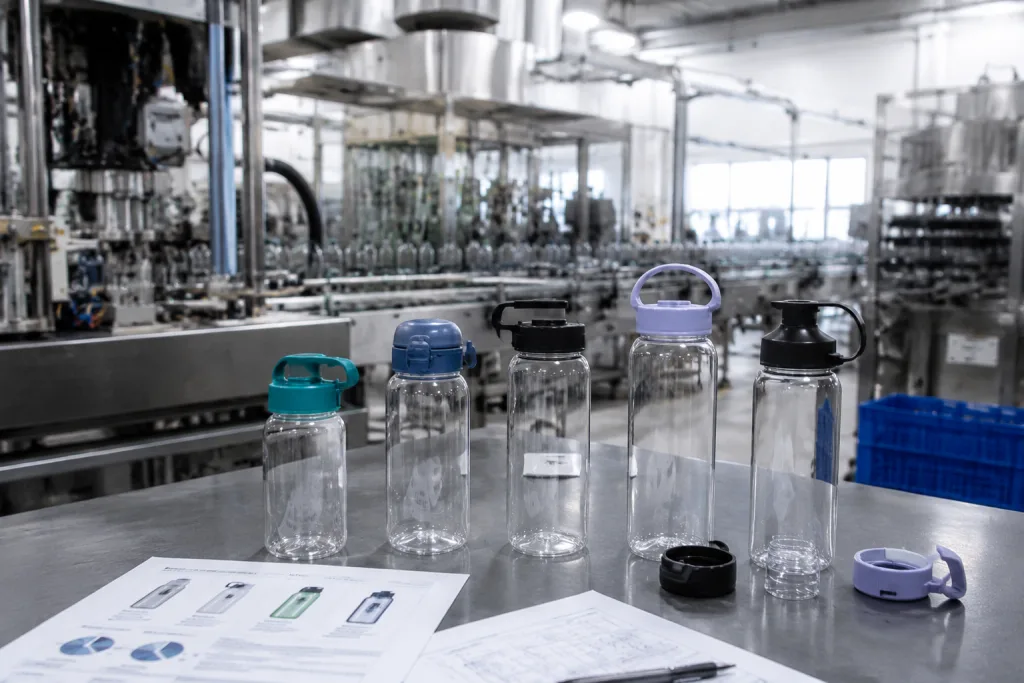
A directory can introduce you to canteen vendors, but it will not do the buyer’s job. We run into this every Canton Fair season: a buyer sends 12 directory links, then asks which factory is “safe.” Wrong question. First screen for red flags that stop the RFQ, then look for green flags that justify sending drawings, Pantone chips, and a real target price.
Red flags usually start small. The supplier refuses to show a business license, or the license address does not match the factory gate shown on the audit video. The product photo appears in 8 unrelated listings with 8 company names. The sales rep cannot explain why Tritan is not PC, PP, or PETG, even after QC pulled the sample and checked the resin mark under the base. The quotation has no Incoterm. MOQ moves from 1,000 pcs to 3,000 pcs to 5,000 pcs in the same email thread. The sample looks clean, but the supplier cannot provide the resin invoice or migration report. One issue does not prove fraud. Five together means risk.
Green flags are concrete. The supplier asks about target market before quoting, because FDA, LFGB, and buyer internal tests change the cost. They separate canteen customized tooling from standard mold options and tell you if a new cap insert needs 25 days and a 3,000 USD mold, not “soon.” They provide a clear AQL plan, commonly critical 0, major 2.5, minor 4.0, and they know how to book a third-party inspection 7 days before ETD. They understand carton marks, mixed SKU packing, and inspection booking, including the small stuff like a PO typo in the barcode number. They will also push back when your artwork crosses the curved shoulder and the scrap math does not work.
For custom growler or customizable growler projects, green flags include pressure or leakage discussion tied to a test method, not a sales promise. Ask how they check cap seal structure, handle pull strength, and packaging protection; our line uses a 24-hour inverted leak test and a 1.2 m drop test for export cartons when the buyer requires it. For distributor growler or distributor drinkware programs, look for reorder stability and color continuity, plus a spare parts policy for lids, silicone rings, and straws. You are buying repeatability, not one clean sample on a desk.
Do not be impressed by a supplier claiming to make every product. Tritan bottle, stainless thermos, glass bottle, ceramic mug, lunch box, and umbrella under one roof is not how most factories in Zhejiang work. A strong China drinkware supplier may coordinate 2 or 3 categories through nearby partners, but a serious team will say what is made in-house, what is subcontracted, and where final QC happens. We have seen this go sideways when a buyer assumed one logo file covered all materials; the thermos passed, the Tritan print failed tape test after 30 minutes, and the shipment lost 12 days waiting for rework.
A shortlist process that works
Use the directory to build a shortlist, not to make the final call. For most B2B buyers, five suppliers is enough for round one. Six just adds noise. We run this the same way on the line: two factory-direct canteen makers, one trader with fast, clear replies, one distributor if local stock matters, and one backup supplier from Zhejiang or another mature China production base.
Send every supplier the same RFQ. Put capacity, bottle size, target order quantity, logo method, packaging, compliance market, delivery deadline, and Incoterm in one file. If the request is loose, the quote will be loose too. Example: “750 ml Tritan bottle, custom canteen with 1-color logo, PP flip lid, silicone seal, retail color box, EU market, 10,000 pieces across 2 colors, FOB Ningbo, AQL 2.5/4.0, shipment before June 20.” That beats three pages of mood-board screenshots. We have seen a buyer miss a lid spec by 2 mm and blame the factory later. Wrong question, wrong result.
Score the replies on speed, accuracy, technical detail, and whether they ask good follow-up questions. A supplier who comes back with five smart questions is often stronger than one who tosses out a low number in 20 minutes. Then order samples from the top two or three. QC pulled the sample, and that is where the truth shows up: leak test, odor, cap fit, logo adhesion, dishwasher claim if it matters, and carton packing. Keep photos and notes in one folder. Procurement memory should not live in email.
Before you pay a deposit, lock the production file: final quotation, PI, artwork, Pantone color, packing method, barcode files, inspection date, shipment term, and who covers a failed inspection. If you need customized canteen or customized growler development, add tooling drawings and ownership terms. If you need repeat distributor canteen supply, add a reorder price validity window, usually 30-60 days, because resin and exchange rates move. The buyer who skips this step usually ends up with a PO typo and a long dispute over one line item.
The best directory result is not the cheapest quote. It is a supplier you can brief once, correct fast, inspect clean, and reorder without drama. That is the standard we use when we ship.
Send your Tritan bottle RFQ for factory review
Share bottle size, order quantity, logo file, target market, and delivery date. We will return MOQ, FOB price, lead time, and risks.
Frequently asked questions
What MOQ should I expect from a Tritan bottle supplier?
For a standard mold Tritan bottle with one logo, a practical MOQ is usually 3,000 pieces per color. Some canteen vendors may offer 1,000 pieces using stock colors, but the unit price is higher and color choice is limited. For custom color matching, expect 3,000-5,000 pieces per color because masterbatch setup and line cleaning cost money. For a new private mold custom canteen, MOQ often starts around 10,000-20,000 pieces, plus tooling cost. At our Zhejiang factory, typical mass production lead time is 35-45 days after deposit, artwork approval, and sample confirmation.
How do I know if a directory listing is a factory or trader?
Ask for the business license, factory address, production process photos, and a live video walkthrough showing injection machines, assembly line, QC area, and warehouse. A real canteen factory should be able to explain machine tonnage, mold count, daily output, and inspection steps. A trader may still be useful, but the role must be clear. Check whether the company name on the quotation matches the bank account and export documents. If the listing claims to be one of the canteen manufacturers but cannot answer who owns the mold or where leak testing happens, treat it as a trading listing until proven otherwise.
What is a reasonable FOB China price for custom Tritan bottles?
For common 500-750 ml customized drinkware, a realistic FOB China price often runs from USD 1.25 to USD 2.80 per piece. The low end usually means a simple cap, standard color, basic logo, and bulk packing. The high end may include flip lock lid, straw, silicone grip, retail box, UV print, or e-commerce labeling. A custom growler or large 1,000 ml bottle can exceed that range. Compare quotes only after packaging, decoration, test requirements, MOQ, and Incoterm are identical. A USD 0.20 cheaper quote can disappear quickly if the carton is weak or testing is excluded.
Which compliance documents should I request for Europe and North America?
For Europe, request EU 10/2011 and LFGB food-contact reports for the Tritan body, PP lid, silicone gasket, and any food-contact coating or ink. REACH SVHC screening may be needed depending on retailer requirements. For the United States, ask for FDA food-contact support and review California Prop 65 exposure risk. If the product is for children, CPSIA and ASTM considerations may apply. Make sure reports match the actual product structure and material color. Testing usually takes 7-12 working days once the final sample is available, so do not leave compliance checks until the shipment is packed.
Can one supplier handle Tritan bottles, custom canteens, and growlers?
Sometimes, but ask what is made in-house. A supplier may manufacture Tritan bottles directly and subcontract stainless customized growler production to a partner factory. That can work if responsibility is clear and QC is controlled. For distributor drinkware programs, using one coordinated supplier can reduce communication work, but you still need separate specifications, test reports, and AQL standards for each category. Ask for monthly capacity by product type, not total sales volume. If a canteen supplier claims full in-house production for plastic, stainless, glass, and ceramic without clear workshop evidence, verify carefully before placing a mixed-category order.