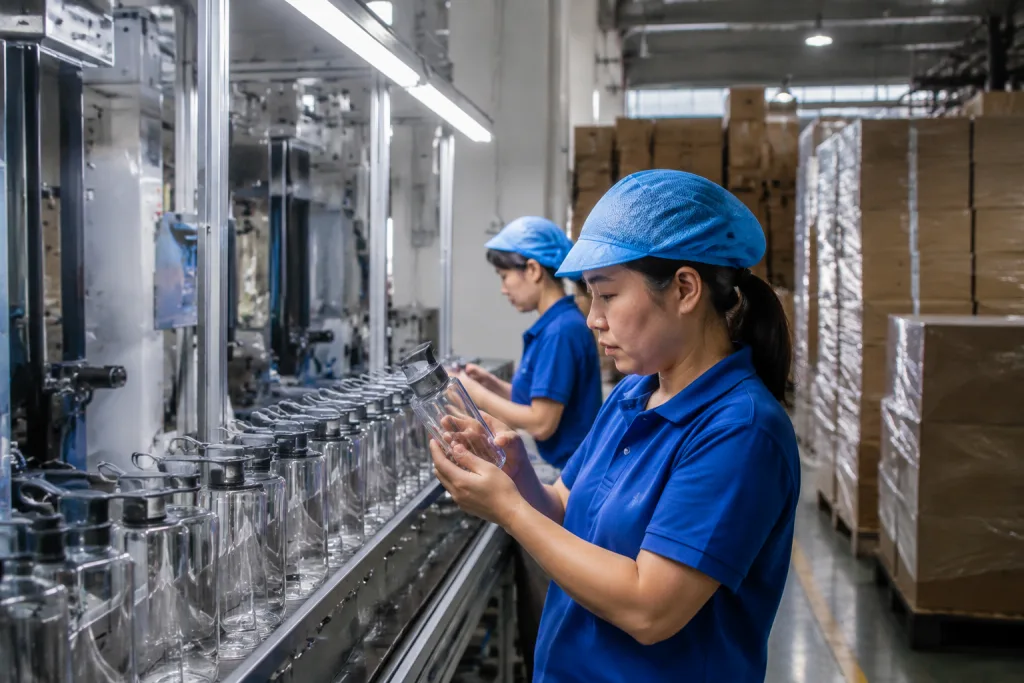
Key Takeaways
- Start RFQs with Tritan grade, capacity, wall thickness, lid type, packing, target FOB price, and 3,000+ unit quantity
- Budget USD 1.25–2.80 FOB China for most promotional Tritan bottles before premium caps or gift boxes
- Use pre-production samples, not hand-picked showroom samples, before releasing a 30% deposit
- Set AQL 2.5 major / 4.0 minor and define logo adhesion, leak test, and carton drop test in the PO
A tritan bottle promotional project looks simple until the quote sheet lands with four plastics, three lid options, six decoration prices, and one lazy line saying “packing included.” That line costs money. We have seen this go sideways when the buyer approved a 650 ml sample in Eastman Tritan, then the PO only said “clear plastic bottle,” and QC pulled the pre-shipment sample with a different resin feel and a 0.6 mm thinner wall. If you do not lock material grade, decoration method, carton spec, and inspection terms early, the bottle you sampled is not always the bottle that ships.
At BottleForge Industrial in Hangzhou, Zhejiang, we manufacture custom drinkware for distributors, brand owners, and importers who need predictable China sourcing. Our Tritan bottle line runs up to 420,000 units/month, with typical MOQ from 3,000 units per color and bulk lead time of 25–35 days after approved sample and deposit. On the line, we check cap torque with a digital torque meter, run drop tests on packed cartons, and confirm logo position against the signed artwork file before mass packing starts.
Start with a tighter RFQ
Your RFQ should not say “500 ml clear Tritan bottle with logo.” We see that line at least 20 times a month, and it creates ten quotes that cannot be compared side by side. Start with the job: event giveaway, retail promo, school program, gym onboarding, or corporate merch. Be specific. A bottle going through a distributor drinkware channel needs tighter control on scratches, carton crush, and barcode position than a one-day conference giveaway. Last March, QC pulled 32 samples from a promo order and found the logo sat 4 mm too low because the buyer never fixed the print height on the RFQ.
For BottleForge, a clean RFQ includes capacity, shape, color, lid material, decoration position, quantity by color, packing method, target delivery port, compliance market, and target landed cost. We run Tritan quotes in Eastman-grade copolyester, BPA-free, with good impact resistance and better clarity than standard PP. For promotional projects, common capacities are 500 ml, 650 ml, 750 ml, and 1,000 ml. Wall thickness usually sits around 1.8–2.4 mm depending on bottle geometry; our line checks it with a digital thickness gauge at the shoulder, waist, and base. If your target is USD 1.20 landed and you ask for a retail box plus full-wrap print, the math does not work. Say the cost target early.
Your RFQ should also name the buying role. A canteen distributor buying repeat catalog stock needs different assumptions from a brand owner buying one seasonal campaign. If you are comparing a canteen manufacturer, canteen supplier, and canteen vendor, force everyone to quote the same PO basis. We once had a PO typed as “FOB China,” and the buyer flagged the USD 0.06 gap only after two suppliers used different ports:
- Incoterm: FOB Ningbo or FOB Shanghai, not “China port.”
- MOQ: 3,000 units per color for standard molds; 10,000+ units for custom colors or mold changes.
- Decoration: one-color silkscreen with artwork size in mm, laser on metal lid with engraving area, heat transfer with Pantone callout, or full-wrap insert with bleed line.
- Packing: bulk polybag, white box, color box, or mailer box with carton size and drop-test requirement.
- Inspection: AQL 2.5 major / 4.0 minor unless your retailer requires stricter.
Loose RFQs invite suppliers to guess. We have seen this go sideways: one canteen factory quotes a 1.8 mm bottle with a basic PP lid, while another quotes Tritan body, silicone carry loop, and retail box. The cheaper quote is the wrong question to ask. After you add the missing lid insert, barcode sticker, and 5-ply export carton, that USD 0.18 saving can disappear before the goods reach Ningbo warehouse.
Build the first PO worksheet
Build a draft PO worksheet before you ask us to cut a physical sample. It does not need your ERP number yet, but it should show every cost driver on one page. This is where a customized drinkware project gets under control. You are buying the Tritan resin grade, mold access, injection time, logo setup, packing labor, compliance files, AQL 2.5 inspection time, and export handling. Last month QC pulled a pre-production sample because the PO said “blue cap” while the approved lid chip was PMS 299C. Small line. Big delay.
A usable PO worksheet for a tritan bottle promotional order should list SKU name, capacity, mold number, Tritan body color, cap color, gasket color, logo artwork version, PMS reference, carton quantity, unit price, setup charge, sample charge, and delivery term. For a 650 ml bottle with one-color logo, normal FOB China pricing is often USD 1.25–1.85 at 5,000 units. Add a flip straw lid, gradient color, color box, or large wrap print and the price can move to USD 2.10–2.80. We run these on a 250T injection machine, and a 0.3 mm change on the silicone gasket can decide whether the lid passes the leak test.
Do not hide the target price. Experienced canteen manufacturers in Zhejiang can usually tell you in 10 minutes whether your number works. If you need USD 1.10 FOB for 750 ml, the math may need a simpler cap, thinner retail packaging, or 10,000 units instead of 5,000. If you need REACH documentation, LFGB migration test, or California Prop 65 review, put it on the worksheet before sampling. Testing after production is the wrong habit. We have seen this go sideways when the buyer flagged LFGB only after the first 82 cartons were packed.
For distributor canteen and distributor growler programs, separate the base bottle from branding options. You may carry one clear bottle body across 4 customers, then change lid color and logo. That keeps MOQ manageable and helps canteen distributors avoid dead inventory. The same thinking applies if you buy a custom growler, customizable growler, or customized growler: standardize the body where possible, customize the visible parts, and protect reorder speed. On our line, changing a logo screen takes about 35 minutes; changing a body mold can burn half a shift.
Ask your China factory to quote the worksheet line by line. If decoration, inner box, barcode label, or export carton is “included,” ask where it sits in the price and what spec was assumed. We have had buyers push back after spotting a 5-ply carton on the quote when their warehouse SOP required 7-ply.
Sample what you will actually buy
We separate samples into 3 buckets because this is where POs get messy. A stock sample proves the mold, cap fit, and hand feel; we usually pull it from the sample rack and check the cavity number on the base. A logo sample proves decoration layout and color, not the final bottle spec. A pre-production sample proves the locked resin color, lid color, packing method, and artwork file after the buyer signs the PI. Only that pre-production sample should control bulk approval. Anything else is the wrong reference.
For a promotional Tritan bottle, stock samples from Zhejiang normally ship in 3–7 days if the mold is open and the warehouse has clean stock. Logo samples usually take 7–12 days after artwork approval; the line still needs the screen, ink mix, and curing time. A pre-production sample can take 10–15 days because we must run the confirmed resin color, lid color, print screen, gasket, and packaging together. We had one buyer push for a fully customized sample in 48 hours. The math doesn’t work unless someone skips color matching, print testing, or the real packing.
Sample review should be boring and written down. Use a 0.1 g scale, not your eye, to check capacity. Fill the bottle to rated volume and confirm the usable fill line with water on a level bench. Measure height and diameter in mm because carton loading and shelf trays get tight fast. Test lid threading, hinge feel, straw pull force, gasket seating, and leak resistance after 3 upside-down shakes. QC pulled the sample last month because the silicone gasket sat 0.6 mm proud and leaked only when the bottle was squeezed. Put the printed logo through a basic tape test and 30 hand washes. Tritan is dishwasher-resistant in many designs, but logo decoration may fail first, especially low-cost pad printing.
For customizable drinkware, artwork approval needs more than a JPG. Ask for vector artwork, PMS or CMYK values, printable area, logo height in mm, distance from bottle base, and proof position on the curved wall. For retail promotion orders, we also lock barcode placement, warning label text, recycling mark, country of origin, and any FNSKU or retailer label before plates are made. We’ve seen this go sideways from one tiny PO typo: “logo 45 mm from bottom” became “logo 54 mm from bottom,” and the buyer flagged it during final inspection.
At BottleForge Industrial, we photograph the approved sample set beside a ruler and attach those photos to the sales order. Basic, yes. It stops arguments when the buyer, the canteen supplier, and the freight forwarder are checking different versions of the product. We also keep one signed sample in Hangzhou until bulk ships, because memory is not an approval document.

Lock compliance before deposit
Compliance is a PO term, not a footer note. On Tritan bottles going to Europe and North America, we run BPA-free proof, food-contact migration support, and material traceability before the deposit clears. For the EU side, buyers usually ask for REACH, LFGB, and Regulation (EC) No 1935/2004 files. For the U.S., FDA food-contact suitability and a California Prop 65 check can land on the table. Children’s bottles bring ASTM, CPSIA, or EN requirements too, depending on the shape and target market. The wrong question is “can you send it later?”
Not every promo bottle needs a fresh third-party test. If we use an existing mold and standard resin, a current report is often enough for a distributor order. Check the report date, tested material, color, lid parts, and applicant name. A clear body report does not cover a blue lid, silicone straw, coated print, or a metal insert. QC pulled the sample on the line and found that mismatch fast. We’ve seen this go sideways when the buyer assumes one report covers the whole set.
Put the required documents and test fees in the PO. A third-party food-contact test usually runs USD 300–900 per material group, and the lead time is often 5–10 working days. If the retail buyer wants BSCI, ISO 9001, or a factory audit file, ask before deposit, not after. We can ship paperwork quickly when it already exists. We cannot invent a real audit in a day, and the math does not work.
For canteen promotional jobs, watch the claims on the artwork proof. Do not print “unbreakable” unless you want to back it up in writing. Tritan takes impact well, but it is still a plastic bottle, not a steel tank. Do not use “dishwasher safe” unless the full assembly, logo and lid included, has passed the temperature and cycle you plan to claim. One buyer flagged a PO typo that said “dishware safe” and we caught it before print. Safer copy is blunt: “BPA-free Tritan body,” “hand wash recommended for printed logo,” or “top-rack dishwasher use for unprinted bottle body.”
Convert approval into bulk terms
After the pre-production sample is approved, turn the worksheet into a formal PO. This is where I still see 6 out of 10 buyers get too loose. A PO for custom drinkware should say more than quantity and price. It should lock the approved sample version, artwork file name, packing specification, inspection standard, shipment window, payment term, and remedy process for serious nonconformity. QC pulled the sample with a red approval sticker last week, but the buyer’s PO used an older logo PDF. That is how the line prints the wrong file.
A workable bulk PO for a 10,000-unit tritan bottle promotional order may read like this: 650 ml clear Tritan bottle, mold BF-T650-23, blue PP flip lid, silicone gasket, one-color white silkscreen logo at 80 mm width, individual polybag, 50 pcs/export carton, FOB Ningbo, USD 1.58/unit, 30% deposit, 70% after passed inspection before shipment. Lead time 30 days after deposit and approved pre-production sample. Inspection AQL 2.5/4.0, leak test 100 pcs, logo rub test 50 pcs, carton drop test 3 cartons. Good PO. We run this against the signed sample, carton mark layout, and the packing table before releasing the silkscreen screen to the line.
If you are a canteen distributor or distributor drinkware buyer, add label rules to the PO. State whether each unit needs UPC, EAN, FNSKU, suffocation warning, country-of-origin mark, master carton label, or mixed-SKU carton label, and give the label size in mm. For Amazon-style prep, the FNSKU must be scannable, placed on a flat surface where possible, and not covered by shrink wrap glare. A 1% labeling error can become a warehouse rejection, not a small cosmetic issue. We have seen this go sideways: the buyer flagged 96 bottles because the FNSKU was placed across the bottle curve and the scanner missed it at the inbound dock.
Payment terms should match risk. For standard molds, 30/70 is normal. For new tooling or a fully customized canteen, expect tooling payment before mold work and a higher deposit. A custom canteen mold may cost USD 3,000–12,000 depending on size, cap complexity, and number of cavities. Do not treat tooling like a sample fee. The math does not work. Tooling ownership, maintenance, and exclusivity must be written down, including who pays if the 0.6 mm gasket groove needs adjustment after the first T1 trial.
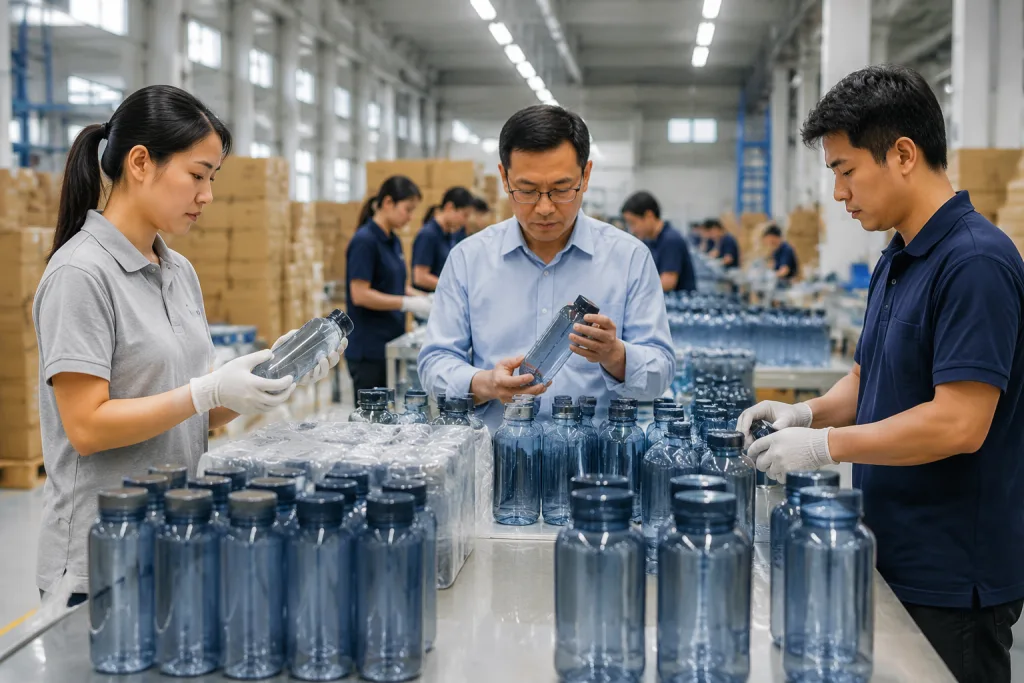
Control production and inspection
Bulk production is where a good canteen factory earns trust. Final inspection cannot fix bad goods after the pallets are wrapped. The line has to control resin drying at the hopper dryer, injection temperature, bottle clarity, lid torque, gasket seating, print curing, and packing. We still ask buyers to lock checkpoints. For a 25–35 day production run in Zhejiang, we share 5 dates: material arrival, injection start, decoration start, packing start, and final inspection. Last month QC pulled the first 30 Tritan bodies from cavity 4 because the shoulder looked slightly cloudy under the light box.
Inspection has to match the defects your channel will reject. Major defects include leaking, cracked body, wrong material, wrong logo, missing gasket, unsafe sharp edge, unreadable barcode, and wrong carton quantity. Minor defects include light scratches, slight color deviation within approved tolerance, small print specks, or carton scuffs. Use AQL 2.5 major / 4.0 minor for most promotional orders, and tighten it for retail shelves at full price. We’ve seen this go sideways when a buyer approved “close enough” PMS color on a desk sample, then the supermarket buyer flagged 260 bottles under store lighting.
Leak testing needs a written method, not a quick squeeze at the packing table. For flip lid bottles, we fill with water, close the cap, invert for 30 minutes, then shake manually for 10 seconds. For straw lids, the test includes straw open and closed positions. For a canteen customizable with multiple lid types, inspect each lid version separately. Do not average results across SKUs. QC pulled the sample means one lid code, one test sheet, one result; mixing flip lid and straw lid data is the wrong question to ask.
Carton strength matters more than buyers think. A bottle that passes inspection at the packing table can arrive damaged after 40 days in ocean freight. Ask for 5-ply export cartons for heavier orders, especially 1,000 ml bottles or custom growler items. A typical carton may hold 24–50 bottles depending on capacity and packing. Keep gross weight under 15 kg if possible; warehouse teams in Europe and North America appreciate cartons that do not punish them. We run a simple carton drop from 80 cm on full cartons, and corner crush tells us more than a clean photo ever will.
If the inspection fails, require sorting and reinspection before balance payment. A serious canteen vendor will accept that. A weak one will argue that “promotional quality” means anything goes. It does not. The math does not work if 3 leaking bottles appear in a 125-piece sample and the factory asks you to release the final 70% balance anyway.
Ship clean and protect reorders
After inspection passes, check the shipping docs before the container or LCL cargo leaves China. Commercial invoice, packing list, bill of lading instructions, HS code, country of origin, and carton count must match the PO line by line. We once had QC pull a 750 ml Tritan bottle order where the PO said “clear body” but the packing list typed “blue body”; customs did not care that the cartons were correct. For Tritan bottles, confirm whether your forwarder files them as plastic drinkware and ask if the destination needs extra paperwork. A wrong product description can hold cargo 3 days even when AQL 2.5 passed clean.
For FOB Ningbo or FOB Shanghai, your freight forwarder controls main carriage. The factory delivers to the port yard or CFS warehouse based on the agreed handover, usually with a stamped warehouse receipt and carton CBM checked against the booking. If you need DDP or delivered duty paid service, quote it as logistics, not as part of the bottle unit price. This is where the math gets messy. DDP works for a 500 pcs distributor canteen launch, but it hides freight, duty, customs clearance fees, and last-mile delivery. For repeat buying, FOB gives cleaner cost control.
Plan reorders before the first shipment sells out. Keep approved artwork, mold number, resin color code, lid color, packaging dieline, carton mark, and inspection report in one folder. On our line, a missing Pantone code can stop pad printing for half a shift while sales chases the buyer on WhatsApp. If your canteen promotional program serves several customers, set SKU rules: same 750 ml clear body with three lid colors, four logo versions, one export carton spec, and one inner box dieline. That lets a canteen supplier schedule production faster and cuts the chance of mixed lids or wrong carton marks.
For distributors, the best China sourcing relationship is not the supplier who says yes to every rush order. It is the canteen manufacturer who tells you which variable will break timing or price. We have seen this go sideways when a buyer changed the lid color after resin was booked, then asked why delivery moved from 12 days to 18 days. BottleForge Industrial is based in Hangzhou, Zhejiang, close to resin suppliers, mold shops, printing vendors, and Ningbo port trucking routes. Location helps. Process matters more. If you keep RFQ, sample, PO, inspection, and reorder data clean, promotional Tritan bottles become a repeatable margin product instead of a seasonal headache.
Send your Tritan bottle RFQ for factory review
Share quantity, target price, logo method, and delivery market. We will return a practical FOB China quote with sample timing.
Frequently asked questions
What MOQ should I expect for a tritan bottle promotional order?
For standard BottleForge molds, a realistic MOQ is 3,000 units per color and logo version. If you split 3,000 units across three lid colors, the unit price usually rises because setup time and material handling increase. Custom PMS body colors often need 5,000–10,000 units because resin color matching and purge loss are not free. For a fully customized canteen mold, plan around 10,000+ units for the first run, plus tooling cost. If you are a canteen distributor testing a new market, start with a standard clear or smoke Tritan body, then customize the cap and logo to keep MOQ and lead time under control.
How much does a promotional Tritan bottle cost FOB China?
Most 500–750 ml promotional Tritan bottles land between USD 1.25 and USD 2.80 FOB China, depending on capacity, lid complexity, decoration, and packing. A simple 650 ml clear bottle with one-color silkscreen and polybag may quote around USD 1.45–1.75 at 5,000 units. A straw lid, color box, silicone sleeve, gradient body, or full-wrap print can add USD 0.20–0.90 per unit. New mold tooling is separate and may run USD 3,000–12,000. Always compare FOB Ningbo or FOB Shanghai on the same specification, because “cheap” quotes often remove carton quality, barcode labels, or compliance paperwork.
Is Tritan better than stainless steel for canteen promotional projects?
Tritan is better when you need clarity, low weight, color visibility, and a lower promotional price. Stainless steel is better when insulation, premium feel, and long heat retention matter. For a 650 ml giveaway, Tritan may be USD 1.25–2.20 FOB, while vacuum stainless often starts much higher depending on grade and finish. Tritan also makes liquid level visible, which gyms, schools, and wellness campaigns like. It is not insulated and it can scratch over time. If your buyer wants a custom canteen for retail shelves, test both materials against the target price, use case, and expected warranty claims.
What should I approve before paying the production deposit?
Approve a pre-production sample, not only a stock sample. The approved set should include final Tritan body color, cap color, gasket, straw or spout if used, logo size and position, packing, barcode label, carton mark, and any retail insert. Your PO should reference artwork file names and sample photos. Also confirm AQL level, inspection method, lead time, FOB port, payment term, and compliance documents. For a typical China factory order, deposit is 30% and balance is 70% after passed inspection before shipment. If anything is still “to be confirmed,” it should not be released to bulk production.
Can one canteen supplier handle bottles, growlers, and other custom drinkware?
Yes, but ask how much is made in-house versus sourced through partner workshops. BottleForge manufactures core plastic and stainless drinkware lines and coordinates related custom growler or customized growler projects when they fit the buyer’s program. The benefit for distributor drinkware buyers is consistent artwork control, inspection language, carton labels, and shipment consolidation. The risk is assuming every product has the same MOQ and lead time. A Tritan bottle may run 25–35 days after approval, while a new stainless growler finish or special lid can need 40–55 days. Keep each SKU’s material, decoration, and inspection requirements separate in the PO.