Key Takeaways
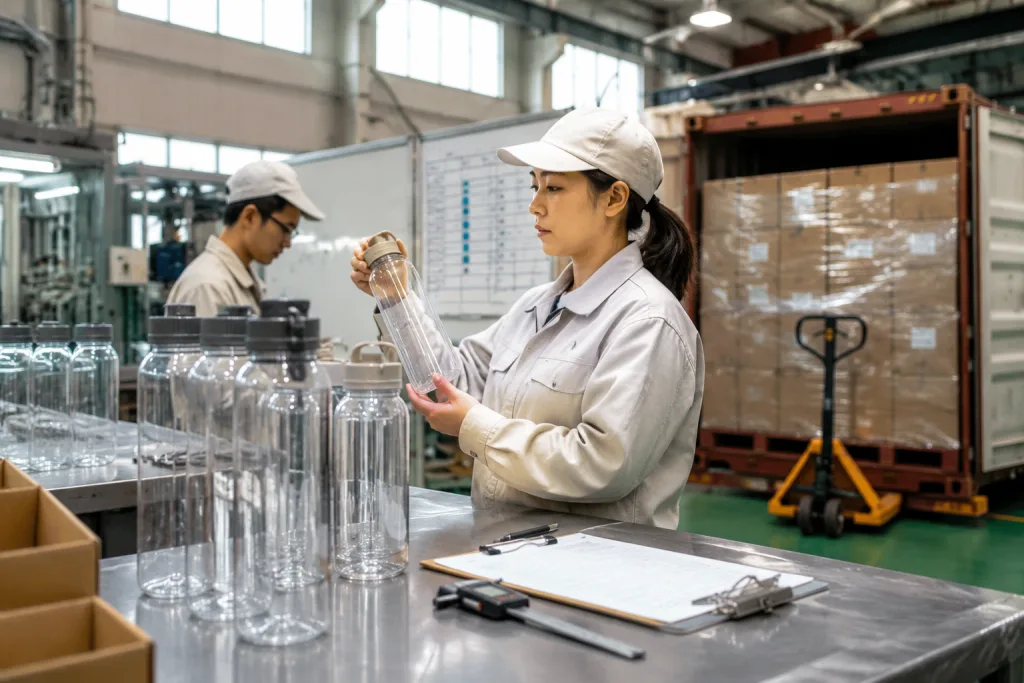
- A standard 600-750 ml Tritan bottle usually lands at USD 1.05-2.40 FOB China depending on lid, logo, and packaging
- Practical MOQ starts around 1,000 pcs for stock colors and 3,000-5,000 pcs for custom color injection
- Normal lead time is 25-40 days after sample approval, excluding sea freight or Amazon FBA appointment delays
- AQL 2.5/4.0 inspection, LFGB/REACH review, and carton drop tests should be quoted before deposit
Search “tritan bottle online wholesale” and the first page makes it look too easy: clear bottle, flip lid, logo, carton, ship. Then the quote lands. We’ve had buyers send the same 650 ml bottle spec to 5 factories and get USD 1.15 to USD 1.78 back; both prices can be honest because resin grade, lid tooling, carton strength, AQL level, and decoration method change the math. QC pulled one sample last month with a 0.35 mm parting line on the lid hinge. The buyer flagged it before we even discussed price.
At our Hangzhou, Zhejiang sales desk, unclear specs burn 4 to 7 days faster than price negotiation does. China moves fast when the drawing, logo file, packaging, compliance target, and inspection plan are locked before sampling; if not, the line waits while everyone argues over a missing Pantone code or a PO typo like “Triten” instead of “Tritan.” A workable wholesale program needs cost ranges by MOQ tier, a carton drop-test target, and a calendar that says 12 days for sampling vs 18 days for sample plus logo revision. Asking only for the lowest unit price is the wrong question to ask.
Start With The Real Unit Cost
A proper tritan bottle online wholesale quote should break out the molded body and lid set first, then show logo method, inner packing, test cost, and freight term as separate lines. If a supplier writes one line, “Tritan bottle USD 1.20,” the buyer still has no BOM to check. This is the wrong question to ask if your team only compares the headline price. Tritan copolyester costs more than PP, so the gap usually sits in 0.8 mm vs 1.1 mm wall sections, lid structure, silicone ring count, and the 2-4% reject allowance we see after injection molding. QC pulled a sample last month where the PO said “food grade Tritan,” but the lid was quoted in PP with no silicone plug.
For a common 650 ml single-wall Tritan bottle from China, FOB Ningbo or Shanghai often sits in these ranges: USD 1.05-1.35 for a simple screw cap in stock color; USD 1.35-1.85 when we run a flip lid with carry loop and one-color logo; USD 1.85-2.40 when custom color matching, measurement scale, stronger export carton, and retail box are all included. A thicker 900 ml fitness bottle can move above USD 2.60 if the lid has a push button, lock, straw, and 3 silicone seals. On the line, that means one more fixture check with a digital caliper and roughly 18 seconds more assembly time per unit.
Body weight matters. A 650 ml bottle using 95 g of Tritan will not feel like one using 125 g. The lighter one may pass basic use, but it can deform during 38°C warehouse storage or after 5 cartons are stacked on a pallet. For wholesale drinkware, ask for gram weight tolerance, usually ±3-5 g, not only capacity. We weigh first-shot samples on a 0.1 g bench scale; if 10 pieces swing by 9 g, the math doesn't work for repeat orders.
At BottleForge Industrial in Zhejiang, our monthly drinkware output across plastic, stainless, and glass lines is about 420,000 units, but we still price Tritan bottle projects by actual mold cycle time and assembly steps. A lid with three silicone pieces is not a small detail. It adds labor, QC points, and spare-part risk. We ship these with a spare silicone ratio agreed before mass production, because we have seen this go sideways when a buyer asks for 2% spare seals after the cartons are already taped.
MOQ Tiers Change The Math
MOQ is where 7 out of 10 online wholesale talks start to wobble. “Low MOQ” sounds nice on a sourcing sheet, then the buyer sees the surcharge, 2 stock colors only, and a production slot that moves from 12 days to 18 days. For stock-body Tritan bottles, 1,000 pcs per style is usually workable. For custom Pantone body color, expect 3,000 pcs per color because the injection line needs resin mixing, a color chip check under the D65 light box, and machine cleaning after the run. For a new lid mold, the commercial order should normally be 10,000 pcs or more. Below that, the tooling math does not work.
A practical MOQ ladder looks like this: 500 pcs for sample-market testing with stock blank bottles and simple carton labeling; 1,000-2,000 pcs for logo printing on stock colors, with the pad-printing jig set once and checked every 200 pcs; 3,000-5,000 pcs for custom color plus retail box, where QC pulled the sample for barcode scan and box drop test; 10,000 pcs and above for exclusive lid details, private mold marks, and better FOB negotiation. If you are buying canteen wholesale or wholesale canteen items alongside Tritan bottles, combining cartons under one PO can improve freight, for example 68 cbm in a 40HQ instead of two loose LCL shipments. It still does not cancel factory MOQ per SKU.
Do not mix too many SKUs too early. We have seen this go sideways. A 5,000 pcs order split into 10 colors is not the same as 5,000 pcs in one color, because each color needs a separate resin batch, first-piece approval, print alignment check within 0.5 mm, and leftover lids or straps at the end of the line. The buyer flagged it once after a PO typed “navy” while the artwork file said “royal blue.” That mistake cost 2 days. If you want drinkware wholesale pricing that stays stable, keep the first order tight: one capacity, two colors, one logo position, one packaging format.
The same logic applies when your category plan includes bulk canteen, bulk drinkware, bulk growler, or growler wholesale programs. Buyers sometimes ask for “one container mixed drinkware bulk,” but this is the wrong question to ask if the goal is clean production. Factories still need MOQ rules by material and production cell. A Tritan bottle runs on an injection molding machine, a stainless beer tumbler goes through polishing and vacuum testing, and a glass beer growler sits on a different production calendar with carton compression checks at 12 kg.
Tooling, Color, And Logo Costs
Tooling is the cost online listings usually keep out of the first quote. Use an existing mold and you skip the biggest upfront hit. A new Tritan bottle body mold can cost USD 4,000-12,000 depending on cavity count, shape, and polish. A new lid mold can cost USD 3,000-8,000. The lid is where projects get expensive: spring button, safety lock, straw channel, silicone vent, 4 slider cores on the mold, and 2-3 trial runs before the line stops leaking at the vent.
Color costs less than tooling, but it still needs tight control. A custom Pantone body usually needs a color masterbatch fee of USD 80-200 per color, plus approval samples. We run color checks under a D65 light box because transparent smoke, amber, and gradient effects show every small batch shift; last month QC pulled 12 bottles from a 500-piece trial because the shoulder looked 1 shade darker than the base. For European and North American retail, confirm that colorant and printed ink align with REACH, LFGB, or FDA food-contact expectations, depending on your market.
Logo cost depends on the method and the bottle shape. One-color silkscreen often adds USD 0.05-0.12 per unit. Heat transfer can add USD 0.18-0.45, but it handles full-color artwork better. Laser marking is common on stainless items, not Tritan, so asking for laser on a clear plastic bottle is usually the wrong question. For UV print, we tape-test with 3M 600 and check rubbing after 24 hours; curved bodies fail faster near the grip ribs if the artwork is too wide.
If your catalog also includes alcohol flask wholesale, alcohol flask in bulk, or alcohol flask wholesale bulk, keep decoration specifications separate. Metal flasks react differently under laser, pad print, and powder coat; we have seen buyers paste the Tritan PO note onto a flask order and leave “clear body logo position 35 mm from base” in the file. Same issue for beer tumbler wholesale bulk or beer tumbler in bulk programs. One brand style guide is fine. One universal decoration process is not.
Ask for a pre-production sample made with final resin color, final logo, and final packaging. A blank sample only proves the mold exists; it does not prove the ink sticks, the carton barcode scans, or the lid passes a 30-minute leak test upside down.

Lead Time Is Not One Number
The honest lead-time answer is a chain, not one promise. For an existing Tritan bottle in a stock color with a one-color logo, sample prep usually takes 5-8 days; we run the logo on a pad-printing jig and QC checks position with a 0.5 mm tolerance. Custom color samples take 7-12 days because the resin masterbatch has to match the Pantone chip under the light box, not just look close on a phone photo. Retail box artwork proofing adds 3-5 days if files are clean. If the dieline is off by 2 mm or the barcode is placed across a fold, we have seen proofing stretch from 5 days to 11 days. Once the sample is approved and deposit is paid, mass production usually needs 25-35 days for 3,000-10,000 pcs. Larger orders or mixed SKUs can run 35-50 days.
Here is a realistic timeline for a new wholesale drinkware order from China: day 1-3 for quote alignment and spec sheet; day 4-12 for sample and logo proof; day 13-16 for buyer approval and deposit; day 17-45 for material purchase, mold setup, screen printing, assembly, leak testing, carton packing; day 46-49 for inspection and booking; then freight. The line does not start because a buyer writes “urgent” in the email. Sea freight to the US West Coast may take 18-28 days port to port, while Europe often takes 30-40 days. Inland trucking and customs can add 5-12 days, and one PO typo in a consignee name can cost another 2 days at booking.
Peak season matters. Before Chinese New Year, production slots tighten from November through January; in our Hangzhou office, the whiteboard for bottle assembly is usually full 4-6 weeks out by mid-December. After the holiday, resin supply and labor return can be uneven for 2-3 weeks. If your retail launch is in April, do not approve samples in late January and expect miracles. This is where the math doesn't work. Zhejiang factories can move fast, but they cannot print, inspect, and ship a delayed decision after QC pulled the sample on January 26 and found the logo 1.2 mm too low.
For Amazon FBA or distributor warehouse delivery, add time for carton labeling, FNSKU application, pallet rules, and appointment windows. We usually budget 2-4 days for label printing and carton relabeling if the buyer sends final FNSKU files late, and Amazon appointment slots can add 3-7 days before the truck unloads. If your order includes beer growler wholesale, beer growler in bulk, or beer tumbler bulk alongside Tritan bottles, treat the slowest production item as the schedule driver. We have seen this go sideways when a buyer planned around the Tritan bottle lead time and forgot the stainless growler needed separate laser marking and pressure testing.
Compliance And QC Budget
Compliance is not a line item you can skip. Tritan sells because it is clear, tough, and BPA-free, but the buyer still needs paperwork on the desk before we ship. For the EU, we usually get asked for LFGB food-contact testing, REACH SVHC screening, and packaging requirements. For the US, FDA food-contact suitability and California Proposition 65 review may apply. If the bottle goes to kids, ASTM and CPSIA checks can come up fast, and that is the wrong place to guess.
Test cost tracks the exact build. A basic third-party food-contact test may cost USD 250-600 per material and color, and full LFGB migration work can run higher. If you switch the body color, lid resin, silicone ring, or pad print, the old report may stop matching the real SKU. We have seen buyers wave a generic PDF from 2021 and then get stuck at customs. The math does not work if the report does not match the resin lot, colorant batch, and cap material on the line.
QC needs to be in the quote before mass production starts. For drinkware wholesale, we usually see AQL 2.5 for major defects and 4.0 for minor defects, with 100% checks on sharp edges, broken locking parts, contamination, and leakage. On Tritan bottles, the useful checks are a 24-hour leak test, cap torque test, print adhesion tape test, carton drop test, barcode scan, and capacity check on the filling machine. QC pulled the sample, found a 1.5 mm lid gap on one lot, and that saved a headache later.
Inspection in China is usually USD 180-320 per man-day through a third party, depending on the city and how deep the checklist goes. On an USD 8,000 PO, that cost feels painful, but it still beats 1,200 bottles with lids that weep in transit. For bulk growler, growler bulk, or wholesale growler glass items, add thermal shock and breakage controls. For alcohol flask bulk items, we check welds, odor, and internal cleanliness harder, because one bad weld will sink a shipment.

Freight, Cartons, And Landed Cost
FOB price is only half the bill. Tritan bottles are light but they eat carton space, so we check carton CBM before we quote freight. A 650 ml bottle may pack 48 pcs per export carton, with carton dimensions around 58 x 40 x 45 cm and gross weight around 8-10 kg; on our line, QC usually confirms this with a tape measure and a 30 kg platform scale after the first packed carton. Add an individual retail box and the carton often drops to 36 pcs, which means the landed unit cost moves even when the FOB price looks unchanged.
For small trial orders under 300 kg, air freight or courier can work, but the cost can add USD 0.80-2.50 per bottle. We ship samples by DHL in 2 cartons often enough to know the buyer usually pushes back when freight is higher than the bottles. For 1,000-3,000 pcs, LCL sea freight is common, but destination charges catch new buyers; one Los Angeles LCL booking last quarter had USD 410 in local fees before final delivery. For 10,000 pcs and above, FCL is cleaner if you combine Tritan bottles with bulk drinkware or canteen bulk items. Compare landed cost, not factory price. The math doesn't work any other way.
Carton strength should match the route. For export, we normally run 5-ply cartons for standard wholesale drinkware and step up the board for heavier stainless or glass items. If you are shipping through e-commerce warehouses, ask for drop-test requirements before production; one buyer flagged a 76 cm corner-drop test after mass packing, and repacking took 12 days vs 18 days for making new retail boxes. A pretty retail box that crushes in transit is not premium packaging. It is a claims generator.
HS codes, duty rates, and local taxes vary by market and material. Tritan plastic bottles, stainless beer tumbler wholesale items, beer growler bulk, and alcohol flask wholesale products may not share the same duty treatment, so your forwarder should verify classification before shipment. We can provide packing list, commercial invoice, and material description from Hangzhou, and our shipping clerk checks the PO for small errors like “Tritain” instead of “Tritan” before documents go out. Your importer of record still owns the customs declaration.
How To Compare Supplier Quotes
For tritan bottle online wholesale quotes, we run a quote sheet that leaves no hiding place: capacity in ml, Tritan grade, body weight in g, lid structure, silicone ring count, MOQ, logo method, packaging, test reports, AQL standard, sample days, production days, FOB port, carton size, payment terms. Ask for body weight, not just “500ml bottle.” We have seen 500ml Tritan bodies quoted at 78g and 92g; the 14g gap changes feel, drop strength, and resin cost. If a supplier leaves half the cells blank, the cheap line is not a quote yet. QC pulled one sample last month where the silicone gasket was 1.6mm instead of the agreed 2.0mm, and that “small” miss became a leak complaint.
Payment terms change risk on both sides. A normal China factory term is 30% deposit and 70% balance before shipment after inspection. For repeat buyers moving 8,000-15,000 pcs per order, terms can loosen after a few clean shipments, but first orders usually stay conservative. If a seller asks for 100% upfront on a large custom order, slow down. If a buyer asks us to buy Tritan resin, print color boxes, reserve line time, and hold stock with zero deposit, the math does not work. We had one PO with “Net 60” typed into the payment line after three rounds of 30/70 confirmation; our merchandiser caught it before the PI went out.
The right wholesale drink bottle is not the cheapest sample on your desk. It is the bottle your customers can use for 12-24 months without leaking, the carton your warehouse can stack without crushed corners, and the reorder your supplier can match in the same Pantone shade six months later. Ask this instead: can the factory repeat the spec? We prefer written specifications over chat screenshots because the line follows drawings, BOM sheets, and approved samples, not a WeChat note from Tuesday night. We have seen this go sideways when a buyer approved a lid photo but never confirmed straw length; final assembly was 6mm short.
If you are building a wider program, such as wholesale drinkware, wholesale growler, beer tumbler wholesale, beer tumbler wholesale bulk, or beer growler wholesale bulk, choose suppliers by production discipline, not catalog size. Catalog size is the wrong question to ask. A factory that tells you the mold cannot hit your target wall thickness, or that production time is 18 days instead of the 12 days you wanted, will save more money than a salesperson who says yes to every price. Zhejiang and broader China supply chains are strong, but they reward clear specs: MOQ, color tolerance, carton drop test, barcode placement, and inspection level agreed before deposit.
Send Your Tritan Bottle Spec For A Real Quote
Share capacity, logo, packaging, MOQ, and destination. We will return FOB pricing, sample timing, and production lead time without vague catalog talk.
Frequently asked questions
What MOQ should I expect for Tritan bottle online wholesale orders?
For stock Tritan bottle shapes, expect a workable MOQ of 1,000 pcs per style if you accept existing body colors and standard lids. For custom Pantone color, 3,000-5,000 pcs per color is more realistic because the factory must mix resin, test color, and clean the injection machine. Retail packaging often pushes suppliers toward 2,000-3,000 pcs because box printing has its own MOQ. New mold projects should normally be planned at 10,000 pcs or more to make tooling cost sensible.
How long does a custom logo Tritan bottle order take?
For an existing mold with one-color logo, plan 5-8 days for sample preparation and 25-35 days for mass production after sample approval and deposit. Custom body color usually adds 3-5 days at the sample stage. Retail box proofing can add another 3-5 days if dielines are correct. Sea freight then adds about 18-28 days to the US West Coast or 30-40 days to many European ports, excluding customs and inland delivery.
Is Tritan more expensive than PP or PET bottles?
Yes. Tritan normally costs more than PP and PET because the resin is positioned for clarity, toughness, and reusable drinkware performance. A 650 ml Tritan bottle may quote at USD 1.05-2.40 FOB China, while simpler PP or PET bottles can be lower. The tradeoff is perceived quality and durability. For promotional giveaways, cheaper plastic may be enough. For retail reusable bottles or brand merchandise, Tritan often justifies the extra USD 0.30-0.80 per unit.
Can I mix Tritan bottles with canteens, growlers, and tumblers in one order?
Yes, but do not assume one MOQ across all items. A canteen wholesale item, beer growler wholesale product, and Tritan bottle may run on different lines, with different packaging and inspection standards. You can combine them under one shipment to improve freight efficiency, especially above 10-15 CBM, but each SKU still needs its own MOQ and lead time. The safest approach is one master PO with separate line-item specs, carton data, and inspection criteria.
What quality checks should I require before shipment?
Use AQL 2.5 for major defects and 4.0 for minor defects as a baseline. For Tritan bottles, require leakage testing, cap fit, lid locking function, silicone seal placement, capacity check, print adhesion, barcode scan, and carton drop test. For a 3,000 pcs order, a third-party inspection usually costs USD 180-320 per man-day in China. Also confirm food-contact documents such as LFGB, REACH, FDA-related material statements, or market-specific reports before the balance payment.