Key Takeaways
- For new Tritan molds, budget USD 3,500-12,000 and 25-40 days before mass production
- A realistic OEM MOQ is 3,000 pieces per color for injected Tritan bodies
- Use REACH, LFGB, FDA, and CA Prop 65 test plans based on your sales market
- FOB Ningbo or Shanghai pricing changes quickly when packaging exceeds 0.018 CBM per piece
If you are sourcing Tritan bottles for retail, corporate gifting, sports programs, or distributor drinkware lines, finding a supplier in China is not the bottleneck. The bottleneck is deciding what must be frozen before RFQ. We see buyers send a logo file, a 3 USD target, and one reference photo, then get stuck when QC pulled the sample and found a 0.6 mm lid gap, the carton failed a 76 cm drop test, or the Pantone color could not hold steady at 3,000 pieces.
From our Zhejiang floor, the pattern is familiar: good buyers lose 20 to 30 days because the brief leaves too much open. Price first is the wrong question to ask. A tritan bottle oem manufacturer should help you lock resin grade, mold route, decoration specs, compliance scope, and packing before the buyer starts pushing for cents; we run this check on a one-page spec sheet, and one PO typo like “Trian” instead of “Tritan” has already delayed artwork approval by 4 days.
Start With Four Buyer Decisions
Before you ask a canteen supplier for a spreadsheet quote, lock four items on your side: what the bottle must do, whether we run an open mold or cut private tooling, which market will test it, and how the logo goes on. These choices hit the quote sheet line by line. We saw this last March: a bank promo bottle at 30,000 pcs only needed a 600 ml Tritan body, PP flip cap, one-color silk print, and bulk carton packing. A retail hiking bottle for a canteen distributor is a different job. The buyer flagged the strap color under a D65 light box, asked for an EAN-13 barcode on the printed box, and wanted cap torque checked at 0.8 N·m before shipment. Same “bottle” word. Different math.
The mold route is the main fork. With an existing factory mold, we can usually sample in 5 to 7 days and move to mass production after artwork approval. If you want a private shape, new handle geometry, locking lid, or custom growler-style wide mouth, you are buying tooling risk. That is fine, but call it product development, not normal sourcing. For a new cap mold, our tool room will start with a 2D drawing, then CNC the steel insert, then QC checks the first shots with a digital caliper; a 0.3 mm mismatch on the hinge pin can make the lid feel cheap. We have seen this go sideways when a PO says “same as sample” but the attached PDF shows a different mouth diameter.
Compliance comes next. European buyers should not accept loose claims like “food grade.” Ask whether the material and finished bottle can be tested for EU 10/2011, LFGB, REACH SVHC, and migration limits. North American buyers usually ask for FDA food-contact confirmation, ASTM where relevant, and CA Prop 65 screening if selling into California. A serious canteen manufacturer in China will not promise every certificate for every color without checking pigments, seals, and printed inks. QC pulled one amber Tritan sample last year because the color masterbatch supplier changed the batch code by one digit; the buyer only noticed after the SGS request form came back with the wrong resin reference.
Decoration also changes the product. Silk screen works well for one or two solid colors, and we normally set a 50 mm x 70 mm print window on a 600 ml bottle before the curve starts fighting the logo. Heat transfer gives a larger retail graphic, but the setup cost is higher and rejection climbs on round shoulders; on one full-wrap order, the line scrapped 4.6% because the film seam drifted near the graduation marks. Laser is common on stainless steel, less useful for Tritan. If you need customized drinkware with full-wrap artwork, say it early. Asking for it after the mold and carton layout are approved is the wrong question to ask.
Material Choices Are Not Cosmetic
Tritan sells because it is clear, impact resistant, BPA-free when the resin is bought from the right channel, and dishwasher tolerant in the right design. Still, “Tritan bottle” is not a spec. Put the resin grade, wall thickness, cap material, gasket material, and working temperature range on the PO. We run most sports bottle bodies at 1.8 to 2.5 mm wall thickness, checked with a Mitutoyo caliper at the shoulder, waist, and base. Below 1.8 mm, the bottle feels thin and can ovalize after a drop test. Above 2.5 mm, the part gets heavy and the injection cycle can move from 38 seconds to 52 seconds, so the math does not work for every promotion order.
Ask your tritan bottle oem manufacturer whether the body is injection molded or blow molded. Injection molding holds threaded mouths tighter, often within ±0.15 mm on the neck finish, and gives a cleaner surface when the mold is polished properly. Tooling costs more. Blow molding works well for simple shapes and lighter bodies, but shoulders, finger grooves, and logo panels need a hard look before steel cutting. We have seen this go sideways when a buyer approved a nice rendering, then QC pulled the sample because the grip area had whitening after a 1.2 m drop. A canteen factory that runs both processes should explain the trade-off, not push every buyer into one line.
The lid needs more attention. Roughly 6 out of 10 leak complaints we receive start at the cap, not the Tritan body. PP lids are common and cost-effective, but the hinge pin, drinking spout, and gasket groove decide whether the bottle survives daily use. Silicone gaskets should be removable, or the groove should be open enough that mold does not sit under the seal after washing. If you want a leakproof flip lid, fill it with 23°C water, put it upside down for 4 hours, then repeat after 3 dishwasher cycles if dishwasher claims appear on packaging. Simple test. We also weigh the gasket on a 0.01 g scale when a supplier changes silicone batches, because a soft gasket can pass day one and leak after compression.
Color is a production issue, not just a design choice. Transparent smoke, amber, and blue look easy in renderings, but pigment load changes clarity and flow marks. A canteen customized in deep transparent color can show gate blush near the base more than a frosted bottle, especially when the wall is under 2.0 mm. For large distributor canteen programs, approve physical color chips and a pre-production sample, not just a Pantone number in an email. We once had a PO with “Pantone 7545C transparent” typed into the color line; the buyer flagged the first sample as too gray because paper Pantone and transparent resin do not read the same under a light box.
Tooling, MOQ, and Real Lead Times
OEM buyers ask us for 1,000 pcs MOQ and a new bottle shape in the same email. That math does not work. For existing molds, BottleForge in Hangzhou, Zhejiang can usually run 3,000 pieces per color for Tritan bottles; 1,500 pieces only works when the same Pantone masterbatch is already on the line for another order. For private tooling, 5,000 to 10,000 pieces per first order is the safer range because we need stable injection settings, resin purchase volume, and enough samples for drop testing. Last month QC pulled the sample after a 1.2 m drop test because the shoulder radius was 0.8 mm too sharp.
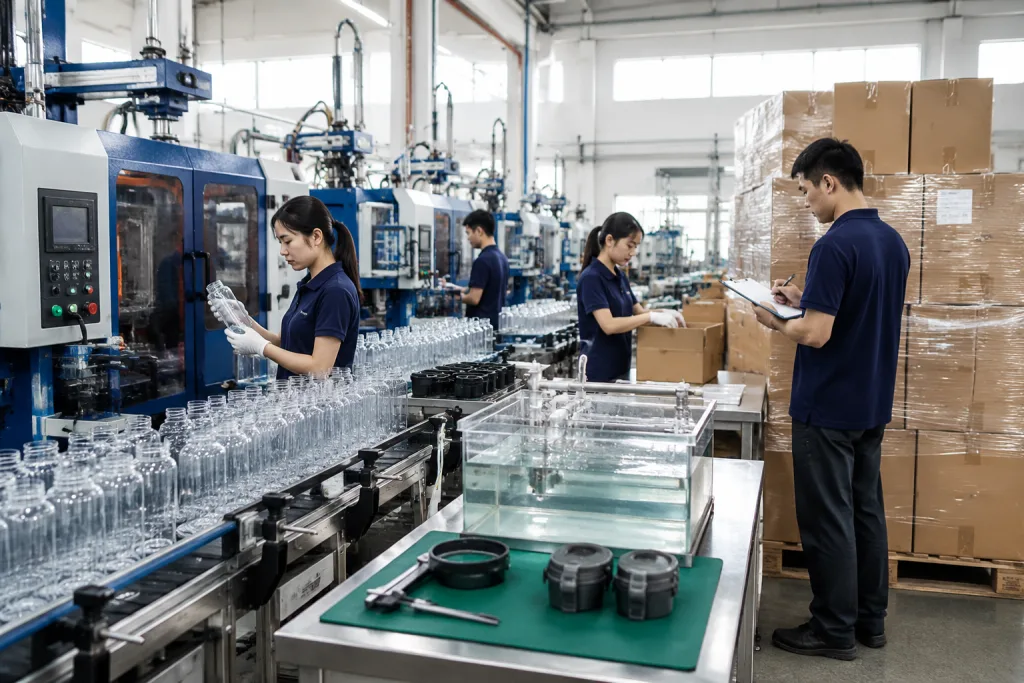
We run about 450,000 units/month for Tritan and mixed plastic drinkware, but lids slow the line fast. A plain screw lid is one thing; a flip lid with straw seal and lock parts needs more assembly checks with a torque tester and air-leak jig. Standard production lead time is 25 to 35 days after deposit and approved pre-production sample. New tooling normally adds 25 to 40 days, including 3D review, CNC mold work, first trial, adjustment, and final sample. If a canteen vendor promises a new private mold plus mass production in 20 days, ask which step disappears. We have seen this go sideways.
Tooling cost depends on cavity count and part count. A simple body mold may start around USD 3,500 to 6,000. A bottle with separate handle, flip button, straw, dust cover, and locking latch can need 4 to 7 mold sets and reach USD 12,000 or more. Clarify who owns the mold, where it is stored, how many shots are guaranteed, and whether the supplier will run it for other canteen distributors. One buyer flagged this after seeing the same 650 ml body on a competitor’s Amazon listing, and the PO had “exclusive mold” typed in the remarks.
MOQ also changes with packaging. A bare bottle in an opp bag is easy to run; a retail set with printed box, insert, manual, spare straw, and carton marks adds outside vendors and another schedule. Customizable drinkware buyers sometimes negotiate bottle MOQ but forget the box factory may require 3,000 to 5,000 printed boxes. Put these numbers in the quote sheet before comparing canteen vendors. We ship fewer surprises when the packaging BOM lists carton size in mm, gross weight in kg, and the exact spare-straw count per carton.

Decoration and Brand Control
Brand owners usually care about shelf look or the first 10 seconds of a corporate unboxing. Distributors care about repeat decoration with no complaint tickets. Both matter, but the decoration method has to fit the artwork, MOQ, and how the bottle will be used. For a simple custom canteen with one logo, silk screen is still my first choice: one screen, one ink, clean edges, easy AQL check with a 30 cm visual distance on the QC table. For a photographic retail design, heat transfer or in-mold labeling can work better, but the setup bill jumps and the first trial often needs 2 rounds before the color sits right on the Tritan body.
For Tritan bodies, surface energy matters. We run into this on the line when a bottle comes off a new mold too glossy or carries a trace of mold release; the ink looks fine at 9 a.m., then QC pulled the sample after curing and the corner lifted. Ask for cross-hatch adhesion testing on printed samples. A practical requirement is 3M tape pull after 24 hours curing, plus rub testing with a damp cloth for 50 cycles. If your customized canteen will be sold through outdoor or school channels, test with sunscreen and hand lotion too. Water is not the problem. Lotion is.
Private label packaging is where OEM programs get messy fast. Decide early whether you need UPC, FNSKU, warning labels, multilingual instructions, recycling marks, and carton labels, then put them into one artwork folder with version dates. Last month a buyer flagged a PO typo where “FNSKU” was written as “FNSK”; that small miss added 3 days because the carton label file had to be re-approved. For Amazon-style fulfillment, each unit may need a scannable FNSKU and carton weight under the receiving limit. For European retail, you may need importer address, material symbols, and language coverage. A canteen promotional order may only need a bulk carton, but a retail customized growler or bottle set needs tighter documentation.
Do not send ten decoration options and ask the factory to “quote all.” This is the wrong question to ask. You will get a slow answer, or a lazy one, because the sales team has to chase screen charges, film cost, packing changes, and line speed for every version. Send two realistic versions: a target version and a cheaper fallback. Good canteen manufacturers can price both and explain the trade-off; we usually turn 2 clean options in 24 hours, while 10 half-finished options can sit for 4 working days.
Quality Checks Before Shipment
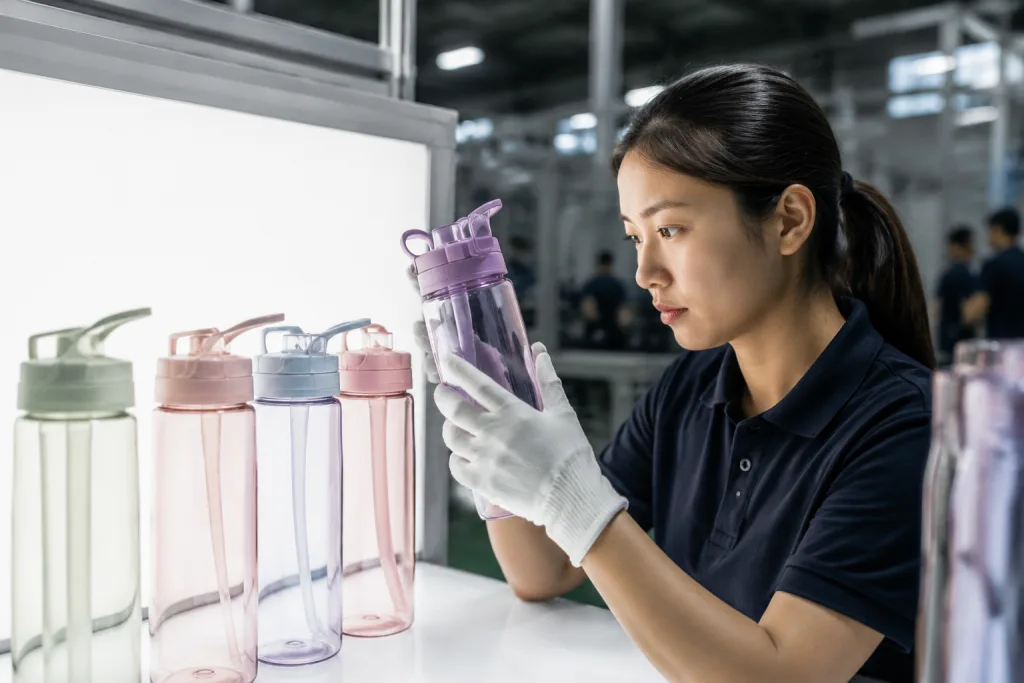
A tritan bottle oem manufacturer should be judged by the checks it runs before shipment, not by the shine on its catalog. For B2B orders, we ask for written inspection criteria tied to AQL, and QC should have the same sheet as the buyer, not a loose note in WeChat. A common setup is AQL 2.5 for major defects and 4.0 for minor defects, with critical defects set to zero tolerance. Critical defects include sharp edges found by the thumb rub test, broken locking parts, foreign material inside the bottle, heavy leakage, wrong resin, or unreadable compliance marks. QC pulled 200 samples on one 18,000 pcs order last year; 7 lids failed the lock check, so the line had to rework before packing.
Your inspection checklist should include capacity measurement, lid torque, leakage, drop test, print position, print adhesion, color deviation, carton dimensions, and barcode scanning, but each item needs a number beside it. For a 750 ml bottle, capacity tolerance of ±3% is usually reasonable unless your market has strict labeled-volume rules. We run capacity with a digital scale and water at room temperature, then record the gram weight against the spec. Drop testing should be defined: for example, filled bottle dropped from 1.0 m on bottom, side, and cap, three samples each. Carton drop testing should follow ISTA-style logic, especially for e-commerce shipments. The buyer once flagged a 6 mm print shift on a front logo; that is small on paper, ugly on shelf.
Material verification is not optional. If you are buying from a canteen supplier in Zhejiang or another China production base, ask for resin purchase records and batch traceability. You do not need to audit every pellet bag, but the factory should link production dates, resin lots, and finished goods cartons within 10 minutes from the ERP or batch card. This protects both sides if a retailer asks for documentation six months later. We have seen this go sideways when a PO typed “Tritan” but the color approval sheet said “AS”; the buyer flagged it only after the first 3,000 pcs were molded.
Factory audits matter, but use them correctly. BSCI, Sedex, ISO 9001, or similar reports tell you something about systems and social compliance. They do not prove your bottle will not leak. This is the wrong question to ask if the only question is “Do you have audit reports?” Combine factory audit, product testing, and final inspection. Canteen suppliers who resist third-party inspection are giving you a warning before you send the balance payment. In our packing area, the last gate is simple: barcode scanner, carton scale, tape gun, and a signed QC report before we ship.
Pricing the Whole Landed Program
Unit price is the wrong first question to ask. For FOB Ningbo or FOB Shanghai, a Tritan bottle can look cheap on the PI, then retail box volume, SGS or Intertek inspection, FDA or LFGB testing, Hangzhou-to-port trucking, and a lid design your channel cannot sell will eat the margin. We run a basic 650 to 800 ml Tritan sports bottle from an existing mold in the USD 1.20 to 2.40 FOB range, depending on lid structure, one-color silk print or heat-transfer print, and whether the buyer wants an opp bag or color box. Add a locking lid, straw, carry handle, and 350 gsm retail box, and a customizable canteen can move above USD 3.50 quickly. QC pulled one sample last month because the flip cap gap measured 0.7 mm wider than the approved sample. Small gap. Big argument.
For distributor growler or large-capacity bottle programs, freight density decides the real cost. Plastic is light, but it steals container space. If the packed volume is 0.018 CBM per piece, a 10,000-piece order uses about 180 CBM before palletization, and that can wipe out a USD 0.10 factory saving fast. We have seen buyers push for a thinner carton to save 4 mm on width, then the line found corner crush after a 10 kg stack test. Ask your canteen manufacturer to quote carton size, gross weight, and units per carton with the first price, not after the PO is approved.
Payment terms affect risk on both sides. Standard terms in China are often 30% deposit and 70% balance before shipment, and most factories will not start material purchasing until the deposit lands. For repeat buyers with 3-month rolling forecasts, we can talk about staged production or shipment release terms, but the math does not work for a new buyer asking for 60 days credit on a first 3,000-piece order. Focus less on squeezing payment terms and more on signed samples, test standards, and shipment inspection rights under AQL 2.5. One buyer flagged a PO typo where “Tritan” became “Titan”; we stopped it before mold engraving, but not every supplier will catch that.
The better OEM choice is simple: pick the bottle your channel can reorder, not the cheapest sample on the table. If you need a canteen promotional item, keep the lid simple and the MOQ realistic, maybe 5,000 pieces with a one-color logo. If you need a distributor drinkware line, build a spec sheet that can run for two seasons with the same mold, same carton, and same barcode position. If you need a customizable growler or premium bottle, budget for tooling and testing from day one. We have seen this go sideways when a buyer approved tooling first, then found the target retailer required a different drop-test height.
Send Your Tritan Bottle OEM Brief Today
Share target volume, market, logo method, and packing needs. We will return a practical quote with MOQ, lead time, and test options.
Frequently asked questions
What MOQ should I expect from a Tritan bottle OEM manufacturer?
For an existing mold, a practical MOQ is usually 3,000 pieces per color for Tritan bodies, especially when you need a custom color rather than clear stock material. If you accept clear, smoke, or another running color, some factories may discuss 1,000 to 2,000 pieces, but the unit price will rise. For a private mold, expect 5,000 to 10,000 pieces for the first order because tooling trials, resin purchasing, and process tuning need volume. Packaging can also set the real MOQ. A printed retail box supplier may require 3,000 to 5,000 boxes, even if the bottle line can run less.
How long does OEM development take before shipment?
For an existing Tritan bottle mold with a standard lid, plan around 5 to 7 days for logo samples, 3 to 5 days for artwork and packing approval, then 25 to 35 days for mass production after deposit. If you need new tooling, add 25 to 40 days for 3D confirmation, mold cutting, first trial, adjustment, and pre-production samples. Testing adds time too. LFGB, REACH, FDA-related food-contact, or CA Prop 65 screening can take 7 to 15 working days depending on the lab and test scope. A realistic first OEM order is often 45 to 75 days door-to-port.
Is Tritan better than stainless steel for custom drinkware?
Neither is automatically better. Tritan is clearer, lighter, and useful when buyers want visible water level, color transparency, and lower FOB cost. It works well for sports, school, fitness, and canteen promotional programs. Stainless steel is better for vacuum insulation and premium thermal performance, but it costs more and has different decoration options. If you are building distributor drinkware for outdoor retail, stainless steel may justify the price. If you are building a customized drinkware program for hydration tracking, events, or youth channels, Tritan is often more practical. Decide based on channel, retail price, compliance needs, and expected use, not material fashion.
What tests should I require before paying the balance?
At minimum, require leakage testing, capacity check, drop testing, print adhesion, visual inspection under AQL, and barcode scanning if retail labels are applied. For AQL, many B2B buyers use 2.5 for major defects and 4.0 for minor defects, with zero tolerance for critical safety defects. For compliance, choose tests based on sales market: EU 10/2011, LFGB, and REACH for Europe; FDA food-contact documentation and CA Prop 65 screening for many North American programs. If dishwasher-safe claims appear on packaging, test printed and assembled bottles after repeated dishwasher cycles. Do not rely only on raw material certificates.
Can I use one supplier for bottles, canteens, and growlers?
Yes, but check whether the factory actually produces those categories or only trades them. A real canteen factory or canteen manufacturer should explain process differences between Tritan injection bottles, stainless vacuum bottles, plastic caps, and larger custom growler designs. If one canteen vendor quotes every material instantly, ask which items are in-house and which are subcontracted. Subcontracting is not always bad, but it needs disclosure, especially for testing and traceability. For a distributor canteen or distributor growler program, using one coordinated supplier can reduce artwork errors, carton mismatch, and shipment consolidation cost. The key is clear responsibility for QC.