Key Takeaways
- A solid Tritan bottle RFQ should include capacity, wall thickness, cap type, decoration method, MOQ, and test standard
- For most B2B custom drinkware programs, 0.9–1.2 mm wall thickness is the practical range
- Retail canteen customized projects usually need stronger packaging than promotional canteen orders
- China factory lead time is typically 25–35 days after sample approval, not after first email
If you are comparing tritan bottle manufacturers, finding a factory is the easy part. The hard part is choosing a bottle spec that survives your sales channel, artwork, and margin target. A 600 ml gym promo bottle we run with a flip cap is not built like a 1,000 ml outdoor canteen for retail shelf display. Different wall thickness, carton pack, drop-test level, and lid structure. QC once pulled a sample from the line after a buyer changed the logo from 42 mm to 58 mm wide; the print passed on paper, then wrapped too close to the grip ribs on the actual bottle.
At BottleForge Industrial in Hangzhou, Zhejiang, we see buyers lose 5–10 days by asking for “a 750 ml Tritan bottle” before they lock the use case. This is the wrong question to ask. China can make it cheap, but cheap without control turns into rework, late cartons, or a cap that leaks at 45 degrees in a simple water-fill test. Our normal MOQ starts at 3,000 units per color, with sample lead time around 7 days and mass production at 25–35 days after approval. Last month the buyer flagged a PO typo—matte black lid on line 3, glossy black in the artwork file—and catching that before mold trial saved a full re-sample round.
Start With The Bottle Job
Before you ask tritan bottle manufacturers for a price, pin down the bottle job. Tritan is a copolyester, not stainless steel and not cheap PP. It gives you clear walls, decent impact strength, and BPA-free claims when the resin paperwork is clean; we still ask for the resin lot COA before the first injection run. Good fit: sports bottles, school bottles, canteen promo orders, and mid-price retail custom drinkware. Wrong fit: hot coffee. The line will not turn a Tritan bottle into a stainless thermos, no matter what the sales deck says.
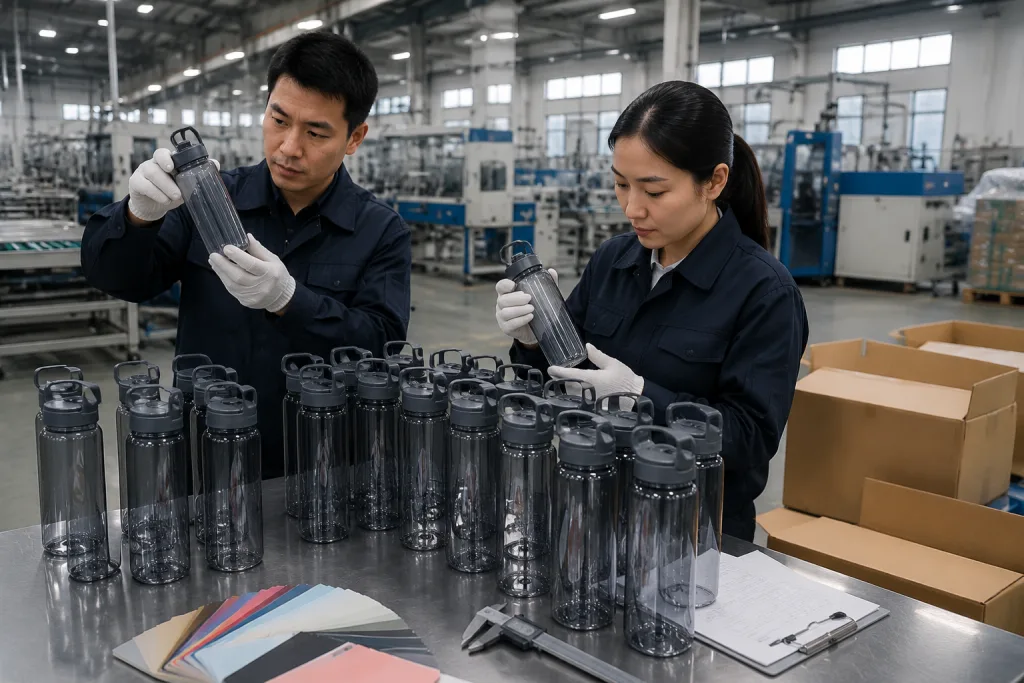
This is how we sort projects on our Zhejiang sample bench, usually with a wall gauge, a leak tester, and 6 sample caps from the cap room:
| Use case | Typical size | Best cap | Wall target | Main risk |
|---|---|---|---|---|
| Promotional custom canteen | 500–650 ml | Flip lid or screw cap | 0.8–1.0 mm | Logo rub-off after packing |
| Retail customizable canteen | 650–1,000 ml | Leakproof lock lid | 1.0–1.2 mm | Drop cracks and return claims |
| Outdoor distributor canteen | 750–1,200 ml | Carry loop cap | 1.1–1.4 mm | Cap hinge fatigue after cycling |
| Kids school bottle | 350–500 ml | Straw lid | 0.9–1.1 mm | Bite valve pull force and small parts |
A canteen distributor usually asks us about repeat color, barcode labels, and how many pieces fit a 5-layer export carton. A brand owner cares about shape ownership and shelf presentation; in 7 out of 10 retail jobs, the buyer flags the cap silhouette before they discuss the bottle body. A canteen vendor running one seasonal campaign can live with a stock mold and silkscreen. Canteen distributors building a catalog should ask about tooling, cap MOQ, and spare cap supply. We have seen this go sideways when a PO says “blue lid” and the approved sample tag says “blue button only.”
The point is simple: do not compare quotes until the use case is fixed. A USD 1.35 bottle and a USD 2.10 bottle may both be honest China prices, but they are not the same product. QC pulled one 650 ml sample last month that looked fine in photos, then failed the inverted leak test after 8 minutes because the gasket groove was 0.3 mm shallow. Cheap on paper. Expensive after returns.
Tritan Versus Common Alternatives
Tritan is the right pick when the brief says clear body, drop resistance, and a plastic bottle that does not feel cheap. It is the wrong material for vacuum insulation, rock-bottom promo pricing, or 100°C filling. On our line, QC pulled a 650 ml sample after a 1.2 m drop test and the body passed, but the buyer still rejected Tritan for a hot-tea project. Fair call. If a canteen supplier claims one material fits every channel, the math does not work.
Use this comparison when you brief your sourcing team; we usually paste these ranges into the first RFQ sheet before tooling talk starts:
| Material | Best fit | Typical FOB range | Buyer note |
|---|---|---|---|
| Tritan | Sports bottles, school canteens, retail customized lines with 500–1000 ml molds | USD 1.20–3.20 | Clear, tough, BPA-free with proper resin; check resin lot code on the COA |
| PP | Low-cost promotional canteen orders above 5,000 pcs | USD 0.65–1.40 | Cheaper and lighter, but the softer surface makes logos look less sharp |
| PETG | Light retail bottle where shelf clarity matters | USD 0.90–2.00 | Good clarity, usually less impact resistant; buyers flag whitening around threaded necks |
| Stainless steel | Insulated tumbler, custom growler, outdoor bottle | USD 3.50–9.80 | Higher freight weight, better thermal function; inspect weld line and inner polish |
| Glass | Office bottle, wellness bottle, infuser bottle | USD 1.50–4.50 | Clean taste, breakage risk; carton drop test matters more than catalog photos |
For a customizable growler or customized growler, Tritan is rarely our first recommendation if the buyer expects insulation or beer freshness. Stainless steel wins most of those orders. We have seen this go sideways: one PO called it a “clear beer growler,” then the buyer flagged warm-fill performance after sampling. For a distributor growler program aimed at outdoor retail, the cap seal and 304 stainless internal finish matter more than a transparent body.
For canteen customizable programs, Tritan earns its place because it takes bright color, translucent finish, frosted texture, volume marks, and retail shapes without making the bottle feel bulky. We run 0.5 mm tolerance checks on the lid thread before mass production, because a pretty body is useless if the cap leaks in AQL 2.5 inspection. It also ships lighter than stainless steel, which helps European and North American distributors when ocean freight and carton cube start squeezing landed cost.
Our rule: choose Tritan when the buyer should see the water, read the color fast, and feel a lighter bottle in hand.
Spec Table Buyers Should Send
A loose RFQ gets loose pricing. Send the same spec sheet to 3 tritan bottle manufacturers and the quotes will tell you more than any “best price” email. We see this every week: one buyer wrote “650ml sports bottle, nice cap” on the PO, then QC pulled the sample and found the cap gasket was 1.8 mm too small. The spec does not need fancy formatting. It needs numbers we can measure on the line.
| Spec item | Recommended request | Why it matters |
|---|---|---|
| Capacity | 500, 650, 750, 1,000 ml | Sets mold choice, carton cube, and freight math |
| Material | Eastman Tritan or equivalent copolyester | Blocks substitution with cheaper plastic resin |
| Wall thickness | 0.9–1.2 mm for most programs | Changes drop-test result and hand feel |
| Cap | Screw, flip, straw, lock, carry loop | Leakage claims usually start at the cap set |
| Decoration | Silkscreen, heat transfer, laser on metal plate, sleeve | Each method has its own MOQ, jig cost, and reject rate |
| Packaging | OPP bag, color box, kraft box, PDQ tray | Retail shelves and Amazon cartons need different packing strength |
| Compliance | FDA, LFGB, REACH, CPSIA if needed | Depends on market, buyer channel, and age grade |
For customized drinkware sold in the EU, ask for LFGB food-contact migration support and REACH documents for coatings, inks, silicone seals, and any soft-touch paint. For the U.S., FDA food-contact testing is standard, and kids products need CPSIA review before artwork approval. One practical check: ask the canteen manufacturer to mark liquid-contact parts, mouth-contact parts, and decoration-only parts on a simple exploded drawing. If they cannot do that, the compliance file is thin. We have seen this go sideways when a buyer flagged black ink on the rim after the pre-shipment inspection.
At BottleForge Industrial, we run about 420,000 units per month for Tritan and plastic drinkware across stock items and custom molds. That does not mean every order ships right away. A 5,000-unit custom canteen with 1 body color and 1 logo is a clean job; the line can usually set up with one pad-printing jig and one color masterbatch. A 30,000-unit program with four body colors, two cap colors, FNSKU labels, and mixed cartons needs a real production schedule. Optimism is not a schedule. If the buyer asks for 12 days but the cap injection slot is 18 days, the math does not work.
Decoration Choices Head To Head
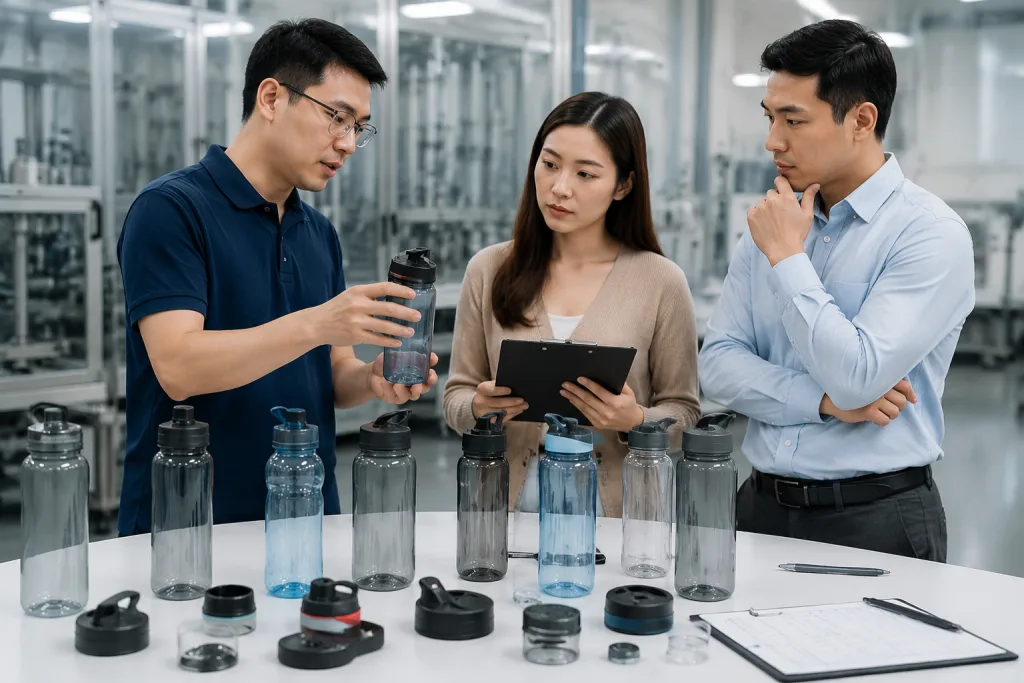
Decoration is where roughly 4 out of 10 custom drinkware projects start to wobble. The buyer approves a clean PDF mockup; the factory has to price screen loss, jig loading time, oven curing, and QC sorting. We run the logo cup through a 12-slot fixture, not a Photoshop file, so the right canteen supplier should talk through the trade-off before sampling.
| Method | Best for | MOQ impact | Durability note |
|---|---|---|---|
| Silkscreen printing | Simple logos, 1–3 colors; solid artwork works best | Low; 3,000 units practical | Good if ink viscosity and oven curing are controlled |
| Heat transfer | Full-color branding with wrap coverage | Medium; setup film needed | Better coverage, higher unit cost |
| UV printing | Short runs with gradients or photo-style artwork | Flexible but slower on the line | Needs cross-hatch and scratch testing |
| In-mold color body | Retail line consistency across repeat POs | Color MOQ applies | Cleanest look, no logo texture |
| Hangtag and sleeve | Distributor canteen assortment with mixed SKUs | Low tooling burden | Packaging does the selling |
If you need a canteen promotional order for a trade show or school event, silkscreen is usually the right answer. Fast. Easy to quote. Setup charges usually land around USD 45–90 per color, depending on artwork, logo size, and whether we need a curved bottle jig. For a canteen customized retail range, heat transfer or sleeve packaging can earn back the extra USD 0.20–0.45 per unit because the shelf face looks stronger; the math doesn't work if the order is only 800 pcs.
For distributor drinkware, consistency beats one dramatic sales sample. Ask for a pre-production sample from bulk material, not only a hand-made sample from the showroom shelf. Define logo position tolerance, for example plus or minus 1.5 mm, and use AQL inspection for print defects. For plastic bottles, AQL 2.5 for major defects and 4.0 for minor defects is common, but buyers with strict retail channels sometimes ask tighter. QC pulled the sample last month after finding a 2.3 mm logo drift on a 5,000 pcs run, and the buyer flagged it before carton approval.
One warning from our China production floor: dark transparent Tritan bodies hide small flow marks better than clear bodies, but they show dust and scratches under retail lighting. Clear is honest. It also exposes poor molding fast. We check clear bottles under a 6500K inspection lamp, and we've seen this go sideways when a PO says “smoke grey” but the approved sample was closer to tea brown.
Supplier Types Are Not Equal
Search results often mix canteen manufacturer with canteen vendor or canteen supplier. The names do not mean the same job. One supplier may run 18 injection machines and own the bottle mold; another may only fit caps, silicone rings, and cartons after buying bodies from a molding shop. A trading office may coordinate 4 workshops from one small sample room. That can work, but this is the wrong question to ask: “Are you a factory?” Ask which process they control and where your money goes.
| Supplier type | Strength | Weakness | Best buyer fit |
|---|---|---|---|
| Direct canteen factory | Owns molding data, resin records, and line settings | Pushes back on 300 pcs trial orders | Brand owners with repeat SKUs |
| Trading company | Can source bottles plus lunch boxes or bags | Root-cause fixes slow when QC pulled the sample | Small range testing before a real launch |
| Assembly specialist | Good cap choices and fast carton changes | Body molding may sit 20 km away | Promotional programs with mixed colors |
| Design-led vendor | Cleaner shelf shape and retail packaging sense | Tooling quotes climb fast, often USD 3,000+ | Private-label lines needing a distinct look |
If you are building a repeat customized canteen or customizable drinkware program, ask blunt production questions. How many injection machines run this bottle family, 4 or 14? Is the mold owned by the factory, locked for your SKU, or shared with another buyer? What is the cycle time per shot, 38 seconds or 52 seconds? Which Tritan resin grade goes into bulk production, and will the bag label match the sample sheet? If your retailer asks, can they send BSCI, ISO 9001, or social audit files before the PO, not 3 days before shipment?
In Zhejiang and nearby China supply clusters, one factory may mold the body while another workshop handles silicone, cartons, or metal accessories. Normal setup. The risk starts when nobody owns the final QC table. At BottleForge Industrial, we run the bottle as one system: 2.2 mm body wall, cap thread fit checked with a go/no-go gauge, gasket compression after hot-water testing, logo position at ±1.5 mm, export carton strength, and document pack. A clean Tritan body with a loose silicone ring still leaks in a buyer’s warehouse.
For a canteen distributor, the safer partner is not the cheapest canteen vendor. The safer partner is the supplier who can ship the same SKU 6 months later without changing the cap shade from Pantone 7472C, switching the carton from 35.5 x 29 x 48 cm, or swapping resin source without writing it on the PI. We have seen this go sideways: the buyer flagged “same as last order” on the PO, but the cap came out half a shade darker because the line used leftover masterbatch.

Cost Drivers You Can Control
Most buyers ask for the FOB price first. Fair. For Tritan bottles, that is the wrong question to ask until the drawing is clear. We quote from resin weight, mold cycle time, lid structure, decoration, packaging, QC level, and order quantity; on the line, a 6 g weight change shows up fast on the electronic scale beside the injection machine.
A plain 650 ml Tritan bottle with screw cap, one-color silkscreen, and OPP bag may land around USD 1.25–1.75 FOB Ningbo or Shanghai at 5,000 units. Add a locking flip lid with 5 plastic parts, silicone carry strap, color box, and two-color print, and the same size can move to USD 1.90–2.60. A retail-ready 1,000 ml canteen customized with full wrap artwork, kraft box, and barcode labels may be USD 2.70–3.40 depending on resin weight and packaging; last month QC pulled the sample because the barcode label was 3 mm off-center on the box panel.
- Resin weight: every 10 g matters when Eastman Tritan resin moves by USD 0.30–0.50 per kg.
- Cap parts: a lid with spring, pin, gasket, and button needs more assembly checks; we have seen leakage fail at the gasket seat after 3 drop tests.
- Color count: each extra print color adds screen setup, registration risk, and inspection time under the light box.
- Packaging: color box can add USD 0.18–0.55 per unit, and a 350 gsm box usually costs more than buyers expect.
- QC level: tighter AQL and third-party inspection add cost, but they catch scratches, weak snaps, and mixed cap colors before we ship.
If you are a distributor canteen buyer, do not over-customize your first order. Start with one proven mold, two body colors, one cap color, and one decoration method. That is enough. After sell-through data, expand into a custom growler, customizable growler, or larger outdoor SKU if your channel supports it. We have seen this go sideways when a first PO had 12 SKUs, 4 carton marks, and one typo in the blue body color code.
For freight, plastic bottles are light but bulky. A 650 ml bottle may pack 48 units per master carton, while a 1,000 ml wide-body bottle may pack only 24. Carton cube can hurt your landed cost more than a USD 0.08 factory price difference; one buyer flagged this after the forwarder measured 0.092 cbm per carton instead of the 0.078 cbm written on the packing list.
Sampling And Inspection Discipline
Sampling should prove the real production route, not just make a sales meeting look good. We run it in three steps: stock sample to check the bottle shape and cap feel, logo sample to check Pantone and print position, then pre-production sample to lock the exact Tritan resin, color masterbatch, cap parts, print, and export carton. QC once pulled a PPS because the logo was 2 mm too close to the shoulder radius. Good catch.
From our Hangzhou, Zhejiang export desk, available stock samples usually leave in 3–5 days, logo samples take 7–10 days, and mass production runs 25–35 days after written approval and deposit. New private mold projects take more calendar time. A simple bottle mold may need 35–50 days for tooling and trial, while a complex cap system can add another 15–25 days. One buyer asked for “12 days faster” after the T1 trial; the math did not work because the mold shop still needed EDM polishing and a second leak trial.
For inspection, ask your canteen factory to define defects before the line starts. Leakage is major. Wrong logo color is major. Small injection gate marks may be minor if they stay inside the approved sample limit, such as under 0.8 mm and not on the front face. Carton damage may be major for retail but minor for bulk promotional shipping. This is where AQL language saves arguments; we have seen this go sideways when a PO only said “good quality” and nobody defined it.
Recommended checks include:
- 24-hour leak test with bottle inverted and horizontal, with QC marking any cap seepage on the inspection sheet
- Drop test from 1.0 m on filled bottle, usually 3 angles, using the same carton-packed sample weight
- Dishwasher claim testing only if you plan to print that claim on the bottle or color box
- Torque or opening-force check for screw caps, measured with a torque meter before packing
- Barcode scan and FNSKU placement check for e-commerce cartons, because Amazon will not care that the PO had a typo
A good canteen manufacturer will not be offended by these checks. They will ask you to confirm the standard, then put it on the pre-production sample tag and inspection report. That is the working style you want with tritan bottle manufacturers: clear drawings, signed samples, and boring QC. Boring ships on time.
Send Us Your Tritan Bottle Spec Sheet
We will review capacity, cap, decoration, MOQ, compliance, and FOB target before quoting your next custom drinkware order.
Frequently asked questions
What MOQ should I expect from tritan bottle manufacturers?
For a stock mold with one body color and one logo, expect 3,000 units per color as a practical MOQ in China. Some canteen vendors will quote 1,000 units, but the unit price usually jumps by 15–35% because setup and printing loss are spread across fewer bottles. For custom color matching, 5,000 units per color is more realistic. For private molds, the first production run is commonly 10,000–20,000 units, plus tooling cost. If you are testing distributor drinkware, start with fewer SKUs rather than forcing a very low MOQ across many colors.
Is Tritan safe for European and North American drinkware programs?
Tritan can be safe when the resin and all contact parts are controlled. For the U.S., ask for FDA food-contact support. For Europe, ask for LFGB migration testing and REACH documentation for inks, coatings, silicone gaskets, and straps. If the bottle is for children, check CPSIA and small-parts concerns. Do not accept a generic “BPA-free” claim as the whole compliance file. A serious canteen supplier should identify the body resin, cap plastic, silicone seal, ink system, and packaging materials separately. Testing should match the final decorated product, not only a blank bottle.
How much does a customized Tritan canteen usually cost?
A basic 650 ml customized canteen with screw cap, one-color logo, and OPP bag is often around USD 1.25–1.75 FOB at 5,000 units. A stronger retail version with locking lid, silicone strap, color box, and two-color print often reaches USD 1.90–2.60. A 1,000 ml outdoor bottle with heavier wall, full-color artwork, and retail packaging can be USD 2.70–3.40. Resin weight, cap complexity, and packaging drive the price more than many buyers expect. Always compare quotes using the same wall thickness, cap structure, and carton pack.
Can I use one factory for Tritan bottles and a custom growler?
Sometimes, but check the actual production capability. Tritan bottles are injection or blow molding projects, while a custom growler or customized growler is often stainless steel forming, welding, polishing, and powder coating. Some China drinkware exporters manage both categories, but the workshop skills are different. If you want one supplier for a distributor growler and Tritan canteen line, ask whether they own production or coordinate partner factories. The benefit is simpler communication and combined inspection. The risk is weaker technical control if the supplier is only passing orders between factories.
What should I check before approving mass production?
Approve a pre-production sample that matches final resin color, cap, gasket, decoration, packaging, barcode, and carton marks. Check fill capacity, leakage, logo position, print adhesion, cap opening force, and color against a Pantone or physical standard. For most orders, use AQL 2.5 for major defects and 4.0 for minor defects unless your retailer requires tighter limits. Confirm lead time in writing from sample approval, not from quotation date. For a 5,000–30,000 unit order, 25–35 days after approval is a normal production window in Zhejiang.