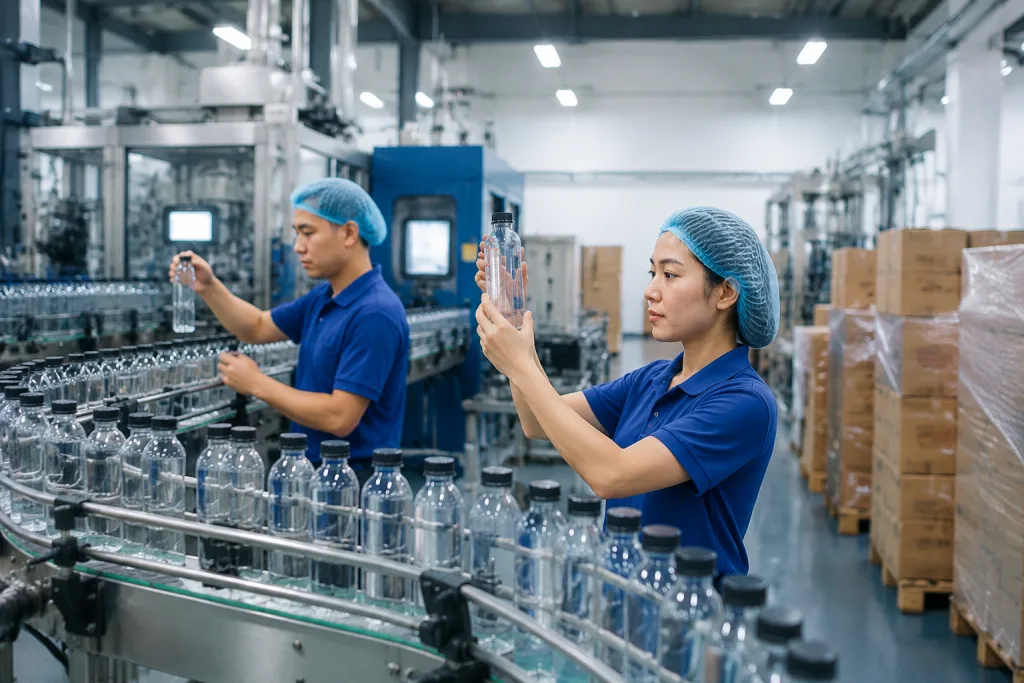
Key Takeaways
- A practical Tritan bottle MOQ is 3,000 pcs per color; new mold projects usually start from USD 2,500-8,000 tooling
- For 750 ml Tritan bottles, ask for 1.6-2.0 mm wall thickness in stress areas, not just total bottle weight
- Use AQL 2.5 for major defects and 4.0 for minor defects on distributor drinkware orders
- Allow 7-10 days for pre-production samples and 30-40 days for mass production after artwork approval
You are not buying “a bottle.” You are locking in a repeat SKU that must sit straight on a Decathlon-style shelf, pass EU import checks, survive 12-14 kg export cartons, and avoid complaint photos from retail customers. Briefing a tritan bottle factory in China starts there. Ask only about the unit price and the math goes sideways.
Here is a real-style brief we run on the line: 10,000 pieces of 750 ml Tritan sports bottles for a European outdoor distributor, custom canteen shape, two-color logo, retail box, and mixed carton packing. BottleForge Industrial in Hangzhou, Zhejiang runs about 450,000 drinkware units per month across Tritan, stainless steel, and glass lines, with typical Tritan MOQ from 3,000 pieces per color and 30-40 days production after sample approval. On one similar PO, the buyer wrote “matte lid” but the approved sample had a gloss PP lid; QC pulled the pre-production sample under the D65 light box before mass production, which saved a 10,000-piece argument.
Start With The Selling Channel
The first mistake is asking a tritan bottle factory for “your best 750 ml bottle” before saying where it will sit on the shelf. Wrong question. A bottle for a canteen distributor supplying outdoor stores needs a different spec from a gym promo bottle, a school program bottle, or an online FBA listing. We had one PO last April that said “750 m” instead of “750 ml”; QC caught it before mold sampling, but that kind of vague start burns 2 days fast.
For this buyer scenario, you sell through regional outdoor retailers in Germany, France, and the Netherlands. The bottle needs to feel like a customizable canteen, not a cheap giveaway. That points the spec toward a Tritan body, screw cap with carry loop, wide mouth for ice, leak test at 45 degrees and inverted position, plus a retail carton that survives store handling. On the line, we run the cap torque with a digital torque meter and reject samples that seep after 30 minutes upside down. A canteen promotional order might accept a lighter body and polybag packing. A distributor canteen line cannot.
Give the factory a one-page commercial brief before price talk. Keep it tight. Our sales desk prints this on one A4 sheet and the sample room checks it against the caliper reading, carton layout, and logo film before quoting:
- Volume: 10,000 pcs first order, target repeat 20,000 pcs per quarter.
- Capacity: 750 ml, marked to 700 ml usable fill line.
- Market: EU retail, REACH and LFGB food-contact documentation required.
- Branding: two-color silkscreen on front, 55 x 70 mm logo area.
- Packing: individual kraft box, 24 pcs per export carton.
- Incoterm: FOB Ningbo or Shanghai, quoted in USD.
That brief lets a canteen manufacturer quote like an engineer, not a catalog clerk. It also lets you compare canteen suppliers without guessing. If one quote is USD 1.18 and another is USD 1.43, the gap might be 1.8 mm versus 2.2 mm wall thickness, PP versus upgraded cap resin, 5-layer carton versus 3-layer carton, LFGB testing cost, or missing requirements. We’ve seen this go sideways when the cheaper quote skipped the individual kraft box and the buyer flagged it only after pre-shipment photos.
Lock The Bottle Specification Early
Once the sales channel is clear, lock the construction sheet. Tritan is a copolyester; buyers like it because it stays clear, takes drops better than SAN, and is BPA-free. It is not magic. Thin walls still dent, weak caps still leak, and poor molding leaves stress whitening around the shoulder. We see it on the line under the LED inspection lamp, usually after the first 20-shot trial.
For a 750 ml customized drinkware order, we define the bill of materials before sampling. Body material should be Eastman Tritan or an approved equivalent with material declaration. Food-contact parts touching liquid should be BPA-free, odor-neutral, and compliant with the target market. For the cap, 7 out of 10 canteen vendors we deal with use PP for the threaded part, silicone for the sealing ring, and TPE only for grip inserts. Ask for the grade, not just the Pantone color. QC once pulled a cap sample marked “PP” on the PO, while the supplier’s bag label said “random recycle PP.” That batch stopped there.
Wall thickness matters more than new buyers expect. For this order, specify 1.6-2.0 mm at the shoulder and base impact zones, with no area below 1.2 mm unless approved on the technical drawing. Bottle weight might be 115-135 g depending on shape. A low-price canteen factory may quote 95 g to win the order. The math does not work. We ship 95 g samples when asked, but after a 1.2 m drop test on our concrete floor, the buyer usually changes back.
Thread design is another place to be strict. A wide-mouth bottle around 53-58 mm opening works well for ice and cleaning, but the cap needs enough thread engagement. We normally want at least 1.5 turns to secure the cap, plus a silicone gasket that seats evenly after repeated opening. For a custom canteen or customizable growler style, larger caps raise the risk of warping if the injection cycle is rushed by 6-8 seconds. QC checks this with a torque tester and a simple leak test: 30 minutes upside down, room temperature, no wet ring on the tissue.
If you need a new shape, confirm whether it is a private mold, shared mold with exclusive color/logo, or fully open mold. New Tritan mold tooling can run USD 2,500-8,000 for a simple bottle and cap set, more for complex lids. For most distributor drinkware launches, an existing mold with modified color and decoration is faster and safer. We have seen this go sideways when the buyer approved “exclusive logo” by email, then found the same bottle body in another booth at Canton Fair 3 months later.
Price The Order Without Guesswork
Send the same RFQ to 2-3 qualified canteen manufacturers in China, then compare line by line. Do not ask for “best price” only. That is the wrong question to ask. Ask for a priced breakdown: unit price, logo charge with print size, packing cost, sample cost, mold cost if any, carton dimensions, gross weight, lead time, payment terms, and FOB port. On our quoting sheet, we fill carton size in cm and gross weight in kg before sales sends the PI, because one missing carton measurement can change the freight quote by USD 80 on a small LCL order.
For this scenario, a realistic FOB China price might look like this:
- Tritan 750 ml bottle with PP cap and silicone seal: USD 1.28-1.55 per pc.
- Two-color silkscreen logo: USD 0.06-0.12 per pc, depending on logo size, film output, and whether the line needs tighter registration within 0.5 mm.
- Individual kraft box: USD 0.10-0.18 per pc, based on 300-350 gsm paper.
- Export carton, 24 pcs: included or about USD 0.015-0.03 per pc.
- Pre-production sample: USD 80-150 including logo setup, excluding courier.
If you are buying as a canteen distributor, protect your margin by calculating landed cost before you approve artwork. A USD 1.42 FOB bottle can land at USD 1.75-2.05 in Europe after ocean freight, duty, customs clearance, insurance, and inland handling, depending on shipment size and season. We have seen this go sideways when a buyer priced 3,000 pcs like a full container and then shipped 18 cartons by LCL. Air freight breaks the math unless the order is small or the launch date is already missed.
Payment terms matter. Standard terms from Zhejiang factories are 30% deposit and 70% before shipment after inspection, often by T/T. Established canteen distributors with repeat orders may negotiate 30/70 against bill of lading copy, but do not expect open account on a first order. A serious canteen supplier will also define quote validity, usually 15-30 days, because resin and carton paper prices move. Last month our buyer flagged a PI where the PO typed “7500 ml” instead of “750 ml”; QC pulled the sample tag before packing, but that kind of typo can hold shipment for 2 days.
Be careful with quotes that skip compliance testing. If your market needs REACH, LFGB, FDA food-contact, or California Proposition 65 screening, testing should be included or listed as a separate line. Someone pays for it. Better to see the cost before the PO than after the goods are finished. We run testing samples from the same resin batch, and if SGS or Intertek pulls a 304 stainless tea infuser or silicone seal for review, the report name must match the importer name on the order.
Approve Samples Like A Buyer
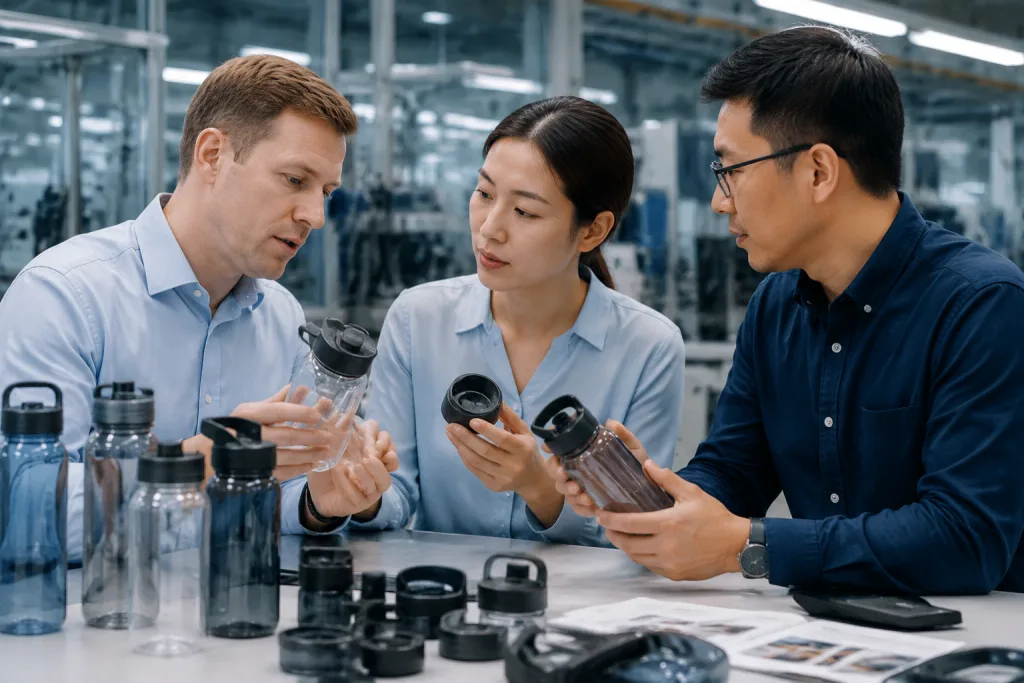
The sample stage is where a custom Tritan canteen order stops being a PDF and starts costing money. Do not approve a bottle because the logo looks “mostly fine” in a phone photo. Bad shortcut. We’ve seen this go sideways when a buyer approved a WeChat photo, then QC pulled the sample under a D65 light box and found the navy logo sitting 1.2 mm off-center.
For the 10,000-piece order, ask for three sample types. Start with a blank physical sample from the existing mold, usually ready in 3-5 days if the mold is on the line and not booked for another SKU. Then request a color chip or resin color plaque matched to your Pantone target; Tritan color matching is not the same as ink on coated paper, and transparent blue, smoky gray, and frosted finishes need a written tolerance. Last, approve a pre-production sample with actual logo, cap color, gasket, box, barcode, and instruction leaflet if used. This normally takes 7-10 days after artwork approval, assuming the PO file name is correct and nobody sends “final_logo_v3.ai” after plates are made.
Check the pre-production sample against a written approval sheet. Use calipers and a scale, not guesswork. Measure height, diameter, capacity, bottle weight, mouth diameter, logo position, and carton dimensions, then record the numbers in mm and g. For a two-color silkscreen logo, registration tolerance of ±0.5 mm is practical; tighter than that sounds nice, but the math doesn't work on a curved Tritan body running through normal fixtures. For laser-marked or pad-printed cap logos, confirm abrasion resistance with 3M tape test and a wet rub test. If the bottle is intended as customizable drinkware for multiple retail customers, create a decoration zone drawing so future logos stay away from ribs, taper, and the cap thread shadow.
Leak testing belongs before mass production, not after. Fill the bottle to 90% capacity, close the cap at normal hand torque, place it inverted for 2 hours, then shake it horizontally for 30 seconds. Also test after 10 open-close cycles. QC should pull at least 6 pre-production samples for this check, because one perfect desk sample tells you almost nothing about gasket seating on the line. If the gasket falls out or twists, fix it before deposit release.
For packaging, scan the retail barcode, check FNSKU if you sell online, and drop one packed carton from 76 cm on edges and corners. It is not a laboratory ISTA test, but it catches weak cartons early; last month the buyer flagged a crushed corner after one 76 cm drop, and we changed from 5-layer 140g corrugated to a stronger export carton before mass packing. A good canteen vendor will not object to these checks. If they do, ask why.
Control Production Before It Drifts
Mass production is not pressing one green button. For Tritan bottles, we control resin drying at 80°C for 4-6 hours, injection pressure, cooling time, cap assembly, logo curing, and export packing. Skip one step and QC pulls bottles with bubbles, flow lines, 1.5 mm cap warp, loose silicone gaskets, or logos that fail a 3M tape test.
Before production starts, issue a purchase order that references the approved sample, artwork file version, Pantone numbers, carton mark, inspection standard, and shipping deadline. In our Zhejiang plant, the signed pre-production sample sits in a clear box beside the line, and QC checks bulk parts against it with a digital caliper. If you approve Sample V3, we should not run V2 artwork because someone found an old PDF in WeChat. We have seen this go sideways.
For a 10,000-piece order, a practical schedule is:
- Day 1-3: deposit received, Tritan resin and packaging materials ordered, with resin lot number recorded on the material card.
- Day 4-10: color matching, print screens, box proof, production planning, including Pantone check under a D65 light box.
- Day 11-25: injection molding, cap assembly, in-line leak checks, with the line testing 30 bottles every 2 hours.
- Day 20-32: logo printing, drying, packing, with printed panels checked by 3M tape and 500 g rub testing.
- Day 33-38: final inspection, carton sealing, booking vessel, with AQL cartons pulled before the booking cut-off.
Ask for in-line production photos, but do not treat photos as QC. Photos confirm color, packing direction, and carton marks; they do not prove material grade or leak performance. For distributor growler, distributor canteen, or distributor drinkware orders, your customer will judge consistency across cartons, not the nicest sample on your desk. Last month a buyer flagged a 4 mm logo position difference between Carton 2 and Carton 17. Fair point.
Production drift usually starts with casual last-minute changes. Changing from black cap to translucent smoke cap can affect resin flow and show stress lines around the hinge. Switching from silkscreen to heat transfer changes lead time by 5-7 days because film proofing and curing need a separate line. Adding a hangtag after carton size is confirmed can reduce carton strength or increase volume weight; the math does not work if the packed carton jumps from 12 kg to 15 kg. Treat every change as a price, tooling, and schedule decision.

Inspect With AQL, Not Hope
Book final inspection after 100% of the goods are finished and at least 80% are packed. For this order, we run ANSI/ASQ Z1.4 or ISO 2859-1 sampling at General Inspection Level II. Common AQL settings stay at 0 for critical defects, 2.5 for major defects, and 4.0 for minor defects. Sounds stiff. It is still the normal export check for Tritan bottles leaving China; our QC team marks the lot on the packing list, then matches it against sealed cartons before pulling samples.
Define defects before the inspector walks into the packing area. Critical means sharp plastic flash on the mouth, wrong food-contact material, black contamination inside the bottle, or leakage during normal use. Major means wrong Pantone logo color, cap not fitting after 3 turns, visible crack, missing silicone gasket, capacity below tolerance, unreadable EAN barcode, or retail box damage that blocks shelf sale. Minor means small surface specks, light flow marks, or tiny printing dust inside the approved limit board. We have seen this go sideways when the buyer says “minor scratches are okay” on email, then rejects 37 cartons after QC pulled the sample.
For 10,000 pcs, the inspector may sample 200 pcs depending on the inspection level and lot structure. A practical QC checklist should include:
- Visual check under normal light at 30-40 cm viewing distance, using the same defect limit board signed during PP sample approval.
- Capacity test using measured water volume in a 1,000 ml graduated cylinder, with tolerance agreed at ±3%.
- Leak test on a selected sample set, usually 32 pcs or more, filled to the marked line and inverted for 30 minutes.
- Logo adhesion test after full drying time, normally with 3M tape pressed flat by thumb for 5 seconds.
- Carton drop test and carton gross weight check, with the scale reading matched against the PO packing data.
- Barcode scan test on retail box and master carton, because one wrong digit can stop receiving at the buyer’s warehouse.
If you are working with several canteen suppliers, standardize this checklist. Otherwise, each canteen manufacturer will judge quality its own way, and the argument starts after defects show up. A good canteen factory wants the checklist early because it cuts disputes; we would rather adjust the line at 500 pcs than rework 10,000 pcs after cartons are sealed.
For higher-risk orders, add third-party testing before shipment. SGS, Intertek, TÜV, or Bureau Veritas can test food-contact compliance and restricted substances. For EU markets, REACH and LFGB are common requests. For the U.S., FDA food-contact documentation and ASTM packaging considerations may apply depending on your product claim and user group. Do not ask the factory, “Will it pass?” That is the wrong question; ask which lab, which test item, which material batch, and whether the report number matches the resin lot on the production record.
Ship Cleanly And Reorder Smarter
Once inspection passes, slow down on the shipping docs. We have seen 3 out of 10 delivery delays start with one wrong line on the paperwork, not with the forwarder. Check the commercial invoice value against the PO, match the packing list to the actual carton count, and confirm bill of lading details, HS code, gross weight, net weight, consignee name, and vessel closing time before the SI cut-off. On one Hangzhou shipment, QC pulled the final carton stack and found the PO had “Trian” typed instead of “Tritan” on the product description. Small typo. Big customs headache. For Tritan plastic bottles, HS classification still depends on local customs reading, so send the draft documents to your broker before the goods leave China.
For the 10,000-piece order packed 24 pcs per carton, you will have about 417 export cartons. If each carton measures roughly 58 x 42 x 36 cm, total volume is about 36.6 CBM before palletizing. That usually prices as LCL or a partial container load unless we combine it with other custom drinkware on the same sailing. If you ship to Amazon or a 3PL, confirm FNSKU placement, carton label size, polybag rules, and the carton weight cap in writing. We run a 150 kg floor scale beside the packing line; anything over 18 kg gets flagged because 4 warehouses we ship to start rejecting or rework-charging cartons above 15-18 kg.
Keep a golden sample and one sealed production carton at your office. Ask the factory in Zhejiang to keep the same set, with the carton tape signed across the seam by QC. Reorders go smoother when you reference the PO number, sample version, mold number, Pantone color, artwork file, and inspection report instead of sending a phone photo from last season. The line needs something real to compare against. We have seen this go sideways when a buyer reordered “same blue bottle” and forgot the old file was Pantone 2925 C with a 0.2 mm logo stroke adjustment.
After retail feedback comes in, separate design complaints from factory defects. “Customers want a larger carry loop” means the handle geometry needs a mold insert change. “Caps leak after two weeks” points to a sealing issue, so we check silicone gasket hardness, thread fit, and drop-test samples from the same batch. “The blue is darker than the website image” is often a photography or color-management problem, not a resin problem. Bring the data back to your canteen supplier with numbers: complaint rate, photos, batch code, customer location, and quantity affected. If 27 caps leaked out of 10,000 pieces, the conversation is different from 27 angry comments with no batch code.
A reliable tritan bottle factory is not the one that says yes fastest. That is the wrong question to ask. The better factory explains the trade-off between wall thickness and bottle weight, holds tolerance with go/no-go gauges at the cap thread, documents compliance, and repeats your customized growler, custom growler, or canteen customizable program without drama. We ship repeat orders cleanly when the spec sheet, retained sample, and production notes all point to the same target. That is what you are sourcing.
Send Your Tritan Bottle Spec For Review
Share capacity, logo method, target market, quantity, and packing. We will return a practical FOB China quote and QC plan.
Frequently asked questions
What MOQ should I expect from a Tritan bottle factory?
For existing molds, a realistic MOQ is 3,000 pcs per color for Tritan bottles, though some factories may accept 1,000-2,000 pcs with a higher unit price or limited colors. For a fully custom canteen mold, expect 10,000 pcs or more for the first production run because tooling, resin setup, and testing need to be spread across enough units. At BottleForge Industrial in Hangzhou, Zhejiang, standard Tritan projects normally start at 3,000 pcs per color, with repeat orders easier to schedule if you keep the same resin color and packaging. If your buyer is testing a new retail channel, use an existing mold first instead of paying USD 2,500-8,000 for tooling too early.
Is Tritan better than stainless steel for custom drinkware?
It depends on the selling promise. Tritan is lighter, transparent, impact resistant, and usually cheaper than vacuum stainless steel. A 750 ml Tritan bottle may quote around USD 1.28-1.55 FOB China before decoration, while a double-wall stainless bottle can be much higher depending on gauge, coating, and cap design. Tritan is good for sports, school, outdoor, and promotional programs where customers want to see liquid level. Stainless steel is better for insulation and premium gifting. If you are a distributor drinkware buyer, carry both categories, but do not position Tritan as thermal drinkware. It is a durable cold-water bottle, not a thermos.
Which logo method is best for a customized canteen order?
For Tritan, silkscreen printing is the most common choice for one- to three-color logos on the bottle body. It gives good color density and can handle a 50-80 mm logo area at reasonable cost, often USD 0.06-0.12 per pc for two colors. Pad printing works better on curved cap areas but has a smaller print zone. Heat transfer can produce richer graphics but costs more and needs careful adhesion testing. Laser engraving is not normally used on clear Tritan bodies the way it is used on stainless steel. For a canteen promotional order, silkscreen is usually enough. For retail, ask for tape test, wet rub test, and print position tolerance before approval.
What certifications should canteen distributors ask for?
At minimum, ask for food-contact material declarations and test reports relevant to your market. EU buyers commonly request REACH and LFGB, while U.S. buyers often ask for FDA food-contact compliance and sometimes California Proposition 65 screening. If the order is for children, check age grading and applicable ASTM or CPSIA requirements with your compliance consultant. Factory audits such as BSCI, Sedex, or ISO 9001 help evaluate management systems, but they do not replace product testing. For each production batch, match the test report to the material and color used. A report for a clear bottle from 2022 does not automatically cover a smoky blue bottle produced in 2026.
How long does a custom Tritan bottle order take?
For an existing mold with custom logo and standard box, plan 7-10 days for pre-production samples and 30-40 days for mass production after sample approval and deposit. Add 5-10 days if you need special resin color matching, retail packaging with multiple proofs, or a complicated cap. A new mold project can add 25-45 days for tooling, trial shots, adjustment, and approval before bulk production even starts. Ocean freight from China to Europe or North America commonly adds 25-40 days port to port, depending on route and congestion. If your retail launch date is fixed, work backward and leave at least 10 days for QC, booking, and document corrections.