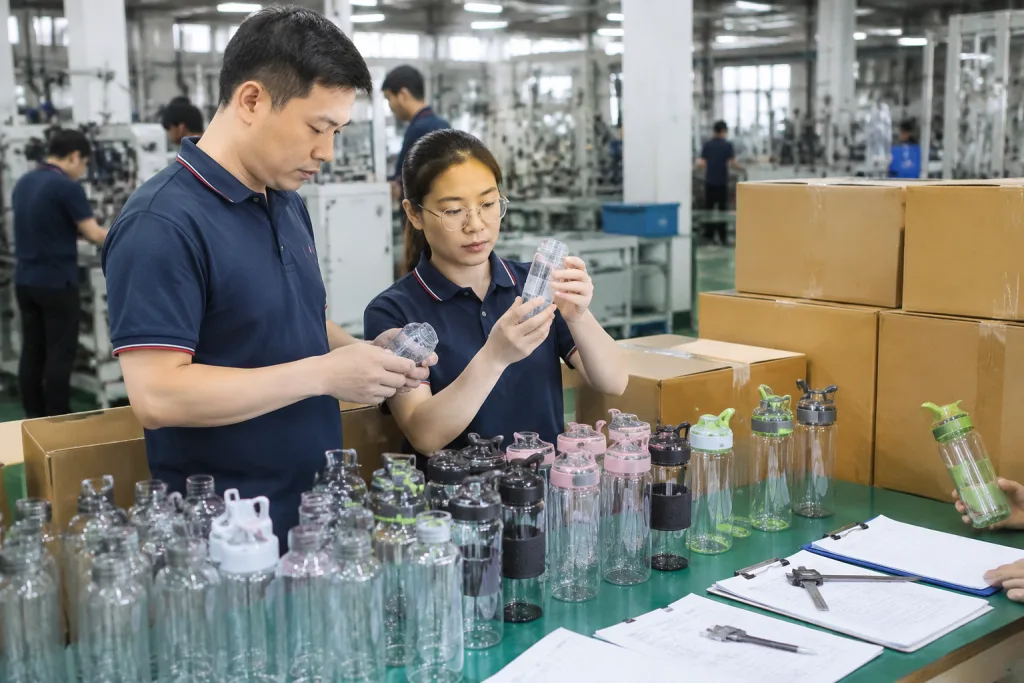
Key Takeaways
- Set Tritan bottle RFQs with capacity, resin, lid material, logo size, carton spec, and target FOB USD before sampling
- Use 2 rounds of samples: functional sample first, logo and packaging sample second
- A practical distributor MOQ is 3,000 units per color, with 30-45 days bulk lead time after deposit and approvals
- Put AQL, REACH/FDA/LFGB scope, carton drop test, spare parts, and barcode rules directly into the PO
If you buy for tritan bottle distributors, bottle shape is not the hard part. The real control points come after the clean render: resin grade, lid fit within 0.3 mm, carton burst strength, color drift under D65 light, logo adhesion after 3M tape test, and whether the line can repeat the same bottle at 30,000 units without a story from production.
We run production in Hangzhou, Zhejiang, and 7 out of 10 delays we see start before sampling. A loose RFQ gives you a loose sample. Then the bulk PO turns into a price argument, not a production order; we have seen this go sideways when the buyer flagged “blue” on the PO but sent a Pantone chip two days after mold trial. This is the sourcing process we recommend for custom drinkware buyers, from first RFQ to final shipment out of China.
Start With A Tight RFQ
A good RFQ for tritan bottle distributors should read like a production brief, not a mood board. Start with the selling channel and country; compliance marks, barcode position, warning text, and carton drop-test rules change fast by market. A bottle for a UK retail chain needs tighter label artwork control than a canteen promotional order for a US corporate event. Last month QC pulled the pre-production sample because the PO said “UKCA sticker,” but the artwork file still showed an EU address.
For each SKU, list capacity in ml and oz, target weight, resin requirement, lid material, straw or no straw, carry loop type, color count, logo method, packaging, and annual forecast. Be blunt. If you want a 750 ml Tritan canteen customized with a flip lid and silicone sleeve, say the sleeve thickness, such as 1.8 mm, and confirm whether the line should run matte or glossy. If you are comparing a custom canteen against a customized growler or sports bottle, split them into separate RFQ lines; mixing them into one line item is how quotes go sideways.
Useful RFQ line items include:
- Product: 650 ml Tritan bottle, 72 mm body diameter, leakproof flip lid, sample checked with a 30-minute inverted leak test.
- Material: Eastman Tritan or equivalent copolyester, BPA-free, food contact compliant, resin lot number shown on the sample tag.
- Logo: 1-color silkscreen, 45 x 55 mm, Pantone 286C, artwork supplied as AI or PDF with logo position in mm from bottle base.
- Packaging: 1 pc/polybag, 24 pcs/export carton, carton under 15 kg gross weight, outer carton tested on our 80 cm drop-test bench.
- Target: FOB Ningbo or Shanghai, USD 2.10-2.60 depending on quantity, with MOQ and forecast split by color.
Do not ask every canteen supplier for “best price” only. That is the wrong question to ask. You will get the cheapest build, often with thin packaging, loose resin wording, and zero testing allowance. A canteen manufacturer in Zhejiang can price accurately when you give us the real commercial target: distributor margin, retail price, and whether you need exclusivity on color or lid combination. We run cost sheets down to gasket weight in grams, and the buyer usually flags the same issue later if it is missing from the RFQ.
Price The Configuration, Not The Picture
Tritan bottles look simple on the buyer sheet. The cost hides in 1-2 mm of body wall, a 304 stainless hinge pin instead of plated iron, imported colorant, a silicone seal ring, and whether the unit goes into a 350 gsm retail box or a plain egg-crate carton. Those choices can move the FOB price by USD 0.20-0.70 per unit. For distributor drinkware programs, that gap decides whether the item still makes money after freight, duty, warehouse handling, and the 3% sales rebate your key account asked for last Tuesday.
Ask each canteen factory to quote the same PO-style matrix. We run columns for 3,000, 5,000, 10,000, and 30,000 units, then add mold status, sample charge, logo setup, color MOQ, packaging cost, and testing cost. One buyer once sent us a PO with “matte balck lid” typed in the color line; QC pulled the sample against the Pantone card before we cut mass material, which saved a wrong-lid batch. Our Hangzhou, Zhejiang line capacity for Tritan and related plastic drinkware is about 480,000 units/month, but capacity is not reserved production. Lock the line with deposit once samples are approved. Waiting 12 days can turn a 30-day slot into 45 days.
Typical factory-level numbers for a 650-800 ml customized drinkware program are:
- MOQ: 3,000 units per color for standard mold, 5,000 units for custom color lid combinations.
- Sample charge: USD 80-200 for logo samples, refundable at agreed order value.
- Logo tooling: USD 30-80 per screen or laser fixture, depending on artwork.
- Bulk lead time: 30-45 days after deposit, approved sample, and packaging file confirmation.
If a canteen vendor quotes far below the group, check what was removed. This is the wrong question to ask: “Why are they cheaper?” Ask what changed in grams, carton burst strength, resin batch record, or lid structure. We have seen this go sideways when the photo showed a one-click lid but the quote covered a lighter flip cap; the first incoming inspection found 11 cracked hinges in a 200-piece pull. Cheap is fine when it is engineered. Cheap by omission is expensive.
Approve Samples In Two Passes
Do not approve a Tritan bottle from one rushed courier sample. We run it in two passes. Sample 1 is for the bottle body: 750 ml capacity check, grip feel, thread fit on the lid, leak test, lid opening force, straw length, sleeve fit, and color direction. QC pulled one smoke-gray sample last month where the cap seated 0.6 mm high on the thread gauge, and the buyer only noticed after we sent the video. Sample 2 is for the selling parts: logo position, print opacity, barcode, retail box, insert card, carton mark, plus any FNSKU or distributor SKU label. This split saves arguments.
For a canteen customizable program, make the first checklist physical. Fill the bottle with water, invert it for 8 hours, shake it for 30 seconds, then check the lid and air vent for seepage with a dry tissue. Measure capacity to brim and usable capacity on a scale, not by eye. A stated 750 ml bottle may only feel right at 700 ml if the lid has a deep insert. If you sell into outdoor, school, or corporate channels, the math matters: a 24-bottle carton with 50 ml less usable volume gets flagged fast by distributors. We have seen this go sideways.
The second sample is commercial. For canteen custom branding, silkscreen is the cleaner choice for bold 1-2 color logos on a straight wall, usually with a 0.15 mm screen and a fixture that holds the bottle from the base. Laser engraving works on stainless steel; it does not give the same result on clear Tritan. Heat transfer can cover bigger artwork, but we ask QC to run a 3M tape pull and a 500-cycle abrasion rub before we sign it off. If you are developing a customizable growler or distributor growler beside Tritan bottles, keep separate decoration standards because stainless, plastic, and powder coat fail in different ways. One buyer flagged a PO typo where “matte black” became “matt black,” and that tiny wording change still slowed approval by 2 days.
Our rule: no bulk PO starts until the buyer signs a dated sample approval sheet with photos, Pantone references, packaging dielines, and allowed tolerances.

Build The PO Line By Line
The purchase order should not say “customized canteen as sample.” We have seen that line turn into a 3-hour argument after QC pulled the pre-shipment sample and the lid color did not match the approved photo. Write the PO like the production planner in Hangzhou never saw your WeChat screenshots or email thread. Put the basics on the line: item code and mold/model number, material, color, logo method, packaging, quantity, unit price, Incoterm, shipment method, inspection standard, document requirements. Better still, attach the approved sample photo with date and version number.
A clean PO line for a canteen distributor might read: “BF-TB750, 750 ml Tritan bottle, transparent smoke body Pantone Cool Gray 9C tint, black PP flip lid, silicone seal ring, 1-color white silkscreen logo 50 x 42 mm, 1 pc/opp bag, 24 pcs/5-layer export carton, 5,000 pcs, FOB Ningbo, USD 2.38/pc, AQL 2.5 major / 4.0 minor.” That detail protects both sides. On our line, a missing logo size can mean the screen room makes a 45 mm logo while the buyer expected 60 mm, and the math does not work once 5,000 bottles are already printed.
Add separate PO lines for spare lids, replacement straws, extra seals, display boxes, and testing. Canteen suppliers quote these late because buyers forget them; last month one PO even had “sillicone ring” typed wrong, and purchasing almost ordered the wrong seal size. If you support distributors or retail accounts, 1-2% spare parts is sensible. For Amazon-style fulfillment, specify FNSKU labels, carton size limits, master carton weight under 15-18 kg, and “no mixed SKU carton” unless approved in writing.
Payment terms are part of risk control too. A common China factory structure is 30% deposit and 70% before shipment after inspection. Simple works. For repeat canteen distributors with 3-5 clean orders and no chargeback history, terms can improve, but first orders should stay tight. If your internal system needs FOB, CIF, or DDP comparisons, ask for 3 separate quotes instead of forcing one unclear landed price into the PO; we have seen this go sideways when the buyer flagged local delivery charges 12 days before vessel closing.
Put Testing Before Production Pressure
Testing is not paperwork decoration. Tritan bottles are reusable food-contact products, so the test plan has to match the sales country on the PO. For North America, buyers usually ask for FDA food contact documentation, and some retail chains still add ASTM-related physical checks before they release the first 5,000 pcs. For Europe, REACH, LFGB, and migration testing may be requested. If the bottle is for children, say it before tooling or color approval; we have seen a buyer flag “kids sports bottle” only after the Pantone chip was signed, and the schedule moved from 12 days to 18 days.
For customized drinkware, test the finished decorated product, not only raw material sheets. Ink, coating, silicone parts, PP lids, and colorants can all affect compliance after the line runs heat-transfer printing or UV print. An old resin certificate is not enough for a serious distributor program. The math does not work if you save USD 180 on lab testing and then hold 3 pallets in a Rotterdam warehouse. Ask for current material declarations, MSDS where relevant, and third-party lab reports tied to the item or material batch; QC pulled the sample from batch label B2406 last month because the lid gasket supplier changed without notice.
Physical QC should be written into the order. For Tritan bottles, we check appearance, capacity by measuring cylinder, weight on a 0.1 g digital scale, lid torque with a torque meter, and leak test for 30 minutes upside down. We also run odor, print adhesion with 3M tape, barcode scan, carton compression, and carton drop. For general canteen manufacturers, AQL 2.5 for major defects and 4.0 for minor defects is common. Critical defects, such as contamination, sharp edges, wrong material, or leaking, should be zero tolerance; one 0.8 mm burr on a drinking rim is not a “minor scratch.”
Schedule inspection at least 2-3 days before planned loading. Morning-of-container inspection is the wrong question to ask because the truck is already waiting and nobody wants to unpack 186 cartons on the dock. A practical canteen vendor will accept clear inspection rules because they cut argument when QC pulls the sample. Vague quality expectations help nobody, especially when the shipment has a fixed vessel closing date in Ningbo or Shanghai and the buyer’s PO even has “Ningbo” typed as “Nignbo.”

Control Bulk Production Reality
After deposit, the job moves from sales talk to the line. Ask for a production schedule that shows resin arrival, injection or blow molding date, lid assembly, logo printing, packaging, inline QC, final inspection, and loading. We usually mark 8 checkpoints on the sheet, not 30 daily photo updates. Daily photos waste time. What matters is getting an update before a bad cap fit or wrong carton mark becomes 18 pallets of trouble; last month QC pulled the sample at 11:20 and caught a 0.6 mm lid gap before assembly started.
Color causes more arguments than buyers expect. Transparent Tritan body colors shift with wall thickness, resin batch, and lighting, so approve a physical color chip or signed sample and allow a working tolerance. Exact Pantone matching is the wrong question to ask for clear molded plastic; Pantone was built for ink on paper, not 2.8 mm Tritan walls under warehouse LED light. For large distributor canteen runs, we keep a retained master sample at the line, then compare every production lot against it in a light box; if the buyer flagged “too blue” on Lot 3, we check it against the signed bottle, not a phone photo.
Logo consistency is another place we’ve seen this go sideways. Silkscreen on a curved bottle can stretch, and a 95 mm wide logo near a taper will distort if nobody checks the artwork on the actual mold shape. A responsible canteen factory should stop and call before printing 20,000 bad units. For complex all-around artwork, pay for a pre-production print sample and inspect it at arm’s length and under strong light; our print room uses a 200-mesh screen and still rejects samples when the edge breaks on the curve. The same rule applies to a customized growler, custom growler, or customizable drinkware item using powder coating and print.
Bulk packing deserves real attention. A beautiful bottle in a weak carton becomes a claims file. Specify 5-layer export cartons for heavier orders, dividers when bottles scuff, and outer carton marks with SKU, quantity, gross weight, net weight, carton size, and country of origin when required. We ship Tritan bottles in cartons tested around 18 kg gross weight, and the math doesn't work if a buyer asks us to save USD 0.08 by removing dividers on glossy bodies. China export logistics run fast, but they do not forgive weak packaging; one typo on a PO carton mark can hold loading while the warehouse reprints 420 labels.
Ship With Documents Ready
Shipping is where 7 out of 10 canteen distributors lose days, usually because documents get handled after the cartons are taped. Before balance payment, confirm the commercial invoice, packing list, bill of lading instructions, certificate of origin if needed, test reports, inspection report, and retailer compliance forms. We once had a PO with “Tratin” typed instead of “Tritan”; QC caught it on the carton mark proof before 312 cartons went to the line. If your warehouse needs pallet labels or ASN data, send the Excel format before production ends, not after the truck is at our gate.
For FOB shipments, your forwarder controls the vessel booking, but the factory still needs the cargo-ready date, shipping marks, and carton dimensions down to the mm. For DDP or delivered terms, ask what is included: duty, customs clearance, last-mile delivery, residential restrictions, palletization, and insurance. DDP looks easy on a 500 pcs customized canteen order, but for repeat distributor drinkware programs, FOB or FCA usually gives cleaner costing. The math does not work when a buyer compares DDP against FOB without separating duty and local delivery.
After loading, request final carton count, container photos, seal number, and document drafts within 48 hours. Simple rule. QC pulled the sample, the warehouse took seal photos with the container door half closed, and we matched the count against the packing list before releasing scans. Keep one approved sample and one production sample in your office. If there is a claim, photos and retained samples cut the argument from 18 days to 3 days. A professional canteen manufacturer wants repeat orders, not one shipment followed by chargebacks.
When you compare canteen vendors, look past the first quote. The better partner gives clear specs, realistic lead times, honest limits, and stable repeat production, with details like 304 stainless cap screws, Tritan resin grade, carton drop-test notes, and AQL 2.5 findings shown before shipment. We have seen this go sideways when a distributor saves USD 0.08 per bottle and then pays for re-labeling 40 cartons in the destination warehouse. That is how tritan bottle distributors protect margin while still offering custom canteen, canteen promotional, and broader customizable canteen programs to their own customers.
Send Your Tritan Bottle RFQ For Review
Share capacity, quantity, logo, market, and packaging needs. We will return a practical FOB quote, MOQ, sample plan, and lead time.
Frequently asked questions
What MOQ should tritan bottle distributors expect for custom colors?
For standard molds, a realistic MOQ is 3,000 units per body color and lid color combination. If you need a special transparent Tritan tint, custom silicone part, or exclusive lid color, expect 5,000 units per SKU because resin, colorant, and setup loss become significant. For a first order, many canteen suppliers in China will allow mixed packaging cartons only if the total run stays efficient, but mixed body colors usually require separate production lots. If your forecast is 20,000 units/year, start with 3,000-5,000 units to validate sell-through, then schedule replenishment 45-60 days before stockout.
Is Tritan better than stainless steel for distributor drinkware?
Tritan is better when you need light weight, clear body, lower unit cost, and visible hydration markings. A 650-800 ml Tritan bottle often lands around USD 1.80-3.20 FOB depending on lid and packaging, while stainless vacuum bottles cost more because of double-wall construction and finishing. Stainless is better for heat retention and premium gifting. Many canteen distributors carry both: Tritan for schools, gyms, events, and daily hydration; stainless for travel, corporate gifts, and outdoor. Do not treat them as substitutes. Treat them as different price tiers with different QC risks and different logo methods.
How many sample rounds are normal before bulk production?
Two rounds are normal for customized drinkware. Round 1 checks the product structure: leakproof performance, capacity, lid action, grip, odor, and general color direction. Round 2 checks branding and packaging: logo size, print position, retail box, barcode, carton mark, and any FNSKU label. A simple canteen promotional order may approve in 10-14 days if artwork is ready. A more complex custom canteen with custom color, new lid combination, or retail packaging can take 20-30 days before bulk approval. Rushing samples usually saves 5 days and creates 30 days of argument later.
What should be included in a Tritan bottle inspection?
Use AQL 2.5 major and 4.0 minor for normal distributor orders, with zero tolerance for critical defects. The inspection should cover quantity, SKU mix, color, appearance, capacity, weight, leak test, lid assembly, seal placement, odor, sharp edges, logo adhesion, barcode scan, packaging, carton strength, and shipping marks. For leak testing, inspect a statistically meaningful sample, fill with water, invert, shake, and leave for a defined period such as 30 minutes or longer for higher-risk lids. If the shipment is retail-bound, include carton drop testing and photo records of master cartons, inner packaging, and pallet condition.
Can one canteen manufacturer handle Tritan bottles, growlers, and other custom drinkware?
Sometimes, but ask how production is actually organized. A canteen manufacturer may assemble Tritan bottles in one workshop, source stainless growlers from a partner line, and print packaging in a separate facility. That is not a problem if the supplier controls QC and documentation. For a distributor growler, customized growler, or customizable growler, the process is closer to stainless drinkware: welding, vacuum testing, powder coating, and different logo adhesion checks. For Tritan, the focus is resin, molding, lid fit, and transparency. One accountable supplier is useful, but only if each product category has the right inspection standard.