Key Takeaways
- A realistic Tritan bottle MOQ is usually 1,000-3,000 pcs per color, with custom molds starting higher
- Ask for resin declaration, FDA/LFGB test reports, REACH screening, and AQL inspection before deposit
- Most logo methods need 7-10 days for samples and 25-35 days for mass production after approval
- FOB China pricing often changes by USD 0.18-0.45 per pc depending on cap, wall thickness, and packaging
If you are searching for a tritan bottle distributor, you probably already know the resin pitch. The real check is simpler: can the factory hold your Pantone within Delta E 1.5, print a 42 mm logo without blur, pack for retail or FBA, pass EU or North American compliance, and still ship on the date your sales team put on the PO?
This is where custom drinkware orders go sideways. We’ve seen a USD 0.18 cheaper quote hide 0.6 mm thinner walls, loose flip caps, unclear Eastman resin paperwork, or decoration that starts peeling after 20 dishwasher cycles. QC pulled the sample last month because the buyer flagged a “BPA FREE” typo on the belly print. From our Zhejiang line, we run the same checks with 30+ distributor projects a month before sampling, because chasing the lowest unit price first is the wrong question to ask.
What Are You Actually Buying?
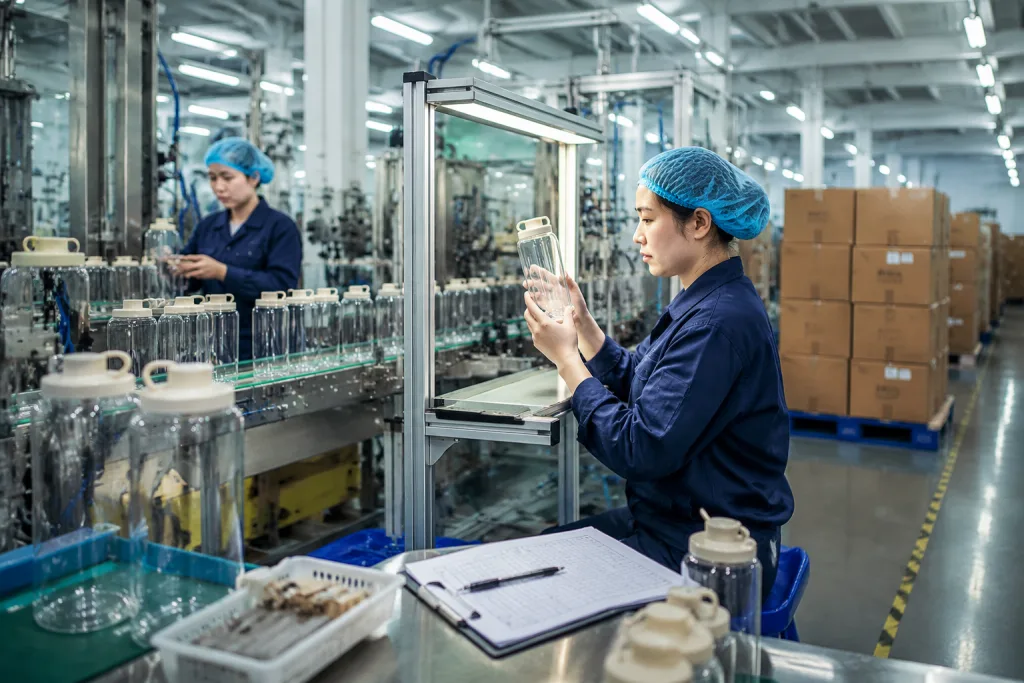
Buyers ask for a tritan bottle distributor, then the RFQ shows they are mixing up 3 jobs: a trading company, a stock canteen supplier, and a canteen factory that owns the mold room, injection machines, assembly benches, pad printing, and final packing. Big difference. On our floor, one 650 ml body can pass through a 300-ton injection press before QC checks the neck finish with a go/no-go gauge, so the risk is not a brochure word; it sits in who controls the part.
A real canteen factory should tell you the resin grade, cap material, seal material, wall thickness, mold cavity count, and daily output without a 2-day relay through WeChat groups. For a standard 650 ml Tritan bottle, we usually see body wall thickness around 1.2-1.8 mm depending on shape, measured with a digital caliper after the first 20 shots. A sports cap may use PP, silicone gasket, and stainless pin hardware. If a canteen vendor cannot answer those points without calling three other people, you are probably not talking to the production source.
Buyer checklist:
- Confirm whether the quotation is direct factory, canteen distributor, or export trading company; ask whose name appears on the packing inspection report.
- Ask for material breakdown: Tritan body, PP cap, silicone seal, stainless parts if used, plus the resin supplier code if your QA team needs it.
- Request capacity tolerance, for example 650 ml ±5%, and have QC pull 12 filled samples from the line.
- Check whether the bottle fits your retail shelf, carton size, and freight plan; one buyer once flagged a 2 mm shelf-height miss after artwork approval.
- Ask for current monthly capacity. Our Zhejiang line can assemble about 280,000 plastic bottles per month across shared styles.
Working through canteen distributors is fine if they lock down quality and own the reply when something fails. The math doesn't work when nobody owns the engineering call. We have seen this go sideways over a cap gasket change that looked small on the PO but leaked in a 45°C tilt test, so a distributor drinkware program needs clear responsibility before you approve the sample.
MOQ, Price, And Honest Trade-Offs
The first uncomfortable answer: 100 pieces is the wrong question to ask for a serious custom canteen order. For existing Tritan molds with one-color logo printing, we run a workable MOQ at 1,000 pcs per SKU. If you need a custom Pantone body color, plan on 2,000-3,000 pcs because the injection line burns resin during color change, and QC pulled 37 off-color bodies from one trial last month before the ΔE reading settled. For a new shape, custom tooling can push the practical start to 5,000-10,000 pcs.
FOB China pricing for a mid-range 500-750 ml Tritan bottle often lands between USD 1.65 and USD 3.20 per pc, before premium retail packaging. A flip straw lid, carry loop, measurement scale, frosted finish, or double-color cap can add USD 0.10-0.60; the silicone seal alone looks small, but a 0.3 mm tolerance miss is where leaks start. Gift box packaging can add USD 0.18-0.45 depending on paper weight and insert style. If the quote is 25% below the market, check the resin grade and cap seal first, then ask whether the 5-ply carton passed drop testing and whether FDA or LFGB testing sits inside the price.
Procurement questions to ask:
- Is the price FOB Ningbo, FOB Shanghai, EXW Zhejiang, or DDP?
- Does the MOQ apply per color, per logo, or total order? We have seen POs say “1,000 pcs total” while the artwork file showed 4 colors.
- Are pre-production samples included, and how many revisions are free?
- What is the carton drop-test standard: 76 cm or 100 cm?
- Is the quotation valid for 15, 30, or 60 days?
For distributor canteen projects, I prefer buyers split the first order into 2-3 colors and stronger packaging instead of chasing eight colors at low volume. The math doesn't work. Inventory that arrives scratched or leaking costs more than a smaller, cleaner launch, and we have seen this go sideways when the buyer flagged 11 cartons with scuffed bottles after a loose PET tray insert shifted in transit.
Can It Be Customized Cleanly?
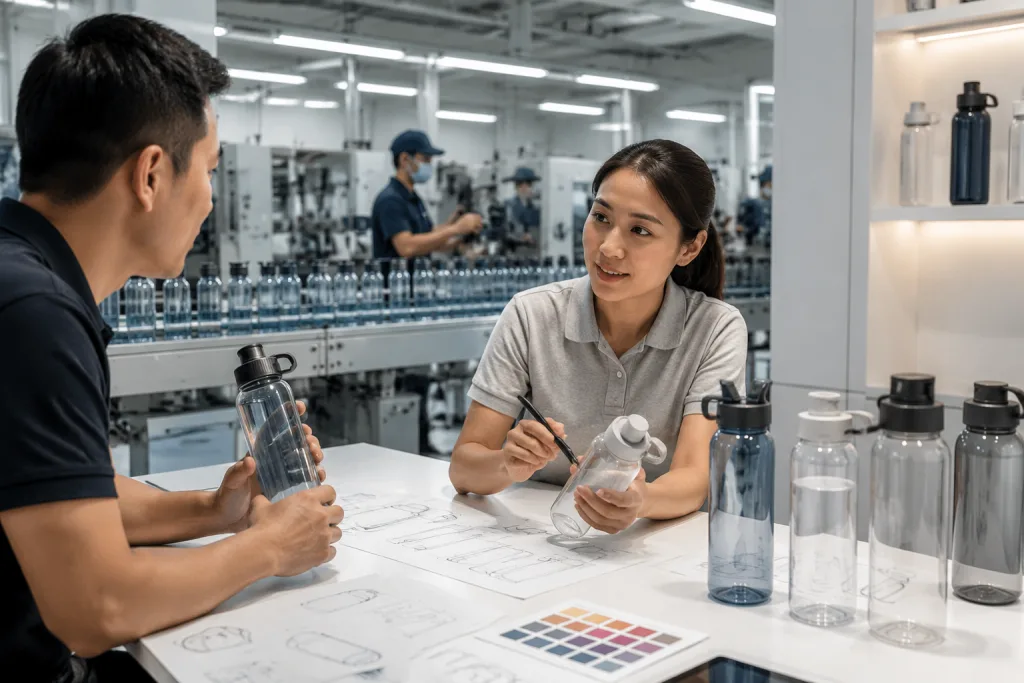
Customizable drinkware sounds simple until the logo lands on a curved, textured, semi-transparent Tritan body. We run the decoration review before we talk catalog items, because a 750 ml bottle with a 62 mm print window behaves differently from a flat tumbler wall. For a canteen customizable program, start with the artwork method. Silk screen printing, pad printing, UV printing, heat transfer, sleeve label, and molded embossing on the cap or grip area all need different fixtures on the line.
Silk screen works well for one or two solid colors and usually needs a print area without heavy curve. Pad printing is better for smaller logos on lids or shoulder curves, but fine gradients turn muddy fast. UV printing handles full-color artwork, costs more, and we always rub-test it before mass production; QC pulled one sample last month after 30 alcohol rubs because the red edge lifted. A molded logo looks clean for a customized canteen project, but the tooling cost and 18-day mold lead time only make sense for repeat programs. For a full canteen promotional line, the smarter play is one core mold with 3 or 4 decoration options, not 6 bottle shapes that split the MOQ and slow packing.
Decoration checklist:
- Provide vector AI or PDF artwork; EPS is fine if fonts are outlined. Do not send a 96 dpi PNG copied from a website.
- Define Pantone C or U values. “Blue” is the kind of PO note that gets flagged before sampling.
- Ask for 3M tape test, 50-cycle alcohol rub test, and dishwasher guidance if the bottle will be washed by machine.
- Approve logo position with a marked sample in hand; a 2D mockup misses 3 to 5 mm drift on curved bodies.
- Keep safety markings and capacity markings separate from branding artwork, especially around the 500 ml and 750 ml lines.
A customizable canteen is not automatically a durable canteen. This is the wrong question to ask if the buyer only says, “Can you print our logo?” Schools drop bottles from desks, gyms leave them in lockers, outdoor clubs clip them to bags, and corporate programs usually care more about gift-box finish. A custom drinkware supplier in China can build for office use or field use, but the spec sheet changes: wall thickness, cap torque, strap pull strength, and carton drop test all move. We have seen this go sideways when the PO says “sports bottle” but the approved sample was only checked on a conference-room table.
Compliance Cannot Be An Afterthought
Tritan sells well because it is BPA-free, clear, impact-resistant, and around 35% lighter than glass in the same 650 ml bottle size. “BPA-free” is the wrong question to ask by itself. We still need a real compliance file: FDA food-contact testing for the US market, LFGB or EU 10/2011 migration testing for Europe, and REACH screening when the buyer or retailer asks for it. If the bottle is for children, lock down CPSIA, ASTM F963, small parts, phthalates, and age grading before the cap tool starts; we once had QC pull a straw lid sample because the silicone bite valve measured 6.8 mm and the buyer flagged it as a child-use risk.
Ask whether the factory has ISO 9001, BSCI, Sedex, or similar audit records. These audits do not promise perfect goods, but they show whether the supplier is used to controlled drawings, signed samples, batch records, and corrective-action paperwork. At BottleForge Industrial in Zhejiang, we normally set inspection at AQL 2.5 for major defects and AQL 4.0 for minor defects unless the buyer writes tighter limits on the PO. For premium retail orders, some buyers move major defects to AQL 1.5; the math does not always work, because a 3,000 pcs order may need 200 pcs checked instead of 125 pcs, and rejection risk goes up when the line is running new artwork.
Documents to request before deposit:
- Material declaration showing Tritan body, PP lid, silicone gasket, and other food-grade contact parts by item code.
- Recent third-party test report, ideally under 12 months old, matching the same resin grade we run on the injection machine.
- Factory audit or social compliance document if your retailer requires it, with the factory name matching the PI and carton label.
- QC checklist covering leakage, odor, printing adhesion, scratches, and carton marks, including test method such as 30 minutes inverted at room temperature.
- Golden sample signed by both sides before mass production, with Pantone, logo position in mm, and cap torque agreed on the sample tag.
Do not wait until the container is finished to ask for compliance. If your canteen supplier cannot confirm testing scope at quotation stage, your schedule is already at risk; we have seen this go sideways when a buyer asked for LFGB after packing, and the shipment sat 9 days while new samples went to the lab.
Sampling, Lead Time, And QC Gates
A normal sampling path for customized drinkware is simple. Do not rush it. For an existing mold with logo printing, we run a digital mockup in 1-2 days, a physical logo sample in 7-10 days, then mass production in 25-35 days after sample approval and deposit. Custom color matching usually adds 5-7 days because the line still needs a Pantone chip, resin batch record, and one trial shot under the same injection settings. New mold development can add 35-60 days depending on body shape and cap complexity; a push-button lid with silicone parts usually needs one extra T1 mold correction.
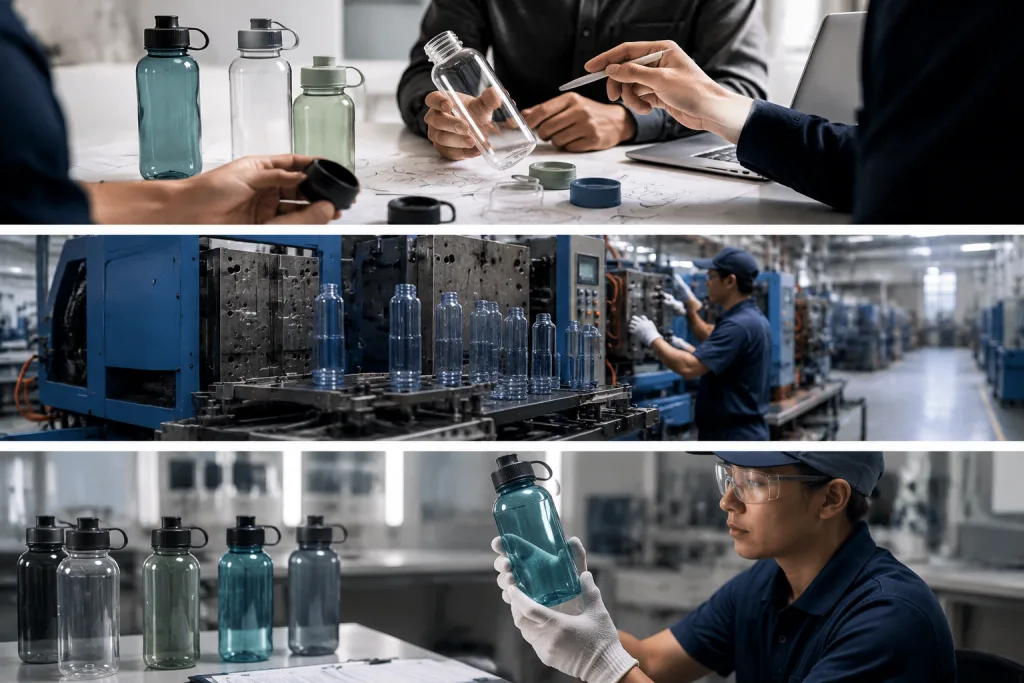
The mistake we see from 6 out of 10 canteen vendors is treating the sample as a sales prop. Wrong question. Treat it as a production contract. Measure the sample with a caliper, fill it to the marked capacity, shake it upside down for 30 seconds, freeze it if the use case requires, test the cap one-handed, check odor after 24 hours closed, and wash it several times. QC pulled one Tritan sample last season because the buyer’s PO said “matte black,” but the approved artwork file said “gloss black.” If you sell through Amazon or retail distribution, scan the barcode, check FNSKU placement, and confirm carton labels before mass packing.
QC gate checklist:
- Pre-production sample approved with date, signature, clear photos, and one sealed counter sample kept in our QC room.
- Inline inspection after 10-20% production to catch color shift or logo print drift before the full line keeps running.
- Final random inspection under AQL before balance payment, with defect photos tied to carton numbers.
- Leak test on filled samples from multiple cartons, not only the top carton near the packing table.
- Carton weight and dimension check against freight booking, especially when the buyer books space by CBM.
For distributor growler or custom growler projects using larger plastic bodies, add a heavier drop test and handle strength check. We usually hang a 3 kg load on the handle and record any whitening, cracking, or pin movement. A 1.5 L bottle failing at the handle is not a small defect. The math does not work; it becomes a claim, a refund, and a distributor relationship problem.
Supplier Selection Questions Buyers Forget
9 out of 10 buyers compare price, MOQ, and lead time first. Strong procurement teams also check communication accuracy. A canteen manufacturer that replies in 8 minutes but avoids hard numbers is weaker than a factory that takes 2 hours and sends cap thread tolerance, carton size, gross weight, and drop-test limit. We saw this on a 600 ml Tritan canteen PO where the buyer flagged “clear blue” but the sample room matched Pantone 2905C; the exact note saved a re-sample.
Before choosing between canteen manufacturers, ask who owns each step. Who buys resin? Who injects the cap? Who prints? Who does assembly? Who runs leak testing? Some canteen suppliers outsource pad printing or color-box packing, and that can work, but you need the name and address. If every step is outsourced, the math doesn't work. You are managing a chain, not a supplier, and when QC pulled 32 pcs from the line for a 0.3 mm cap gap, nobody wanted to own the fix.
Shortlist checklist:
- Factory location and export port, for example Zhejiang to Ningbo or Shanghai, with normal truck time shown as 3 hours or 5 hours.
- MOQ by SKU, color, and decoration method, because 1,000 pcs plain color and 3,000 pcs silk print do not cost the same.
- Capacity in units/month and current production queue, stated by line, mold set, and booked ship date.
- Named contact for engineering drawings, QC photos with AQL 2.5 result, and export documents such as CI, PL, and CO.
- Payment terms, usually 30% deposit and 70% before shipment for first orders, with the beneficiary name matching the PI.
- After-sales policy for verified defects, shortages, and carton damage, including the photo count and claim window in days.
If you need a canteen customized for a retailer launch, choose the supplier that challenges your specification early. A solid canteen vendor will say your 65 mm print area hits the bottle curve, your 250 g color box fails a 1.2 m drop test, or your target price cannot carry the flip cap mold. Good pushback feels annoying at RFQ stage. It saves money. A supplier that says yes to every line item is often pushing the argument into mass production, and we have seen that go sideways after the first 500 pcs came off the line.
Send Your Tritan Bottle Spec For Review
Share capacity, target price, logo method, market, and MOQ. We will reply with practical options, risks, and FOB China pricing.
Frequently asked questions
What MOQ should I expect from a Tritan bottle distributor?
For existing molds, expect 1,000 pcs per logo or SKU as a workable starting point. If you need a custom Pantone body color, many factories require 2,000-3,000 pcs because resin color matching creates setup loss. A new mold or special cap can require 5,000-10,000 pcs to make tooling and testing practical. Some canteen distributors offer 300-500 pcs from stock, but color, logo size, packaging, and compliance documents are usually limited. For a first distributor drinkware order, 1,000-2,000 pcs in one strong-selling color is often safer than splitting small quantities across five colors.
Is Tritan better than stainless steel for promotional canteens?
Tritan and stainless steel solve different problems. Tritan is lighter, transparent, usually cheaper, and good for gyms, schools, wellness programs, and outdoor retail where customers want to see water level. Stainless steel is better for insulation, hot liquids, and premium gifting. A canteen promotional Tritan bottle may land around USD 1.65-3.20 FOB China, while insulated stainless can easily run USD 4.00-8.00 depending on capacity and finish. If your buyer needs dishwasher visibility, low freight weight, and bright colors, Tritan works well. If they need 12-24 hour temperature retention, use stainless.
Can I order a custom canteen with my own cap design?
Yes, but treat the cap as an engineering project, not just a design feature. A new cap mold may cost roughly USD 3,000-12,000 depending on sliders, hinges, buttons, and sealing structure. Development usually takes 35-60 days including mold cutting, first trial, adjustment, and leak testing. If you only need brand differentiation, it may be smarter to use an existing cap and customize color, loop, silicone grip, or printed logo. A canteen factory should test cap opening force, gasket fit, leak rate, and hinge durability before approving mass production.
What tests should I require for Europe or North America?
For North America, ask for FDA food-contact testing and, if children may use the bottle, CPSIA and ASTM F963 review for relevant parts. For Europe, ask for LFGB or EU 10/2011 migration testing, plus REACH screening when required by your retailer. Also request BPA-free declaration, material composition, and printing ink safety confirmation. Product testing should match the final production version, including colorant, cap, gasket, and print. For inspection, many buyers use AQL 2.5 major and AQL 4.0 minor, with leakage, odor, sharp edges, scratches, and logo adhesion listed as check points.
How do I compare canteen suppliers beyond price?
Ask each canteen supplier for the same data: MOQ per color, FOB port, lead time after approval, wall thickness, resin grade, cap material, carton size, test reports, audit status, and AQL standard. Then compare how clearly they answer. A good supplier gives numbers and flags risks. A weak supplier gives only a low price and broad promises. Also check whether they control injection, assembly, decoration, and packing or outsource most steps. For a distributor canteen program, supplier discipline matters because one late or defective shipment can damage several customer accounts at once.