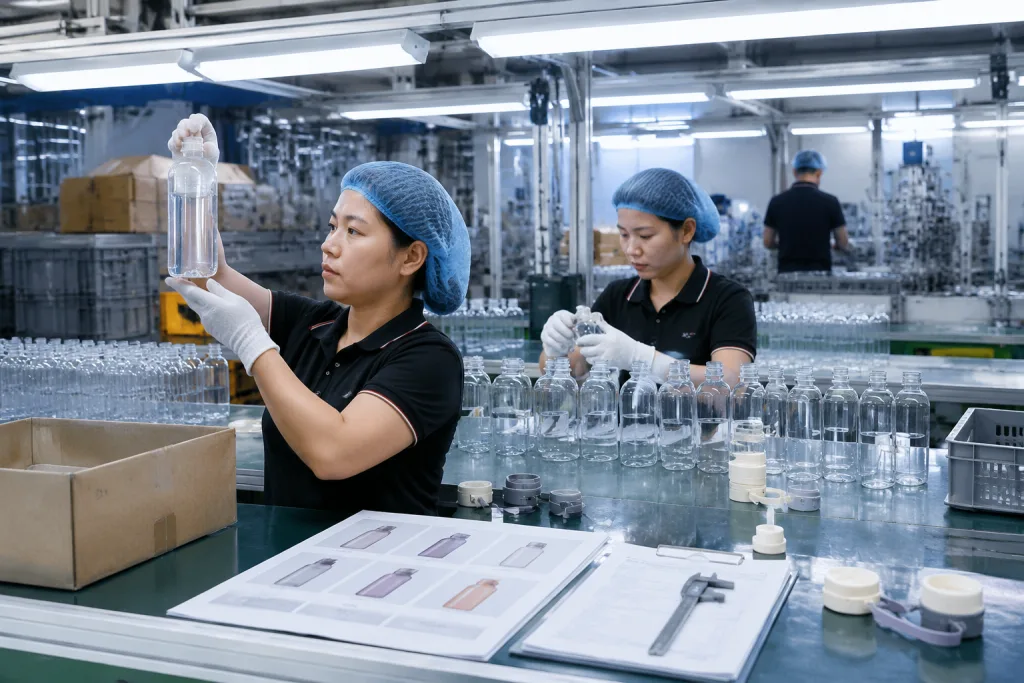
Key Takeaways
- Set Tritan body thickness at 1.8-2.2 mm for most 500-750 ml bottles
- Confirm MOQ by decoration method: 1,000 pcs for stock-color logo, 3,000 pcs for custom color
- Use AQL 2.5/4.0 inspection with leak, torque, logo adhesion, and carton drop checks
- Plan 25-35 days production after sample approval for a typical Zhejiang factory run
A tritan bottle customized project looks easy on the RFQ sheet. Then QC pulls 32 pcs from the first pilot run and finds cloudy bodies, lids leaking at the silicone ring, logos failing the 3M tape test, or export cartons splitting after a 1.2 m drop test. By that point, your launch window is down to 12 days, not 18, and the margin gets eaten by rework, air freight, or replacement stock.
On our Hangzhou, Zhejiang production floor, we see the same 6 problems repeat. They are not bad luck. The buyer leaves wall thickness at “standard,” approves artwork from a low-res JPG, assumes every clear plastic is the same as Tritan, or asks for the QC plan after the line has already run 8,000 pcs. China can make solid custom drinkware, but this is the wrong question to ask: “How cheap can you make it?” Ask what spec, mold, logo process, packing, and AQL check will keep the order sellable when the distributor opens the first carton.
Failure starts with vague material specs
The first failure mode is material drift. A buyer asks for a tritan bottle customized for retail or a school canteen promo, then the PO only says “Tritan, BPA free.” Too loose. We ask buyers to name the Eastman Tritan grade or write “approved equivalent subject to sample approval,” then lock body clarity and the color masterbatch code on the artwork sheet. State whether recycled content is allowed. For EU orders, request LFGB or EU 10/2011 food-contact documents. For North America, ask for an FDA food-contact declaration and California Proposition 65 screening when the bottle will sell in that market. Last month QC pulled 3 incoming resin bags where the supplier label was clear, but the batch number was missing from the delivery note.
Tritan is tough. It is not magic. It can scratch, stress-whiten around hard drops, and deform near high heat. For most sports and office bottles in 500-750 ml capacity, we run 1.8-2.2 mm wall thickness on the body. Thin 1.3-1.5 mm bodies save resin, but the math does not work if the buyer wants a premium retail feel; we have seen 1.4 mm samples ovalize under a 12 kg squeeze test. Thicker 2.5 mm bodies feel premium but add resin cost and cooling time in injection molding, often turning a 38-second cycle into 46 seconds on the line.
Ask your canteen supplier to define the resin lot control method. At BottleForge Industrial in Zhejiang, we record resin batch numbers against production date and machine line, because when a customer reports haze or brittleness six months later, guessing is useless. A serious canteen factory should run incoming material checks instead of trusting the resin bag label. We use a simple melt-flow check and keep a 200 g retained sample from each resin lot; it is boring paperwork until one container gets flagged after delivery.
Do not approve color from a screen image. Require a physical color chip or a pre-production bottle under D65 lighting. Transparent smoke and tinted blue are easy to misjudge. We have seen a custom canteen look premium in a render, then turn gray on the shelf after the pigment load changed wall clarity by only a small amount. On one 6,000 pc order, the buyer flagged “amber” as too close to tea color, and QC pulled the sample beside a Pantone chip before we released mass production.
Lids fail before bottles do
On customized drinkware orders, the bottle body is rarely the first complaint. The lid is. We shipped 18,000 Tritan sports bottles last spring; the buyer flagged 42 returns, and 31 were lid leaks after the bottle sat sideways in a gym bag. Usual weak spots are gasket Shore A, thread tolerance, hinge fatigue, straw OD mismatch, and cap resin that shrinks 0.3 mm more than the drawing allowed.
For screw lids, write down thread engagement and closing torque before the mold is cut. On many Tritan sports bottles we run, 0.8-1.2 N·m works on the torque meter, but your cap geometry can change that. Too loose, the cap backs off in a 12 kg export carton during truck vibration. Too tight, shoppers cross-thread it or split the cap skirt at the parting line. If the lid uses a silicone gasket, specify food-grade silicone, Shore A hardness, and color code on the PO. A 50-60 Shore A gasket is common for flexible sealing; the groove depth and compression are what decide whether QC pulls the sample.
Flip lids need cycle testing. No shortcut here. For a canteen customizable program going into outdoor or school channels, ask for at least 3,000 open-close cycles on the hinge and button, checked on the cycle jig before pre-shipment inspection. If the factory offers only a visual check, push back. We have seen this go sideways: sample-room lids are often hand-fitted with a needle file, while mass production parts come straight off the line with normal flash and pin marks.
Leak testing belongs in the QC checklist, not in a WeChat promise. We use inverted static tests and shake tests with room-temperature water, normally 30 minutes inverted plus 30 seconds of manual shaking for selected samples under AQL 2.5. If your bottle is for carbonated drinks, say it before sampling; most Tritan water bottles are not built for internal pressure. A custom growler or customized growler needs a different sealing structure and pressure validation than a standard canteen, and the math does not work if you copy the same lid tooling.
Do not let a canteen manufacturer treat the lid as an accessory. In complaints data, the lid is usually the product.
Logo decoration has hidden limits
Decoration failures hurt because your logo is the defect everyone sees first. On our line, QC usually catches four issues: registration drift over 0.3 mm, ink rub-off after curing, laser marks turning tan instead of clean gray, and artwork crossing a curved rib so the letters bend. A tritan bottle customized with a 90 mm vertical logo needs a different jig and print sequence than a 28 mm front mark. We have seen this go sideways when the buyer approved the flat artwork but never checked the bottle radius.
For screen printing on Tritan, keep fine text above 6 pt where possible and avoid hairline strokes below 0.25 mm. One-color logos are the safest choice and the math works for most promo orders. Two to four colors need tighter registration control; cost usually rises by USD 0.05-0.18 per color per unit depending on size and volume. Pad printing works better on small curved areas, but the line runs slower, about 1,200 pcs per shift vs 3,000 pcs for simple screen print in our Hangzhou workshop. Heat transfer can carry full-color graphics, but QC pulled samples last month with a visible edge line after the 3M tape test.
Laser engraving on plastic is not the same as laser on stainless steel. Some buyers expect a crisp silver mark, then receive a smoky gray or tan mark and flag it as a factory mistake. It is usually the wrong question to ask; the real issue is Tritan color, resin grade, and laser power setting. If you want a premium permanent logo, test the exact Tritan color and resin grade first with a 10 pc pre-production sample. Transparent bodies often make laser contrast weaker than expected, especially under the inspection lamp at 6500K. For canteen promotional orders, silkscreen or UV printing is usually more predictable.
Ask for a tape test and rub test before approving mass production. A simple 3M tape adhesion test after 24 hours curing catches ink failures before we pack 1,000 pcs into export cartons. For higher-risk retail programs, add an alcohol rub test with 75% ethanol for 20 cycles. This matters if your distributor canteen product is sold into gyms, schools, or corporate wellness kits where bottles are wiped 2-3 times a day. We ship better when the approval sheet says the exact test method, not just “logo must be durable.”
Artwork files should be vector AI, PDF, or EPS, with Pantone references. If your canteen vendor accepts a low-resolution JPG and says “no problem,” that is not flexibility; it is a warning sign. We once received a PO with “Panton 286C” typed wrong, and the buyer flagged the blue after printing 500 samples. Send the vector file, Pantone code, logo size in mm, and placement distance from the bottle base.
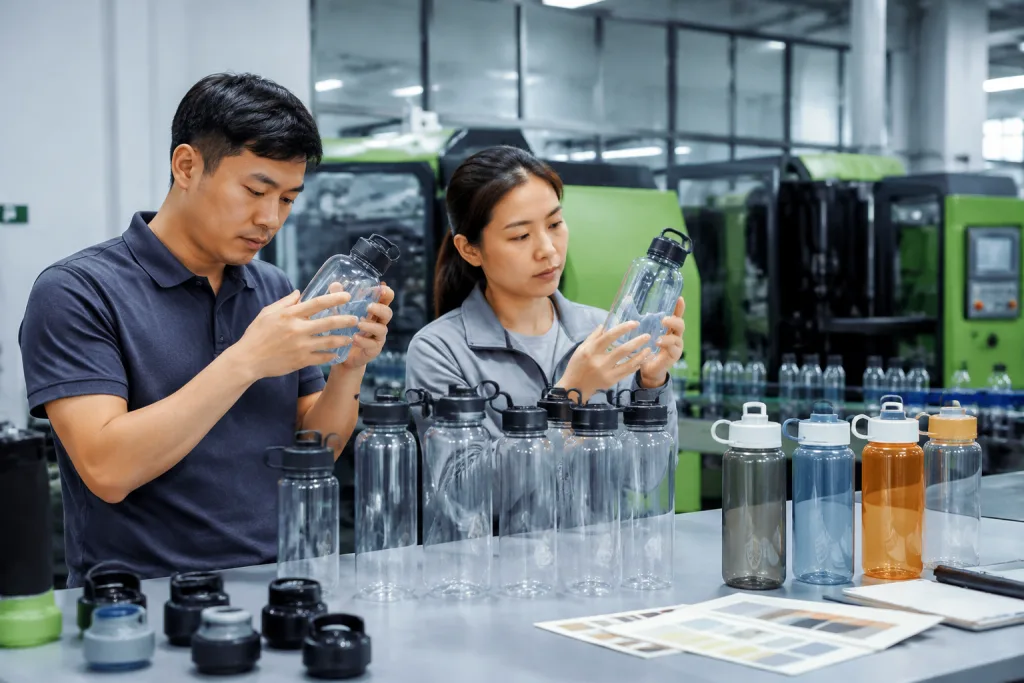
Mold choices change the economics
Buyers ask us one question almost every week: “Do we need private tooling?” Most of the time, no. If the bottle body, lid thread, capacity mark, and logo position work with a stock mold, we run custom color and logo first because the math is cleaner. Private mold makes sense when the shape protects your shelf position: a new grip, a lid system competitors cannot buy, a built-in filter, or a retail silhouette your chain wants locked down. Last month a buyer pushed for a new 720 ml body, but the caliper check showed our stock 710 ml mold was within 3 mm of their drawing. We saved them tooling money.
For a stock Tritan bottle, a typical MOQ is 1,000 pcs for existing body color with one-color logo, 3,000 pcs for custom body color, and 5,000 pcs or more if you need a custom lid color plus multiple accessories. FOB China pricing for a 650 ml Tritan sports bottle often lands around USD 1.60-3.20 depending on lid complexity, resin grade, decoration, packaging, and inspection level. A simple canteen promotional bottle sits near the lower end. A retail-ready customized canteen with carry loop, straw lid, printed box, and spare gasket does not. We had one PO come in with “pantone 286C lid” typed as “268C”; QC pulled the sample before bulk resin mixing, because one digit can turn into 5,000 wrong caps.
Private tooling for a Tritan bottle body and cap set can range from USD 6,000 to USD 25,000. That gap is not factory mystery pricing. Cavity count, mold steel, hot runner design, and part complexity change the quote fast. A one-cavity prototype mold is cheaper, but the line crawls when you move into mass production. A multi-cavity production mold costs more upfront, then starts to make sense if you are ordering 30,000-100,000 pcs per year. We’ve seen this go sideways when a buyer chose the cheap mold, then asked for 18,000 pcs in 22 days. The machine schedule didn’t bend.
At BottleForge Industrial in Hangzhou, Zhejiang, our drinkware lines support about 450,000 units/month across stainless steel and plastic programs, with Tritan lead time usually 25-35 days after sample approval for normal orders. That number matters, but sample speed is the wrong question to ask. A canteen distributor should ask whether the canteen manufacturer can hold color, lid fit, and carton quality during week three, after the easy first batch is gone. On our line, we check lid torque with a torque meter and pull carton drop-test samples at 12.5 kg gross weight. Small misses show up there first.
Packaging creates expensive surprises
Packaging failures look boring on a quote sheet. Then the claim hits. We have had bottles pass factory QC, with calipers showing the cap OD within 0.2 mm, and still reach the buyer with scuffed bodies, crushed retail boxes, or barcodes the warehouse scanner rejected. For distributor drinkware, carton design belongs in product engineering, not the last email before shipment.
Define the packing method in the PO: polybag, tissue wrap, white box, color box, egg-crate divider, or master carton only. For clear Tritan, loose bottle-to-bottle contact inside cartons is asking for abrasion; QC pulled the sample after 30 minutes of shake testing and the transparent wall already showed rub marks. If you use color boxes, lock paper grade, flute type, and print finish. A 350 gsm single retail box is common, but a 650 ml bottle with a carry loop or e-commerce parcel handling often needs E-flute or reinforced corners.
For Amazon FBA or third-party logistics, carton labeling needs line-level control. FNSKU, suffocation warning, country of origin, carton quantity, and barcode grade should be checked before the container leaves China. We run a scanner check on 10 cartons per SKU before sealing the pallet; one buyer once flagged a PO typo where “24 pcs” was printed on cartons packed at 48 pcs. A canteen vendors network can quote cheap labeling, but crooked labels, duplicate FNSKUs, or labels placed over carton seams will stall inbound receiving.
Run carton drop testing. For export cartons under 15 kg, a 1.2 m drop test on one corner, three edges, and six faces is a useful baseline. It does not guarantee zero logistics damage, but it exposes weak cartons and poor internal protection fast. If the product is headed for retail shelves, talk vibration or compression with your canteen suppliers, especially for mixed SKU pallets; we have seen a 5-layer stack crush the bottom color boxes after 12 days at sea plus 3 days in a domestic truck.
Do not let the factory reduce carton ply to save USD 0.03 per unit without written approval. The math does not work. That saving disappears fast when a pallet arrives with 8% sellable-box damage, and the buyer sends photos with a ruler against every dented corner. Packaging is one of the few specs where a small change on the line can create a large loss after delivery.

Compliance cannot be retrofitted later
Compliance is the failure mode we hate most, because QC usually hears about it after cartons are packed and the vessel booking is already cut. You cannot turn a non-compliant bottle into a compliant one with a fresh label or a revised gift box sticker. Wrong question to ask. If your customized drinkware is going into the EU, UK, Canada, or the US, lock the test plan before we run resin drying at 82°C and start the injection line.
For Tritan bottles, buyers usually ask for BPA-free declarations and FDA food-contact compliance first, then EU 10/2011 migration testing, LFGB testing for Germany, and REACH/SVHC screening for restricted substances. If the bottle is for children, add ASTM F963, CPSIA, small parts review, and applicable heavy metal testing to the PO before mold trial, not after the first 500 pcs come off the line. Kids parts get tricky fast. QC pulled a sample last season where the removable silicone plug measured 28 mm across, and the buyer flagged choking risk even though the artwork said “Not intended for children under 3.” That sentence is not a shield if the shape, colors, and straw design clearly target young children.
Social compliance also blocks larger retailer orders. BSCI, Sedex/SMETA, ISO 9001, and factory audit availability may be required before purchase order release, and the date on the audit cover page matters as much as the logo. Not every canteen supplier in China has current audit status. We ask our own sales team to attach the latest audit report cover page and corrective action status before quoting mass retail; one typo on a PO once listed “SMETA 4-pillar valid” when the factory only had a 2-pillar report, and the buyer froze the order for 12 days. A canteen factory that says “we can pass if needed” may still need 30-60 days to prepare, plus another week if the CAP requires fire-door or chemical-room fixes.
Testing should use production material, not a polished golden sample made from a different resin lot. For large programs, hold back 20-30 production units as retained samples, sealed with the resin lot number, injection date, and carton mark written on the sample tag. We run this in the packing area after AQL 2.5 inspection, usually before the last pallet is stretch-wrapped. If there is a recall, retailer dispute, or distributor growler claim later, retained samples let both sides cut open the same production batch instead of arguing from memory. We have seen this go sideways without samples.
The practical rule is simple: if compliance is on your customer’s vendor manual, put it on your purchase order. Verbal compliance promises do not protect importers when customs, a retailer lab, or a marketplace safety team asks for documents. Put the test names, target market, sample quantity, and report language on the PO; our merchandiser can then match it against the lab submission form before we ship.
Inspection must match real risks
A final inspection that only checks quantity, carton marks, and surface appearance is too thin for a tritan bottle customized order. This is the wrong question to ask. The checklist has to follow the ways the bottle fails in a customer’s hand: leakage after a 180° invert test, cap thread mismatch checked with a go/no-go gauge, logo rub-off after 3M tape pull, odor inside the bottle, scratches near the logo panel, color drift against the approved Pantone chip, barcode scans, and carton drop strength. Last month QC pulled 32 samples from a 6,000 pcs run and found 5 caps that needed extra torque to close.
Use AQL sampling, not random “looks good” checking by the line leader. For most B2B drinkware orders, AQL 2.5 for major defects and 4.0 for minor defects is a reasonable starting point. Critical defects should be zero tolerance. Critical means sharp edges on the mouth rim, foreign material inside the bottle, unsafe odor, wrong material, severe leakage, or incorrect compliance labeling. Major defects include logo offset over the approved mm tolerance, cap malfunction, deep scratches in the front viewing area, wrong color against the signed sample, or crushed retail boxes. Minor defects include tiny specks or light cosmetic marks inside the agreed limit. We run this with a caliper, barcode scanner, torque meter, and the sealed golden sample on the QC table.
Pre-shipment inspection should happen when at least 80% of goods are packed and 100% of goods are produced. Inspect too early and the math doesn’t work: the factory can fix the first 20 cartons, then repeat the same lid gap on the next 300 cartons. For high-risk launches, add an in-line inspection at 20-30% production. It costs extra, but it catches color drift, loose lids, or logo position errors before the full batch is finished. We have seen this go sideways on a 12,000 pcs launch where the buyer flagged a 2 mm logo shift only after pallet wrapping.
Send your inspector a product standard sheet with photos. Words like “small scratch acceptable” cause arguments. Define scratch length, location, and quantity. For example: no scratch over 10 mm on the front logo area; maximum two light scratches under 5 mm on non-logo side; no black specks over 0.5 mm visible at 30 cm. Good enough. This level of detail is not fussy; it keeps a canteen distributor, canteen manufacturer, and overseas buyer from fighting over debit notes after the container ships. On our floor, the inspector tapes the photo standard beside the light box so the day shift and night shift judge the same defect.
China production can be reliable when the inspection plan is built before mass production. If QC starts only after defects appear, you are already negotiating who pays for rework, air freight, or a 5% discount instead of preventing the loss. We ship cleaner orders when the PO, artwork file, and approved sample match before tooling starts; one typo in a PO color code can turn a 12-day schedule into 18 days.
Send us your Tritan bottle spec for review
We will check material, lid, logo, MOQ, packaging, and QC risks before you commit to a production order.
Frequently asked questions
What is the realistic MOQ for a tritan bottle customized order?
For stock mold Tritan bottles, a realistic MOQ is usually 1,000 pcs with one-color logo on an existing bottle color. If you need a custom Pantone body color, expect 3,000 pcs because resin coloring and machine setup waste are higher. If the lid, strap, silicone sleeve, or retail box also needs custom color, 5,000 pcs is more realistic. A private mold project normally starts at 10,000 pcs for the first run, although tooling can be built earlier. Be careful with a canteen vendor offering 300 pcs custom color; they may be painting the surface, mixing leftover resin, or charging a high hidden setup cost.
How long does production take after I approve the sample?
For a normal tritan bottle customized project using an existing mold, plan 25-35 days after signed sample approval and deposit. Add 7-10 days if you need custom resin color matching, and another 5-7 days for complex retail packaging or barcode labeling. Private mold programs are slower: 25-45 days for tooling, 7-14 days for mold trials and revisions, then normal mass production time. Shipping is separate. Ocean freight from Ningbo or Shanghai to Europe or North America can add roughly 25-45 days port to port, depending on route and season. If your launch date is fixed, approve artwork and compliance testing before the factory production slot is booked.
Is Tritan better than stainless steel for custom drinkware?
It depends on the use case. Tritan is clear, lightweight, impact-resistant, and good for cold water bottles, school bottles, gym bottles, and canteen promotional programs where visibility and low weight matter. Stainless steel is better for vacuum insulation, hot drinks, premium retail, and long thermal performance. A 650 ml Tritan bottle might weigh 120-180 g, while a vacuum stainless bottle of similar size can be 280-380 g. Tritan is usually cheaper than double-wall stainless steel, but it does not keep drinks hot or cold for 12-24 hours. Many distributor drinkware ranges carry both: Tritan for sports hydration and stainless steel for travel tumblers or thermos bottles.
What logo method should I choose for a customized canteen?
For most customized canteen orders, one-color silkscreen printing is the safest balance of cost, speed, and appearance. It works well for logos around 40-80 mm wide and usually adds about USD 0.05-0.15 per unit depending on order size. Pad printing is better for small curved areas, while UV printing or heat transfer is better for full-color graphics. Laser marking on Tritan must be tested first because contrast depends heavily on resin color. Always approve a physical logo sample, not only a digital mockup. Add tape adhesion and rub testing to the inspection checklist, especially if bottles will be handled daily in gyms, schools, or corporate programs.
How do I compare canteen manufacturers without just choosing the lowest price?
Ask each canteen manufacturer for the same data: resin grade, wall thickness, lid material, gasket specification, MOQ, FOB price, lead time, compliance documents, AQL standard, and packaging method. Then compare line by line. A quote at USD 1.72 may be worse than USD 1.95 if it uses thinner walls, weaker cartons, no retained samples, and no leak testing. Also check whether the factory is the actual producer or a trading canteen supplier. Trading companies can be useful, but you should know who controls molding, assembly, and QC. For larger orders, request a video audit, production photos, and a pre-shipment inspection report before paying the balance.