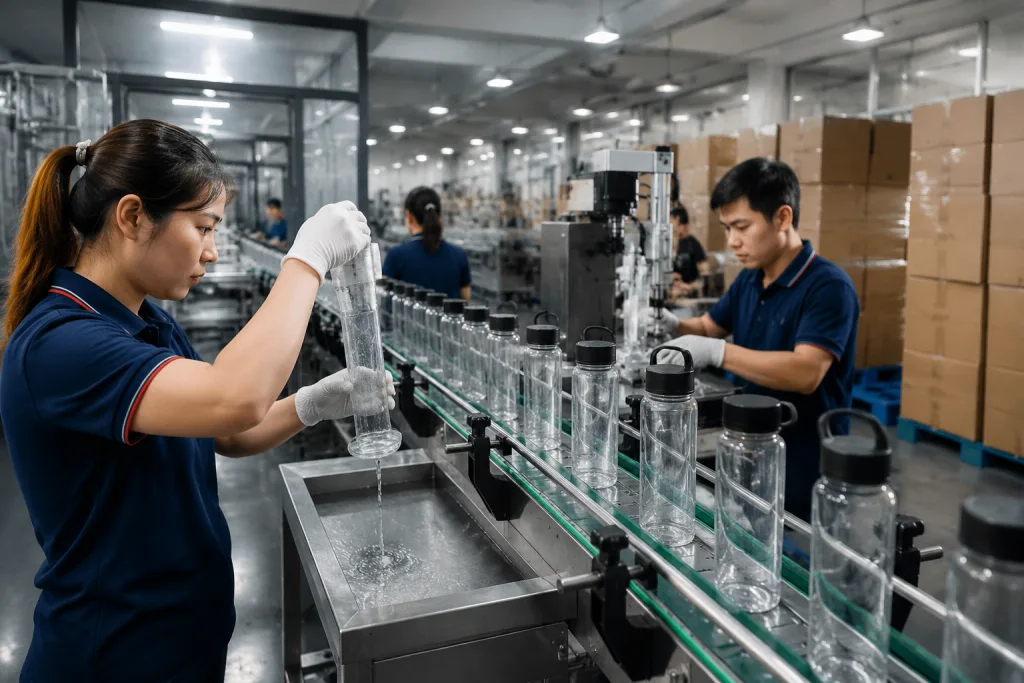
Key Takeaways
- Set Tritan wall thickness at 1.2-1.8 mm for most 500-1000 ml bottles
- Use AQL 2.5/4.0 inspections plus leak, drop, torque, and decoration rub tests
- Expect MOQ from 3,000 pcs per color and 30-45 days after artwork approval
- Require resin traceability, LFGB/FDA food-contact reports, and pre-shipment samples
A tritan bottle customizable project looks simple on a quotation sheet: capacity, cap type, Pantone color, logo method, carton spec, FOB Ningbo or Shanghai. Then QC pulls 20 pcs from the line and the trouble shows up: sweat marks after a 1.2 m drop test, a flip lid leaking after 300 open-close cycles, a silk-screen logo failing a 3M tape rub, or a resin certificate that lists a different batch number than the PO. That is when the math changes. You are no longer buying bottles; you are paying for complaint handling, replacement stock, and awkward emails from your key account.
We manufacture custom drinkware in Zhejiang, China, and we see the same 6 buyer mistakes every peak season. Tritan is tough, but it is not magic. This is the wrong question to ask: “Can you make it cheaper?” Ask where the bottle fails first. For a custom canteen, distributor drinkware line, or canteen promotional program, we run the weak points before mass production: cap torque, silicone ring fit in mm, dishwasher logo resistance, carton drop direction, and whether the FDA or LFGB file matches the resin lot we ship.
Resin Claims That Do Not Match
The first failure is not visible. A canteen supplier quotes “Tritan” because the buyer wrote it on the RFQ, then the line runs mixed copolyester, PC substitute, or recycled off-grade material from a side-door resin bag. Day-one clarity proves little. We have seen 0.6 mm haze at the shoulder after hot-water rinse, solvent odor after 48 hours in a sealed carton, and stress cracks around the injection gate. The trouble usually appears when the retailer asks for the compliance file and QC pulls a bottle that does not match the resin label.
For a tritan bottle customizable order, do not accept a material promise in an email. Put the exact resin grade on the PO, ask for batch traceability, and require food-contact test reports tied to the factory name, not only the trading company. For Europe, buyers usually request LFGB or EU 10/2011 migration testing; for North America, FDA food-contact compliance is common. If the bottle is for children, add CPSIA and ASTM F963 where applicable. REACH and California Proposition 65 screening also come up with chain stores; one US buyer flagged us because the PO said “Tritan TX1001” while the artwork sheet had a typo, “Triatn.” Small typo. Big delay.
Do not over-spec if your channel does not need it, but do not under-spec for retail. This is the wrong question to ask if the only target is a 3% lower bottle cost. A canteen manufacturer in China should keep incoming resin records and provide COA files by batch. In our Zhejiang plant, we keep resin batch records for at least 24 months because distributor canteen buyers sometimes need documents 14 months after the shipment arrives, usually when their own customer starts a shelf audit.
- Spec around it: name the resin grade in the PO, not just “Tritan-like”; our ERP will block the work order if the grade field is blank.
- Check before deposit: request existing LFGB/FDA reports issued within 24 months, then compare the factory name and sample description line by line.
- Check before shipment: match the resin bag batch label, injection production date, and finished goods lot code; QC should photograph all 3 before carton sealing.
If a canteen vendor refuses traceability but offers a 5% cheaper price, the math does not work. You are not saving money. You are moving compliance risk from the factory floor to your warehouse.
Molding Defects Buyers Miss
Tritan bottles usually fail at the molding bench, not in the catalog photo. If the preform shot weight, injection pressure, or blow-mold cooling is loose, QC will see short shots on the thread, sink at the base push-up, flow lines down the body, or wall thickness drifting left to right. We run a Mitutoyo caliper and cut samples at the shoulder; last month QC pulled one 650 ml bottle with a 0.9 mm shoulder against a 1.4 mm spec. It looked fine. It cracked after a filled drop test.
For most 500-1000 ml customizable drinkware programs, a workable wall thickness is 1.2-1.8 mm depending on the bottle shape. Tall slim bottles need tighter control at the base radius and neck transition, where the material stretches hard during blowing. Square bottles and flat-panel custom canteen designs sell well because the logo sits clean, but the corners take the hit first. If a buyer asks for a canteen customized with a 70 mm recessed logo panel, we push for a T1 prototype before any 10,000 pc mold run. The math doesn't work if the corner splits after tooling is paid.
Cap fit causes quiet trouble. A thread off by 0.15 mm can pass during packing, then leak after 7 days in a hot warehouse carton or after repeated opening. Ask your canteen factory to lock cap torque, thread gauge checks, and go/no-go measurements on the inspection sheet. We use a digital torque tester on the line, and the buyer flagged one PO where “28 mm cap” was typed as “28.5 mm cap.” Small typo. Big leak risk. A normal inspection plan should cover bottle weight tolerance and capacity tolerance, then set visual limits for black spots, bubbles, scratches, and parting lines.
Our Zhejiang, China factory output for Tritan and stainless drinkware averages about 450,000 units per month, but capacity does not replace process control. Big volume only helps when the line signs first-article approval, checks parts every 60 minutes, and writes corrective action when scrap rises above the control limit. We ship containers, yes, but we still stop a line for a bad cooling-water reading on the mold chiller.
Pretty samples are not proof of stable molding. A production run is only stable when the 3,000th bottle matches the 30th bottle.
Leaking Lids And Bad Threads
The lid is where about 3 in 10 canteen projects lose margin, and buyers lose trust fast. A bottle body can pass the caliper check at ±0.2 mm, but if the silicone gasket is too soft, the straw vent is 0.4 mm oversized, or the hinge pin creeps out during the line check, the user sees one thing: water in a backpack.
Leak risk changes by lid type. A screw cap is easier to hold than a flip straw cap. Push-button lids need spring fatigue checks on the test jig, not just a thumb press at the packing table. Sports caps need bite valve material review because one buyer flagged a rubber smell after 7 days in a sealed polybag. Carry-loop lids need pull testing; users hang bottles from bags and stroller hooks, and we have seen loops fail at 8 kg when the spec said 12 kg. If you are sourcing canteen promotional items, the cheapest lid can work for a 2-week giveaway. For a reusable retail SKU, the math does not work after the first return batch.
A practical QC plan should include a 30-minute inverted leak test, a 60-second shake test, vacuum or pressure testing where the lid design calls for it, and torque testing after assembly with a digital torque meter. For flip lids, specify 1,000 open-close cycles for approval if the product is positioned as daily-use drinkware. QC pulled one sample last month where the button plug came loose after 420 cycles, and that is not a minor defect for children’s products. Check small parts and choking hazards before carton sealing.
Gasket material matters. Food-grade silicone is standard, but hardness should be written into the PO, often around Shore A 50-60 for bottle seals. Too soft, and it rolls out of the groove during cap tightening. Too hard, and it fails to seat on the thread start. Ask your canteen supplier to keep spare gasket tooling records; a 0.15 mm change on the gasket lip can shift the leak rate, and we have seen this go sideways after a mold “polish” nobody approved.
- Define pass/fail criteria: no visible water after 30 minutes inverted, checked on white tissue so the inspector cannot miss small seepage.
- Confirm torque: cap closing torque needs a measured range on the torque meter, not “hand tight” written on the QC sheet.
- Test after decoration: heat transfer or coating can distort the neck or lid skirt; we run this check after printing, not before.
Decoration That Fails In Use
Decoration turns a customizable canteen into a brand asset, and it is also where 6 out of 10 claim emails start after delivery. Silk screen looks sharp on flat panels; on a tapered Tritan body, the 70-durometer squeegee can drag the logo oval by 1-2 mm. Pad printing works better around curved shoulders, but a 45 mm logo may already be too wide for the pad cup we run on the line. Heat transfer gives cleaner full-wrap graphics if the operator holds the film temperature within a tight window. Laser engraving belongs on stainless steel, not clear Tritan bottle bodies, so don’t price every custom drinkware process as if it fits every material.
For a tritan bottle customizable order, lock the logo size in millimeters, the Pantone code with coated or uncoated reference, the print position tolerance from a fixed point such as the lid seam, and the abrasion test you expect. “Logo as sample” is the wrong instruction. We had one PO with “same blue” typed in the artwork column, and QC pulled the sample against three different blue chips before the buyer admitted no Pantone was approved. A reasonable position tolerance for mass production might be ±1.5 mm for simple one-color printing, but complex wrap designs need more room unless the fixture is tight and checked every 2 hours. For retail-grade appearance, approve a decorated pre-production sample made by the same machine and ink planned for mass production.
Dishwasher claims need careful wording. Tritan can take repeated washing better than some plastics, but the printed decoration is often the weak point. If you sell the bottle as dishwasher safe, run 20-50 dishwasher cycles on decorated samples before that claim goes on the color box. We’ve seen this go sideways: the bottle passed, the logo feathered at the edge, and the buyer flagged it during incoming inspection. For canteen promotional giveaways, a basic 3M tape test and 500 g rub test may be enough. For a premium distributor drinkware program, ask for cross-hatch adhesion with photos, alcohol rub with cycle count, and hot-water soak testing at the temperature you expect users to reach.
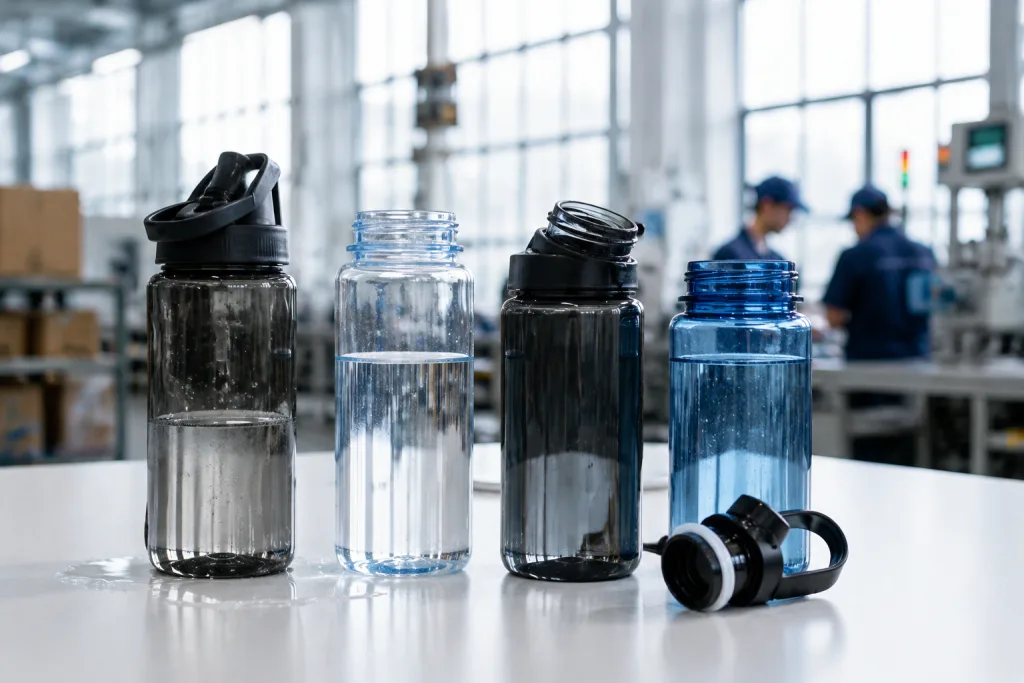
Custom color bodies add another failure mode. Transparent smoke shows weld lines near the base, amber can look dirty under warm LED, and blue often exposes flow marks around the shoulder radius. Color masterbatch should be approved under daylight and indoor LED because the same bottle can look different in a warehouse than on your website. QC pulled one 650 ml sample under a D65 light box and it matched; under the buyer’s office lamp, it looked green. For canteen distributors selling into multiple markets, keep one approved color chip and one golden sample at the factory and at your office.
Packaging Damage Before Retail
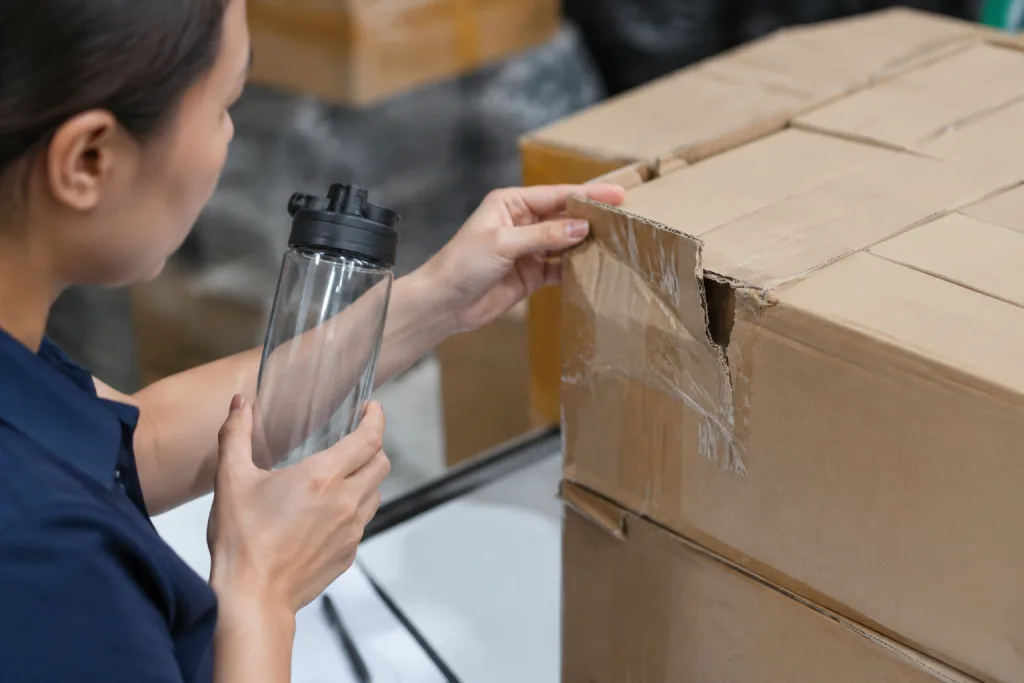
I still see 6 out of 10 buyers spend two weeks on the bottle shape and only 10 minutes on the packaging. Wrong question. Tritan can take a drop, but a clear bottle with a 12 mm scratch, a rubbed PP cap, or a crushed color box gets rejected at retail. We have seen this go sideways when the export carton used 3-ply board instead of 5-ply, the inner polybag was removed to save USD 0.018 per unit, or the line packed bottles cap-to-cap with no EPE divider. QC pulled the sample after the vibration table test and found scuff rings on 14 bottles in one carton.
For e-commerce, packaging specs must be tighter than palletized wholesale. If we ship to Amazon FBA or a 3PL, we run a 5-ply export carton, FNSKU label position check with a scanner, carton drop test from 76 cm, and barcode scan check before sealing. A 32 ECT carton can pass for lighter wholesale cartons under 8 kg, but heavy mixed cartons need stronger board or the corners collapse. If the bottle includes a straw brush, manual, spare gasket, or hangtag, the packing line needs a counting jig plus a weight check on the 30 kg scale. Missing accessories are not rare; last May, a buyer flagged 37 cartons short of straw brushes because final packing was rushed before the container cutoff.
Retail packaging changes lead time. A plain white box may take 7-10 days. A custom color box with lamination takes 12-18 days after artwork approval, and the clock starts only after the dieline is signed, not after the first email. If your launch date is tight, approve the dieline early and do not wait until bulk bottles are finished. For a custom growler or customizable growler project, the math doesn't work if packaging is treated as an afterthought, because one filled master carton can hit 16 kg and dented corners show up fast during sea freight. Our carton supplier checks the creasing line with a 0.5 mm tolerance gauge before mass printing.
Ask for carton markings before production: item number with the exact PO suffix, quantity per carton, gross weight and net weight in kg, carton size in cm, country of origin wording, plus handling marks in the buyer's required layout. If you buy through a canteen distributor, make sure the factory still receives your exact packaging SOP. We once received a PO where “matte black lid” became “mate black lid,” and that typo followed the packing instruction until the buyer caught it in the pre-shipment photos. Instructions passed through three parties often land at the packing table as one vague sentence.
Inspection Plans Too Light
AQL inspection is not a magic shield, but it beats hoping the canteen vendor got every station right. In our Hangzhou line, about 7 out of 10 import buyers set AQL 2.5 for major defects and AQL 4.0 for minor defects, with critical defects set to zero. Zero means zero. Critical defects include leakage after a 30-minute inverted test, unsafe sharp edges found by the finger sweep, wrong material against the approved Tritan spec, visible contamination, or a failed lid function. Major defects include poor assembly with a loose straw seat, wrong logo position by more than 2 mm, deep scratches on the body, crushed retail boxes, or capacity outside tolerance.
Do not rely only on final random inspection. We run staged control: first-article approval before mass printing, a during-production check at 20-30% completion, then pre-shipment inspection when at least 80% is packed. This matters for a canteen customizable project because the logo pad, Pantone color, lid gasket, and inner box can drift on different days. QC pulled the sample once at 60% packing and found the logo 4 mm lower than the signed sample; final inspection would have caught it, but reprinting 8,000 bottles would have pushed the vessel by 12 days, not 2.
Your inspection checklist should read like a work instruction, not a wish list. Include capacity check with water on a digital scale, assembled weight in grams, wall-thickness spot check with a caliper, lid torque reading, leak test, drop test from 1.0 m when filled, 3M tape print adhesion, barcode scan, carton drop, and count verification. If the product is a customized growler or large bottle above 1.5 L, add handle pull testing at 15 kg and base stability checks on a flat steel table. For kids’ bottles, add small-parts review and age-grade labeling; we have seen this go sideways when a buyer approved the artwork but missed a tiny “3+” typo on the PO.
BottleForge’s usual MOQ for Tritan custom canteen production is 3,000 pcs per color, with 30-45 days lead time after deposit, artwork approval, and sample sign-off. Smaller pilot runs sometimes work with stock molds, but custom color plus custom lid combinations need enough volume to cover purging loss, color matching, and line setup. The math doesn't work when a canteen manufacturer promises 500 pcs, custom color, custom logo, custom box, and 15 days. Something is being skipped, usually color stability, proper incoming carton inspection, or the 80% packed pre-shipment check.
Supplier Signals Worth Checking
You do not need to walk through 30 canteen manufacturers in China, but you do need to check whether the supplier talks like a factory or a forwarding desk. A real canteen factory can tell you the mold has 8 cavities, Tritan resin is dried around 80–90°C for 4 hours, the lid torque is checked with a digital torque meter, and the silicone gasket is 50–55 Shore A. They should know their AQL level and carton compression target too. A forwarding desk usually copies your question into WeChat and comes back 6 hours later with “no problem.” That answer means nothing.
This does not make every trading company useless. Some canteen distributors and canteen suppliers work well for mixed SKUs under 500 pcs per color or for buyers needing EU local warehousing. The problem is role clarity. Ask who owns the mold, who runs QC on the line, and who signs the 8D corrective action if the cap leaks. If they cannot answer those two names, the math does not work, even with USD 0.08 lower FOB. For customized drinkware, accountability beats a cheap quote. We have seen this go sideways when QC pulled the sample and the supplier still could not say who approved the gasket change.
Before paying a deposit, ask for factory audit documents such as BSCI, ISO 9001, or a recent social compliance report if your customer requires it. Ask for production photos of similar Tritan projects with date stamps, not catalog renderings cleaned up by a designer. Get the sample timeline in writing: 7 days for a plain sample, 12 days for logo and color matching, and 30–35 days for mass production after PP sample approval is a normal range for us. Confirm FOB port and payment terms on the PI, because we once saw “Ningbo” typed as “Nimbo” on a PO and the freight forwarder flagged it. Ningbo and Shanghai are common FOB ports for Zhejiang drinkware exports, and both work for North America and Europe shipments.
Check communication speed during quoting. If a canteen vendor needs four days to answer a wall-thickness question, they will not move faster when a 40HQ is sitting at the gate. Good suppliers push back. If you request a thin 1,000 ml bottle with a deep side recess and a budget flip lid, an experienced canteen manufacturer should warn you about drop-test and leak-test risk before taking your deposit. On our line, QC uses a 1.2 m drop test and a 30-minute inverted leak check; if the buyer flags a 1.0 mm wall at the waist, we say no or change the structure.
Send Your Tritan Bottle Spec For Review
Share capacity, lid type, logo method, target price, and market. We will flag production risks before you place the order.
Frequently asked questions
What MOQ should I expect for a tritan bottle customizable order?
For a real custom color and logo project, expect 3,000 pcs per color as a practical MOQ. Stock clear bottles with simple one-color printing may start around 1,000-2,000 pcs if the factory has inventory. Custom molds, special lids, and custom boxes usually push the MOQ to 5,000-10,000 pcs because resin color matching, line setup, and packaging waste need volume. Be careful with quotes below 500 pcs for custom color Tritan. They often use available stock colors or mixed leftovers, which can create shade variation between cartons.
How long does production take after I approve the sample?
A normal timeline is 7-12 days for sampling, 30-45 days for mass production, and 3-7 days for final inspection and export handling. Custom color boxes can add 12-18 days if the artwork is late. New mold development is separate and may take 35-60 days depending on complexity. For China exports from Zhejiang, FOB Ningbo or Shanghai is common. If your launch date is fixed, lock the bottle sample, decoration proof, packaging dieline, and barcode files before you pay the bulk deposit.
Is Tritan better than stainless steel for promotional canteen programs?
It depends on the channel. Tritan is lighter, transparent, and usually cheaper for large canteen promotional programs. A 700 ml Tritan bottle may weigh 120-180 g, while a stainless vacuum bottle can be 280-420 g. Tritan also lets users see liquid level, which is useful for sports and school bottles. Stainless steel is better for insulation and premium gifting. If you need a low freight cost, bright custom colors, and fast logo application, Tritan is often the practical choice. If you need 12-hour heat retention, choose stainless.
What tests should I require before shipment?
At minimum, require AQL 2.5/4.0 inspection, 30-minute inverted leak test, 1.0 m filled drop test, cap torque check, capacity check, print adhesion test, barcode scan, carton drop test, and visual inspection for scratches, bubbles, black spots, and color mismatch. For flip lids, add 1,000 cycle testing during sample approval. For kids’ bottles, add small-parts review and relevant ASTM or CPSIA checks. Ask the inspector to test finished packed goods, not only loose samples pulled from the line.
Can one supplier handle custom canteen, custom growler, and bottles together?
Sometimes, but check the manufacturing base. A canteen supplier strong in Tritan injection and blow molding may not be strong in stainless vacuum growlers. A supplier strong in stainless welding may outsource plastic sports bottles. Mixed projects can work if the supplier clearly identifies which items are in-house and which are subcontracted. For distributor growler and distributor canteen programs, ask for separate QC checklists by material. Tritan, stainless steel, and glass have different failure modes, so one generic inspection sheet is not enough.