
Key Takeaways
- A practical tritan bottle custom MOQ starts around 1,000-3,000 pcs per color depending on lid tooling and decoration
- Confirm Eastman Tritan grade, wall thickness, and LFGB/FDA test scope before approving a sample
- Decoration choice can shift cost by USD 0.12-0.85 per unit and add 3-7 production days
- Use AQL 2.5/4.0 inspection, 24-hour leak checks, and 1.2 m drop testing for shipment approval
A tritan bottle custom project looks simple until the first quotation sheet lands on your desk. One supplier quotes 650 ml brim-full, another quotes 700 ml working capacity, and the lid that looks the same in a photo fails after 8 minutes on a 45° leak-test rack. If you buy custom drinkware for retail shelves, corporate gifting, or distributor canteen programs, loose specs burn budget before the mold shop cuts 1 mm of steel.
At BottleForge Industrial in Hangzhou, Zhejiang, we see this problem on about 6 out of 10 RFQs from Europe and North America: buyers compare unit price before they check Tritan grade, lid tooling, print area limits, 5-layer carton strength, and compliance files. A Tritan bottle is not difficult to make in China. The hard part is repeatability. We run the line with calipers on the thread fit, QC pulls samples during packing, and the buyer flags it fast if the second order drinks differently from the first. Asking “what is your best price?” too early is the wrong question; the math doesn’t work without a spec sheet that survives sampling, inspection, and repeat orders.
Material line: resin is not cosmetic
The first line on your spec sheet should not read only “Tritan.” Write the resin grade, food-contact test requirement, color method, and recycled-content status. On our injection line, the material label on the dryer hopper and the batch sticker on the 25 kg resin bag must match the PO. Buyers asking for a tritan bottle custom program usually want glass-like clarity and no BPA, but that is the wrong question to ask first. Ask what resin, what test, and what color masterbatch.
For Europe, request LFGB or EU 10/2011 food-contact testing on the finished bottle, not just a raw material certificate. For the U.S. and Canada, check FDA food-contact compliance and the state rules tied to your sales channel. If the bottle is for children, the test scope can expand to CPSIA and ASTM-related items based on age grading, paint, and small parts. We had QC pull a lid sample last year because the silicone straw color on the PO said “Pantone 2925C,” while the lab submission form showed 2935C. Small typo. Big delay.
In China, genuine Tritan resin costs more than generic copolyester or PETG. If one quotation lands USD 0.35 below the other 4 canteen suppliers, ask for the resin purchase invoice or batch certificate before you celebrate. The math does not work otherwise. A factory can shoot a clear sample for photos, then ship bottles that yellow after 8 hot-fill cycles, smell stronger after 70°C water, or crack at the thread after a 1.2 m drop test. We have seen this go sideways.
For a normal sports canteen customized for retail, we usually see bottle wall thickness around 1.2-1.6 mm, with heavier bases at 2.0 mm or more. We check it with a digital caliper after cutting the sample body, not by guessing from the weight. Thin walls cut unit price and carton weight, but drop resistance drops with them. If you sell into outdoor, school, or gym channels, do not buy only by capacity and price. Put wall thickness and resin grade on the purchase order.
Capacity, mold, and hand feel
Capacity is where 6 out of 10 Tritan bottle projects start to drift. A “750 ml” bottle can mean brim-full volume, safe drinking fill, or an old catalog number copied into a PO. We write both on the spec sheet: 700 ml nominal, 735 ml brim, tolerance plus or minus 3%. QC checks it with a 1,000 ml graduated cylinder before we sign the sample tag.
That tolerance matters for distributor drinkware because retail buyers compare the shelf label with the carton mark. If your Amazon listing says 1 liter but the bottle only holds 930 ml to the thread, the math doesn't work. That is not a molding defect; it is a spec mistake. We had one buyer flag a carton typo where “1000ML” was printed on a 900 ml bottle, and the whole shipment sat for 2 days while the stickers were changed. The same issue comes up on a custom canteen for promotional buyers, especially when the client asks if it fits a bicycle cage, a 72 mm car cup holder, or a school backpack side pocket.
Mold choice sets price and schedule. If we run an existing Zhejiang mold, sampling is usually 7-12 days and production can start after approval. A new private mold for a canteen customizable shape normally needs 25-35 days for tooling, plus 5-10 days for first article corrections. Tooling for a Tritan body is not always the scary line item; delay is. We have seen this go sideways when the lid thread looked fine on CAD, but the silicone gasket compressed 0.6 mm too much during the leak test on the line.
Hand feel is not design talk. A bottle with a 74 mm body diameter works for adult fitness channels, while 68-70 mm is easier for school and commuter use. QC pulled the sample and checked the grip with a 150 mm digital caliper, because 2 mm can change how the bottle feels in a smaller hand. A large custom growler or customized growler follows different rules: grip texture must hold when wet, shoulder radius affects pouring, and filled weight decides whether the buyer calls it premium or heavy. If you plan to sell through canteen distributors, ask your sales team which shelf depth and master carton size matter before freezing the mold.
Lid system and leak claims
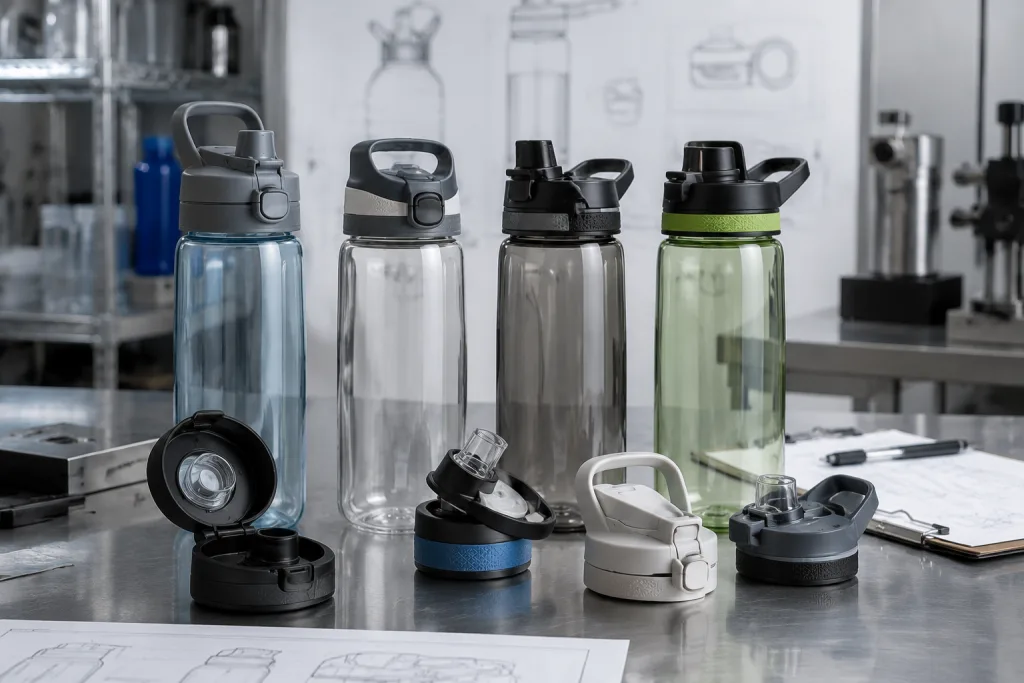
The lid is where a cheap canteen manufacturer can ruin a good bottle body. Your spec sheet should name the lid type: screw cap, flip-top, push-button, straw lid, chug lid, or hybrid, then lock down gasket material, thread engagement, carry handle load, and spare gasket packing. We run hinge cycling on a simple bench jig before mass production because Tritan bodies often survive 24 months while weak hinges and soft silicone parts fail first. Treat the lid as a mechanical assembly, not an accessory.
A real leak claim needs a test method. At BottleForge Industrial, a normal validation for a canteen customized order means filling to 90-95%, closing the lid, inverting for 24 hours, and checking seepage at room temperature on white inspection paper. For tougher orders, QC pulled the sample after warm-water filling at 45°C, then added shaking tests and pressure checks. Do not approve “leakproof” unless the canteen vendor states the test. No test, no claim.
Straw lids need extra attention. Buyers like them for gym and school channels, but they add failure points: straw fit, air vent, hinge pin, button spring, dust cover, and silicone bite valve all need separate checks. We have seen a PO typo call for “soft straw” when the approved sample used a hard PP straw, and the buyer flagged it during pre-shipment inspection. For a canteen promotional order with a tight unit budget, a simple screw lid is often the better call if users do not need one-hand drinking.
Ask for torque guidance on threaded lids. Too tight and users complain; too loose and cartons come back wet. For some lids, we set functional inspection at around 8-12 kgf.cm depending on thread size and gasket compression, using a pointer torque wrench on the line. If you are comparing canteen vendors in China, put lid assembly weight in the quotation table. A lid that is 12 g lighter may explain a lower price, and it may also explain a higher defect rate after three months in market.
Decoration line: logo versus durability
Decoration is where your brand team and the line need to lock the decision before mold trial or pre-production sample. A tritan bottle custom order can use silk screen printing, pad printing, heat transfer, UV printing, laser marking on metal lid parts, or molded color effects. We run all six, but they do not behave the same after a 3M tape test, 500-cycle rub test, or carton drop. Cost, artwork limit, scratch resistance, and lead time all move. Pick late, pay twice.
Silk screen is still the safer choice for simple one- or two-color logos on curved bottles. It is usually economical from 1,000 pcs and can keep decoration cost in the USD 0.12-0.35 range per unit, depending on size and color count. Full-wrap heat transfer can look better on a retail shelf, but it may add USD 0.45-0.85 per unit and needs tighter control of bottle curvature; last month QC pulled 12 samples because the wrap lifted near a 2.5 mm radius change. UV printing gives sharp detail for customized drinkware, but test adhesion on the exact resin and coating combination. The math doesn't work if the buyer approves UV on a flat plaque and expects the same result on a tapered bottle.
For a customizable canteen program, define the logo size in millimeters, not “large logo.” Write 45 mm wide, 28 mm high, 62 mm from bottle base if that is what you want. State whether the artwork is centered on the front, opposite volume marks, or aligned with the lid hinge. If you sell distributor canteen products to multiple accounts, keep a decoration zone map so future reorders do not drift by 5-10 mm. We have seen this go sideways after a PO typo changed “front” to “font,” and the buyer flagged 3,000 pcs even though the print quality passed AQL 2.5.
Color also belongs in the decoration line. A translucent smoke bottle, frosted green bottle, and solid black lid are not one color approval; they are separate control points with different resin batches, masterbatch ratios, and wall thickness effects. Use Pantone references where possible, but transparent materials shift when the wall moves from 1.8 mm at the body to 2.6 mm near the shoulder. For serious retail orders, approve a physical color chip or golden sample under D65 light. Zhejiang factories can match colors well, but “blue” is not a specification.
Compliance and inspection lines
Compliance is not paperwork to chase after the line has packed the cartons. Put it in the product spec before we cut the first Tritan bottle sample. For Europe, ask your canteen supplier for REACH screening where it applies, LFGB or EU food-contact testing, and migration testing on the finished bottle, lid, straw, printing ink, and silicone ring. For North America, request FDA food-contact support plus the state rules tied to your sales channel, such as California requirements if the bottle will sit in a retail chain. If the product is for children, confirm CPSIA, lead, phthalates, and small-parts risk before sampling; QC once pulled a straw cap at 31 mm that looked fine on the drawing but failed our small-parts gauge.
The inspection line should be just as clear. We run AQL Level II with critical defects at 0, major at 2.5, and minor at 4.0 for most customized canteen and customizable drinkware orders. Critical means contamination, sharp edges, unsafe detachable parts, serious leaks, or wrong material. Major means pad printing off by 2 mm, lid thread failure, wrong capacity marking, or carton shortage against the packing list. Minor means light scuffs inside the agreed viewing distance, usually 30 cm under normal warehouse light. One buyer flagged “scratches” at 10 cm with a phone flashlight; the math does not work unless that standard is written before inspection.
Functional testing belongs in the inspection checklist, not in a sales email. Typical checks include 1.2 m drop testing on packed cartons, bottle drop testing on the base and side, 24-hour inverted leak test, dishwasher claim verification if advertised, odor check after warm-water rinse, and lid cycle testing at 300 open-close movements. If your packaging says dishwasher safe, test it. Tritan handles daily use better than cheap AS plastic, but printing, lid seals, and metallic coatings are usually where we see claims go sideways. Last month QC pulled the sample after 6 dishwasher cycles because the silver logo lost gloss near the bottle curve.
A canteen manufacturer that resists third-party inspection is not automatically dishonest, but it is a warning sign. A good China export factory understands AQL, pre-shipment inspection, and corrective action reports without acting offended. BottleForge Industrial runs about 450,000 drinkware units per month across plastic, stainless steel, and glass lines, so we prefer inspection language that a QC team can measure with a torque meter, scale, or leak-test rack. “Premium quality” cannot be inspected. “No leakage after 24 hours inverted” can. We have seen this go sideways when a PO typo changed “Tritan” to “PP” on line 4, so lock material, test standard, artwork, and packing spec before the deposit hits.

Packing, barcodes, and channel rules
Packing looks boring until the first container lands with 1,200 crushed gift boxes. Put inner packing, master carton material, carton size, gross weight cap, barcode position, and drop-test requirement on the spec sheet. Be blunt. For online channels, one Tritan bottle in a thin color box usually fails the corner-drop at 76 cm; QC pulled a sample last month and the lid punched through the box wall. For retail, the box must look clean on shelf and scan at the first pass, not after the cashier rubs the barcode with a thumb. For distributor growler or distributor drinkware programs, cartons need to handle mixed-pallet warehouse work, including clamp pressure and 18 kg cartons stacked 5 layers high.
Common options are polybag only, white box, kraft box, printed color box, PDQ tray, and mailer box, but do not treat them as equal. The math changes fast. A canteen promotional order may choose bulk packing to save USD 0.18-0.40 per unit, while a retail order may spend more on a 350 gsm color box with inserts and a 2 mm EPE pad under the base. If you sell through fulfillment centers, request carton drop testing and compression checks; we run the carton through a simple edge-crush check before booking space. For marketplace shipments, FNSKU labeling, suffocation warnings, and carton content labels belong in the packing spec, because the buyer flagged it after one PO had “24 pcs blue” printed on cartons that actually held 12 pcs clear.
Do not forget spare parts. If the lid has a straw, decide whether one spare straw is included. If the gasket is removable, decide whether replacements are packed or sold separately, and write the gasket size in mm so purchasing does not guess. Small part, big headache. Canteen suppliers can pack these parts cheaply during production, often 1 spare straw and 1 silicone gasket in a 6 x 8 cm PE bag, but air-freighting replacements later is expensive and annoying. We have seen this go sideways when a buyer saved USD 0.03 per set and then paid USD 180 to courier 500 replacement straws.
Carton dimensions affect landed cost more than buyers expect. A bottle that is USD 0.06 cheaper but packs 36 pcs per carton instead of 48 pcs may cost more after ocean freight, warehousing, and pick fees. Ask your canteen factory for carton cube, gross weight, and pallet loading; our line normally sends a carton drawing with L x W x H in cm and a pallet plan before final artwork. For European buyers, check packaging waste reporting and recycling marks. For North American buyers, check retailer routing guides before you approve the final carton artwork, because one missed GS1-128 label position can hold a full pallet at the DC.
Commercial lines that protect repeat orders
The commercial section has to tie the spec sheet to buying decisions: MOQ, sampling fee, production lead time, payment terms, Incoterms, tooling ownership, and reorder stability. For most tritan bottle custom projects we run in Hangzhou, Zhejiang, a workable MOQ is 1,000-3,000 pcs per color for existing molds, and 5,000 pcs or more for a private color mix, 3-position print, or exclusive lid setup. Below 1,000 pcs, the math gets ugly. Last month QC pulled a 650 ml Tritan sample from the line and the buyer asked for 500 pcs in 4 colors; the pad-print setup alone killed the price. Smaller trial runs can work, but that unit price will not match mass production.
Lead time depends on how fast approvals move. Existing mold samples normally take 7-12 days. Bulk production is commonly 25-35 days after deposit and confirmed artwork. New tooling can add 25-35 days before production. If you need a Christmas or back-to-school shipment, build in 5-7 days for testing, AQL inspection, vessel booking, and port waiting time at Ningbo or Shanghai. We have seen this go sideways: a canteen distributor sent artwork 15 days late, then pushed for the same FOB price and sea shipment date. That is the wrong question to ask. The line cannot recover lost calendar days.
Price should be quoted with Incoterms on the same page as the bottle spec. FOB Ningbo or FOB Shanghai is common for Zhejiang and nearby China factories. EXW looks lower on a spreadsheet, but it leaves local trucking, export docs, and customs coordination with you. For a canteen vendor comparison, ask every supplier to quote the same spec, same packing, same test scope, same MOQ, and same Incoterm; if one PO says “1 color logo” and another says “full wrap print,” the comparison is already broken. We caught that exact typo on a buyer’s PO at 2 mm logo height difference before pre-production sample approval. Small line item, big argument later.
Tooling ownership needs plain wording. If you pay for a new mold, state whether it is exclusive, how long we store it, who pays maintenance, and whether the factory can run similar components for other customers. For a custom growler, customizable growler, or private custom canteen shape, this protects your channel when a distributor reorders 12,000 pcs after the first sell-through. For standard bottle bodies with custom logos, exclusivity may not be worth the cost; a shared 304 stainless cap insert or existing flip lid often keeps reorder lead time at 25-35 days instead of waiting for tool repair. Spend money where it protects sales, not where it only feels proprietary.
Send your Tritan bottle spec for a factory quote
Share capacity, lid style, logo method, MOQ, and market. We will return a practical FOB quote and sampling plan.
Frequently asked questions
What MOQ should I expect for a tritan bottle custom order?
For an existing bottle mold, a practical MOQ is usually 1,000-3,000 pcs per color and logo design. If you need a private Pantone body color, custom lid color, full-wrap print, or special retail packaging, 3,000-5,000 pcs is more realistic. New mold projects often start at 5,000 pcs because tooling setup, resin color matching, and inspection time need volume to make sense. Some canteen manufacturers will quote 500 pcs, but unit cost, decoration cost, and freight per piece will be higher. For a distributor canteen trial, we often suggest using an existing mold first, then investing in private tooling after sell-through data is clear.
Is Tritan better than stainless steel for custom drinkware?
It depends on the channel. Tritan is lighter, transparent, and usually cheaper than vacuum stainless steel, so it works well for gym, school, outdoor, and promotional programs. A 700 ml Tritan bottle may weigh around 120-170 g before packaging, while a stainless vacuum bottle can be 280-380 g or more. Stainless steel is better for hot/cold insulation and premium gift positioning. Tritan is not designed to compete with a vacuum flask on temperature retention. If your buyer wants visible water level, fruit infusion, lower freight weight, and strong color options, Tritan is practical. If they demand 12-24 hour thermal performance, choose stainless.
What tests should I require before mass production?
At minimum, require food-contact compliance testing on the finished product, not only raw material documents. For Europe, that usually means EU 10/2011 or LFGB scope, plus REACH where relevant. For North America, request FDA food-contact support and check CPSIA if the product is child-targeted. Functionally, ask for a 24-hour inverted leak test, 1.2 m drop test, odor check after warm-water rinse, print adhesion test, and carton drop test. For inspection, use AQL Level II with 0 critical, 2.5 major, and 4.0 minor. These tests are not excessive; they are normal controls for customized drinkware sold through professional channels.
How much does logo decoration add to the unit price?
For a simple one-color silk screen logo, expect roughly USD 0.12-0.25 per bottle at normal B2B volumes. Two-color printing may move closer to USD 0.25-0.40 depending on size and registration. Full-wrap heat transfer or detailed UV printing can add USD 0.45-0.85 per unit, sometimes more for small runs. Setup fees, film charges, and color matching may also apply. The bigger risk is not only price; it is durability. Always test adhesion on the actual Tritan surface and confirm whether the bottle will be marketed as dishwasher safe. A beautiful logo that scratches off after 20 wash cycles is a warranty problem.
How do I compare different canteen suppliers fairly?
Give every canteen supplier the same written spec sheet: resin grade, capacity tolerance, wall thickness, lid type, gasket material, logo method, color references, packing, test standards, MOQ, Incoterm, and required lead time. Ask for FOB pricing from the same port, usually Ningbo or Shanghai for Zhejiang-area factories. Then compare sample quality, communication speed, defect policy, and inspection acceptance, not only unit price. A USD 0.08 saving disappears quickly if cartons fail drop tests or lids leak at 3%. Good canteen suppliers should answer technical questions directly and provide sample revisions without changing the agreed spec every week.