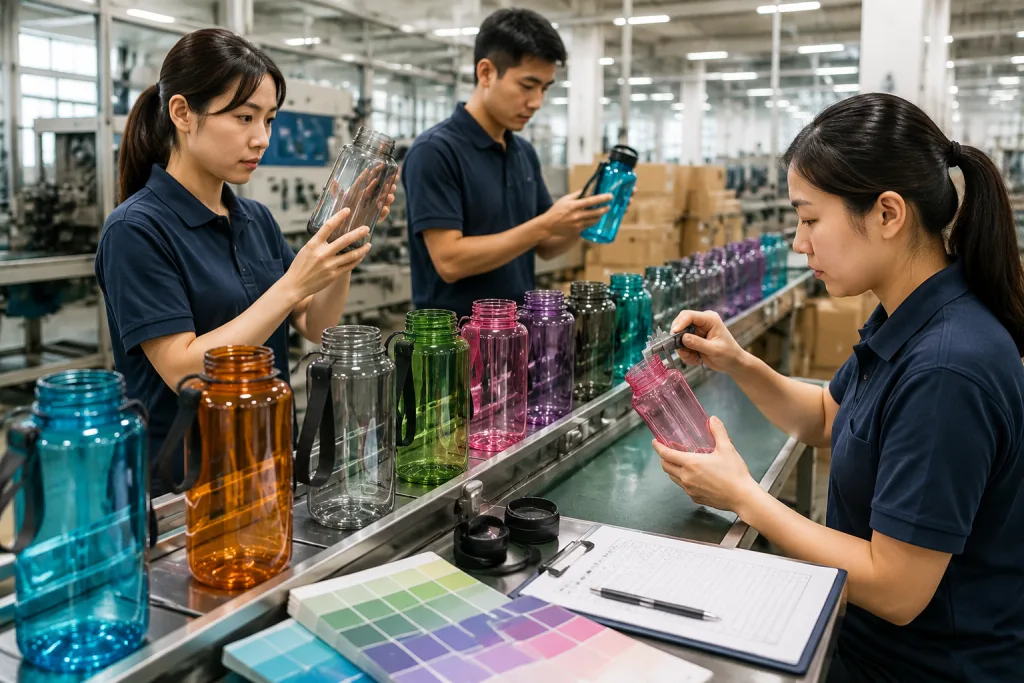
Key Takeaways
- Set Pantone tolerance at Delta E 1.5-2.0 for most transparent Tritan colors
- Typical MOQ is 3,000 units per color for standard molds and 10,000 units for custom tooling
- Approved pre-production samples usually take 7-12 days after artwork and Pantone code confirmation
- Use AQL 2.5 major / 4.0 minor with 100% leak testing for bulk drinkware orders
A tritan bottle custom Pantone order looks simple until you ask 3 canteen suppliers for quotes and get 3 different resin grades, 2 cap structures, loose packing notes, and lead times of 12 days vs 18 days. Unit price is the wrong question to ask first. Last month QC pulled a 650 ml Tritan sample under the D65 light box and the body read Delta E 1.8 against Pantone 2975 C; the buyer flagged it because their retail set limit was 1.0. The costly parts sit in the details: mold condition at the parting line, masterbatch ratio in grams per kg, logo process, 24-hour leak test, 5-ply carton strength, and whether the line can repeat the same blue after 6 months.
We manufacture custom drinkware in Hangzhou, Zhejiang, and we see the same mistakes from B2B buyers in Europe and North America about 20 times a quarter. Put the boring items in writing before money moves: RFQ bottle capacity in ml, approved Pantone code, cap drawing, logo size in mm, packing method, sample approval standard, bulk PO wording. Small stuff matters. We once had a PO typo that said “Pantone 186 U” while the artwork showed “Pantone 186 C”; production stopped for half a day because the math doesn't work when the resin color and print ink follow different books.
Start With A Usable RFQ
Your RFQ needs to describe the bottle on the table, not the market slide your team used in the meeting. If the cap, resin, carton, and logo stay “open,” a canteen manufacturer in China can quote 8–12% lower by changing small parts you will notice later. The quote is not fake. It is just not safe for purchasing; we have seen this go sideways when QC pulled the pre-shipment sample and the cap gasket was 1.2 mm thinner than the approved sample.
For a tritan bottle custom Pantone RFQ, include capacity in ml and oz, body diameter in mm, height limit, target weight in grams, lid type, mouth diameter, carry loop material, and whether the body is transparent, translucent, or opaque. Tritan works well for sports bottles and school bottles because it is BPA-free, impact resistant, and clearer than cheaper copolyesters; for a lightweight custom canteen program, it also keeps freight math under control when a 750 ml bottle stays near 145 g instead of drifting to 170 g. Ask the canteen factory to state the exact resin grade or approved equivalent, not “Tritan style.” That wording is where the math doesn’t work. On our line, we check the first shot with a digital caliper and a 0.01 g scale before Pantone matching starts.
Your first PO-related line items should look like this. Short is fine. Vague is not.
- Product: 750 ml Tritan sports canteen, standard mold BF-T750 or buyer-approved equivalent, with height tolerance called out before tooling review.
- Color: Body Pantone 2995 C translucent blue, cap Pantone Black C, Delta E target 2.0, checked under a D65 light box instead of office lighting.
- Logo: 1-color silk screen, 55 mm wide, position opposite volume scale, with artwork file name and print direction confirmed on the PO.
- Packing: 1 pc/polybag, 24 pcs/export carton, 5-ply carton, drop test requested, carton mark layout approved before mass packing.
- Compliance: EU food contact, LFGB or FDA as market requires, REACH for surface coating if used, with test sample color matching the shipped color.
At BottleForge Industrial in Zhejiang, our standard Tritan bottle MOQ is 3,000 units per color, with monthly output around 480,000 plastic and metal drinkware units across active lines. We ship better when the buyer sends hard specs first; one PO last year wrote “Pantone 2995” but forgot the C, and the buyer flagged it after our lab dip was already mixed. A serious canteen supplier should give you hard numbers before you spend time on artwork: MOQ, sample lead time, mass production days, carton size, and expected defect standard such as AQL 2.5.
Lock Pantone Before Pricing
Pantone matching on Tritan is not ink on a coated paper card. The color shifts with 1.8 mm wall thickness, resin clarity, masterbatch dosage, mold texture, and fill level. We check it with a light box, not by eye at the packing table. A transparent bottle with 1.8 mm wall thickness reads one way on the flat grip panel, darker on the curved shoulder, and heavier at the reinforced base where the material stacks up to about 3.2 mm.
If you need a tritan bottle custom Pantone color, tell the factory the exact part you want matched: bottle body only, or body plus cap set. The buyer flagged this on a 5,000 pcs order last spring because the body was Tritan, the lid was PP, the gasket was silicone, and the straw was PE. Same Pantone code. Four different results. A decent canteen vendor should say this before quoting, not promise “100% match” and then fight over the golden sample after QC pulled the sample.
At quotation stage, use tolerances that the line can hold. For opaque PP caps, Delta E 1.5 is possible on 7 out of 10 regular colors we run. For translucent Tritan, Delta E 2.0 is the safer number, especially on bright orange, neon green, or smoke gray because the resin itself changes the read. If your brand book asks for Delta E 1.0 on a clear smoke bottle, the math doesn't work without extra trials. Ask for a paid color chip before full sampling. In China, a masterbatch chip usually adds 3-5 working days and USD 60-120 per color, depending on pigment complexity.
Put the working details in the PO or sample order: Pantone code with suffix, target transparency in plain words like “30% smoke gray,” approved chip reference number, Delta E test method, approver name, and light source. D65 daylight is common. We once saw a PO typo list 7545C in the header and 7454C in the artwork note; that cost 2 days before anyone touched the mold. Do not approve color from a mobile phone photo. That is how customized drinkware programs turn into arguments instead of shipments.
Quote The Real Unit Cost
After the RFQ is locked, ask each canteen manufacturer for a split quote, not one blended number. We ask for bottle body, lid set, decoration, inner packing, master carton, testing, tooling, and FOB port as separate lines. Clean quotes lie. A single USD 1.42 looks easy for the buyer’s sheet, but last month QC pulled a Tritan sample where the supplier had priced a 0.42 mm thinner carton and no drop test. A canteen distributor filling retail shelves is not buying the same cost structure as a distributor drinkware buyer ordering 8,000 pcs for a weekend giveaway.
For a standard 650-750 ml Tritan bottle from a Zhejiang canteen factory, a workable FOB Ningbo or Shanghai price sits around USD 1.25-2.10 at 5,000-10,000 units, depending on lid parts and decoration. The lid changes the math fast. A flip lid with push-button lock, silicone seal, and carry handle uses more parts than a screw cap, and the line runs slower when workers need to fit the seal by hand with a small plastic pick. A 360-degree full-wrap print costs more than a small front logo because scrap goes up when the artwork is 1-2 mm off center. Individual kraft box packing can add USD 0.18-0.35 per unit versus bulk polybag packing.
Your sourcing comparison should include these PO line items:
- Incoterm: FOB Ningbo, FOB Shanghai, EXW Hangzhou, or DDP with ocean freight, duty, and last-mile delivery shown as separate costs.
- Payment: 30% deposit, 70% before shipment after QC pass, or LC for larger programs where the bank charges still make sense.
- Tooling: Existing mold free to use, private logo mold USD 180-450, new bottle mold quoted separately with mold steel, cavity count, and sample lead time listed.
- Decoration: Silk screen, heat transfer, laser on metal insert, or in-mold label if applicable, with print area in mm and Pantone code confirmed on the PO.
- Testing: FDA, LFGB, EU 10/2011, REACH, ASTM as requested by your sales market, with lab name and sample quantity agreed before production.
Do not force every canteen supplier to match the lowest quote unless the specification is identical. This is the wrong question to ask. Cheap resin, thin carton, and skipped inspection show up after the goods are already on the water; we have seen it go sideways when a buyer flagged cracked lids at destination and the PO still had “Trian” typed instead of Tritan.

Approve Samples Without Guesswork
Sampling is where we turn a sketch into something QC can measure. For custom canteen orders, we split samples into stock sample, color sample, logo sample, and pre-production sample because each one answers a different risk. The stock sample checks shape and hand feel; our line usually pulls it from the 2F sample room and checks mouth ID with a digital caliper. The color sample checks Pantone against a light box, not a phone photo. The logo sample checks ink edge, curing, and rub resistance. The pre-production sample checks the exact bottle, cap, gasket, logo, carton mark, and packing method that bulk production will follow.
A practical China timeline is 2-3 days for available stock samples, 5-7 days for logo samples on an existing color, and 7-12 days for custom Pantone color samples after artwork confirmation. International courier to Europe or North America usually adds 3-6 days. Fast is possible. Magic is not. If a canteen vendor promises a fully customized sample in 48 hours, ask what is being skipped: resin color matching, screen setup, leak test, or courier cutoff. We had one buyer flag this after DHL collected at 17:40 and the “48-hour sample” still had a loose silicone gasket.
Your sample PO should list quantity, cost, refundable terms, courier account, approval deadline, and the fix if the sample fails. Make it concrete: 3 pcs pre-production samples in Pantone 2995 C translucent body, 1-color silk screen logo, leak tested, sample fee USD 90, courier paid by buyer, sample fee refundable after bulk PO above 5,000 units. Put the logo size in mm and attach the artwork file name; “final logo.ai” has caused more trouble than it should. Keep one signed sample at your office and one sealed golden sample at the factory, with our QC stamp across the bag seam.
Check the boring things carefully: cap thread fit, gasket seating, drinking spout burrs, odor after 24 hours closed, logo rub resistance, carton label, barcode location, and dishwasher claim if you plan to print one. Boring saves money. QC pulled a sample last month because a 0.4 mm burr on the spout passed the first look but failed the hand wipe test. A canteen promotional program may live with a basic polybag, but retail customized canteen orders need cleaner finishing and traceable packing with the SKU, PO number, and carton count printed in the right position.
Write Bulk PO Line Items
The bulk PO is a purchasing form, but the line also reads like a work order for the line, QC table, packing bench, and export docs desk. If your PO says “customizable canteen, blue, 5,000 pcs,” the math doesn’t work. You have pushed color, logo position, carton label, and inspection calls onto the factory floor. We’ve seen this go sideways: one buyer approved a Pantone chip by WeChat photo, then QC pulled the sample under a D65 light box and the cap looked 1 shade darker than the bottle.
For a tritan bottle custom Pantone bulk PO, write the item code, approved sample date, Pantone details, resin requirement, capacity tolerance, weight tolerance, logo artwork file name, print size, packing method, carton marks, inspection standard, shipping mark, and document requirements as separate lines. Don’t bury them in email. If you sell through marketplaces, add FNSKU or barcode rules before mass packing starts, including label size in mm and scan position on the polybag or color box. Relabeling 5,000 bottles after carton sealing is slow and expensive; last quarter we had 42 cartons reopened because the PO showed “FNSKU” but the attachment file name had a typo.
Use firm but fair tolerances. Capacity may be 750 ml plus or minus 5%. Bottle weight may be plus or minus 5 g on a standard mold. Wall thickness may range from 1.6-2.2 mm depending on bottle geometry, but the factory should confirm the critical thin areas during trial production with a digital thickness gauge, not by eye. For decoration, define acceptable logo position shift, often within 1.5-2.0 mm for silk screen on round bottles. A buyer once flagged a 3 mm drift near the curve of a sports cap, and he was right to push back because the approved sample had the logo centered on the front rib.
Quality terms should be explicit: AQL 2.5 major / 4.0 minor, critical defects zero, 100% leak testing before packing, random carton drop test, and buyer right to third-party inspection before balance payment. This is normal B2B practice, not distrust. We run leak testing with water at the packing line, then QC pulls sealed cartons for a 76 cm drop test when the export carton is under 15 kg. Canteen manufacturers that export regularly from Zhejiang or other China production hubs already understand this language, and a serious supplier will prefer clear PO wording over 18 back-and-forth messages after production has started.
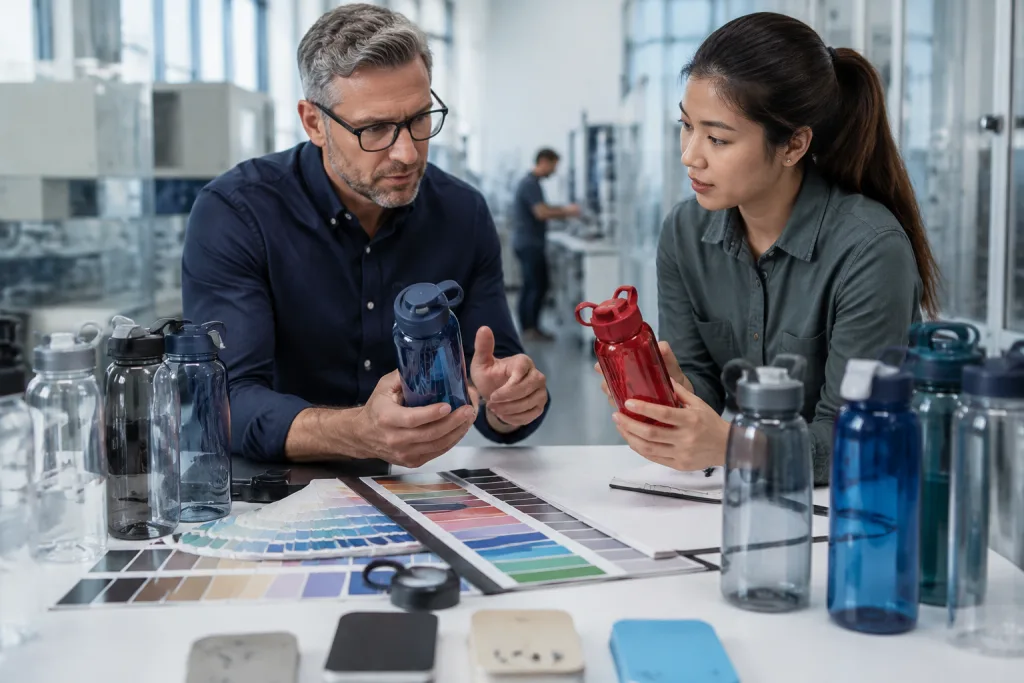
Control Production And Shipment
After deposit, we issue the production schedule within 24 hours, and the dates must match the PO. For standard mold Tritan bottles, bulk lead time is usually 25-35 days after sample approval and deposit. Add 5-10 days if the Pantone masterbatch needs a second lab dip, if the gift box has EVA insert work, or if the order mixes custom growler and customizable growler items in one container. We had one PO last month with “PMS 3125C” typed as “PMS 3215C”; QC pulled the color chip before material mixing, which saved a 6,000 pcs batch from going sideways.
Ask for these checkpoints: incoming material confirmation, first-off production photos, and mid-production status. First-off photos should show body color under a D65 light box, cap assembly, logo placement measured from the bottle shoulder in mm, carton packing, and leak test setup. For large distributor canteen or distributor growler programs, request an inline inspection when 20-30% of goods are finished. Final inspection should happen when 80-100% is produced and at least 80% packed. The wrong question is “can you ship early?” Ask which line is booked and how many cavities are running.
Shipment planning matters because plastic bottles eat container space. A 750 ml Tritan bottle packed 24 pcs/carton may have a carton size around 48 x 36 x 55 cm and gross weight near 9-11 kg, depending on design. That means freight cost can change the landed price more than a USD 0.03 factory discount. We ship some 40HQ loads where carton bulge after drop test adds 12 cartons less than planned, so ask your canteen vendors for carton dimensions at quotation stage, not after production. The math does not work if the buyer only compares unit price.
For export documents, confirm commercial invoice, packing list, bill of lading, certificate of origin if needed, test reports, and any retailer-specific forms. If you use FOB Ningbo, your forwarder controls the main freight. If you ask for DDP to the US or EU, require a written breakdown of duty, customs clearance, and delivery terms. Some canteen distributors prefer DDP for convenience, but FOB is cleaner for repeat orders once volume grows. We have seen DDP quotes hide USD 420 “remote delivery” charges after sailing; get the terms written before the booking sheet is released.
Send Your Pantone Tritan Bottle RFQ Today
Share capacity, Pantone code, logo artwork, MOQ, and target market. We will return a practical quote with sample timing and QC notes.
Frequently asked questions
What MOQ should I expect for a tritan bottle custom Pantone order?
For an existing Tritan bottle mold, expect 3,000 units per Pantone color as a normal starting MOQ in China. Some canteen suppliers accept 1,000-2,000 units with a higher unit price or shared production color, but color control is weaker. If you need a new bottle shape, private mold, or exclusive cap design, the MOQ usually moves to 10,000 units or more because tooling setup, resin drying, injection trial, and color masterbatch waste must be absorbed. At BottleForge in Zhejiang, we quote lower MOQs only when the buyer accepts standard colors or combines several distributor drinkware SKUs in the same production window.
Can Tritan match any Pantone color exactly?
No, and a canteen manufacturer should not promise exact matching without conditions. Tritan is transparent or translucent in many bottle programs, so the perceived color changes with wall thickness, curvature, and lighting. Opaque colors are easier, but very bright, fluorescent, metallic, or deep smoke colors can be difficult. For most custom drinkware projects, Delta E 1.5-2.0 is a sensible commercial tolerance. You should approve a physical masterbatch chip or bottle color sample under D65 daylight before bulk production. If the cap is PP and the body is Tritan, both can use the same Pantone reference but may not look identical.
What should be included in the sample order?
Your sample order should include the bottle model, capacity, Pantone code, transparency level, logo process, artwork file name, packing request, sample quantity, sample fee, courier method, and approval rules. A typical pre-production sample set is 3-5 pieces and costs USD 60-150 for a standard mold custom Pantone Tritan bottle. Lead time is commonly 7-12 working days after artwork and color confirmation, plus 3-6 days courier time to Europe or North America. Ask the canteen vendor to keep one sealed golden sample at the factory. That sample becomes the production reference for color, logo position, cap fit, and packing.
Which compliance tests do B2B buyers usually request?
For the US market, buyers often ask for FDA food contact compliance and sometimes ASTM-related safety checks depending on sales channel and user age group. For the EU, common requests include EU 10/2011 for plastic food contact, LFGB for Germany, and REACH for coatings, inks, or restricted substances. If the bottle is for children, discuss small parts, strap safety, and age grading early. Testing cost depends on scope, but a focused food contact test may run USD 250-600 per material or color family. Put the exact test standard and report language in the PO, especially if you are a canteen distributor serving retailers.
How do I compare quotes from different canteen vendors fairly?
Normalize every quote before choosing a canteen supplier. Compare resin grade, bottle weight, wall thickness, cap structure, logo method, packing, MOQ, lead time, Incoterm, payment term, tooling ownership, testing cost, and inspection standard. A USD 1.35 quote with thin carton and no test report may be more expensive than a USD 1.48 quote with 5-ply export carton, FDA report, and 100% leak testing. Ask each canteen factory to quote FOB Ningbo or FOB Shanghai and provide carton dimensions. For bulky customized drinkware, freight can add more landed cost than small unit-price differences.