Key Takeaways
- Set custom Tritan color MOQ at 3,000 pcs per color for stable resin batching
- Approve color by physical chip, not only Pantone code on email
- Write PO line items for bottle body, lid, gasket, logo, carton, and spare parts
- Allow 7-10 days for color sample and 30-40 days for bulk after approval
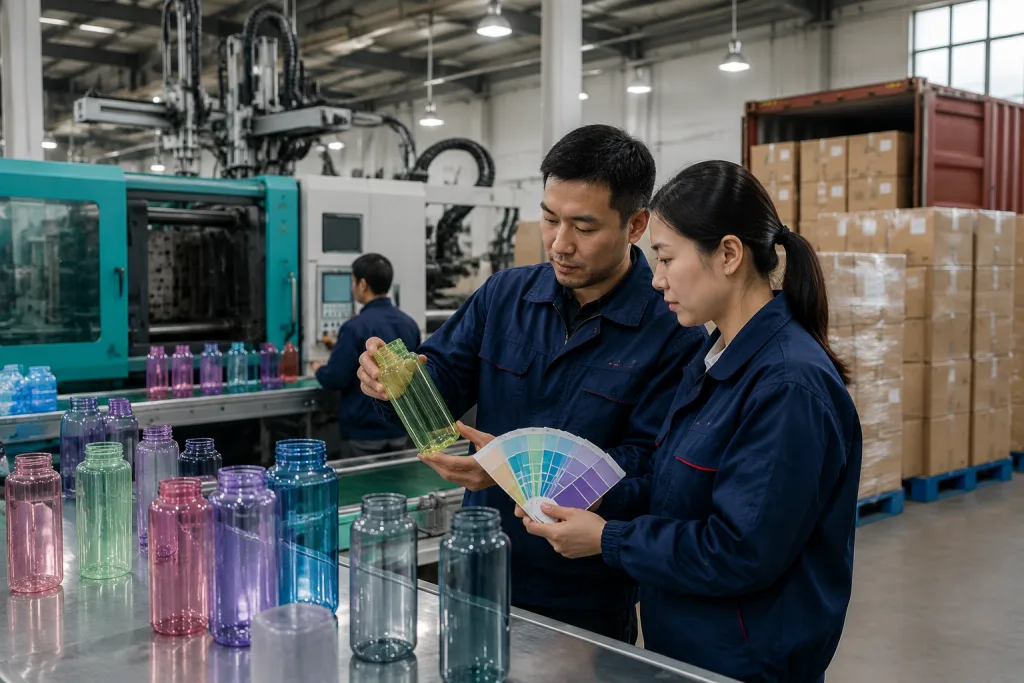
A tritan bottle custom color project looks simple until the first lab dip misses your brand guide by ΔE 1.8, the cap looks darker after torque assembly, or the carton mark sends 3,000 pcs to the wrong distributor bay. “What Pantone can you make?” is the wrong question to ask. Color drives resin ordering and MOQ; it changes mold scheduling, logo contrast, QC tolerances, and food-contact paperwork when the masterbatch supplier changes. QC pulled one 750 ml sample under a D65 light box last month, and the body passed while the PP lid failed against the same Pantone chip.
We manufacture custom drinkware in Hangzhou, Zhejiang, and we see buyers lose 5 to 12 days because the RFQ says “blue bottle” with no chip, no finish, and no approval method. If you want a canteen customized for retail shelf programs or distributor promo orders, treat color as an engineering line item, not decoration. We run it in this order: RFQ with Pantone code and surface finish, quotation with color MOQ, sample sign-off, PO check, production, AQL 2.5 inspection, and shipment. Small detail, big pain: one PO typo changed “matte smoke gray” to “smoke grey,” and the buyer flagged it after cartons were already printed.
Start With A Color-Specific RFQ
Your RFQ should not say “blue Tritan bottle with logo.” We saw one buyer get 3 blues from 3 suppliers: one close to Pantone 2935 C, one almost royal blue, one with a gray cast after drying at 80°C for 4 hours. No clean comparison. A usable tritan bottle custom color RFQ separates the bottle spec from the resin color, logo method, packing, test standard, and shipment term.
For the bottle body, specify Tritan copolyester, capacity, wall thickness, lid style, straw option, leak-proof requirement, and stock mold or private mold. For a stock 650 ml sports bottle, a normal wall is around 1.8-2.2 mm; our caliper check at the shoulder usually reads 2.0 mm on mold BFT-T650. If you ask for a 1.2 mm wall to save USD 0.08, the math doesn't work for retail. The bottle will feel thin.
For color, send a physical Pantone chip, RAL chip, or approved brand color plaque if possible. Digital Pantone references are fine for the first quote, but monitors lie; QC pulled one sample last month that looked correct on the buyer’s PDF and failed beside the paper chip under the D65 light box. For transparent colors, state clear tint, smoky translucent, frosted translucent, or solid opaque, then add a target sample if you have one. Tritan does not behave like PP or stainless steel, so the same Pantone formula will not match across materials.
Your RFQ should include these PO-style fields from day one; we have seen this go sideways when the PO says “match approved sample” but the approved sample code has a typo:
- Item: 650 ml Tritan bottle, stock mold BFT-T650
- Body color: Pantone 2935 C translucent, physical chip required
- Lid color: PP Pantone Cool Gray 9 C solid
- Logo: 1-color silkscreen, 60 mm x 35 mm
- Packaging: 1 pc/polybag, 24 pcs/export carton
- Compliance: LFGB or FDA food contact, REACH SVHC statement if shipping to EU
- Incoterm: FOB Ningbo or FOB Shanghai
This detail lets a canteen manufacturer quote the real job, not a catalog guess. It also filters out vendors who cannot run custom resin color on the line, because they will push back on the chip, the MOQ, or the pre-production sample right away.
Price The Real Configuration
After the RFQ is locked, build the quote from actual parts, not one loose unit price. For a 650-750 ml Tritan bottle in a common stock mold, we would usually quote FOB China around USD 1.35-2.20 at 3,000-10,000 pcs, based on the lid structure, logo process, packing style, and test scope. The lid matters. A flip lid with a silicone button, PP hinge pin, and carry loop costs more than a plain screw cap; our costing sheet usually shows 4-7 separate lid parts before assembly. A gift box can add USD 0.18-0.45 per unit before freight, and QC pulled one sample last month because the E-flute box crushed at 8.6 kg on the compression tester.
Custom color changes the math. The resin supplier has a minimum batch, the injection line needs purging time, and rejected color parts are hard to reuse without making the next batch muddy. At our Zhejiang facility, we usually set MOQ at 3,000 pcs per custom Tritan body color and 5,000 pcs if you want two matching plastic parts in exact custom colors. Monthly output is about 450,000 plastic and stainless drinkware units across mixed models, but the color line is scheduled by resin batch, dryer time, and injection machine tonnage. Not optimism. We run 160T and 220T machines for most bottle bodies, and a buyer once flagged a 1.5 Delta E color gap after asking us to “match close enough”; that is the wrong question to ask if the bottle sits next to a Pantone-coded retail display.
Your quotation should read like a future PO:
- Unit price: Tritan body, lid, gasket, strap, and standard packing, with the cap structure named clearly
- Color fee: masterbatch development or resin surcharge, including the minimum resin batch if the color is not from stock
- Logo cost: silkscreen setup, laser plate, or heat-transfer film, with print size in mm so nobody argues later
- Sample fee: usually USD 80-150 for color and logo samples, before courier charge
- Testing fee: third-party LFGB, FDA, REACH, or ASTM if requested, with the report holder named
- Tooling: only if the custom canteen requires private mold changes, such as a new strap slot or 0.8 mm logo emboss
If you are buying as a canteen distributor or distributor canteen program, ask for tiered pricing at 3,000, 5,000, 10,000, and 20,000 pcs. It gives you space to quote retailers without making the factory guess your volume. We’ve seen this go sideways: one PO said “assorted blue,” the artwork file said Pantone 2925C, and the buyer expected three carton marks for the same SKU.
Approve Samples Without Guesswork
The sample stage is where 6 out of 10 customized drinkware delays start. We’ve seen this go sideways: the buyer approves a phone photo, the line runs bulk, and QC pulls cartons that look two shades darker under a 6500K warehouse lamp. Do not approve custom color from a photo unless the color does not affect sell-through and the order is only 1,000-3,000 pcs for a short promo.
For a tritan bottle custom color project, request two sample rounds if the calendar has room. First, ask for a color plaque or injected bottle body without logo, measured beside your Pantone chip on a D65 light box. Second, approve a full assembled pre-production sample with lid, silicone gasket, logo, PE bag, barcode label, and carton mark. A color plaque usually takes 5-7 days after receiving the chip. A full assembled sample normally takes 7-10 days if the mold exists and components are in stock; if the buyer changes the cap color after sample sign-off, the math often moves from 12 days to 18 days.
Your sample approval sheet should include:
- Body color: approved against physical chip under D65 light, not a WeChat photo from the injection room
- Transparency: acceptable haze level and tint depth checked on a filled bottle and an empty bottle
- Lid fit: leak test after 30 minutes inverted with water, with the gasket seated by hand before testing
- Logo position: tolerance within +/-2 mm, measured from the bottle seam or fixed mold line
- Logo durability: 3M tape pull and 50 rubs with wet cloth after 24 hours curing
- Packing: barcode, FNSKU if Amazon FBA, carton drop requirement, and carton mark spelling matched to the PO
If your program includes canteen promotional products, you may accept a wider color tolerance, for example Delta E below 3.0. For a retail shelf program where bottles sit beside brand packaging, this is the wrong question to ask; approve physical upper and lower limit samples instead of arguing about a screen color. A serious canteen factory will keep one signed sample in China and send one to you, with both samples sealed in a zip bag and tagged by PO number. That avoids arguments later when QC pulled the sample and the buyer flagged “too smoky” on a transparent grey body.

Write The PO Like A Checklist
A purchase order should protect both sides. “5,000 pcs customized canteen, blue, logo” does not. We have seen that line turn into three different blues on the line: body matched to Pantone, lid guessed from a phone photo, gasket pulled from stock. Write every visible part and every working part as its own PO line.
A clean PO for a customizable canteen or customized canteen should spell out the product code and capacity first, then the material, each color part, logo method, artwork version, packaging, carton size, test requirements, inspection standard, payment terms, shipment term, and delivery date. If you buy from 3 canteen manufacturers, keep one PO structure for all of them. It makes the quotes easier to compare, and it stops the handover mistake we still see too often: sales writes “blue lid,” production reads “blue body,” and QC pulls the sample only after 1,200 pcs are already assembled.
Example PO line items, written the way our merchandiser wants to see them before we run a pre-production sample:
- Product: BFT-T750 Tritan sports bottle, 750 ml, stock mold
- Material: Eastman Tritan or equivalent copolyester, BPA-free declaration required
- Body: translucent Pantone 320 C, approved sample dated May 12, color checked under D65 light box
- Lid: black PP flip lid with silicone seal, leak-proof, 100% air-pressure check on the first 50 pcs
- Logo: white silkscreen, artwork file V3, print area 70 mm x 40 mm, position tolerance within 2 mm
- Packaging: 1 pc kraft box, 24 pcs/master carton, carton mark per file CM-02
- Inspection: AQL 2.5 major, 4.0 minor, critical defects not accepted
- Shipment: FOB Ningbo, latest vessel closing June 28
For payment, 8 out of 10 China factories we deal with still ask for 30% deposit and 70% balance before shipment on first orders. If you are an established distributor growler or distributor drinkware buyer with repeated orders, talk credit terms after 2 or 3 clean shipments. Do not write “same as sample” by itself. That is the wrong shortcut. Use the sample ID, date, and signed photo; one buyer once sent us a PO with “same as sampel,” and the typo was harmless, but the missing sample number delayed approval by 4 days.
Control Bulk Production Early
Bulk production is the wrong time to find the cap insert is half a Pantone shade away from the bottle body. Before mass injection starts, ask your canteen supplier for the line schedule and first-article sign-off. We run the first 20-50 pcs, lay them beside the approved color chip under a D65 light box, then check flash, black dots, shrink marks, wall thickness, lid fit, and logo adhesion before the full batch opens up.
For custom Tritan color, control starts with resin and masterbatch, not with the finished bottle. The factory should record batch number, mixing ratio, drying temperature, and machine setting on the injection sheet; last month QC pulled one sample where the PO said 2.0% blue masterbatch, but the hopper tag showed 1.8%. Tritan resin is hygroscopic, so drying is not optional. Bad drying gives you bubbles, silver streaks, and weak transparency. A normal drying condition is around 80-90°C for 4-6 hours, based on resin supplier guidance and our moisture meter reading before the material enters the hopper.
During production, ask for process photos, but do not treat them as QC. Photos prove the line is running; they do not prove the bottle passes inspection. We’ve seen this go sideways when a buyer accepted WeChat photos, then flagged 3 cartons with loose flip lids after arrival. Useful production checkpoints include:
- Injection start: first-article approval against the physical sample, with color checked under a D65 light box
- Mid-production: random check every 2 hours for color drift and lid assembly torque
- Logo printing: 3M tape adhesion test and position check every 500-1,000 pcs
- Leak test: sample from each assembly shift, filled to the marked capacity and inverted for 30 minutes
- Packing: barcode scan test before cartons are sealed, including one master carton from each packing table
A canteen vendor who says “QC checks everything at the end” is asking you to pay for their laziness. End inspection catches defects; it does not stop them. In Zhejiang, our production team issues inline QC reports during injection, printing, assembly, and packing, because reworking 10,000 packed bottles means cutting tape, replacing polybags, re-scanning barcodes, and losing 2-3 days on the shipment.

Inspect Before Balance Payment
Inspect after production is 100% finished and at least 80% packed. For rush orders, we sometimes let SGS or the buyer’s QC come in at 80% finished, with 48 cartons still open on the line, but the risk is real: the last 20% has not passed leak test or color sorting yet. For a normal B2B custom Tritan bottle order, use AQL standards with clear defect classes. A common setting is AQL 0 for critical, 2.5 for major, and 4.0 for minor defects.
Critical defects include sharp edges on the mouth ring, unsafe material, broken parts, serious leakage, or wrong compliance marking. Major defects include color outside the approved tolerance, logo misprint, loose lid, heavy scratches, incorrect barcode, or carton quantity error; last month QC pulled a sample where the Pantone color was close under office light but failed under the D65 light box. Minor defects include small flow marks, light scuffs, or slight print position variation within agreed tolerance.
Your inspection checklist should match the PO, not the sales chat. We have seen this go sideways when the buyer approved “matte smoke gray” by email, while the PO said “transparent gray”; the final argument was over 0.8 mm logo placement and nobody wanted to own it.
- Quantity: carton count and unit count, checked against the packing list before sealing the last 30 cartons
- Color: compare to approved signed sample under a D65 light box, not an email image on a phone screen
- Function: leak test, lid open-close cycle for 20 cycles, handle pull check with the agreed kg load
- Decoration: logo size in mm, placement from bottle base, adhesion after 3M tape test, and ink color
- Packing: inner box, barcode, FNSKU, carton mark, pallet label, with one scanned carton from each pallet
- Documentation: packing list, commercial invoice, test reports, COO if needed, and the PO number typed exactly as issued
If you source from 3 canteen distributors or 12 canteen suppliers, use one inspection template across all orders. The data finally means something. After inspection passes, release balance payment and book shipment; if it fails, require a corrective action plan with re-inspection scope, because “we will check again” is not a plan. We run re-checks by defect type, carton range, and production date, not by hope.
Ship With Retail Reality In Mind
Shipping is where a clean production run can still turn into a warehouse complaint. We have shipped custom Tritan bottle orders that passed AQL 2.5, then the buyer flagged crushed master cartons after a 1.8 m pallet stack sat under mixed cargo. Barcodes are another trap. QC pulled one retail carton last April where the EAN scanned on our Zebra DS2208, but failed after the gloss label wrinkled around a curved bottle body.
For sea freight from China, FOB Ningbo or FOB Shanghai is common for our Hangzhou, Zhejiang location. Transit to the US West Coast is often 18-25 days port to port; to major North Europe ports, 30-40 days is more realistic. Add 3-7 days for trucking, customs clearance, and your warehouse receiving slot if the forwarder books smoothly. Air freight works for urgent promotional launches, but it can add USD 1.50-3.50 per bottle depending on volume and season. On low-price canteen promotional orders, the math doesn't work. Last peak season, one buyer asked us to air 6,000 pcs after a PO color typo changed “smoke gray” to “smoky green”; freight cost more than the bottle margin.
Your final PO and shipping file should cover:
- Carton strength: 5-layer export carton, often 170-200 lb burst strength equivalent; we run a drop check on packed cartons before mass packing
- Carton weight: keep below 15 kg if manual handling is expected, especially for club-store or 3PL receiving teams
- Marks: SKU, color code, PO number, quantity, country of origin; print at least two carton sides so warehouse staff do not cut every box open
- Retail prep: barcode, warning label, hangtag, care card, FNSKU if needed; scan the barcode from the packed unit, not just the PDF artwork
- Palletization: pallet size, height limit, corner protection, stretch wrap; tell us if your DC rejects pallets over 1.6 m
The same discipline applies if your wider program includes a custom growler, customizable growler, customized growler, or distributor growler line. Color, packaging, compliance, and warehouse handling must be written before production starts. A good canteen manufacturer will push you for these details early. It feels annoying. Still, we've seen this go sideways: 48 cartons relabeled by hand at destination because the buyer sent the FNSKU file 2 days after the line finished packing.
Send Your Tritan Color RFQ For Review
Share Pantone target, quantity, logo file, packaging, and destination. We will return a practical MOQ, sample plan, and FOB China quote.
Frequently asked questions
What MOQ should I expect for a Tritan bottle custom color order?
For most stock-mold Tritan bottles, expect 3,000 pcs per custom body color as a practical MOQ. If the lid, straw, strap, or silicone parts also need exact custom colors, 5,000 pcs is more realistic because each material has its own batching requirement. For a first test order, some canteen suppliers may offer 1,000-2,000 pcs using existing colors, but not true resin-matched color. Private mold projects are different; 10,000 pcs per color is common because tooling, resin setup, and production risk are higher. If you are a canteen distributor building a range, reduce complexity: one bottle body color with two standard lid colors is usually easier and cheaper than four fully custom combinations.
Can you match Pantone exactly on transparent Tritan?
Not exactly in the way paper printing matches Pantone. Tritan is a transparent plastic, so wall thickness, surface texture, resin clarity, and lighting all change the perceived color. A Pantone code is a target, not a guarantee. For transparent Tritan, we recommend approving a physical injected sample and defining an acceptable tolerance, often Delta E under 2.0-3.0 depending on the brand requirement. If the bottle has uneven wall thickness, the shoulder and base may look darker than the side wall. That is normal physics, not necessarily bad production. For strict retail programs, approve two limit samples: one slightly lighter and one slightly darker. Then bulk inspection has a real reference.
How long does sampling and bulk production take?
For a stock-mold tritan bottle custom color project, color sample development usually takes 5-7 days after we receive your Pantone chip or physical standard. A full pre-production sample with logo and packaging normally takes 7-10 days. Bulk lead time is usually 30-40 days after sample approval and deposit, assuming 3,000-20,000 pcs and no unusual packaging. Add 3-7 days if third-party LFGB, FDA, REACH, or ASTM testing is required before shipment. During peak China export seasons, especially before major holidays, add another 7-14 days of buffer. If your launch date is fixed, lock the color first; late color approval is the most common reason bulk delivery slips.
Which logo method works best on colored Tritan bottles?
For most customized drinkware orders, 1-color or 2-color silkscreen is the most economical choice, usually with a setup charge around USD 40-80 per color and a low unit cost. It works well on smooth Tritan surfaces if the ink system and curing are correct. Heat transfer is better for complex multicolor artwork, but it costs more and needs careful adhesion testing. Laser engraving is not normally the best choice on transparent Tritan because contrast is weak compared with stainless steel. For dark translucent bottles, use white or light ink and test logo visibility after filling the bottle with water. Always run a tape pull test and wet rub test before approving bulk.
What compliance documents should a European or North American buyer request?
For Europe, request LFGB food-contact testing or EU food-contact declaration, plus REACH SVHC documentation where relevant. For the United States, FDA food-contact compliance is the basic requirement, and California Proposition 65 may apply depending on your sales channel. If the product is for children, ask about CPSIA, ASTM, and small-parts risk based on the design. For Canada, confirm applicable food-contact and labeling requirements with your importer. Documents should match the actual material and supplier batch, not a random old test report from another model. A responsible canteen factory in China can provide material declarations, BPA-free statements, and third-party reports, but you should specify the required standard in the PO.