
Key Takeaways
- For tritan bottle bulk, confirm resin grade, wall thickness around 1.8-2.5 mm, and actual impact testing before price approval
- Typical MOQ is 3,000 units per color for existing molds and 10,000+ units for custom bottle shapes
- AQL 2.5/4.0 inspection, REACH/LFGB/FDA checks, and carton drop tests should be written into the purchase order
- FOB China pricing can move 8-18% depending on lid complexity, logo method, carton spec, and color matching
Buying tritan bottle bulk looks easy until the first quote sheet hits your inbox. Supplier A writes “BPA-free plastic,” Supplier B writes “Eastman Tritan TX1001,” and Supplier C sends a low FOB price but leaves out resin grade, 1.8 mm wall thickness, carton drop test, and AQL terms. We’ve seen this go sideways: QC pulled a 750 ml sample last month, checked it with a digital caliper, and the side wall was 1.35 mm against a 1.6 mm drawing. The math doesn’t work if you compare those three quotes as the same bottle.
At BottleForge Industrial in Hangzhou, Zhejiang, we run this check every week for brand owners moving from stainless steel into lighter drinkware bulk programs, often starting with a 3,000 pcs MOQ trial order. This guide treats the bottle like a working spec sheet, line by line, so you can ask sharper questions before paying for molds, logos, cartons, and compliance testing in China. Small details matter. A buyer once flagged a PO typo that changed “clear lid” to “clear body,” and the line stopped for 2 hours while sales, molding, and packing confirmed the artwork file.
Start With Resin Grade
The first spec line for tritan bottle bulk should not be capacity or logo. It should be resin. Tritan is a copolyester, but buyers use the word loosely; we have seen 4 quote sheets in one week call generic clear plastic “Tritan.” Bad start. If you sell in Europe or North America, ask for the resin brand, exact grade, supplier invoice traceability, and food-contact declarations before you fight over the last USD 0.03. On our line, QC checks the resin bag label against the PO before drying pellets at 80°C.
For sports and lifestyle bottles, we run Tritan grades chosen for clarity, dishwasher resistance, and impact strength. The factory should show a resin purchase record tied to your production batch, not just a clean-looking PDF. If the supplier refuses, assume the material might be switched. In China, substitution usually does not happen because the factory is evil; it happens because the buyer wrote “BPA-free bottle” on the PO, left out the grade, then pushed the MOQ from 5,000 pcs to 3,000 pcs and still asked for the old price.
The buyer impact is simple. Real Tritan costs more than commodity PETG or PC-like alternatives, but it gives better drop resistance, lower odor complaints, and stronger retail confidence. We have seen this go sideways: QC pulled the sample after a 1.2 m drop test and the cap survived, but the body cracked because the “Tritan” was not the grade quoted. For wholesale drinkware programs, returns are not just product cost. They become chargebacks, customer service hours, and a buyer asking why the compliance file has a missing resin invoice.
- Ask for: resin grade with brand name, BPA-free declaration, FDA 21 CFR or EU food-contact statement, plus batch traceability matched to the production lot.
- Watch for: quotes that say “Tritan material” but cannot name the resin grade or show the resin bag photo from the warehouse.
- Buyer impact: cleaner compliance files, fewer third-party testing surprises, and less back-and-forth when the retailer audits the order.
Capacity Is Not Just Volume
Capacity looks like the easy line on the spec sheet: 500 ml, 650 ml, 750 ml, 1 L. It is not. On the line, that one number changes the blow mold, carton cube, freight cost, hand feel, lid torque, and how the bottle sits on a 285 mm retail shelf. A 750 ml bottle works for a gym brand, but we have seen a school buyer reject the same height because it would not fit a lunch bag pocket. A 1 L bottle looks strong in photos, then the math gets ugly when a 12 kg master carton jumps from 0.068 CBM to 0.091 CBM.
For tritan bottle bulk orders, existing molds usually cover the fast commercial sizes: 500 ml, 600 ml, 700 ml, 750 ml, and 1000 ml. If you want a bulk canteen look with a wider shoulder or military-style profile, ask for the mold number and a real sample, not just a rendering. We run this check with calipers at the neck finish and shoulder width before quoting, because a 2 mm change can mean a different lid set. Custom tooling makes sense only when the volume carries the cost. For our Zhejiang plant, a practical MOQ is 3,000 units per color for existing molds and usually 10,000-20,000 units for a new custom body, depending on mold cavities and lid design.
Do not copy capacity logic from other drinkware categories. A bulk growler or beer growler bulk program is often built around 32 oz or 64 oz fill expectations. Canteen wholesale buyers usually push us harder on carry weight, belt clip clearance, and cap tether pull strength. If you also source beer tumbler wholesale or alcohol flask wholesale bulk items, keep those specs on a separate PO; we once had a buyer flag “beer pressure test” on a tritan bottle order, and that was the wrong question to ask. Tritan bottles are not pressurized beverage containers, so do not position them like stainless beer growler wholesale bulk products unless the design and testing prove that use.
The right question is not “what capacity sells best?” Ask, “what capacity keeps this bottle usable, shippable, and compliant for my channel?” Retail wants shelf fit. Corporate gift wants hand feel and logo area. Amazon FBA cares about carton dimensions, barcode placement, and drop-test damage; QC pulled a 1000 ml sample last month because the lid scuffed through the polybag after a 76 cm drop. That answer changes between retail, corporate gift, outdoor, and Amazon FBA programs.
Wall Thickness Changes Everything
Wall thickness is where cheap quotes hide. Two bottles can both be 750 ml and look the same in a PDF, but one runs a 1.5 mm wall and the other sits at 2.2 mm. The thin one wins the first price sheet. Then QC pulls cartons after the first warehouse drop test. For tritan bottle bulk, we usually quote 1.8-2.5 mm depending on the mold shape, rib depth, bottle height, and drop target; last month a buyer pushed for 1.6 mm on a tall 900 ml body, and the math did not work.
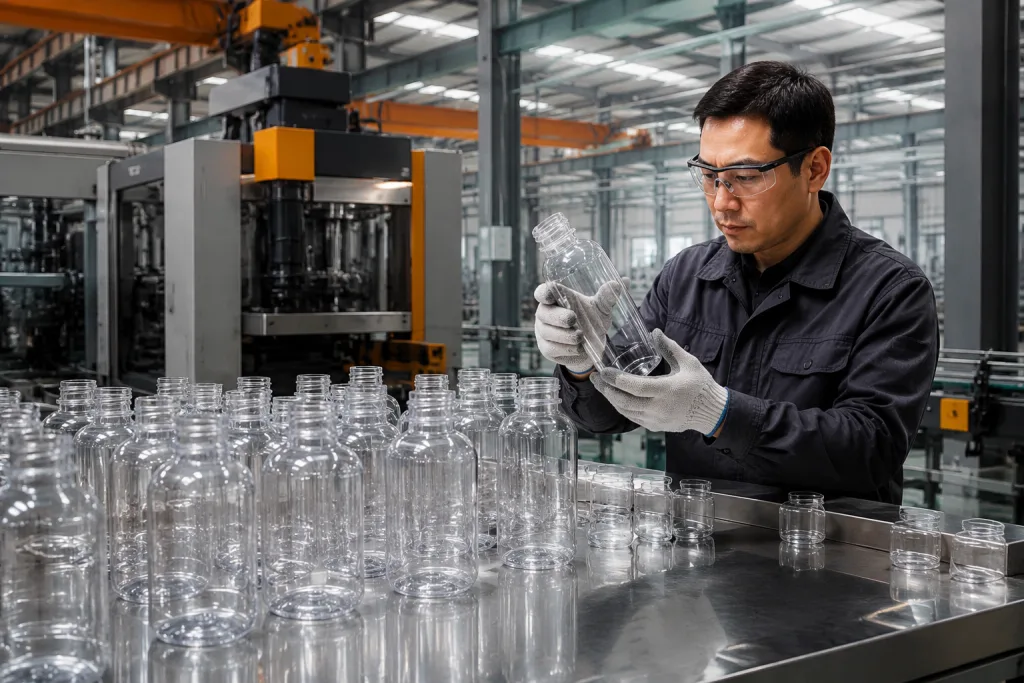
Thicker is not a magic fix. Extra Tritan can leave sink marks near the molded grip, push cycle time from 28 seconds to 34 seconds, add 12-18 g per bottle, and burn resin budget fast. Too little material gives you shoulder flex, stress whitening after impact, and loose thread feel after 3 cap-on tests with a torque meter. A capable China factory should point to the reinforcement zones on the drawing: base radius, shoulder transition, thread area, carry loop connection, and molded grip panels with their own rib layout.
For procurement, this one spec changes unit price and damage rate before it changes anything on the invoice. It also changes how the bottle feels in hand. If your brand wants the best wholesale drink bottle in a mid-market retail set, the body cannot cave in when a buyer squeezes it at a trade show. If your distributor needs sharp drinkware wholesale pricing for a 20,000 pcs promotion, accept a lighter wall, but cut the drop claim from 1.5 m to 1.0 m and write it on the PO. We have seen this go sideways when the PO only said “same as sample” and nobody listed the gram weight.
Do not approve a sample only by appearance. Weigh it, measure it, drop it, and compare it against the approved production standard.
Our check is simple. Keep one sealed golden sample, record unit weight tolerance, and test random line pieces against it with a digital scale and caliper. A 5-8% unexplained weight reduction after approval is a red flag; on a 50,000 pcs drinkware bulk order, that is not “small variation,” it is missing resin and higher claim risk.
Lid System And Leak Risk
The bottle body gets the attention; the lid brings most of the claims. On our line, 7 out of 10 sample complaints on Tritan sports bottles start at the cap: flip lid springs that feel loose, straw lids that whistle, screw caps with shallow threads, or silicone seals that sit 0.3 mm proud after washing. Nice-looking is not enough. Before approving any canteen bulk or wholesale canteen design, ask whether the lid survives school bags, gym lockers, and one-handed use.
For a standard sports bottle, we check thread engagement with a go/no-go gauge, gasket hardness with a Shore A tester, hinge pin diameter with calipers, straw fit after pull-out, vent hole size, and lock strength after repeated pressing. A lid can pass the sample-room upside-down check and still leak after 500 open-close cycles, especially after the silicone ring is removed for cleaning and pushed back by hand. If your sales copy says leakproof, this is the wrong place to trust a nice video.
A practical factory test should include a 24-hour inverted water hold, 1 m drop tests at room temperature, open-close cycling, and carton vibration on the shaker table for 2 hours. For premium programs, we also run a 60°C hot-water deformation check if end users may pour warm drinks into the bottle. Tritan takes heat better than basic PET, but the lid may mix PP shell parts, PE straw pieces, silicone rings, and small metal springs. QC pulled one sample last month because the PP button warped 0.6 mm and stopped locking.
Related sourcing categories split fast here. An alcohol flask in bulk uses a tighter seal path and usually fewer moving parts than a hydration bottle; beer tumbler in bulk orders often use splash-resistant slider lids, not true leakproof lids. A bulk growler for beer needs closure performance for pressure, grip, and repeated fridge use. We have seen this go sideways when a PO just says “drinkware bulk lid” and the buyer later flags leakage after a backpack test.
Buyer impact: a more complex lid can add USD 0.12-0.45 FOB per unit, depending on parts and assembly time. The math works for retail packaging with a USD 12 shelf price, but not for a giveaway program at 10,000 pcs MOQ where a simple screw cap leaks less and keeps packing speed at 38 cartons per hour. Fancy lids sell in photos. Simple lids survive abuse.
Logo Method And Color Tolerance
Brand owners usually ask about the logo before they ask about thread pitch or wall thickness. Fair enough. Still, decoration specs need to read like a drawing, not a mood board. For tritan bottle bulk, we normally quote 5 logo methods: silk screen printing, pad printing, heat transfer, UV printing, and molded embossing when the mold is open for changes. Laser engraving belongs more on 304 stainless than clear Tritan, so don’t copy the same decoration line across your bulk drinkware PO. We had one buyer send “laser logo on clear body” in column G of the PO; our sample room caught it before the CNC mold shop wasted 2 days.
Silk screen works best for 1 or 2 colors on a straight panel, usually within a 45 mm by 70 mm print window on a 650 ml bottle. Pad printing is better on curved shoulders or small cap badges. UV printing can carry richer graphics, but adhesion and scratch resistance must be checked before mass production. QC pulled the sample after 30 rubs with 3M tape on one smoky grey bottle, and the black ink lifted at the edge. Not good. For transparent or frosted bottles, ink opacity matters. A white logo on a smoky grey bottle can look premium; the same white on a clear bottle looks thin unless we run a denser ink layer.
Color matching is the part buyers underestimate. If you request a Pantone cap, a translucent body, and a printed logo, those 3 parts come from different materials and processes. A PP cap will not visually match a Tritan body exactly. This is the wrong question to ask if the buyer expects “same Pantone everywhere.” In Zhejiang production, we ask for approval under D65 lighting, then lock either a Delta E tolerance such as 1.5-2.0 or a signed physical swatch. A phone photo from the buyer’s office under yellow light has caused more than 10 unnecessary remake arguments on our line.
Decoration cost jumps fast. A simple one-color print may add USD 0.04-0.08 per unit. A full-wrap heat transfer can add USD 0.20-0.60 and push rejects up by 3%-6% if the bottle shape has ribs or a sharp waist. The math doesn’t work when the target FOB is USD 1.15 and the artwork asks for a 360-degree gradient wrap. We’ve seen this go sideways: the buyer approved the look, then flagged the price after we had already ordered transfer film at a 5,000 pcs MOQ.
Good purchase orders spell out logo size, position, Pantone reference, print method, adhesion test, scratch test, and approved artwork file version. Better ones also include a 1:1 PDF with the logo centerline marked in mm from the bottle base. Small detail. Big difference. That level of detail prevents arguments when the pre-shipment inspection report shows a logo sitting 4 mm higher than the buyer expected.

Compliance, Inspection, And Packaging
Compliance is not one PDF in a folder. It starts with the Tritan material declaration, then runs through injection settings, line checks, outside lab testing, final inspection, and packed-carton control. For tritan bottle bulk shipped into Europe, buyers usually ask for REACH and LFGB; EN 14350 comes up when the bottle is sold for children. For the United States, we check FDA food-contact suitability first, then ASTM or CPSIA based on the cap design and age grading. If the bottle has a straw and a cartoon print, do not treat it like a 750 ml adult gym bottle. QC pulled one kids’ straw sample last season because the silicone mouthpiece gap measured 1.8 mm wider than the approved sample on a digital caliper.
At BottleForge Industrial, our Hangzhou, Zhejiang operation can produce about 450,000 plastic and stainless drinkware units per month across mixed lines, with normal lead time of 25-35 days after deposit and sample approval for existing molds. Still, “factory has capacity” is the wrong question to ask. The better question is whether the line is locked to the approved BOM, color chip, cap torque, and packing method before mass production starts. We recommend pre-shipment inspection using AQL 2.5 for major defects and 4.0 for minor defects, with critical defects set at 0. On a recent 12,000 pcs Tritan run, QC flagged 37 bottles with light sink marks near the shoulder after the mold temperature controller drifted 6°C during night shift.
Packaging should be fixed early, not after the goods are sitting in the finished-goods area. A polybag plus white box is cheaper and faster to pack than a kraft retail box with insert card, EAN barcode, and hang tag, but the damage risk changes. We have seen this go sideways when a buyer approved the bottle sample but forgot the shelf-ready box; the line waited 3 days for revised artwork because the PO showed “matte box” and the dieline said “gloss.” Amazon FBA orders need FNSKU labels, carton weight limits below 15 kg where possible, and drop-tested master cartons. Distributor orders often work better at 24 pcs per carton because warehouse staff can lift them without splitting cartons. Retail buyers may require ISTA-style carton testing or their own vendor manual.
If you are also buying beer tumbler wholesale bulk, alcohol flask wholesale, or growler wholesale items, keep carton labeling and inspection formats aligned across categories. Your warehouse team will thank you. The product specs differ, but carton marks, PO numbers, SKU labels, and pallet rules should read the same way on every shipment. We run a carton-label check with a barcode scanner before sealing the master carton; one buyer once flagged a PO typo where “Tritan-750CL” printed as “Trian-750CL” on 86 cartons, and nobody wants that at receiving.
Pricing, MOQ, And Quote Discipline
A serious tritan bottle bulk quote needs enough detail to show where the price comes from. FOB Ningbo or FOB Shanghai pricing changes with resin grade, bottle weight in grams, lid parts, logo process, packing style, order quantity, and test standard. If a supplier sends one number with no resin code, no carton spec, and no lid drawing, that is not a quote. It is a guess. Last month QC pulled a 750 ml sample that was 18 g lighter than the approved counter sample; the price looked good until the drop test failed at the hinge.
For existing mold Tritan bottles, 6-8 China factories we track quote from roughly USD 1.10-2.80 FOB per unit for common 500-1000 ml designs, depending on the spec. Simple promo bottles with screw lids and bulk polybag packing sit near the low end. Retail bottles with flip lids, silicone boots, full-color printing, and 350 gsm gift boxes move up fast. Custom tooling can add several thousand dollars, and multi-cavity molds cost more upfront but cut cycle cost once the order reaches 20,000-30,000 pcs. We run mold quotes through the tooling room first, not the sales desk, because a 0.3 mm wall-thickness change can change both cooling time and reject rate.
MOQ is not just factory preference. It comes from resin ordering, color masterbatch, pad-print setup, carton MOQ, and line changeover time. A 1,000-unit test order may work for a stock color with no logo, but the math does not work for custom PMS color and retail packaging unless the buyer accepts a higher unit price. For canteen wholesale or wholesale growler programs, the same rule applies: lower MOQ usually means higher cost or fewer custom options. We have seen this go sideways when a PO says “blue” but the artwork file says Pantone 299C; the buyer flagged it after 12 cartons were already packed.
Quote discipline protects both sides. Send one RFQ sheet with capacity, resin, wall thickness target, lid type, logo method, packaging, compliance market, incoterm, and forecast volume. Ask suppliers to quote against that sheet only. Then compare price, not imagination. This is the wrong question to ask: “What is your best price?” A better RFQ says “700 ml, Eastman Tritan, 85 g bottle body, flip lid, 1-color logo, FDA, AQL 2.5, 3,000/10,000/30,000 pcs,” and gives the line something real to cost.
The cheapest supplier often wins the spreadsheet and loses the shipment. The better supplier explains the trade-offs before production starts, including which corner they refuse to cut.
Send Your Tritan Bottle Spec For Review
Share capacity, lid, logo, MOQ, and market requirements. We will return practical FOB China options, not a vague catalog quote.
Frequently asked questions
What MOQ should I expect for tritan bottle bulk orders?
For existing molds, a realistic MOQ is usually 3,000 units per color with logo printing. If you accept a stock color, simple cap, and bulk carton packing, some factories may support 1,000-2,000 units, but the unit price will be higher. For custom bottle bodies, expect 10,000-20,000 units because mold cost, resin planning, and production setup need volume. Custom colors also have minimum masterbatch requirements, so 500 units in five colors is inefficient. If you are testing a new wholesale drinkware SKU, start with one body shape, one lid, and two colors. That gives useful market feedback without creating a messy inventory problem.
Is Tritan better than stainless steel for wholesale drinkware?
Neither is automatically better. Tritan is lighter, transparent, impact resistant, and usually cheaper than double-wall stainless. It works well for sports bottles, school bottles, outdoor hydration, and promotional drinkware bulk programs. Stainless steel is better for vacuum insulation, premium tactile feel, and hot beverage performance. A Tritan bottle at 750 ml may land around USD 1.40-2.40 FOB depending on the lid and packaging, while a vacuum stainless bottle often costs more. If your buyer wants visible water level, low weight, and color variety, Tritan is sensible. If they need 12-24 hour thermal claims, choose stainless.
What tests should we require before shipping tritan bottles?
At minimum, require food-contact testing for your destination market, a leak test, a 1 m drop test, logo adhesion testing, and a pre-shipment inspection under AQL 2.5/4.0. For Europe, ask about REACH and LFGB. For the U.S., request FDA food-contact documentation and review CPSIA if the item is intended for children. The inspection checklist should include capacity, unit weight, color, logo position, lid function, gasket presence, odor, scratches, black spots, carton marks, and barcode scans. If the bottle is sold online, add carton drop testing because parcel handling is rougher than pallet distribution.
Can I combine tritan bottles with growler or flask items in one order?
Yes, but do not treat them as the same product family for specifications. Tritan bottles, beer growler in bulk items, beer tumbler bulk orders, and alcohol flask bulk programs use different materials, sealing systems, and compliance assumptions. You can combine them under one purchase order or container shipment to improve logistics, especially from China, but each SKU needs its own spec sheet and inspection checklist. For example, a beer growler wholesale item may need stainless steel grade confirmation and capacity marking, while a Tritan bottle needs resin traceability and plastic lid cycling. Shared carton labels and pallet rules are fine; shared performance claims are not.
How long does production usually take after sample approval?
For existing molds, normal production is 25-35 days after deposit, artwork approval, and final sample sign-off. Add 5-10 days if you need custom color matching, special packaging, or third-party lab testing before mass production. Custom tooling can add 20-45 days before the production clock starts, depending on mold complexity and revision rounds. Ocean freight to Europe or North America then adds several weeks, so work backward from your required delivery date. If you need goods for a retail reset or seasonal campaign, lock the spec sheet early. Late changes to lid color, carton layout, or logo size are common causes of missed ship dates.