Key Takeaways
- A realistic travel tumbler wholesale MOQ starts at 1,000 pcs per color for standard molds
- Double-wall 304 stainless with 0.4-0.5 mm inner wall suits most coffee programs
- Powder coating usually adds USD 0.25-0.55 per unit versus basic spray paint
- Lead time is normally 25-35 days after artwork approval for factory direct orders
A travel tumbler looks simple until you have to buy 5,000 units for a coffee launch, employee gift, or distributor catalog. Then the questions get sharp fast: 304 or 316 stainless, powder coat or spray paint, 350 ml or 600 ml, laser logo or silk screen, carton drop test or one nice product photo. On our line, QC pulled a 600 ml sample last month because the lid gap measured 0.8 mm on the feeler gauge; the buyer only wrote “same as photo” on the PO. That is where tumbler projects start to slip.
If you are sourcing travel tumbler wholesale from China, the cheapest quote is rarely the safest quote. At BottleForge Industrial in Hangzhou, Zhejiang, we see buyers lose 12 days vs 3 days on sampling because the first RFQ says only “custom coffee mug.” Not enough. You need a spec that matches how people drink, ship, wash, and brand the tumbler, including logo size in mm, carton weight limit, test standard, and MOQ by color. We’ve seen this go sideways when a buyer flags scratches after mass production, but no one agreed whether daily dishwasher marks were acceptable.
The spec table buyers should start with
When a coffee brand or corporate-gift buyer asks for a bulk coffee travel mug, color is the wrong first question. Start with the use case. A commuter mug for a café subscription box needs a lid that survives a bag tilt test; a high-polish executive gift needs clean engraving and no orange peel on the coating. Last month QC pulled 32 samples from a 1,200 pcs pilot run, and the buyer flagged the same thing we see often: the PO said “travel tumbler,” but the sample room had no note on car-cup-holder diameter.
Here is the head-to-head comparison we use before quoting a travel tumbler wholesale program, usually checked against a caliper, lid torque gauge, and the packing spec sheet:
- Coffee brand retail: 350-500 ml, double-wall vacuum, 304 stainless steel, powder coating, leak-resistant press lid, retail box, 1,000-3,000 pcs per SKU. We run a 24-hour hot-water hold check before photo samples if the brand plans shelf sales.
- Corporate gift: 450-600 ml, vacuum insulation, 304 or 316 stainless inner wall, laser engraving, premium kraft or rigid box, 500-2,000 pcs per design if using stock colors. The engraving file should state logo height in mm, not just “centered.”
- Distributor catalog: 400-700 ml, standard mold, spray paint or powder coat, silk screen logo area 50 x 70 mm, master carton packing, 3,000-10,000 pcs mixed order. We ship these by carton code, so one typo in the PO color suffix can split inventory at loading.
- Event giveaway: 300-450 ml, single or double wall, lower-cost lid, one-color logo, polybag or white box, tight 20-25 day delivery if stock body is available. If the event date is fixed, ask for stock-body photos from the warehouse rack before paying the deposit.
The travel mug buyer who gives these details gets a sharper quote. The buyer who asks for “coffee mug in bulk, best price” gets a generic answer, then finds out the lid leaks at 30 degrees, the logo scratches after 50 rubs with a 3M tape test, or the carton mark is not ready for European distribution. We’ve seen this go sideways. Cheap unit price does not fix a failed drop test.
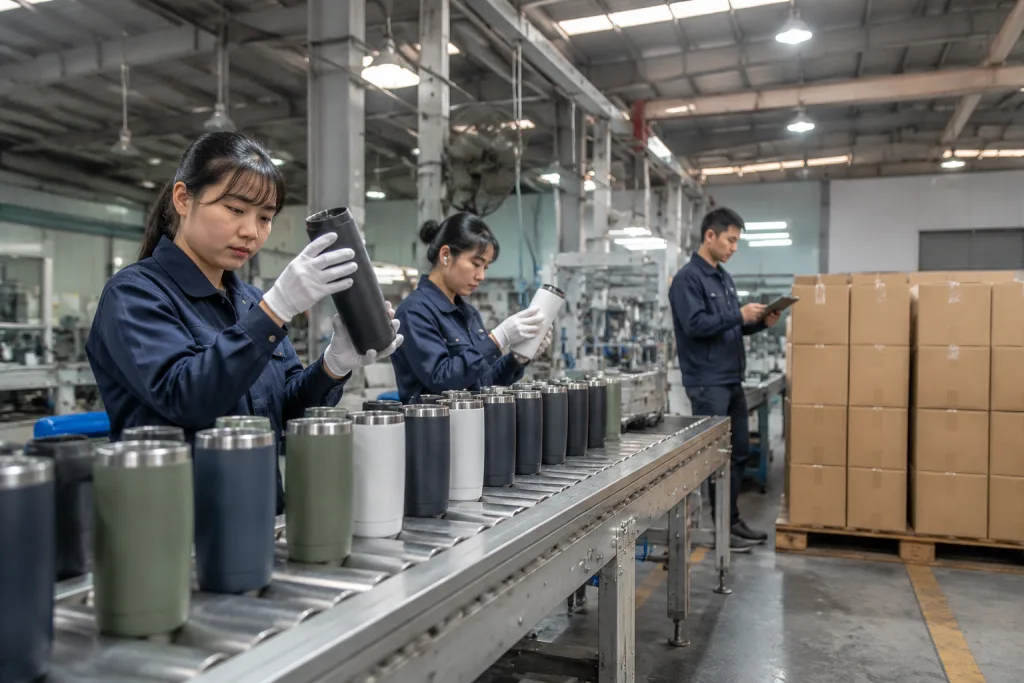
Our Zhejiang factory can produce about 450,000 stainless drinkware units per month across tumblers, bottles, and thermos lines. For standard travel tumbler molds, MOQ is usually 1,000 pcs per color. For a coffee mug custom made body or private mold, you should expect 10,000 pcs or more because tooling, trial injection, and stainless forming all need setup time; a new lid insert alone can take 12 days for T0 samples vs 18 days if the button mold needs rework on the CNC line.
Retail coffee brand versus gift program
A coffee brand is buying repeat use. A corporate-gift buyer is buying fewer complaint emails and clean branding. We see both briefs on the same RFQ sheet, sometimes with the logo file named “final_final.ai,” but the right tumbler spec is not the same.
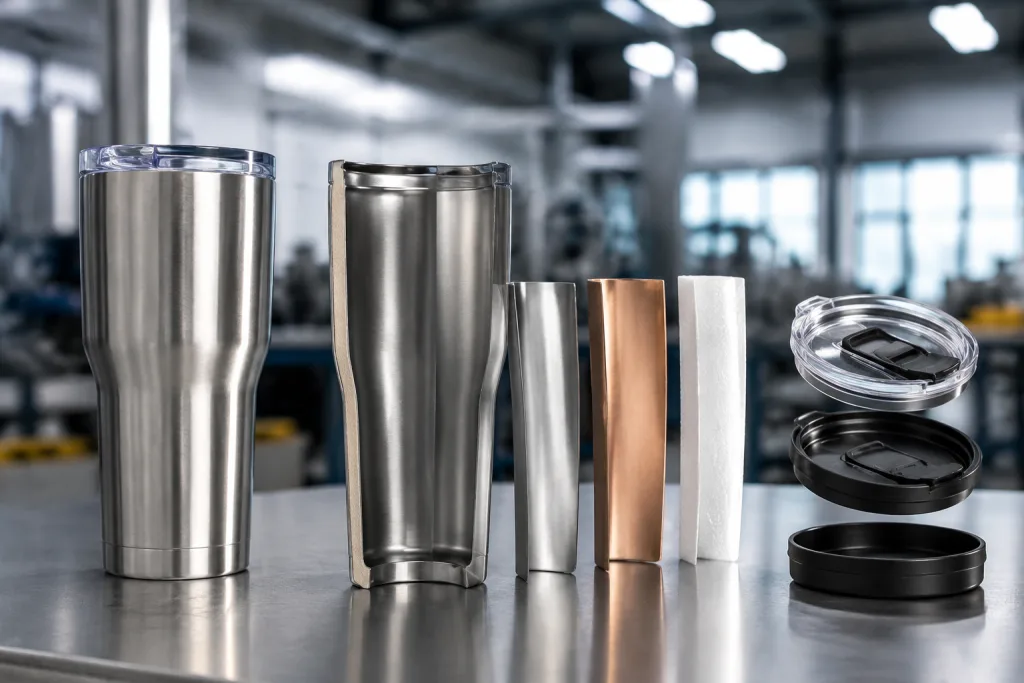
For coffee brands, the cup sits beside beans, capsules, or subscription bundles, so it has to look like it belongs on a retail shelf. I would spec a bulk coffee tumbler with 304 stainless steel inside and outside, 0.4 mm inner wall, 0.5 mm outer wall, copper vacuum layer if the margin can carry it, and a powder-coated finish with a 60-70 gloss reading on the gloss meter. A good 450 ml unit at FOB Ningbo or Shanghai usually lands around USD 3.20-5.80 depending on lid design, coating, and box. Add a handle, ceramic coating, or a complex flip lid and the math changes fast. The line slows, too.
For corporate gifting, defects hurt more than shelf appeal. The recipient may not care about 8-hour versus 12-hour heat retention, but they will spot a crooked logo at arm’s length. QC pulled a sample last month where the logo was 2.5 mm off center, and the buyer flagged it before asking about insulation. Laser engraving is safer than large-area silk screen on curved powder coating because it avoids ink adhesion problems. If the program needs names or departments, individual laser personalization works, but it slows packing. Plan 3-7 extra days for variable data engraving, and send the Excel file without merged cells.
The wrong question is, “Which tumbler works for every channel?” Retail coffee programs should pay for hand feel and display packaging; gift programs should pay for logo position within ±1 mm, lid leak testing, and AQL inspection on the packed goods. If you are a coffee mug distributor buying for both channels, do not force one SKU to do everything. We run one bulk travel mug for catalog volume and one better coffee mug private label version for key accounts, usually with a 1,000 pcs MOQ per color so production does not go sideways.
Steel, insulation, and lid trade-offs
Travel tumbler wholesale buyers usually ask us about stainless grade first. Fair question, but this is the wrong question to ask first. In our claim log from the last 12 months, lid leakage showed up 47 times; cup-body rust showed up 6 times. A 304 stainless tumbler with a loose slider lid can still wet a laptop bag, and QC pulled one sample last month where the silicone gasket sat 0.4 mm proud of the groove. A 316 inner wall looks nice on a spec sheet, but it will not save a bad lid fit.
For coffee, 304 stainless steel is the normal choice and is accepted in North America and Europe when food-contact documentation is complete. We run 304 for most café, gift, and retail programs because the math works. 316 stainless is more corrosion-resistant, but for normal coffee and tea use it is usually a marketing upgrade, not a functional requirement. If your brand sells acidic drinks, salt-air outdoor products, or premium corporate sets, 316 can make sense. For a standard 500 ml coffee tumbler, we would rather spend the extra USD 0.18-0.35 on coating thickness, lid tooling, and AQL checks; the buyer flagged this exact point after seeing two scratched black samples from a low-cost coating line.
Insulation performance depends on vacuum quality, wall thickness, cup shape, and lid opening. A narrow 500 ml tumbler can keep water above 55°C for 6-8 hours under common lab conditions. A wide-mouth tumbler with a drinking slot usually loses heat faster at the lid, and we have seen 6 hours vs 9 hours on the same body after changing only the cap design. Small part, big result. Be careful with supplier claims like “24 hours hot” unless the test method is stated; ask for start temperature, room temperature, fill volume, and the actual thermometer record, not just a sales PDF.
For lids, compare these three common options before you approve tooling:
- Press-fit slider lid: lowest-cost choice for desk and car-cup-holder use; easy to sip from, but we normally call it splash-resistant, not leakproof, after a 180° inverted water check.
- Screw lid with flip cap: better for commuting because the thread and cap seal do more work; it has more parts, so the mold shop must control hinge gap, gasket hardness, and assembly pressure.
- Handle lid: strong for outdoor sets and gym buyers; the handle adds carton height, so a 40HQ may load 8-12% fewer units than the same cup with a flat lid.
A practical coffee mug manufacturer will push back when “leakproof” is too strong a claim. We’ve seen this go sideways. Hot coffee builds pressure, steam softens some gaskets, and one typo on a PO changed “leak-resistant” to “leakproof” before the buyer noticed. We prefer to mark travel tumblers as leak-resistant unless the lid passes an inverted water test, swing test, and temperature cycling test, with QC signing off on 20 pcs from the line before bulk packing.
Logo methods compared side by side
Custom branding is where about 4 out of 10 bulk travel tumbler projects get messy. The artwork file looks perfect on a flat screen, then fails on a tapered cup with a 6 mm diameter change from top to bottom or a matte coating that holds ink differently. Start with the real printable area. On the line, we check it with a flexible ruler and a paper logo strip before making the mockup. A coffee mug customizable program should start with the actual printable area, not a generic mockup.
For most travel tumblers, laser engraving is the cleanest method on powder coating. It removes the coating and exposes stainless steel underneath. The mark is sharp, durable, and right for 1-color corporate logos. Full-color artwork will not work. That is the wrong question to ask if the buyer wants a photo-style logo. A typical laser logo area is 35 x 60 mm to 60 x 80 mm depending on the tumbler shape, and QC pulled one sample last month because the logo sat 3 mm too close to the bottom radius.
Silk screen printing works well for bold graphics and coffee mug promotional products, especially when the logo uses 1-2 Pantone colors. It is cheaper than heat transfer for simple marks, often around USD 0.08-0.18 per color per position at volume. Ink adhesion still needs a tape test on powder coat. Fine lines under 0.25 mm can break on curved surfaces, and we have seen this go sideways when a buyer insisted on tiny slogan text below the logo.
Heat transfer or water transfer is better for full-wrap art, gradients, and seasonal coffee campaigns with retail shelf pressure. It costs more, usually adds USD 0.35-0.90 per unit, and requires careful curing. We run an oven check because 12 minutes vs 18 minutes can change the edge adhesion. It is not my first choice for a low-budget event giveaway; the math does not work below a tight MOQ. It can make a coffee mug customized line look retail-ready.
Embossed or debossed logos need custom tooling. They are strong for a coffee mug private labeling project when the buyer commits to 10,000-30,000 pcs over a season. If you are testing a new café merchandise line, start with laser or silk screen. Do not buy tooling until repeat orders prove demand. We had one PO with “debosed” typed in the logo note, and the buyer flagged it only after the mold drawing was issued.
Pricing from factory direct quotes
A factory direct quote for travel tumblers needs separate lines for the cup body, logo process, packaging, inspection, and freight basis. One lump-sum price is the wrong question to ask. Last month a buyer sent us two quotes for a 500 ml tumbler; our sheet showed USD 0.38 for powder coating, USD 0.22 for a color box, and AQL 2.5 inspection booked at USD 180 per man-day, while the cheaper quote assumed a plain white box and no third-party inspection. QC pulled the sample with a 0.18 mm coating chip near the bottom radius, so those details were not “small print.”
For standard stainless travel tumblers, realistic FOB pricing from a Zhejiang or broader China coffee mug factory often looks like this. We run these ranges against 304 stainless coil cost, lid BOM, carton CBM, and the coating line’s daily output of about 18,000 pcs:
- 350 ml basic double-wall tumbler: USD 2.10-3.40 FOB, simple lid, spray paint or plain stainless.
- 450-500 ml vacuum tumbler: USD 3.20-5.80 FOB, powder coat, laser logo, individual box.
- 600-700 ml handle tumbler: USD 5.20-8.90 FOB, larger lid assembly, higher carton volume.
- Ceramic-coated inner tumbler: add roughly USD 0.45-1.10 per unit depending on coating area and test requirements.
MOQ changes the math fast. At 500 pcs, we usually accept only when blank stock is already on the rack, and the buyer must live with existing colors. At 1,000 pcs, standard color customization starts to make sense because one powder booth changeover takes about 45 minutes. At 3,000 pcs, logo and packaging cost has room to move. At 10,000 pcs, a coffee mug oem manufacturer can talk about adjusted lid color, silicone color, or a custom sleeve without pushing the unit price into nonsense. We have seen this go sideways when a PO says “Pantone Black” but the artwork file says Pantone 426C.
Be careful with supplier lists scraped from a coffee mug supplier directory. A coffee mug supplier list may give you 80 names in one afternoon, but it does not prove who owns the welding machines, vacuum testing station, or salt-spray cabinet. Ask for BSCI or ISO 9001 status, recent REACH or LFGB food-contact reports, and production photos showing today’s date on the line board. A trading company can still do a clean job; just know whether you are dealing with a coffee mug factory, a trading office, or a mixed model before you wire the deposit.
Compliance and inspection before shipment
For Europe and North America, compliance is not a PDF you chase after production. It decides the 304 stainless grade, powder coating, printing ink, silicone ring, and even the PE bag warning before we run the first 50 pcs pre-production sample. A solid coffee mug manufacturer should ask the destination market before PI confirmation; if they do not, the buyer flagged it too late in 7 out of 10 messy orders we have seen.
For the EU, you may need LFGB or EU food-contact testing, REACH checks for coatings or external parts, and packaging compliance for heavy metals. For the US, buyers often ask for FDA food-contact documentation; children’s items bring CPSIA or ASTM requirements into the file. An adult travel tumbler is not a kids bottle. This is the wrong question to ask if the team says, “Can one test cover everything?” QC pulled one painted lid last month because the lab needed the exact coating batch, not a nice-looking golden sample.
Inspection should be written into the PO, not argued about when cartons are already taped. We normally recommend AQL Level II with critical defects at 0, major defects at 2.5, and minor defects at 4.0 for normal wholesale drinkware. Critical defects include sharp edges, contamination, broken glass if applicable, unsafe lid parts, or serious leakage over 30 minutes upside down. Major defects include coating peel, wrong logo position, poor vacuum performance, and lid assembly failure; we check these with a caliper, 3M tape, torque by hand, and hot water at the line.
A practical inspection checklist should include:
- Capacity check with tolerance, usually ±5% unless otherwise agreed, measured with a 1,000 ml graduated cylinder.
- Logo position tolerance, often ±2 mm for laser or screen print, checked from the cup seam or handle centerline.
- Coating cross-hatch adhesion test on painted samples, with QC cutting a 1 mm grid before tape pull.
- Vacuum heat retention sampling after 4 or 6 hours, with start and end temperatures written on the inspection sheet.
- Carton drop test for retail or e-commerce packing, usually 10 drops after the master carton reaches packed weight.
If you ship to Amazon FBA or a distributor warehouse, add barcode and carton label checks. FNSKU errors feel small until 2,000 cartons get rejected because one digit was copied wrong from the PO; we have seen “B0” typed as “80” on a side mark. For travel tumbler wholesale, the cheapest inspection is the one done before the container leaves China.
Packing choices by sales channel
Packing is not decoration. It changes freight cost, damage claims, warehouse touches, and the buyer’s first impression. We see this on the packing table: the same 500 ml tumbler in a thin white box passed our 80 cm drop test, while the loose polybag version came back with rim dents in 6 pcs out of 200. The right pack for a bulk coffee mug sold through a roaster is not always the right pack for a corporate-gift order.
For retail coffee brands, an individual color box earns its keep. A standard tuck-end or kraft box may add USD 0.18-0.45 per unit depending on paper thickness, printing, and inserts. If the tumbler sits beside coffee beans, the box needs a barcode, product claims, care instructions, and country-of-origin marking. QC pulled the sample last month because the PO said “matte black,” but the box dieline file was named “BLACK GLOSS V3.” Small typo. Big delay. Do not print “dishwasher safe” unless the coating and logo have passed wash testing.
For corporate gifts, simple gift boxes with foam or molded pulp inserts look cleaner, but they eat carton space. The math does not work if nobody checks carton CBM. A 24 pcs master carton can become 12 pcs after a foam insert and greeting card sleeve, which pushes up ocean freight and courier cost for split deliveries. If you need 2,000 units sent to 80 office addresses, ask for drop-shipping carton plans before artwork approval. We can pack by department or address code, but the line needs printed labels, a scanning table, and 1 extra worker per 600 cartons.
For distributors, master carton efficiency matters more than fancy boxing. A 500 ml tumbler might pack 24 pcs per carton, while a large handle tumbler may pack only 12 pcs. That difference changes pallet count and warehouse storage fast. We run this check with a tape measure and a 1,200 x 1,000 mm pallet drawing before mass production, because buyers flag over-height pallets when the warehouse door is only 2.2 m. If you are a coffee mug distributors group carrying 20 SKUs, standardize carton size where possible.
At BottleForge Industrial in Hangzhou, Zhejiang, our usual lead time is 25-35 days after deposit and artwork approval for standard travel tumblers. Add 7-12 days for new packaging proofing and 20-30 days for new mold development. China production moves fast when the spec is locked. We have seen this go sideways when the buyer changes the lid, logo, and box after sampling; one order sat 9 days because the barcode sticker size changed from 30 x 20 mm to 40 x 25 mm after the carton mark was approved.
Send your tumbler brief for a factory quote
Share capacity, quantity, logo file, packaging needs, and destination market. We will return a practical spec and FOB China pricing.
Frequently asked questions
What MOQ should I expect for travel tumbler wholesale?
For standard molds, expect 1,000 pcs per color for a normal travel tumbler wholesale order. Some factories accept 500 pcs if blank stock is available, but color choice and logo method will be limited. For a coffee mug custom made body, custom lid, or exclusive shape, the MOQ is usually 10,000 pcs or higher because stainless forming tools and injection molds must be justified. If you are testing a coffee mug promotional campaign, start with a stock body, powder coat, and laser logo. That gives you a credible product without locking money into tooling before sales data exists.
Is 304 stainless steel enough for a bulk coffee travel mug?
Yes, 304 stainless steel is enough for most bulk coffee travel mug programs in Europe and North America. A typical spec is 304 inner and outer wall, 0.4-0.5 mm wall thickness, food-grade silicone gasket, and PP or Tritan lid parts depending on design. 316 stainless is useful for premium positioning or more corrosive use cases, but most coffee brands get better value by spending on powder coating, lid quality, and inspection. Ask your coffee mug manufacturer for food-contact reports that match the actual material and coating used, not just a generic certificate from another model.
Which logo method is best for coffee mug custom branding?
For coffee mug custom branding on travel tumblers, laser engraving is the safest choice for durability and low complaint risk. It works especially well on powder-coated stainless steel and is common for corporate gifts. Silk screen printing is better when you need a solid Pantone color logo or larger design area, but adhesion testing is important. Heat transfer works for full-wrap art and seasonal retail packaging, but it adds roughly USD 0.35-0.90 per unit and needs stronger QC. For a first coffee mug private label order, choose laser or 1-color silk screen before trying complex wrap designs.
How long does factory direct production take in China?
For a coffee mug factory direct order using an existing travel tumbler mold, normal production is 25-35 days after deposit, final artwork, and sample approval. If you need a new color proof, add 3-5 days. If you need a new retail box, add 7-12 days for proofing and confirmation. New lid or body tooling can add 20-45 days depending on complexity. Ocean freight to Europe or North America is separate, often 25-40 days port to port. Build your launch calendar around approved samples, not the first quote date.
How do I compare coffee mug suppliers without getting misled?
Compare coffee mug suppliers with a fixed RFQ sheet: capacity, stainless grade, lid type, coating, logo method, packaging, testing, Incoterm, MOQ, and lead time. If one quote is USD 0.80 cheaper, check whether it excludes powder coating, individual box, AQL inspection, or food-contact testing. Ask whether the supplier is a coffee mug factory, trading company, or combined exporter. A coffee mug supplier directory can create a shortlist, but it cannot verify production. Request factory photos, BSCI or ISO status, past inspection reports, and a pre-production sample before paying a large deposit.