Key Takeaways
- Set AQL at 2.5 major / 4.0 minor and inspect at least 80 units on a 3,000-piece order
- For powder-coated travel tumblers, define Pantone tolerance before production, not after shipment
- A realistic MOQ for coffee mug custom made work is 1,000 pieces per color and logo
- Ask for lid leak testing at 30 seconds inverted plus 5 minutes side-rest testing
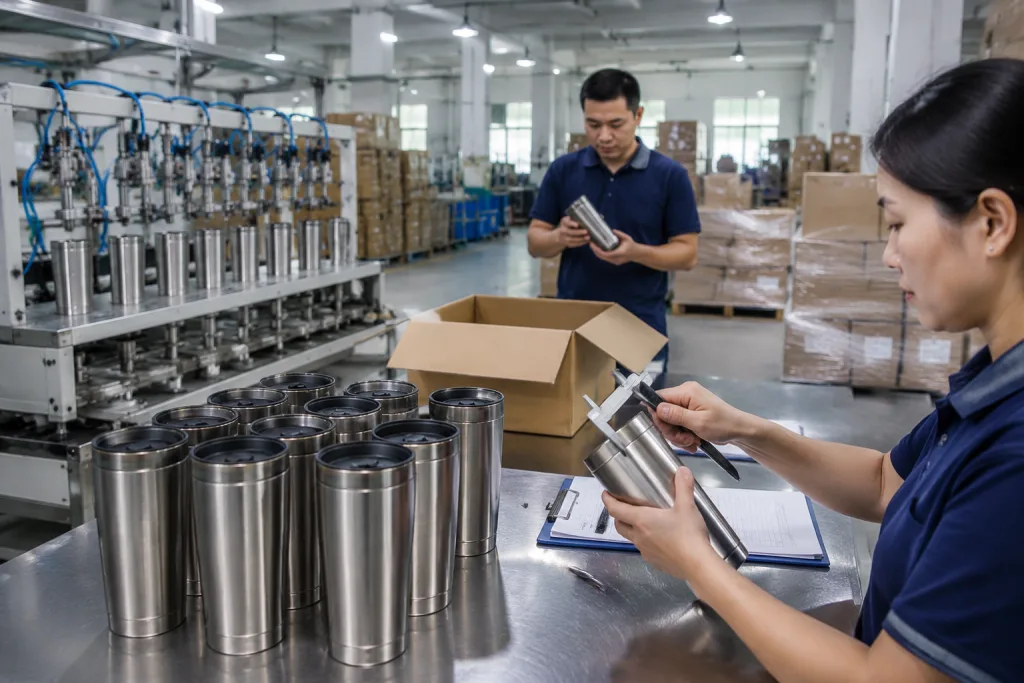
A travel tumbler wholesale bulk order can look clean on the quote sheet: 20 oz, 304 stainless, powder coating, logo, carton packing. Then QC pulls 32 lids from the first carton and finds 3 slow leaks after a 180° shake test, or the PMS Black on the PO becomes matte charcoal after baking at 190°C. That is where profit disappears.
If you buy for a coffee chain or corporate-gift program, you are not just buying a bulk coffee tumbler. You are buying the same cup, carton after carton. From our Zhejiang, China line, we run into trouble fastest when buyers approve a pretty sample but skip the failure points: lid torque, sleeve height in mm, cup-holder diameter, and logo scratch resistance after 50 rubs with 3M tape. Ask those questions before mass production. The math works better.
Leakage Starts With Cheap Lid Assumptions
The complaint we hear most in travel tumbler wholesale bulk orders is not the stainless body. It is the lid. A buyer approves a clean sample on Monday, then the line runs 8,000 lids and QC pulls a carton with silicone rings sitting 0.4 mm proud. The slider feels loose, the gasket is too soft, or the lid tolerance shifts after the plastic mold has been running hot for several thousand shots.
For a bulk coffee travel mug, treat the lid as a working part, not decoration. Ask your coffee mug manufacturer to confirm lid material, gasket hardness, slider structure, and spare-part policy. For hot coffee use, we run food-grade PP or Tritan lid parts with a silicone seal in the 50-60 Shore A range, checked by Shore A durometer before assembly. Softer seals feel better in the hand but can deform after a 90°C water soak. Harder seals may pass dry fitting on the bench, then leak when the tumbler lies sideways in a commuter bag. The math doesn't work if you save USD 0.08 on the lid and eat 3% customer complaints.
Your purchase specification should state the test method. “Leak-proof” means nothing. Use language like: fill with 90°C water to 90% capacity, close lid, invert for 30 seconds, then place horizontally for 5 minutes; no continuous dripping allowed. For slider lids, require 500 open-close cycles on pre-production samples, and have QC mark the sample with a paint pen so nobody swaps in a fresh lid halfway through the test.
If your brand sells through corporate gifting, leakage becomes a brand problem fast. One failed bulk travel mug can create more complaints than a small logo defect because the end user blames the brand, not the factory. We have seen buyers flag a single wet gift box photo harder than a 1 mm logo offset. A coffee mug factory direct supplier in China should show lid tooling history, spare gasket stock, and batch inspection photos before shipment, including carton number and PO number; yes, we once caught a PO typo only because the inspection board photo showed the wrong suffix.
Vacuum Loss Is Usually Invisible
Double-wall vacuum insulation is what sells the tumbler, but a dead vacuum almost never shows up at normal receiving. The carton looks clean. The logo passes. Then the tumbler loses heat in 2 hours instead of 6, and the end customer blames the coffee brand, not the factory. We had one buyer flag this after a café chain staff test: 24 samples on the counter, hot Americano at 92°C, and 3 cups were warm on the outside before lunch.
The usual causes are thin stainless steel, loose welding control, weak vacuum sealing, or over-polishing around the bottom plug. For a bulk travel tumbler, the inner wall should be 304 stainless steel. Common body thickness is 0.4-0.5 mm for the inner wall and 0.5-0.6 mm for the outer wall, depending on shape and target weight. If the FOB price is lower by USD 0.18-0.25 per piece, ask where the saving came from. Did the supplier reduce gauge? Did they switch the outer shell to 201 stainless? For some low-cost coffee mug promotional products, that can pass the brief, but hiding it is where the math goes sideways. On our line, QC checks wall gauge with a digital micrometer before polishing starts.
At BottleForge Industrial in Zhejiang, our standard vacuum test checks surface temperature rise after hot-water filling and resting time. For a 20 oz travel tumbler, we run a practical pre-shipment check: fill with water above 95°C, close the lid, hold for 30 minutes, then touch-check and record whether the outer wall turns warm. Simple test. It catches bad cups. For tighter QC, QC pulled the sample under a thermal imaging camera and compared it with the approved golden sample; a 4-6°C higher shell reading is enough for us to stop and sort the lot.
If you are working from a coffee mug supplier list or coffee mug supplier directory, ranking factories only by FOB price is the wrong question to ask. Ask for the vacuum defect rate from the last three production runs, not a sales answer like “low defect.” A serious coffee mug oem manufacturer should know whether its vacuum failure rate is 0.3%, 1%, or 3%. Last month, one PO even had “vacumm test” typed in the inspection clause, and the buyer still noticed the missing defect-rate line before deposit payment.
Color Drift Kills Brand Consistency
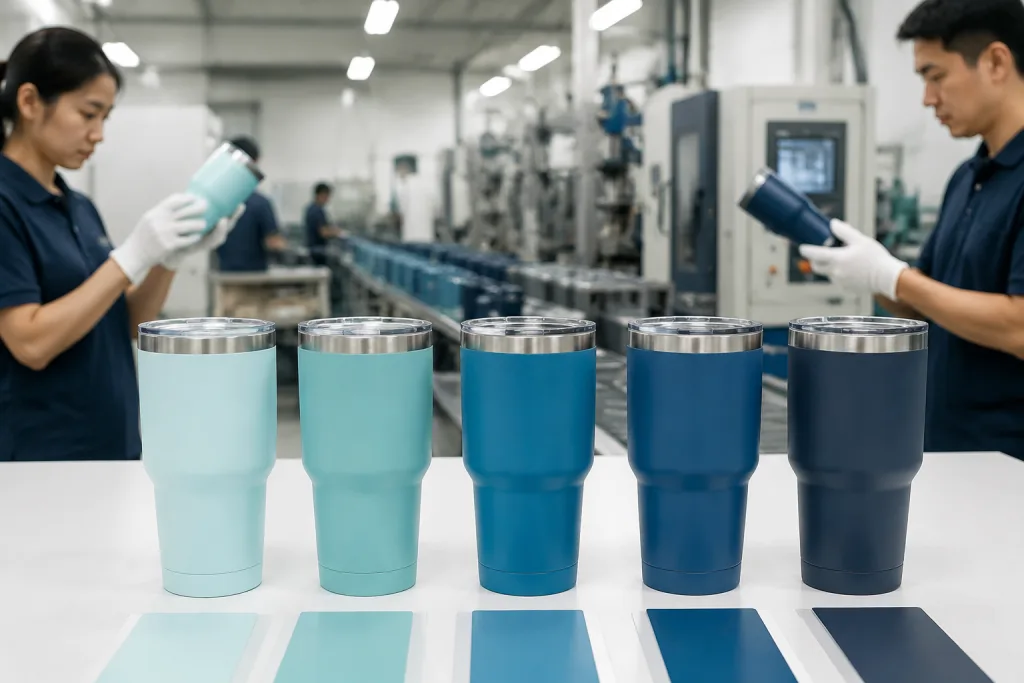
Powder coating gives a travel tumbler that heavier retail feel, but this is where 4 out of 10 coffee mug customized projects get ugly. A buyer approves a matte cream sample in June, then the August shipment lands 1.5 ΔE yellower under the light box. QC pulled the sample beside the signed chip, and the buyer flagged it in 20 minutes. The factory says it is “within normal range.” Your brand manager says no.
Arguing after production is the wrong question to ask. Lock the color system before the purchase order. For coffee mug custom work, send Pantone or RAL references, surface finish notes, and a written tolerance such as ΔE ≤1.0 or ΔE ≤1.5. If color carries the campaign, approve a coated metal chip, not a digital rendering. Screens lie. A 304 stainless cylinder reflects light differently than flat AI artwork on a PDF, and we have seen one PO typo turn “matte ivory” into “matte ivory yellow.”
For a coffee mug private label program, specify coating performance in the same spec sheet. A standard powder coat for corporate gifts should pass cross-cut adhesion testing with 3M tape pull, handle 300 cycles of dry rub, and show no peeling after a 24-hour room-temperature water soak. We run the rub test on a 1 kg load tester, not by thumb. If the tumbler is meant for dishwasher-safe retail claims, be careful. The math does not work if only the body passes. Many powder-coated coffee mug promotional products should stay hand-wash recommended unless the coating, logo method, and lid pass testing as one set.
Batch-to-batch color control hurts most on reorder. A coffee mug factory in China may buy powder from a new lot after 18 days, while your first shipment used powder received 12 days before production. For programs above 5,000 pieces, ask the factory to reserve powder from one batch or record powder lot numbers on the inspection report. It is one small line in the spec. It can stop a split shipment where 2,500 pieces of your bulk coffee mug order look like a different SKU under store lighting.
Logos Fail When Artwork Is Under-Specified
Logo trouble usually starts with a buyer trying to save time. We get a JPG pulled from a sales deck, the email says “coffee mug customizable logo,” and the buyer expects shelf-ready branding. On the line, our artwork tech traces the file in Illustrator, then the 0.3 mm stroke becomes too thin after film output. QC pulled the first sample under a 10x loupe and the edge looked fuzzy. Nobody cheated anyone. The file was not a production spec.
For travel tumbler wholesale bulk orders, send AI, EPS, or PDF vector artwork with fonts outlined. State the print size in millimeters, the distance from the rim, the center line relative to the handle or seam, and the exact Pantone code if printing color matters. For a straight-sided tumbler, we run silk screen when the logo sits flat and the order is above 1,000 pcs. For tapered tumblers, laser engraving or pad printing is safer because the screen mesh can drag the artwork wider by 1-2 mm near the bottom. Laser engraving lasts, but on powder coat it cuts through to the steel or base layer, so asking for “laser logo in blue” is the wrong question to ask.
A practical rule: avoid fine lines below 0.25 mm for screen printing and avoid tiny reversed text under 5 pt. For a coffee mug custom made gift set, approve a physical logo sample before mass production, even if it adds 5-7 days. We ship samples by DHL most weeks, and a logo strike-off is cheaper than opening 38 cartons to explain why the slogan filled in. Digital mockups work for placement. Not for final QC approval.
If you manage coffee mug private labeling across several SKUs, create a logo control sheet. Put the logo file name and revision date on one line, then add size, color, position, approved sample photo, and carton marking with SKU code. This helps the coffee mug supplier avoid mixing your 16 oz and 20 oz artwork; we have seen it happen when the PO had a typo like “20oz matte black” but the attachment name said “16oz_black_logo_v3.” Our Hangzhou team has watched small artwork errors become full rework jobs because the PO only said “print client logo” and nothing else. The math does not work after production starts.
Cartons Break Before Tumblers Do
Corporate-gift buyers often approve the tumbler sample and leave export packaging as “standard packing” on the PO. That is the wrong question to ask. A 304 stainless tumbler survives daily use, but a bulk carton can crush under 5 layers on a pallet, 780 kg of side pressure, or one bad courier toss at the depot. Last quarter QC pulled 2 cartons from a pilot run and found clean tumblers inside, but 17 color boxes had rubbed corners because the divider height was 3 mm short.
For a coffee mug in bulk shipment, lock the inner packing and master carton spec before deposit. We run one tumbler in a polybag or tissue wrap, then white box or kraft box, then 24 pieces per master carton for most 20 oz styles. For heavier 30 oz tumblers, 12 pieces per carton is safer; the math does not work when buyers push 24 pieces just to cut carton count. Master cartons should use 5-ply corrugated board for export, with edge-crush strength matched to pallet stacking. If the order will go by parcel after import, run a 76 cm drop test on the packed retail box; our line marks the test carton with a red QC sticker so nobody mixes it back into saleable stock.
Amazon-style or 3PL fulfillment changes the packing job. If you need FNSKU labels, suffocation warnings, carton barcodes, or mixed-SKU packing, put that into the quotation with label size and placement in mm. We have seen this go sideways when a buyer sent “label on carton” and the warehouse later rejected 312 cartons because the barcode sat across the tape seam. A coffee mug distributor may care more about carton dimensions and cubic meters than unit price because storage and pick fees eat margin. For reference, a 20 oz travel tumbler in a color box often packs around 24 pieces per carton, roughly 48 x 36 x 26 cm, depending on shape and lid.
Our China factory ships about 450,000 drinkware units per month, and packaging failures are still the easiest way to waste money. The tumbler can pass AQL, but if the carton fails, your customer receives a damaged product. We ship pallets with corner protectors and stretch film, yet QC still checks carton bursting, tape width, and gross weight on the floor scale before release.
Compliance Cannot Be Added Later
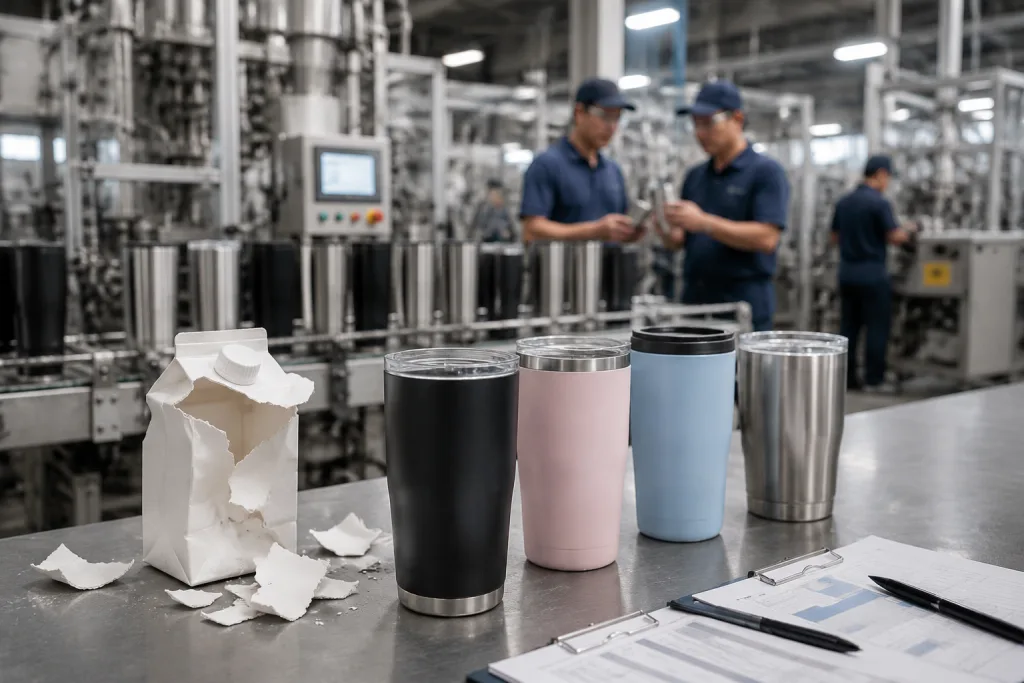
Compliance is not paperwork you buy after the container leaves Ningbo. For coffee brands and corporate buyers in Europe and North America, drinkware touches food-contact rules and chemical limits; if the artwork says “family camping set,” the buyer may also treat it like a children’s product. We have seen QC pull a printed sample at 9:40 p.m. because the PO said “kids tumbler” in one line and “adult commuter mug” in another. That wording changes the test path.
For stainless steel travel tumblers, ask for food-contact testing on the actual material and coating system, not a similar cup from last March. Common requirements include LFGB for Germany, EU food-contact declarations, FDA food-contact expectations for the US market, and REACH screening for restricted substances. If the tumbler includes plastic lids, straws, or silicone seals, those parts need their own material declarations; our lab usually labels them as lid PP, straw Tritan, and seal silicone before sending the sample set. A full coffee mug manufacturer should not hand over one generic certificate for every SKU in the catalog. The math doesn’t work.
Corporate buyers also ask about factory audits. BSCI, Sedex, ISO 9001, and social compliance reports do not make a tumbler better by themselves, but they cut procurement back-and-forth by 3-5 emails on a normal corporate order. If you are a coffee mug distributor supplying large companies, missing audit documents can block the sale even when the product is fine. We had one buyer flag an expired Sedex PDF during final artwork approval, after the line had already booked 18,000 powder-coated bodies.
Build compliance into the RFQ. State your destination market, retail channel, and claim language. “BPA-free,” “dishwasher safe,” “keeps hot 8 hours,” and “recycled stainless steel” all need proof, not sales talk. A coffee mug supplier that says yes to every claim without test cost or lead time is not helping you; we have seen this go sideways when a random showroom cup was tested instead of a production-representative sample from the welded batch. Real testing normally adds 7-12 working days, and for rush launches we run the sample pack with a 0.01 g scale check, coating thickness record, and full lid material breakdown before the lab pickup.
MOQ And Lead Time Hide Risk
MOQ is not a factory rule; it is a risk signal. For most coffee mug custom programs, we can run 500 pieces when the job is simple laser engraving on stock colors, and the line only needs a logo file plus a jig check. For coffee mug custom made production with a matched powder color, logo placement, insert card artwork, and retail box dieline, 1,000 pieces per color is the cleaner starting point. Below that, the math doesn't work. On one 700-piece job, QC pulled 46 cups after coating because the Pantone color shifted 1.5 shades between the first and second spray batch.
At BottleForge Industrial in Zhejiang, a typical travel tumbler wholesale bulk order runs 25-35 days after sample approval for stock molds, plus 7-10 days for sampling. New tooling, special lids, or molded silicone parts can add 20-30 days. If a coffee mug factory direct quote promises 10 days for a fully customized 5,000-piece order during peak season, ask what “custom” covers. We’ve seen this go sideways: the buyer flagged it only after receiving the PI, where “custom color” meant a stock black tumbler with a pad-printed logo.
Price also needs context. A basic 20 oz stainless bulk coffee mug with stock lid and one-color logo may quote around USD 3.20-4.80 FOB China at 3,000 pieces, depending on coating, packaging, and steel grade. A premium handle tumbler with custom box, laser logo, and heavier wall can sit at USD 5.50-8.50. Freight, duty, inspection, and testing sit outside that number. Last month a buyer asked why our quote was USD 0.42 higher; the answer was a 0.5 mm thicker inner wall and a 5-layer export carton that passed the 12 kg drop test.
For a coffee mug distributors program, the safest path is staged approval: quotation, technical spec sheet with lid diameter in mm, pre-production sample, pilot run photos from the line, AQL inspection, then shipment release. Slow? Yes. Cheaper too. That process is slower than clicking “reorder,” but it beats explaining 3,000 leaking tumblers to a corporate client after QC finds silicone gasket flash on 8 out of 80 inspected lids.
Send your tumbler spec before you request prices
Share capacity, lid type, logo method, MOQ, market, and packing needs. We will return a factory-direct quotation with practical risk notes.
Frequently asked questions
What is a realistic MOQ for travel tumbler wholesale bulk orders?
For stock travel tumbler shapes with laser engraving or one-color screen print, 500 pieces can be workable. For powder-coated custom colors, retail boxes, insert cards, or coffee mug private label packing, plan on 1,000 pieces per color. At 3,000 pieces, pricing becomes more stable because coating setup, logo screens, and carton printing are spread across more units. Very low MOQ quotes are not always bad, but ask whether the supplier is using existing inventory, mixed production lots, or a substitute lid. For coffee brands, consistency across reorders matters more than squeezing the first order to 300 pieces.
How do I compare quotes from different coffee mug manufacturers?
Compare the technical assumptions, not only the FOB price. Ask each coffee mug manufacturer to list steel grade, wall thickness, lid material, coating type, logo method, packaging, testing, MOQ, sample cost, and lead time. A USD 3.60 tumbler and a USD 4.40 tumbler may look similar on a spreadsheet, but one may use 201 outer steel, thin powder coating, and a generic lid. The other may use 304 inner steel, a tighter silicone gasket, and 5-ply export cartons. Also ask whether the quote includes pre-production samples and whether AQL inspection is supported before balance payment.
Which logo method is best for a coffee mug promotional order?
For simple one-color logos on straight walls, silk screen printing is usually the best cost-performance choice and works well above 1,000 pieces. Laser engraving costs more but is more durable and avoids ink adhesion risk, especially on powder-coated tumblers. Pad printing helps on curved or tapered areas but has size limits. UV printing can handle full-color artwork, but scratch resistance must be tested. For a coffee mug promotional order, do not decide from a catalog photo. Ask for a physical logo sample and define artwork size, placement tolerance, and acceptable defects under AQL 2.5 major / 4.0 minor.
Can a coffee mug factory direct supplier handle corporate-gift packaging?
Yes, if you specify it early. A coffee mug factory direct supplier can usually provide kraft boxes, white boxes, printed color boxes, belly bands, instruction sheets, barcode labels, and master carton markings. The risk is assuming packaging is included when the quote only covers a polybag and export carton. For corporate gifts, confirm box material, print colors, insert layout, carton quantity, gross weight, and drop-test requirement. If the goods ship to a 3PL or multiple offices, add carton labels and pallet requirements. Packaging approval often adds 5-10 days because box dielines and print proofs need buyer sign-off.
What should I inspect before releasing final payment?
Inspect function, appearance, branding, packing, and quantity. For a 3,000-piece bulk travel tumbler order, use an AQL plan such as 2.5 major / 4.0 minor and pull a statistically valid sample size, often around 80-125 units depending on inspection level. Check lid leakage, vacuum performance, coating defects, logo position, barcode accuracy, carton strength, and mixed-SKU risk. For hot-fill tumblers, include a heat retention spot check against the approved sample. Do not rely only on factory photos. A third-party inspection in China usually costs far less than sorting defective tumblers after they reach your warehouse.