Key Takeaways
- A 20 oz stainless travel tumbler usually lands at USD 3.20-6.80 FOB China depending on lid, finish, and packing
- Realistic MOQ is 1,000 pieces per color for stock shapes and 3,000-5,000 pieces for custom parts
- Normal production lead time is 30-45 days after deposit and artwork approval, not after first email
- Decoration choice can add 3-12 days and USD 0.08-0.65 per unit
If you are buying tumblers for a coffee brand launch or a corporate-gift program, the hard part is not the cup shape. It is checking whether a quote from travel tumbler vendors can survive real production. A USD 3.20 tumbler can land at USD 5.10 after powder coating, laser logo, color box, AQL 2.5 inspection, and FOB Ningbo charges. We have seen a promised 25-day shipment stretch to 55 days because the PP lid mold was still on the CNC bench and the buyer flagged the straw hole 0.8 mm off-center.
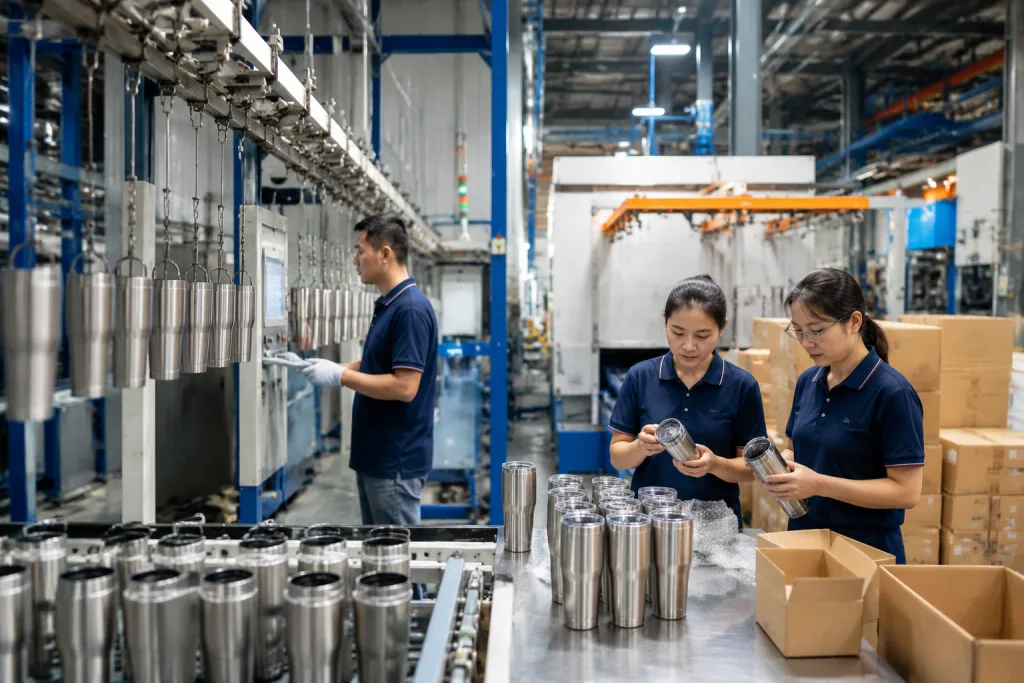
At BottleForge Industrial in Hangzhou, Zhejiang, we see the same buying mistake about 6 times a month: buyers compare unit price only. That is the wrong question to ask. China factory pricing is tiered, and timing follows 304 stainless booking, spray line slots, silicone ring stock, and test report lead time. Our travel tumbler line runs about 420,000 units/month, with standard MOQ from 1,000 pieces per color; QC pulled 32 samples from last week’s matte-black run after finding 3 lids with weak snap fit.
Start with the real unit cost
Do not open a RFQ to travel tumbler vendors with “your best price.” That is the wrong question to ask. Ask for a costed specification sheet first: capacity, steel grade, wall construction, lid type, finish, decoration, carton packing, test requirement, and trade term. On our line, QC pulled two 20 oz samples last month that looked identical, but one had a 0.45 mm outer wall and the other was 0.38 mm. Same photo. Different cost.
For a standard 20 oz double-wall vacuum tumbler made with 304 stainless steel inside and 201 or 304 outside, a workable FOB China range is USD 3.20-4.30 for simple powder coating, one-color logo, and egg-crate export carton. A better lid with slider, gasket, and splash resistance may add USD 0.18-0.45. Full 304 stainless steel inside and outside usually adds USD 0.25-0.55, depending on steel market price and wall thickness. We run a wall-thickness gauge before mass production because 0.1 mm sounds small, but across 10,000 pcs the math shows up fast.
Decoration gets underquoted. Laser engraving on a coffee mug custom project may add USD 0.12-0.28 per unit. One-color silkscreen is often USD 0.08-0.18. Wraparound printing, gradient coating, UV printing, or 360-degree artwork can add USD 0.35-0.90, especially if the artwork needs two fixture passes. Gift-box packing can add USD 0.20-0.75, more if you need molded pulp inserts or retail-ready barcodes. We have seen this go sideways when the buyer approved a logo PDF but the PO had one digit wrong in the Pantone code.
If you are a coffee mug distributor buying for 6 or 12 repeat campaigns, split the base tumbler cost from decoration and packing. Reorders move faster that way. Your coffee mug manufacturer can keep the same base SKU and change logo, sleeve, box, or FNSKU label without re-quoting the whole item every time. On a clean reorder, we ship artwork confirmation in 1 day; if the base SKU changes, the sample room needs 5-7 days before the line can lock the BOM.
MOQ tiers that actually matter
MOQ is not a punishment. It is the point where material yield, coating line setup, printing fixtures, QC labor, and export packing stop fighting the price. For a coffee mug in bulk order, most China factories will quote at 500 pieces, but we see color control settle down at 1,000 pieces per color after the powder room runs one full rack, usually 96-120 bodies per pass. Below that, the line spends too much time cleaning guns and changing fixtures.
For stock travel tumbler bodies, BottleForge normally works with these tiers: 1,000-2,999 pieces for first orders, 3,000-9,999 pieces for repeat promotional programs, and 10,000 pieces plus for annual contracts or distributor stock. At 1,000 pieces, you may pay USD 0.20-0.45 more per unit because coating, logo setup, and carton handling are spread over fewer items. At 10,000 pieces, the saving is usually 6-12%, not 40%. The math does not work when a vendor promises a huge price drop unless they are changing wall thickness, lid material, or packing spec; we once had a buyer flag a 35% drop and the sample came back with a lighter 0.42 mm outer shell.
Custom lids, handles, silicone boots, and unique body tooling change the math fast. A coffee mug custom made shape can require USD 1,500-6,000 for body tooling and USD 800-3,500 for lid or accessory molds. MOQ then moves to 3,000-5,000 pieces because we must block mold time, injection machine capacity, and trial production slots; QC pulled one lid sample last month because the snap-fit gap measured 0.7 mm too loose with a feeler gauge. A coffee mug oem manufacturer should show you the tooling ownership terms in writing.
For corporate-gift buyers, the better starting point is often a stock body with coffee mug customized branding: powder coating, laser logo, custom box, and insert card. You get a branded result without tying your campaign to a 90-day tooling schedule. We ship this setup often at 1,000 pieces per color, and the buyer’s usual pushback is simple: “Can we approve the gold logo before mass production?” Yes — we run a pre-production sample first.
Where lead time gets lost
Lead time starts after deposit, artwork confirmation, and sample approval. It does not start when you send an RFQ. This is the wrong question to ask. We run the clock from the signed PI, approved dieline, and the PP sample sitting on the QC table with the buyer’s approval email attached. A normal bulk coffee travel mug order from Zhejiang can ship in 30-45 days after approval if the body is a stock mold and packaging is standard. Add 7-15 days for complex retail boxes, especially if the 350gsm art paper box needs a window patch or spot UV. Add 12-25 days if you need new tooling; our CNC shop will not cut steel from a WhatsApp sketch. Add more time before Christmas, Lunar New Year, and the September corporate-gift rush.
A realistic timeline looks like this: quotation and spec locking, 2-4 working days; artwork proof, 1-3 days; pre-production sample, 5-10 days using stock parts; buyer approval, variable; mass production, 25-35 days; final inspection and loading, 2-4 days. Buyer approval is where we lose 6 days on average, not on the line. Last month QC pulled the sample because the PO said PMS 186C, while the artwork file showed PMS 185C. Sea freight to the US West Coast may take about 18-28 days port-to-port, while Europe is often 28-40 days depending on routing. Air freight is faster, but the math doesn’t work on 3,000 bulk coffee tumblers unless the campaign date is already in trouble.
Decoration is a bottleneck. A simple laser logo can move quickly because the jig is simple; our laser fixture usually needs 0.2 mm position tolerance and one operator can keep the line moving. Multi-color printing needs separate screens and registration checks every 200 pcs. Matte powder coating needs oven time, hang marks control, and color approval under a D65 light box. If your campaign uses 4 colors and 12 department logos, ask your travel tumbler vendors how many decoration lines they run per shift and whether your order will be printed in one batch. We’ve seen this go sideways when half the order prints Monday and the balance prints Thursday after the ink mix changes.
For launch planning, we advise coffee brands to approve samples at least 75-90 days before the required warehouse date. Corporate buyers should leave 60-75 days for standard China production plus ocean freight. Anything shorter needs a tighter spec, not wishful thinking. If the buyer flags a lid fit issue at 8:30 p.m. Hangzhou time, we can recheck with a 0.05 mm caliper the next morning, but we cannot make a 45-day ocean schedule behave like 30 days.
Materials change price and risk
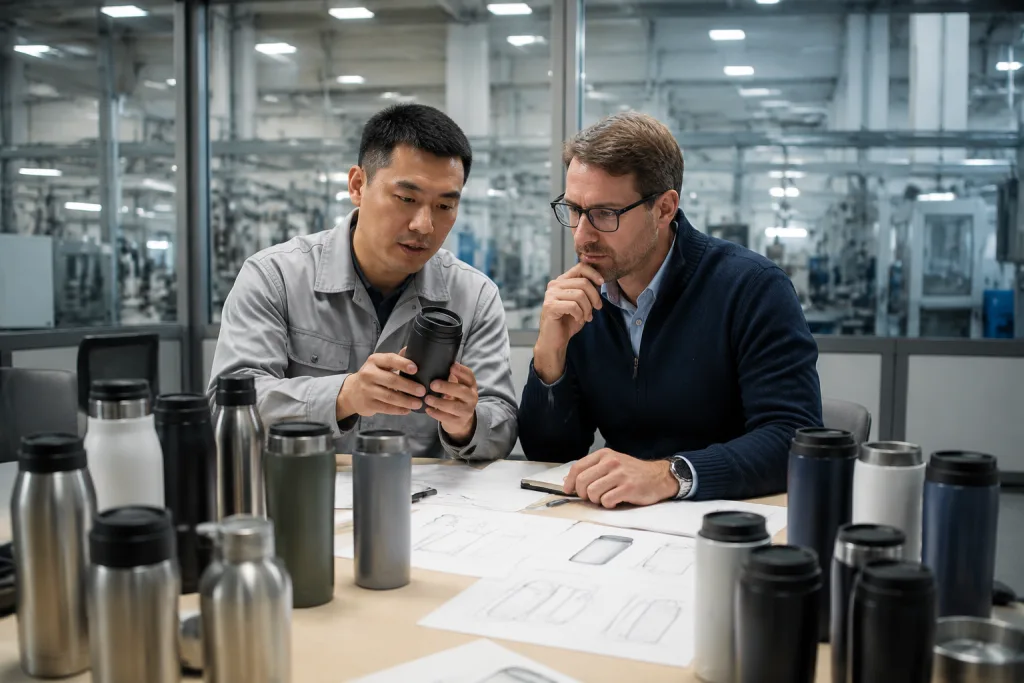
Most travel tumblers we ship use double-wall vacuum stainless construction. The usual inner wall is SUS304 because it touches coffee, milk, tea, and acidic drinks. Outside steel is often 201 or 304. A 304/201 build is fine for 30,000-piece coffee mug promotional products when the inside is 304 and the powder coating passes cross-hatch tape testing. Full 304/304 costs more, but the sales story is cleaner for premium coffee mug private label programs, and QC pulled fewer rust complaints after 48-hour salt spray checks on those orders.
Wall thickness matters. Too many quotes hide it. A normal tumbler body starts around 0.4-0.5 mm steel before stretching on the hydraulic forming line. Drop that below spec and the math doesn't work: you save a little weight, then lose cartons to dents during 18 kg master-carton compression and rough loading. Vacuum performance also comes from laser welding, bottom sealing, and vacuum evacuation, not steel grade alone. Ask for a heat retention test: 95°C water, 6 hours, measured at 20°C room temperature. A decent 20 oz tumbler should hold roughly 55-65°C after 6 hours, depending on lid opening and body geometry.
Lids carry the messy compliance risk. Tritan, PP, silicone, and gasket materials need food-contact declarations with the resin grade shown, not just a pretty PDF. For Europe, buyers often ask for LFGB or EU 1935/2004 support, plus REACH for coating and packaging components. For North America, many buyers request FDA food-contact documentation, CPSIA if children may use it, and sometimes ASTM-related performance checks. We have seen this go sideways when a black silicone gasket failed odor inspection after 3 days in the sample room; your coffee mug supplier should not treat testing as a last-minute PO line.
If you are building a coffee mug customizable range for 8 roasters, choose materials you can repeat for 12-24 months. A low quote from an unknown coffee mug supplier directory may use a temporary lid mold or coating code that disappears before your reorder. The buyer flagged this once when the second PO said “matte sage” but the factory matched “match sage” from a typo on the first PO. Small error. Big color argument.
Decoration and packaging costs
Brand owners look at the tumbler on a café counter, in a 12-second unboxing clip, or next to a laptop. We look at the line speed. Decoration is not “just add logo.” On a 3,000 pcs travel tumbler order last month, QC pulled 47 cups for logo position drift over 1.5 mm, and that scrap went straight into the unit price, inspection time, and shipping plan.
Laser engraving is the safer pick for 304 stainless and most powder coating; we run it for corporate names, roaster marks, or one clean logo at 35-45 seconds per cup. Silkscreen costs less for a one-color mark, but curved bodies and 0.3 mm fine lines are where it starts to bite. UV printing gives better color blocks, so we do cross-hatch adhesion testing with 3M tape, mainly on textured powder coating. Heat transfer covers a bigger graphic area, but the film cost is real, and a 500 pcs batch can move slower than a 2,000 pcs run because setup time does not shrink.
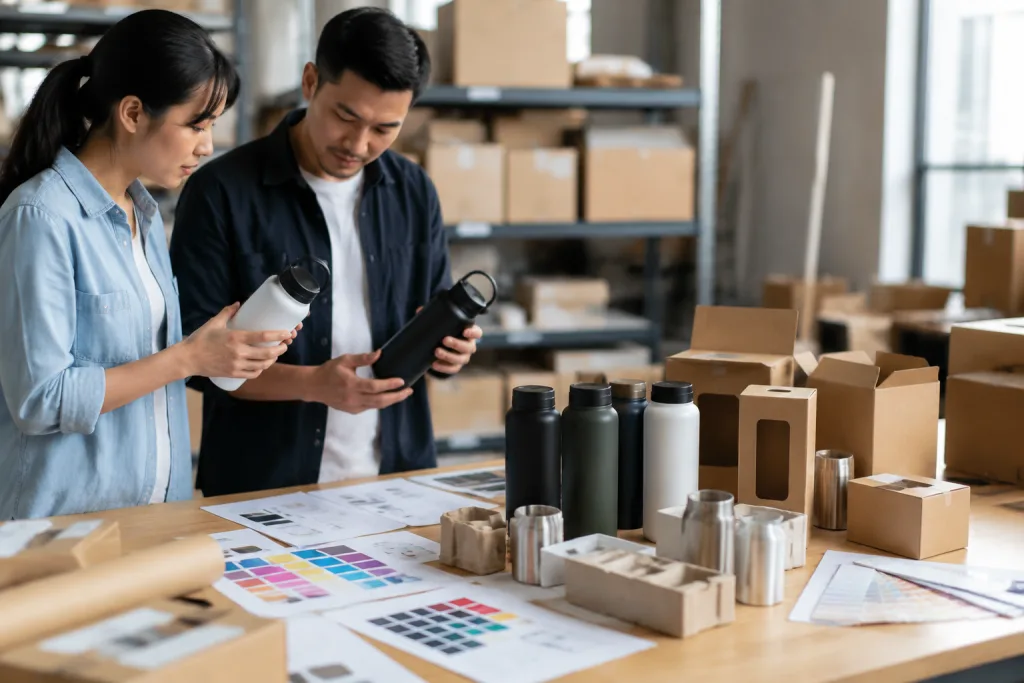
Packaging hides money too. A plain white box is cheap and fast. A printed color box with barcode, warning text, QR code, and FNSKU label is fine if the dieline is locked before sampling; we have seen a PO typo turn “BPA Free” into “BAP Free,” and the buyer flagged it after 2,400 boxes were printed. A gift set with straw, brush, insert card, and sleeve may add USD 0.60-1.50 per unit and 5-12 working days. For Amazon or distributor programs, define carton marks, pallet height, drop-test rules, and master carton weight early, or the math does not work at final inspection.
For travel tumbler private labeling, ask the factory to quote three separate lines: tumbler only, tumbler with decoration, and full retail pack with inner box and master carton. This is the cleaner question to ask. It keeps the buyer, designer, and finance team honest, and it also shows whether a factory direct quote is cheaper on the cup or only hiding cost in the packaging line. We ship clearer orders when the RFQ spells out MOQ, logo size in mm, and carton gross weight target from day one.
Quality checks before shipment
A sharp FOB price means nothing if 8% of lids leak or 27 cartons arrive crushed in your warehouse. For bulk coffee mug and bulk travel mug orders, lock the inspection standard before the line starts welding bodies. We run AQL Level II for general inspection, with critical defects at 0, major defects at 2.5, and minor defects at 4.0 unless the buyer’s QC manual is tighter; last month one PO even had “AQL 25” typed by mistake, and QC caught it before sampling.
For travel tumblers, the checklist needs real measurements: capacity by scale, unit weight in grams, 304 stainless confirmation, coating adhesion, logo position within 1.5 mm, color against the approved Pantone chip, lid fit, gasket seating, odor, vacuum performance, and carton strength. Do the ugly tests. A 3M tape pull on printing, a cross-hatch coating check with a 1 mm cutter, and a 95°C hot-water leak check will catch problems while rework is still cheap. For vacuum failure, sampling alone is the wrong question to ask; we run inline checks before packing because one weak weld can hide inside a clean-looking tumbler.
Certifications help with screening, but do not mix up factory audits and product compliance. BSCI, Sedex, or ISO 9001 tell you how the factory manages labor records, documents, and process control. They do not prove your powder coating passes REACH or your PP lid is food-safe for the EU. The test report must match the destination market and the exact item: same coating, same gasket, same straw, same supplier batch. We have seen this go sideways when a buyer accepted an old LFGB report for a different lid resin.
If you buy from a coffee mug factory in Zhejiang or another China manufacturing region, ask for pre-production samples, bulk material photos, and a final random inspection report before balance payment. For coffee mug distributors running several customer logos, keep one golden sample for each order in a labeled carton. Simple habit. When the buyer flagged a 3 mm logo height difference after delivery, the approved sample on our QC shelf settled the argument in 5 minutes.
How to compare vendor quotes
A coffee mug supplier list is only a starting point. The real job is sorting vendors by quote clarity, not sweet talk. A serious vendor should confirm 304 or 316 steel grade, capacity tolerance such as ±5%, lid material, MOQ by color, sample fee, tooling fee, unit price, packing method, lead time, payment terms, inspection method, and FOB port. We run into trouble when a quote skips 6 of those 13 items; procurement then has to guess, and guessing is where the math doesn't work. Last month QC pulled a 20 oz sample that measured 585 ml on the graduated cylinder, so “20 oz” on a quote was not enough.
Use one RFQ sheet for every supplier. Put your target quantity, delivery country, required test reports, logo method, carton limits, and required warehouse date in the first email. If you need coffee mug promotional products for a conference, give the event date and the hard latest ship date, not “ASAP.” If you need coffee mug customized retail packs for a coffee subscription box, say whether each unit needs barcode labeling and whether the barcode is EAN-13 or UPC-A. We once had a PO with “mat black” instead of “matte black,” and the buyer flagged the shade only after the pre-production sample. Good travel tumbler vendors answer with constraints, MOQ splits, and risk points instead of saying yes to everything.
For a first order, do not overbuild the product. A 16 oz or 20 oz stock travel tumbler with 304 inner steel, powder coating, laser logo, custom box, and AQL inspection is enough to judge a coffee mug manufacturer. Simple is faster. On our line, a stock body with laser marking can usually move to sample in 5-7 days, while a new molded lid often pushes sampling to 18-25 days before mass production even starts. Once the first order ships clean, move into coffee mug private labeling, custom lids, color series, and annual price locks with real order data behind the negotiation.
Factory direct buying from China can save money, but it needs clean decisions from your side. If you change artwork after sample approval, add 3-7 days. If you change box structure after printing plates are made, expect extra cost, because the CTP plate and die-line are already locked. We've seen this go sideways: one buyer changed the logo by 2 mm after the gold foil plate was finished, and the rework cost more than the sample fee. A good vendor protects your timeline by pushing back early, even when that answer is not what purchasing wants to hear.
Send your tumbler spec for a costed quote
Share quantity, size, logo method, packing, and delivery market. We will return a practical MOQ, FOB price, and lead-time plan.
Frequently asked questions
What MOQ should I expect from travel tumbler vendors?
For a stock stainless travel tumbler, expect 1,000 pieces per color as a practical MOQ. Some factories will accept 500 pieces, but the unit price is usually USD 0.20-0.45 higher and color consistency may be harder to control. For a coffee mug custom made body, custom handle, or unique lid, MOQ normally rises to 3,000-5,000 pieces because tooling, injection molding, and trial production must be scheduled. If you are testing a corporate-gift program, start with one body size and two colors rather than five colors at low quantity.
How much does a custom travel tumbler cost FOB China?
A standard 20 oz double-wall vacuum tumbler usually costs USD 3.20-4.30 FOB China with powder coating, one-position logo, and export carton packing. A premium retail version with 304/304 steel, better lid, color box, barcode label, and stronger decoration can reach USD 5.00-6.80. Tooling is separate if you need a custom body or lid. A coffee mug factory direct quote should clearly split base item, decoration, packaging, testing, and any mold charge so you can see what is driving the price.
Can I use the same tumbler for coffee retail and corporate gifts?
Yes, but the specification should match the tougher channel. Coffee retail needs repeatable color, shelf-ready packaging, barcode control, and food-contact documents. Corporate gifts need logo accuracy, gift-box appearance, and reliable delivery before an event date. A 20 oz 304 stainless inner tumbler with powder coating and laser engraving works for both. For coffee mug private label retail, add a printed box and insert card. For corporate gifting, you may instead use a plain kraft or white gift box to save USD 0.15-0.40 per unit.
How long should I allow for production and shipping?
For stock shapes, allow 30-45 days for production after deposit, artwork approval, and sample approval. Add 5-10 days for pre-production samples and 2-4 days for final inspection and loading. Ocean freight adds about 18-28 days to the US West Coast and 28-40 days to many European ports. If you need new tooling, add 12-25 days before mass production. For a fixed event date, a safe planning window is 75-90 days from approved specification to warehouse arrival.
What should I ask before choosing a coffee mug supplier?
Ask for the exact steel grade, wall thickness range, lid material, MOQ by color, sample timeline, mass production lead time, decoration method, packing details, FOB port, and payment terms. Then ask what test reports they can provide for your market: EU food contact, REACH, LFGB, FDA-related declarations, or other buyer requirements. Also ask about AQL inspection standards. A real coffee mug manufacturers team can answer with documents and limits. A weak vendor only sends photos and a low price.