Key Takeaways
- A realistic custom travel tumbler MOQ starts at 1,000 pcs per color for powder coating
- 304 stainless steel with 0.5 mm outer wall and 0.4 mm inner wall fits most coffee programs
- Laser logo tooling is usually USD 45-80, while full-wrap heat transfer setup can reach USD 120-250
- Normal China production lead time is 30-45 days after artwork and deposit approval
If you buy tumblers for a coffee brand, roastery, office campaign, or corporate gift program, finding a travel tumbler vendor is the easy part. The harder question is which spec survives 300 cycles in a dishwasher test, keeps a 45 mm logo print sharp, and still leaves margin after freight, duty, and the buyer’s “can you cut 8%?” email.
We manufacture custom drinkware in Hangzhou, Zhejiang, and we see the same RFQ mistake about 6 times a month: buyers ask for a bulk travel tumbler price before they lock the lid type, 304 stainless thickness, powder coating, carton pack, and test standard. The math doesn’t work. Last week QC pulled the sample and found two “same price” quotes used different lids: one passed the 180° leak test, the other dripped after 12 seconds. Here is the practical head-to-head view we use with new buyers.
Spec Table Before Price Talk
A serious travel tumbler vendor should quote from a locked spec table, not from one lifestyle photo. Send only a picture and ask for coffee mug custom pricing, and the line will fill in the blanks for you. Bad idea. One coffee mug factory may quote 201 stainless steel; another may quote 304. One may pack each piece in a 350 gsm kraft box, while another prices 24 pcs loose in a master carton. We had a buyer flag this last April: the cheaper offer used a 0.38 mm outer wall, not the 0.50 mm wall shown on their sample.
For coffee brands and corporate-gift buyers, we run these four builds first:
| Build | Capacity | Material | Best fit | Typical FOB China |
|---|---|---|---|---|
| Basic commuter | 350-400 ml | 304 inner, 201 outer | Budget event giveaway | USD 2.10-3.20 |
| Retail coffee tumbler | 450-600 ml | 304 inner and outer | Coffee shop resale | USD 3.40-5.20 |
| Car-cup travel mug | 600-900 ml | 304 stainless | Corporate desk and commute | USD 4.20-6.80 |
| Premium gift set | 500-750 ml | 304 or 316 inner | Employee and VIP gifts | USD 6.00-9.50 |
Those FOB ranges are not promises. They are starting points from normal China orders at 1,000-5,000 pcs, with logo artwork ready and carton marks confirmed. Wall thickness, lid construction, paint rejection rate, and packaging can move the quote by 15-35%; QC pulled one matte black sample last month because 7 pcs out of 50 had pinholes after the cross-hatch tape test. If a coffee mug supplier gives one number without the table, ask what is included before you compare. The lowest price is the wrong question to ask until the spec is nailed down.
Stainless Steel Versus Plastic Liners
For hot coffee, stainless steel wins in 8 out of 10 buyer programs we quote. A bulk coffee travel mug with a plastic inner liner looks cheaper on the first cost sheet, but we have seen it go sideways after repeated espresso, milk coffee, and 70°C dishwasher cycles. Odor hangs around. Stains show fast. Last April, QC pulled the sample after 24 hours with black coffee, and the buyer flagged the plastic smell before we even started the AQL 2.5 check.
Our default from the Zhejiang line is 304 stainless steel inside. For the outer shell, 201 can work on low-cost promotional programs when the target is a giveaway MOQ of 3,000 pcs, but 304 outer reads better for retail and private label. For a coffee mug private label program, saving USD 0.25 by downgrading the inner liner is the wrong place to cut. The math does not work once 2% of end users complain, because the liner touches the drink and creates the complaint trail.
Here is the practical comparison:
- 304 stainless inner: good corrosion resistance for coffee, stable after milk coffee use, and common for LFGB and FDA food-contact testing; we run a magnet check and XRF spot check on incoming coils.
- 316 stainless inner: stronger corrosion resistance, worth quoting when the buyer wants a premium spec story or a coastal-market angle, but it usually adds cost without changing daily coffee performance.
- Plastic inner liner: lower cost and acceptable for a 30-day promotion, weak for coffee mug promotional products used every morning; staining around the fill line is the usual first complaint.
- Glass inner liner: clean taste, but fragile; one drop test from 1.2 m can kill the program before mass production.
For a coffee mug manufacturer, the steel grade is easy to type on a quote. Proving consistency is harder. Ask for material test reports and incoming steel inspection records, then check whether the vendor can support REACH, LFGB, FDA, or California Proposition 65 screening when needed. We have seen one PO list “304 inner” while the approved sample tag said “201/304”; that single typo cost 3 days of email back-and-forth before pre-production sample signoff.
Lid Designs Change Everything
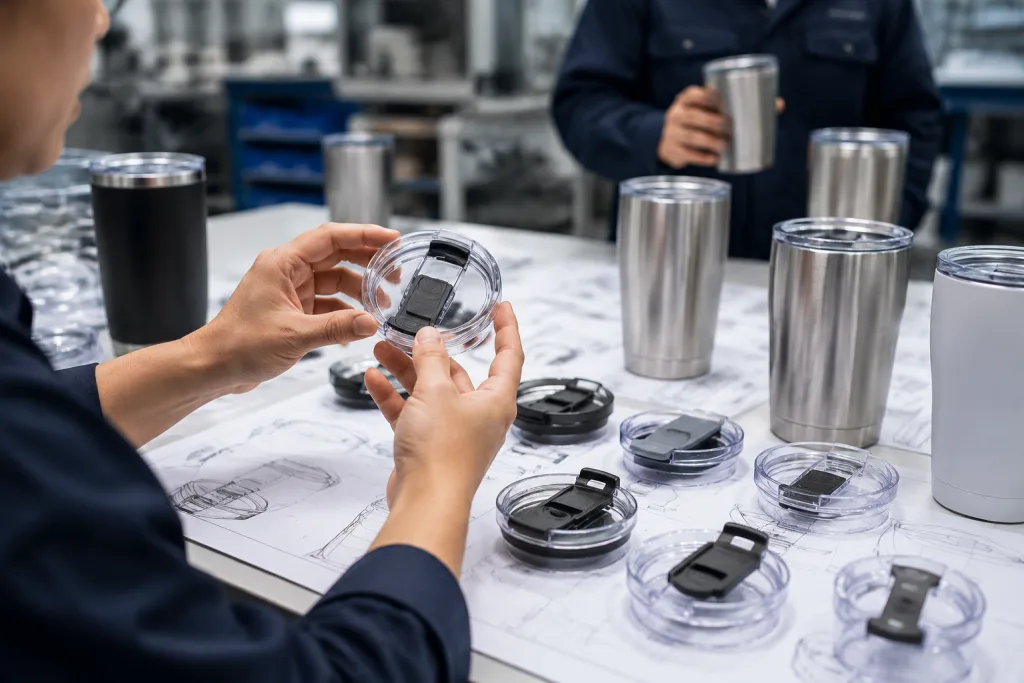
On bulk travel mugs, we see about 7 out of 10 field complaints start at the lid, not the cup body. Buyers spend half the call on Pantone matching and logo height, then the buyer flagged “water in backpack” after the first shipment. The lid decides whether the product leaks in a laptop bag, drips in a car cup holder, or feels loose after 14 days. A coffee mug oem manufacturer should put lid samples on the table before artwork approval, because one lid change can mean a new mold insert, different silicone hardness, extra assembly time, and a separate spare-part SKU.
The sliding lid is the low-cost choice and works for desk use. It is not leakproof. We run a simple 45-degree tilt check on the line, and QC pulled the sample last month because coffee seeped through a 0.4 mm slider gap. A flip lid with silicone plug is better for commuting, but the hinge pin and locking tab need cycle testing, at least 3,000 open-close pulls if the buyer plans retail. A screw lid with gasket is safer for corporate gifts, especially when 2,000 tumblers ship to 12 offices and users expect zero instruction sheet drama.
For coffee brands, we usually split the job by use case:
- Cafe merchandise: sliding or sip-through lid, since the customer carries it upright from counter to table and wants one-hand drinking.
- Corporate onboarding: screw lid or locked flip lid, because one HR complaint after distribution costs more than the 0.18 USD saved on a cheaper lid.
- Trade show giveaway: lower-cost push lid, but print “spill-resistant” on the insert card. Calling it leakproof is the wrong promise.
- Retail gift set: transparent Tritan lid with spare gasket; we usually pack the gasket in a 60 x 80 mm PE bag so the set feels complete.
If you sell through a coffee mug distributor or coffee mug distributors in different countries, ask whether spare lids can be ordered at 5-10% of tumbler quantity. We ship these in separate inner cartons, 100 pcs per carton, so the distributor can handle after-sales without opening finished gift boxes. Small detail. It saves angry emails later.
Logo Methods Head To Head
Logo choice is where buyers lose margin. We see it on about 6 of every 10 new tumbler RFQs: a coffee mug custom made program for a 300 pc roastery launch gets quoted like a 20,000 pc bank promotion. Wrong question to ask. Start with quantity, color count, coating texture, dishwasher claim, and whether the artwork crosses the 360° seam; our line checks that wrap position with a paper jig before tooling.
Laser engraving is durable and tidy. It works best on powder-coated 304 stainless steel, and we run it at USD 0.12-0.35 per position after a USD 45-80 setup. For coffee mug customized orders with a one-color logo, this is the safer premium option. QC pulled one black matte sample last month because the engraving depth was 0.03 mm too shallow under the caliper, so do not judge laser from a mockup only.
Silkscreen printing saves money on simple logos, mainly on white, black, or solid Pantone coatings. It is common for coffee mug promotional orders and bulk coffee mug campaigns. Expect USD 0.08-0.20 per color per position, with setup around USD 35-60 per color. The risk is abrasion if the ink and coating are not matched; we once had a buyer flag scuffing after 50 rubs on the 3M tape test, and the math did not work after rework.
Heat transfer and water transfer are better for gradients or full-wrap artwork. They look strong for a coffee mug customizable retail range, but rejection runs higher and the line moves slower. On 3,000 pcs, a full-wrap design may add 4-7 days compared with laser. We have seen this go sideways when a 1.5 mm lid shadow covered the top edge of the print, even though the flat artwork looked perfect.
Do not approve mass production from a flat PDF only. Ask for a pre-production sample with your real finish, real logo, and real lid.
For private-label buyers, coffee mug private labeling should cover carton marks, barcode, care card, and sometimes FNSKU labeling, not just the logo on the cup. Check the PO line by line; last quarter we caught one “FNSKU” typed as “FNSKUU” before carton printing, which saved 120 export cartons from relabeling.
MOQ And Lead Time Reality
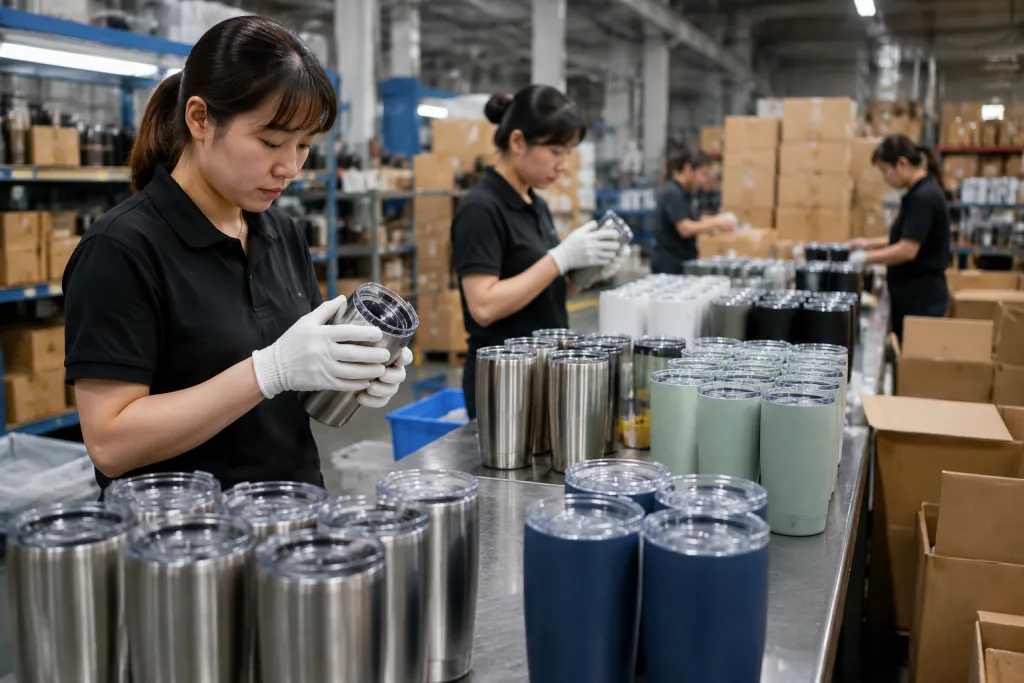
At BottleForge Industrial in Hangzhou, Zhejiang, we normally run custom travel tumbler orders at 1,000 pcs per color for powder coating, or 3,000 pcs when the job needs a new molded lid or an exclusive body shape. Our monthly capacity is about 450,000 stainless drinkware units across tumbler, bottle, and thermos lines. Capacity helps, but approvals still control the clock. Last month QC held 2,400 black 20 oz tumblers because the approved sample measured 0.18 mm thicker on coating than the mass-production pull.
A typical China timeline looks like this: 3-5 days for quote and artwork confirmation, 7-10 days for a decorated sample, 30-45 days for mass production after deposit, and 3-7 days for final inspection, packing, and booking. Then sea freight to North America or Europe adds several weeks, depending on port and sailing space. Air freight fixes time, not cost. We had one buyer ask for 18 days door-to-door on 12,000 pcs; the math did not work once the cartons hit 1,150 kg chargeable weight.
MOQ depends on the part you touch. A stock-shape bulk coffee tumbler with laser logo can start at 500-1,000 pcs if the color is already in our warehouse or scheduled on the line. A Pantone powder-coated bulk coffee mug usually needs 1,000 pcs because paint mixing, line cleaning, and rejection allowance cost real money. A new lid mold can cost USD 3,000-8,000, so it makes no sense for a 600 pcs conference giveaway. We check this with a mold-flow review, calipers on the lid fit, and a leak test before we quote it seriously.
If you are building a coffee mug supplier list or checking a coffee mug supplier directory, compare MOQ by component: cup body, coating, lid, logo method, retail box, barcode label, and paper insert. Factory direct does not always mean low MOQ. Coffee mug factory direct means fewer trading layers, but the production math stays the same. We have seen this go sideways when a PO says “matte navy” but the artwork file says Pantone 2965C, so the buyer flags the color after the first spray panel is already out of the oven.
Quality Checks Worth Paying For
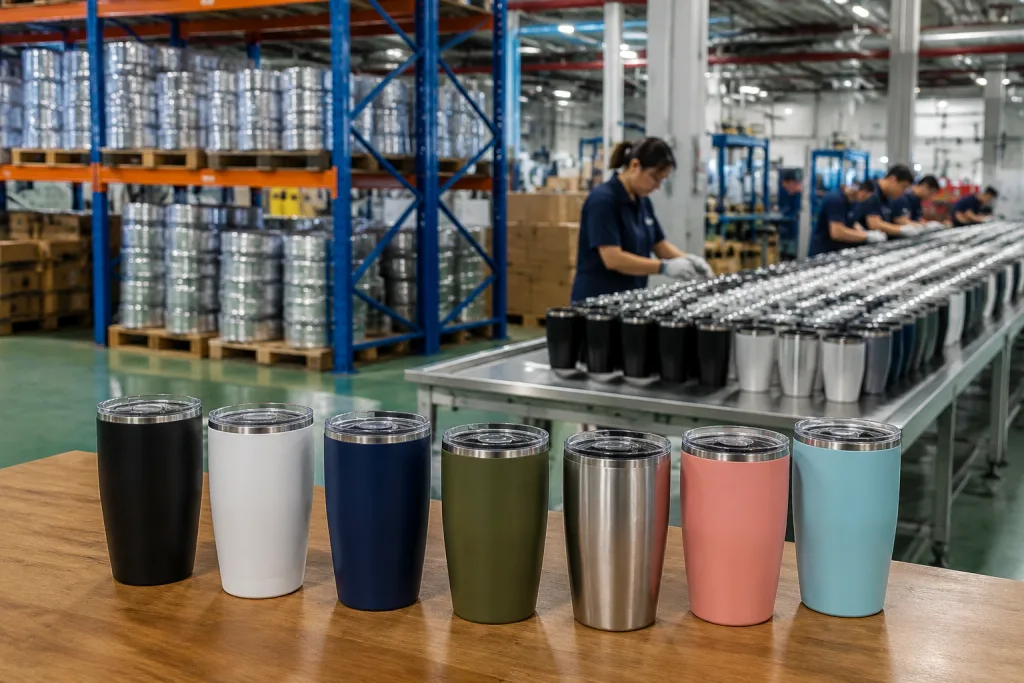
For a travel tumbler vendor order, inspection is not paperwork. It is cheap insurance. AQL inspection on a 5,000 pcs run usually costs less than one public complaint from a corporate client. We recommend AQL 2.5 for major defects and AQL 4.0 for minor defects on most bulk travel tumbler orders. For premium retail, lock the cosmetic standard before production starts, especially on matte black and light beige coatings where a 0.5 mm scratch shows under the QC light box. We have seen this go sideways when the buyer approved a glossy PP sample, then wrote “matte finish” in the PO.
The basic test list should cover vacuum retention, lid leakage, coating adhesion, logo abrasion, odor check, capacity check, carton drop, and barcode scan. If that sounds like too much, the math doesn’t work. A leaking lid can kill a reorder faster than a 3-day shipping delay. For vacuum performance, we run hot water at 95°C and check it after 6 hours with a probe thermometer. On a well-built double-wall tumbler, the outer wall should not feel hot in hand, and the temperature drop must match the signed sample within the agreed range. QC pulled one sample last month where the weld looked clean, but the body failed vacuum after 18 minutes.
Food-contact compliance depends on market. Europe often asks for LFGB, EU 1935/2004, REACH, and sometimes PAHs or heavy metal screening. The US often asks for FDA food-contact compliance, CPSIA if children are involved, and California Proposition 65 depending on distribution. If the order is for a coffee mug distributor serving 4 retailers, test requirements can sit above the legal minimum because each retailer adds its own restricted-substance list. We usually ask for the buyer’s test protocol before tooling, not after packing, because a missing PAHs line item can delay shipment by 12 days vs 18 days if retesting is needed.
Ask whether the coffee mug manufacturers you shortlist operate under ISO 9001, BSCI, Sedex, or similar audits. Certifications do not guarantee a clean shipment, but they show whether the factory has a management system beyond one sales rep and a photo catalog. This is the wrong question to ask if you stop at “Do you have certificates?” Ask for the audit expiry date, factory name on the report, and whether the address matches the production site. We once had a buyer flag a Sedex report where the Chinese address had one wrong district name; small typo, big trust problem.
Best Fit By Buyer Type
A coffee brand selling merchandise should start with drink feel and color repeatability, not the lowest FOB. This is the wrong question to ask if the first line on the brief is “cheapest coffee mug in bulk.” Your customer holds that tumbler at 7:30 a.m. every day. We run 500-600 ml 304 stainless bodies with powder coating, laser logo, and retail kraft box as the safer starting set; on the line, QC checks rim smoothness with a cotton wipe and rejects burrs over 0.2 mm. It costs more than a bare promo cup, but it protects the brand.
A corporate-gift buyer should cut complaint risk first. Use a stable lid, one conservative color, clear care instructions, and packaging strong enough for multi-location delivery. If HR or procurement ships to home addresses, we ship individual color box plus outer carton with 5-ply export board; our packing table drop-test is 60 cm on one corner and two edges before we release the carton spec. Thin white boxes look cheaper on the quote. We’ve seen this go sideways when 300 cartons arrive with crushed corners.
A promotional-products buyer working through a coffee mug factory often has a tighter target price. Fine. Accept a simpler lid and silkscreen logo, but keep 304 stainless inside. For coffee mug promotional products, USD 0.40-0.70 is often the gap between a throwaway giveaway and a desk mug people keep; the math doesn’t work if the buyer saves USD 0.22 and then gets 2% lid complaints. QC pulled the sample last month because the silkscreen logo sat 3 mm off-center.
A distributor needs repeatability. If you are a coffee mug distributor managing seasonal programs, ask your vendor to reserve coating recipes, lid BOM, gasket material, and carton layout. Coffee mug manufacturers in China can repeat a program well, but only when the approved sample and production file are controlled. We keep a sealed gold sample, Pantone chip, torque note for the lid thread, and carton drawing in the job folder; one PO typo changing “matte sand beige” to “matte beige” delayed approval by 12 days vs 18 days when the buyer had no signed color card. For coffee mug factory direct sourcing, that production file is your insurance policy.
Send Your Travel Tumbler RFQ For Factory Review
Share capacity, lid style, logo artwork, market, and target quantity. We will return a practical China factory quote with risks marked clearly.
Frequently asked questions
What MOQ should I expect from a travel tumbler vendor?
For a stock-shape travel tumbler with a standard factory color, MOQ can be 500-1,000 pcs. For custom Pantone powder coating, plan on 1,000 pcs per color. For a new lid, new body mold, or exclusive silhouette, MOQ usually moves to 3,000-5,000 pcs, plus tooling from USD 3,000-12,000 depending on complexity. If you need multiple logos for departments or cafe branches, ask whether the factory can split laser engraving within one body color. That is often easier than splitting coating colors.
Is laser engraving better than printing for coffee brands?
Laser engraving is usually better for coffee brands that want a durable, retail-grade look on powder-coated stainless steel. It does not peel like ink, and it handles daily handwashing well. The trade-off is that it is normally one-tone; the logo appears as the exposed steel or underlayer color. Silkscreen printing is better when you need exact brand colors or a lower unit cost on a bulk coffee mug order. For 1,000 pcs, laser may add USD 0.12-0.35 each, while one-color print may sit around USD 0.08-0.20, depending on size and position.
Can you ship custom tumblers directly to Amazon or 3PL warehouses?
Yes, but you need to specify that before packing is quoted. Amazon and many 3PLs require scannable barcodes, carton labels, carton weight limits, and sometimes FNSKU labeling on each retail unit. A normal export carton may not be enough. For a bulk coffee travel mug shipment, we can pack individual color boxes, add suffocation warnings if polybags are used, apply FNSKU labels, and keep cartons under a requested weight such as 15 kg. This adds labor and label cost, but it avoids warehouse refusal.
What is a fair FOB price for a custom travel tumbler?
For a 450-600 ml double-wall stainless tumbler with 304 inner, powder coating, standard lid, one logo, and individual box, a realistic FOB China range is often USD 3.40-5.20 at 1,000-5,000 pcs. Larger 900 ml car-cup styles may run USD 4.20-6.80. Premium gift sets with straw, handle, retail insert, or 316 inner can reach USD 6.00-9.50. If a quote is 25% lower than the market, check steel grade, wall thickness, lid gasket, coating type, and packaging before assuming it is better.
How do I compare a coffee mug supplier list properly?
Build a comparison sheet with the same capacity, steel grade, wall thickness, lid design, coating, logo method, packing, test standard, MOQ, lead time, and payment terms. Ask every coffee mug supplier to quote against that sheet. Also request sample photos from actual production, not only catalog renders. A useful supplier list should separate trading companies, factories, and OEM manufacturers. Factory direct can be valuable, but only if the factory communicates clearly, provides compliance documents, accepts AQL inspection, and can repeat the approved sample in mass production.