Key Takeaways
- A realistic custom tumbler MOQ is 1,000-3,000 pcs per color for powder coating
- 304 stainless steel at 0.4-0.5 mm wall thickness is the normal export baseline
- Laser engraving suits 500-2,000 pcs; full-wrap print needs tighter artwork control
- Expect 25-35 days production after deposit and approved pre-production sample
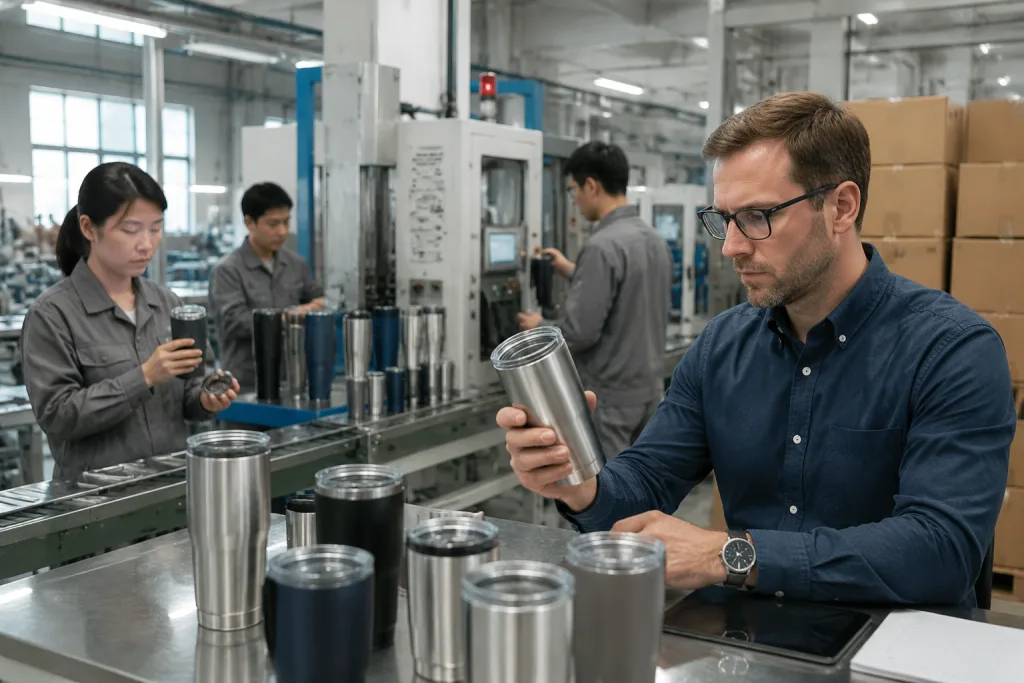
If you are sourcing tumblers for a coffee launch, office gift, or distributor catalog, the hard part is not finding travel tumbler suppliers. It is choosing one without paying for the wrong steel grade, weak insulation, 12-day artwork approval that turns into 18 days, or cartons that land with dented lids. We have seen a glossy sample pass the buyer’s desk, then QC pulled the bulk sample and found a 0.6 mm lid gap on the caliper. That is where orders go sideways.
From our factory base in Hangzhou, Zhejiang, we see buyers make the same four calls: product structure, branding method, compliance level, and order economics. Ask for the price list too early and the math does not work. A cheap cup is easy to quote; a reliable bulk travel tumbler program needs stable laser welding, lid fit checked on the line, coating adhesion after a 3M tape test, and inspection standards such as AQL 2.5 written clearly on the PO. Last month a buyer even typed “304 stainless” on the spec sheet and “201” on the PO. We flagged it before production.
Start with the usage case
Your first decision is not capacity or color. It is where the cup gets used. A coffee brand selling through retail needs a different build than a corporate-gift buyer packing 8,000 pieces for a 2-day conference. We had one buyer flag this after their PO said “desk mug,” while their sales team wanted a commuter cup for subway use. That changes the lid, the gasket, and even the base diameter. A desk-drink coffee mug promotional program can live with a simple slide lid. A commuter bulk coffee travel mug needs one-hand opening, better leak resistance, and a bottom that stays around 68-72 mm so it fits common car cup holders.
For coffee brands, we run 350 ml, 450 ml, and 600 ml most often. The 350 ml size fits espresso-based drinks and does not crowd a retail shelf. The 450 ml size is the safer bet; our line packs it cleanly in a 7-layer export carton without wasting foam space. The 600 ml size looks generous, but carton volume goes up by 20-35%, and the math does not work if the buyer later asks for air freight. For corporate gifts, 450 ml and 500 ml feel substantial without pushing the gift box past a practical size.
Then choose the drinking style. A slide lid is cheaper and easier to clean, but it is not leakproof. A flip lid with silicone gasket adds USD 0.25-0.60 depending on structure, but QC pulled fewer wet-carton complaints on commuter orders with that setup. A straw lid suits lifestyle brands; it is the wrong lid for hot coffee. If you are a coffee mug distributor or one of several coffee mug distributors building a catalog, do not mix too many lid systems in the first order. We have seen this go sideways: 3 lid molds, 2 gasket sizes, and one instruction insert typo turned a simple reorder into a spare-parts argument.
Good sourcing starts with the user scenario, not with the cheapest FOB quote.
Choose steel, insulation, and lid
In our export orders, 304 stainless steel on the inner wall is the baseline for Europe and North America. Outer wall can be 201 or 304, depending on target price and finish. If a coffee mug factory comes in 8-12% below the other quotes, this is the wrong question to ask: do not ask why it is cheap first, ask them to confirm the inner wall steel grade and sheet thickness. A normal double-wall vacuum travel tumbler uses 0.4-0.5 mm stainless sheet before forming. We have seen 0.32 mm bodies look fine on the desk sample, then QC pulled the sample after a 1.2 m carton drop because the shoulder dented near the rolled mouth.
Vacuum insulation comes from the weld seam, vacuum pumping time, copper plating coverage, and lid seal, not from nice words on a quotation sheet. For a 450 ml bulk coffee tumbler, a practical benchmark is 6 hours above 55°C when filled with 95°C water and tested at 20°C room temperature. Some designs hold heat longer, but the lid usually decides the result. A wide drinking slot loses heat faster than a sealed flip lid; on our line, we test this with a K-type probe through a drilled test cap, and a 2 mm gap at the slider can drop the reading by 5-7°C after 6 hours.
Ask the coffee mug manufacturer for these quote details before approval: steel grade declaration with inner and outer wall separated, lid material with resin code, gasket material with cleaning design. PP lids are common. Tritan works for clearer lids, but the math doesn't work for every promo order because it can add USD 0.18-0.35 per lid at 5,000 pcs MOQ. Silicone gaskets should be food-grade and removable for cleaning. For EU buyers, LFGB testing may be requested in addition to standard food contact checks. For US buyers, FDA food-contact expectations and, for kids-related items, CPSIA/ASTM considerations may apply. We once had a PO typo that changed “PP lid” to “PC lid,” and the buyer flagged it during document review before production release.
At BottleForge Industrial in Zhejiang, our standard output for stainless drinkware is about 600,000 units/month across tumbler and bottle lines. Capacity only matters if the quality system holds tolerance. We run go/no-go gauges on mouth diameter, check thread fit with production lids every 30 minutes, and record lid gasket compression so the first 500 pieces do not feel tighter than the last carton. We have seen this go sideways when a supplier changes a polishing wheel mid-shift and the mouth edge loses 0.15 mm after buffing.
Decide how your logo should age
Branding is where a lot of coffee mug custom projects go sideways. In the last 12 sample reviews we handled, 5 buyers picked the best-looking render instead of the logo method that survives a backpack, car cup holder, and office dishwasher. Wrong question. The right question is how the logo should look after 6 months of use. A coffee mug customizable design for retail has different needs than a one-off HR gift. On a matte powder-coated tumbler, we usually push for laser engraving when the artwork is small and clean. The fiber laser strips the coating by about 0.03 mm and shows the 304 stainless underneath. Clean edge. No ink to peel. It works well for small logos, staff names, and corporate text, but the math does not work for multi-color artwork.
Silkscreen printing is cheaper for one- or two-color logos, often adding USD 0.08-0.25 per position depending on size and quantity. It suits simple coffee mug promotional products, as long as the surface treatment and oven curing are controlled. On the line, QC pulled the sample after curing and ran a 3M tape test plus a cross-hatch test before we released mass production. If your design wraps around the cup, expect extra setup time and a higher reject rate. The tumbler is tapered and curved, so a 210 mm wrap that looks perfect on a flat AI file can drift by 1.5-2 mm at the seam.
Heat transfer and UV printing give richer color. They fit coffee mug customized artwork, limited campaigns, and influencer-style packaging where the buyer wants a photo-grade look. Cost and surface durability are the trade-off. We have seen this go sideways when a buyer approved a glossy UV logo, then asked for “dishwasher safe” text on the instruction sheet 2 days before packing. For a coffee mug custom made program that will sell at retail, ask for dishwasher guidance at sample stage and write it on the PO. Many powder-coated, printed tumblers should be labeled hand-wash only, even if the sales team wants a softer answer.
Private-label packaging needs early decisions too. A coffee mug private label program may include printed boxes, hang tags, instruction leaflets, and barcode labels. Coffee mug private labeling is not just a logo on the cup. We ship cartons where the buyer flagged a missing country-of-origin line, a wrong EAN digit, or a “matel” typo on the PO after the master carton artwork was already plated. If your distributor requires carton marks, inner box labels, or country-of-origin text, approve those at sample stage. Fixing packaging after production starts can cost 5-7 days.
Compare quotes beyond FOB price
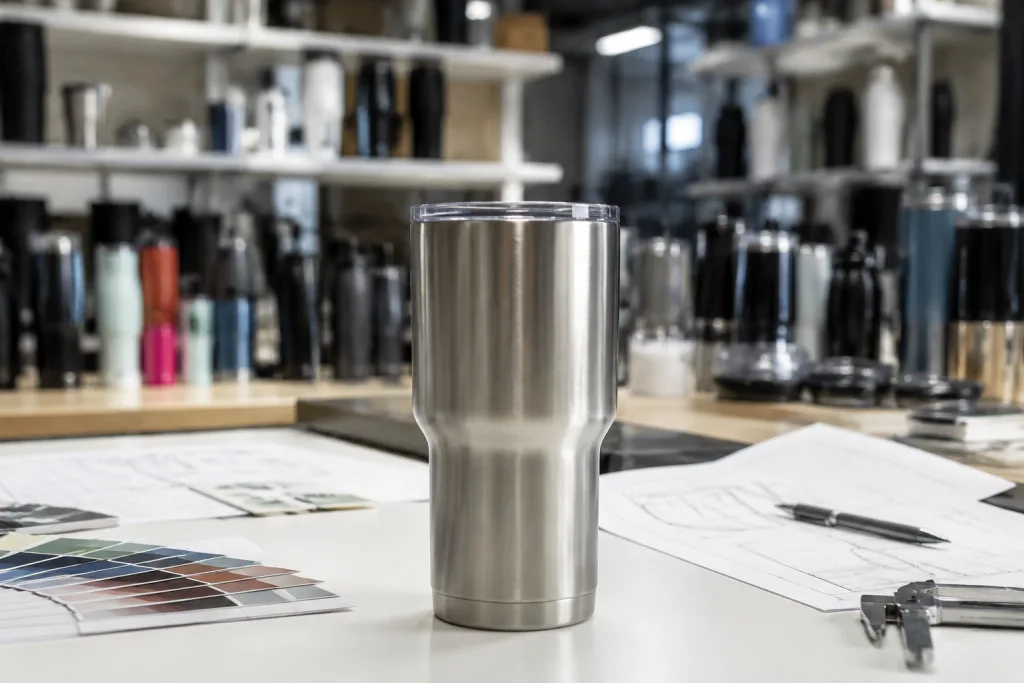
Send every travel tumbler supplier the same spec sheet. A photo plus “best price” is the wrong question to ask. We’ve seen 7 quotes come back for 7 different cups: one with 304 inner and 201 outer, one with 0.38 mm thinner steel, one missing the individual white box. Last month QC pulled a quote sample where the PO said “304 stainless,” but the outer shell tested as 201 on the XRF gun. The lowest FOB Ningbo or FOB Shanghai number can be the least useful number in the file.
For a 450 ml stainless bulk travel mug with powder coating, individual white box, and one-position laser logo, a realistic factory-direct export range from China is often USD 3.20-5.80 FOB depending on lid, finish, and quantity. MOQ usually starts around 1,000 pcs for stock shapes and 3,000 pcs when the buyer wants a matched Pantone powder coat. A simple bulk coffee mug with plastic inner liner can be cheaper, but it sits in another product class. Don’t mix them. If you compare a coffee mug in bulk for office giveaways against an insulated retail tumbler, the math doesn’t work.
Build a quote table with these columns: capacity, steel grade, wall thickness, lid type, logo method, packaging, MOQ, sample cost, production lead time, carton dimensions, and gross weight. Ask for carton size in cm and gross weight in kg, because a 58×39×25 cm carton shipping 24 pcs prices differently from a 46×31×28 cm carton shipping 12 pcs. Add inland freight and document charges if your supplier quotes EXW instead of FOB. A coffee mug factory direct quote can save margin, but only if your team can handle AI artwork files, pre-shipment inspection, and the commercial invoice without a trading layer.
Check payment terms line by line. Standard terms are 30% deposit and 70% before shipment for new buyers. Tooling or custom molds may require 50% upfront. For repeat coffee mug oem manufacturer projects, better terms can be discussed after two or three clean orders; we usually talk about it after the second container ships with no chargeback. If a quote is unusually cheap, ask what inspection standard is included. AQL 2.5 for major defects and 4.0 for minor defects is common for drinkware exports, and the buyer should confirm whether the line inspection includes vacuum test, coating cross-hatch test, and lid leak test.
Set compliance before artwork
Compliance will not sell the tumbler, but it can stop the shipment. Set it before the line opens. For Europe, we usually check food-contact material declarations, LFGB or EU 1935/2004-related testing, REACH checks for powder coating, and packaging waste markings by destination market. For North America, 7 out of 10 retail buyers ask for FDA food-contact documentation, California Proposition 65 review when applicable, and third-party lab reports for coatings or plastics. Corporate-gift programs also ask for BSCI, Sedex, ISO 9001, or factory audit documents. Last month, QC pulled a 40 oz sample with a PP lid insert marked wrong on the BOM, and the buyer flagged it before artwork approval.
Do not assume every coffee mug supplier has current reports for your exact model and color. This is where orders go sideways. A test report from another lid, coating, or plastic straw part may fail a strict importer review, even if the cup body is still 304 stainless. If you need reports under your company name, budget USD 250-900 per test group depending on lab, country, and scope. Lead time is often 5-10 working days after samples arrive at the lab. We ship samples in a 3-piece lab pack with model code, color chip number, and lid material written on the sample card, because one PO typo in “AS lid” versus “PP lid” can cost a full retest.
Amazon and distributor programs add operational compliance. If you sell through FBA or a third-party warehouse, confirm FNSKU labels, suffocation warnings for polybags, master carton limits, and drop-test expectations before carton printing. A carton above 15-18 kg may be rejected or trigger handling complaints. The math does not work if you save USD 0.04 on a thinner carton and then fail a 76 cm drop test. For coffee mug distributor list placement or a coffee mug supplier directory submission, buyers often ask for product photos, dimensions, certificates, and packing data in a fixed format. We run a carton check with a digital scale and caliper, then record gross weight, carton size in mm, and pieces per carton on the packing sheet.
Our practical advice from Zhejiang: freeze compliance requirements before you freeze decoration. A coating can look clean under the spray booth light and still fail a chemical migration test or a 3M tape scratch test. China factories can adjust materials, but not after 12,000 coated cups are already finished. Ask this before artwork: which market, which test standard, whose name on the report, and which exact lid, straw, coating, and gasket are included.
Control samples and production risk
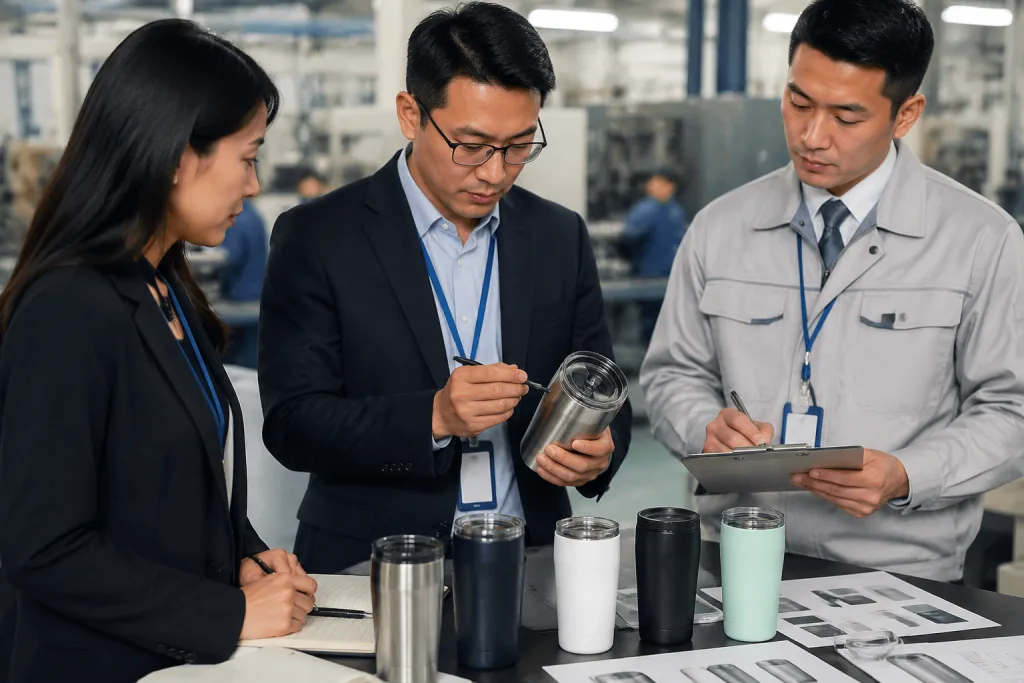
Samples are not souvenirs. They are control tools. For a new bulk coffee travel mug project, ask for a blank sample first if we have not run that body before. Put it in a real car cup holder, weigh it on a 0.1 g bench scale, check the lid thread with wet hands, and drink from it for 10 minutes. Small things show up fast. After that, approve a decorated pre-production sample with the exact logo size, Pantone color, packaging layout, and barcode. Keep one approved sample on your desk and leave one sealed in our sample room with the PO number on the carton; QC pulled the sample more than once when a buyer flagged a 2 mm logo shift.
Typical sample timing is 3-5 days for existing blanks and 7-12 days for decorated samples. Mass production usually takes 25-35 days after deposit and sample approval. Peak season before Q4 can stretch to 40-50 days, especially for powder coating and gift-box printing. If your event date is fixed, add at least 10 days of buffer for inspection, vessel booking, and customs paperwork. We have seen this go sideways when a buyer counted 35 days from PO issue, not from deposit received; the line was ready, but the custom box film still needed 6 days at the printer.
Inspection should happen before final payment and before the goods leave the factory. For 5,000 tumblers, an ANSI/ASQ Z1.4 general inspection level II sample size is commonly used, with AQL 2.5/4.0 unless your buyer sets stricter terms. Inspectors should check vacuum performance with a hot-water hold test, coating scratches under a 600 lux lamp, logo position against the artwork, lid leakage after a 30-second inversion, odor, carton drop damage, barcode scanning, and packing quantity. A leak test on every unit sounds good, but the math does not work on most orders; at minimum, write the sampling plan into the PI before we ship.
If you are building a long-term coffee mug supplier list, track defect rates by model and batch. One clean order does not prove a factory. Three repeat orders with stable cartons, clean documents, and complaint rates below 1% tell you much more. We run a simple batch sheet for each PO, and one buyer once found the carton mark typo “STAINLESS STEEL TUMBER” before loading because that sheet had the artwork revision number printed on it.
Pick the right supplier model
Most buyers end up with one of three sourcing routes: trading company, factory-direct, or hybrid export manufacturer. A trading company makes sense if your PO has ceramic mugs, notebooks, and travel tumblers in the same 40HQ. Factory-direct gives tighter cost control and cleaner answers on 304 stainless thickness, lid fit, and powder coating, but your spec sheet must be sharp. A hybrid coffee mug manufacturer with export sales engineers is often the safest middle ground: we run the line, then prepare the carton marks, test reports, and pre-shipment files your import team asks for. Last month a buyer sent a PO with “mat black” on page 1 and “PMS Black 6C” on page 3; QC pulled the sample before mass coating, or that mistake would have cost 12 days.
For coffee brands and corporate-gift buyers, fastest reply is the wrong question to ask. Ask what the supplier makes in-house. Vacuum forming, welding, polishing, powder coating, printing, and packing do not always sit under one roof; in Yongkang and Hangzhou, 2 or 3 workshops are common on one tumbler project. Outsourcing is normal in China. Loose control is not. Ask for monthly capacity, current lead time, BSCI or ISO status, and photos of the actual production line, not a clean showroom with 20 display cups. We had one buyer flag a “factory” because every welding photo used the same angle and no worker had a jig or caliper in frame.
MOQ tells you fast who you are dealing with. If a supplier accepts 100 pieces of a fully coffee mug customized design at a low price, it is probably a stock reseller changing the logo only. Fine for a sample run. Bad math for a national campaign with 80,000 pcs and fixed delivery windows. For custom color powder coating, 1,000-3,000 pcs per color is more realistic because the coating line loses material during color change and oven setup. For custom molds, 10,000 pcs and tooling cost from USD 1,500-6,000 are common depending on lid and body complexity. On our side, a new push-button lid usually means CNC sample, silicone gasket trial, and at least 2 leak tests before we quote mass tooling.
The right travel tumbler suppliers should push back on weak specifications. If you ask for dishwasher-safe full-color print on matte coating at the lowest price, a serious supplier will explain the risk before taking the deposit. We have seen this go sideways: print passed the desk sample, then failed after 8 dishwasher cycles because the coating and ink system did not match. A perfect-looking quote sheet is cheap. A supplier who catches that problem before production is worth more.
Send your tumbler spec before you buy
Share capacity, lid, logo, quantity, market, and packing needs. We will reply with a practical FOB quote and risk notes.
Frequently asked questions
What MOQ should I expect from travel tumbler suppliers?
For existing stainless travel tumbler bodies, expect 500-1,000 pcs for laser logo on stock colors and 1,000-3,000 pcs per color for custom powder coating. If you need a coffee mug custom made body, new lid tooling, or a special molded handle, MOQ often moves to 10,000 pcs because tooling setup and line changeover are not cheap. Packaging has its own MOQ too. Printed gift boxes may start at 1,000-2,000 pcs, while custom color cartons may require more. A small test order is possible, but the unit price can be 15-40% higher than a normal bulk travel tumbler run.
How do I know if a quoted bulk coffee tumbler is good quality?
Ask for measurable specifications, not adjectives. You want 304 stainless steel on the inner wall, clear outer-wall material, 0.4-0.5 mm sheet thickness before forming, food-grade PP or Tritan lid, silicone gasket, and a defined heat-retention test. For a 450 ml vacuum tumbler, holding water above 55°C after 6 hours at 20°C room temperature is a practical benchmark. Check the lid fit, odor, coating smoothness, base stability, and logo alignment on the sample. For production, use AQL inspection and include vacuum failure, leakage, dents, scratches, and barcode errors as checkpoints.
Is laser engraving better than printing for a coffee mug promotional order?
Laser engraving is usually better when the logo is simple, the tumbler is powder coated, and the buyer cares about durability. It does not peel because it removes the coating and exposes the stainless surface. Printing is better for multi-color artwork, campaign graphics, or large brand marks. For a coffee mug promotional order under tight budget, one-color silkscreen can be economical, often adding USD 0.08-0.25 per unit. For retail coffee mug customized programs, test adhesion before mass production. A nice printed sample is not enough; ask for tape, rub, and wash guidance.
What is a realistic lead time for a coffee mug private label project?
For an existing tumbler body with logo and printed box, plan 3-5 days for blank samples, 7-12 days for decorated samples, and 25-35 days for mass production after approval and deposit. Add 5-10 working days if you need third-party LFGB, FDA-related, or REACH testing. During Q3 and early Q4, production can stretch to 40-50 days because powder coating, printing, and packaging lines get crowded. Sea freight to North America or Europe may add 25-45 days port to port, so a safe private-label calendar is usually 8-12 weeks.
Should I use a coffee mug supplier directory or go factory direct?
A coffee mug supplier directory can help you build an initial coffee mug supplier list, but it does not replace qualification. Many listings show similar photos, and some companies are resellers rather than manufacturers. If you need one mixed promotional order, a reseller may be fine. If you need repeat bulk coffee mug orders, consistent color, private labeling, and compliance files, factory direct or an export-focused manufacturer is safer. Ask for factory audit documents, production-line photos, monthly capacity, sample records, and packing data. The best supplier is not the one with the longest catalog; it is the one that controls your exact product.