Key Takeaways
- A 500 ml stainless travel tumbler usually lands at USD 3.20-6.80 FOB Ningbo or Shanghai depending on lid, finish, and packaging
- Practical MOQ starts at 500 pcs for stock colors and 3,000 pcs for custom powder coating
- Normal production lead time is 25-40 days after artwork and deposit approval
- Logo and packaging decisions can change total project cost by 8-22%
If you are buying branded tumblers for a coffee chain, roaster, subscription box, or corporate-gift program, the first quote is rarely the landed cost. A USD 3.20 tumbler can become USD 4.10 after powder coating, laser logo, insert card, carton tests, and inland freight. We see this on the costing sheet before the sample room even fixes the logo position at 38 mm from the rim. Ask for the cost before artwork approval, not after the PI is signed.
As a travel tumbler supplier in Zhejiang, China, we run into the same issue 6 or 7 times a month: buyers compare unit price and skip MOQ tiers, lead time, defect allowance, and packaging volume. A bulk coffee travel mug order is not hard, but vague specs make the math fail fast. Last month QC pulled the sample because the PO said “matte black” while the approved color chip was Pantone Black 6 C, and that one typo pushed the line back 2 days.
Start With The Real Unit Cost
Ask a coffee mug supplier for the use case before you ask for the price. This is the right starting point. A 2,000 pcs corporate event travel mug can run a basic flip lid and a 250 g E-flute box because nobody is putting it on a retail shelf. A coffee brand selling through cafés needs better lip feel, cleaner powder coating around the rim, and packaging that survives staff handling; we once had QC pull 18 scratched boxes from a 200 pcs pre-shipment sample because the buyer’s shelf test was stricter than the PO said. Those two products look close in a PDF. They are not the same build.
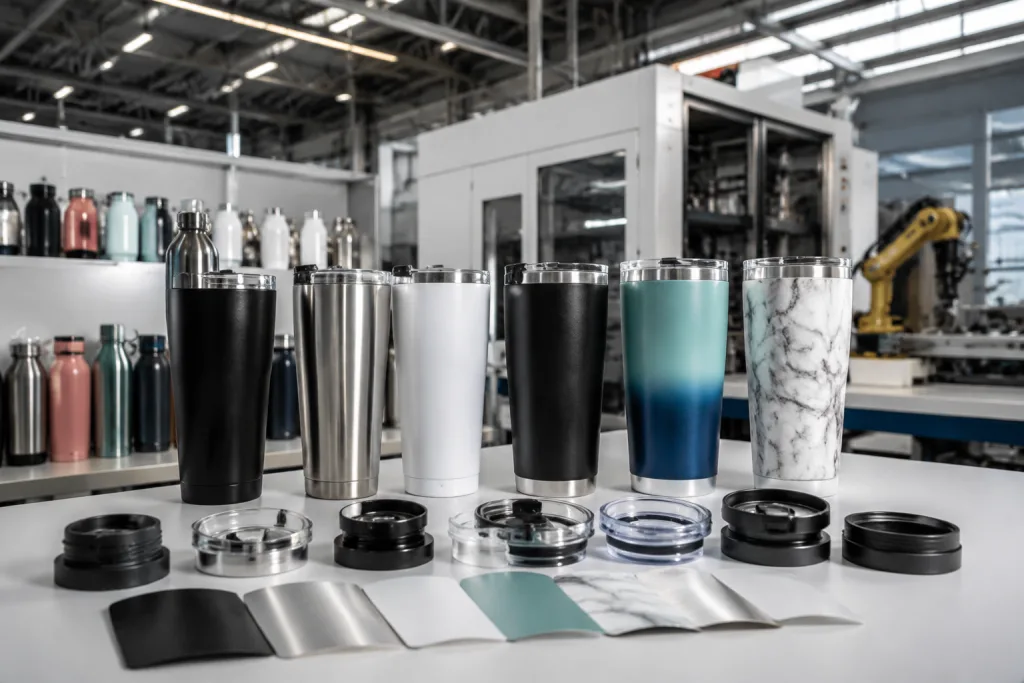
For a 500 ml double-wall stainless tumbler, a realistic FOB China range is usually USD 3.20-4.20 for stock shape, stock color, and one-position laser logo at 1,000-3,000 pcs. A more retail-ready bulk coffee tumbler with custom color, sliding lid, silicone base, 350 g white box, and insert card often sits at USD 4.60-6.80. If you need a ceramic-lined interior or leak-resistant push-button lid, expect another USD 0.45-1.20 per unit. On our line, the price also changes when the buyer wants 12 days sampling instead of 18 days, because we have to jump the powder coat queue and run a smaller fixture batch.
The steel grade matters. Most export coffee mug factory direct programs use 304 stainless steel inside and 201 or 304 outside. Wall thickness often runs 0.4-0.5 mm inner and 0.5 mm outer. Thinner steel saves money, but it dents faster in transit and feels cheap in hand; we have seen 0.38 mm inner walls pass the drawing review and then fail the 80 cm carton drop test with rim deformation. For coffee brands, saving USD 0.15 here is the wrong math.
Ask your coffee mug manufacturer to quote by line item: base tumbler, lid, logo, finish, packaging, carton, and testing. Push for the real BOM split, not one tidy number. If the supplier refuses, you cannot tell whether you are buying efficient tooling or a hidden downgrade, such as a 5-layer carton swapped to 3-layer after the PO typo says “standard export carton.” We have seen this go sideways at final inspection.
MOQ Tiers Change The Math
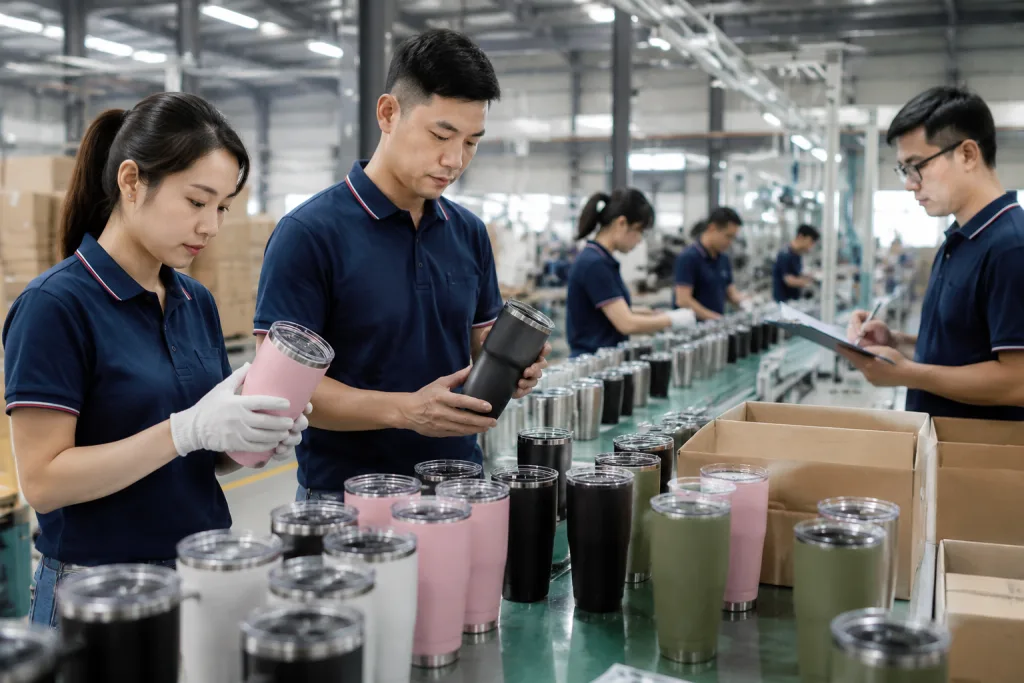
MOQ is not a punishment. It is the point where setup labor, fixture time, and carton handling stop eating the order. At BottleForge Industrial in Hangzhou, Zhejiang, our normal monthly travel tumbler capacity is about 420,000 units/month, but a 500 pc run and a 10,000 pc run do not sit on the same cost sheet. We run 500 pcs on stock bodies when the buyer accepts available body colors, existing 24 pcs/master carton packing, and no new barcode layout. QC still checks rim roundness with a 0.02 mm caliper. The math doesn't work if a buyer asks 500 pcs to carry the same price as a 10,000 pc replenishment order.
For stock bodies, common MOQ tiers are 500 pcs for laser engraving, 1,000 pcs for silkscreen printing, and 3,000 pcs for custom powder coating. The laser table needs one positioning jig; silkscreen needs film, mesh, ink mixing, and a first-article pull; powder coating ties up the line for color change and oven cleanup. For molded lids, new shape development usually starts at 8,000-15,000 pcs because plastic tooling can cost USD 2,500-9,000 depending on cavity count and mechanism. Last March, a buyer flagged a straw lid spring after our mold trial because the open-close force hit 1.8 kg instead of the requested 1.2 kg. A coffee mug custom made project with a unique handle, straw lid, or grip profile is OEM work, not a logo order.
If you are a coffee mug distributor or one of 6 coffee mug distributors buying for regional clients, the cleaner route is a shared platform: one tumbler body with several logo versions, then 2 colorways tied to the same lid and carton insert. Simple sells. We ship mixed-logo cartons only when the PO line notes match the artwork file names, because we have seen one typo on a PO send 12 cartons to the wrong regional campaign. That setup keeps the line moving while each end customer still gets a coffee mug customized to their promotion.
A warning: some supplier listings advertise 100 pc custom MOQ. Usually that means trading stock inventory, using decal or UV print, and charging a high unit price. Fine for samples. Fine for influencer kits. It is a weak base for coffee mug private label replenishment because the buyer gets stuck with color gaps, batch-to-batch gloss changes, and a reorder lead time that jumps from 12 days to 18 days when stock bodies run out. We have seen this go sideways after the second order, when the buyer asks for the same Pantone and the warehouse only has mixed lots left.
Logo Methods And Their Cost
Logo choice changes both unit cost and ship date. For most travel tumbler promotional orders, laser engraving is the safe call. It costs about USD 0.08-0.18 per position, will not peel, and runs clean on powder-coated 304 stainless bodies. The catch is color. If your buyer needs an exact Pantone logo, laser is the wrong question to ask because it cuts down to bare metal or the undercoat, not ink. On the line, we run a 50-piece first-article check and QC pulls one sample to compare engraving depth under a 5000K light box.
Silkscreen printing fits one- or two-color logos on a bulk travel tumbler order. Budget USD 0.10-0.28 per unit, plus a screen fee of around USD 30-60 per color. It looks sharp when the cup wall is straight enough, but tapered bodies squeeze the artwork fast; one buyer flagged a 62 mm logo that warped near the lower curve on a 20 oz sample. Ask for the printable area in millimeters before approving any wraparound mockup. Saves arguments later.
UV printing handles gradients and full-color artwork, usually at USD 0.25-0.70 per unit. We use it for travel tumbler customizable gift programs when the artwork has shadows, photos, or small QR details. Test it before sales promises go out. QC should run dishwasher simulation, alcohol rub, and 3M tape pull on the exact powder coat, ink, and curing setting; we have seen this go sideways when a supplier changed the curing speed by 2 meters per minute. Do not promise dishwasher-safe decoration until that exact process passes.
For a travel tumbler custom retail line, packaging artwork often eats more calendar time than the logo. A plain white box moves fast. A printed gift box needs dieline approval, color proof, and carton packing review with the actual 7-layer export carton on the packing table. Add 5-8 days for printed packaging, and more if your legal team needs barcode, FNSKU, recycling marks, REACH statement, or multilingual warnings. We once lost 2 days because the PO spelled “stainless” as “stailless” on the side panel artwork.
Lead Time From Quote To Ship
A workable bulk travel tumbler timeline starts before the PO. Send artwork in AI or PDF, target price, quantity, destination market, and Incoterm; we can usually return a line-by-line quote in 24-48 hours. Send only “send catalog and best price” and the number will be loose, closer to a coffee mug supplier list reply than a buyer-ready quotation. We see this every week. Last month a buyer forgot the Pantone code on the RFQ, and our merchandiser had to hold the quote for 9 hours while the line checked whether the color matched our existing powder stock.
Sampling usually takes 5-7 days for a stock tumbler with laser logo and 10-15 days for custom color or printed packaging. International courier to Europe or North America adds 3-6 days. Do not skip physical samples for retail or café resale. This is the wrong place to save 6 days. Stainless weight, lid fit, sipping angle, and powder-coat texture are hard to judge from photos; QC pulled one 500 ml sample last quarter because the lid gap measured 0.6 mm on a feeler gauge and the buyer flagged leakage after three shakes.
After sample approval and deposit, mass production is normally 25-40 days. Stock color orders sit at the shorter end. Custom powder coating, retail packaging, or peak-season production pushes toward 35-45 days. Sea freight then adds about 25-38 days to major European ports and 18-32 days to North America depending on port pair and congestion. Air freight is faster but can add USD 1.20-2.80 per unit for a 500 ml tumbler, so reserve it for launch gaps, not routine replenishment. The math does not work on repeat orders. On the floor, we run coating racks by color batch; changing from matte black to cream white means cleaning guns and checking film thickness, often 60-80 μm, before the next lot can move to curing.
China holidays matter. Before Lunar New Year, capacity tightens from mid-December. If your campaign ships in March, approve samples before early December. A coffee mug oem manufacturer cannot compress coating, curing, assembly, inspection, and export booking into one clean week because the launch date moved. We have seen this go sideways: one PO arrived with “Feb 31” as the requested ship date, and the booking team lost a full day confirming whether the buyer meant February 21 or March 1.
Testing, Compliance, And Inspection
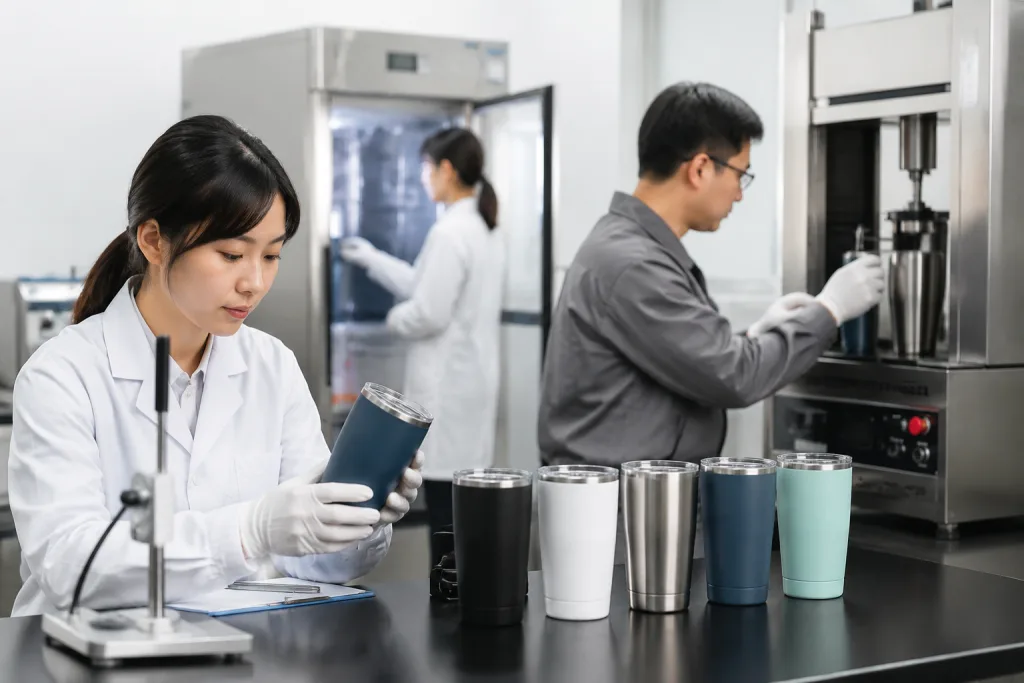
For Europe and North America, drink-contact compliance is a gate item, not a nice extra. On stainless tumblers, we check food-contact safety by material batch, coating adhesion with a 3M tape cross-hatch test, heavy metals on painted parts, and lid material declarations against the actual PP or Tritan grade on the BOM. Depending on market, buyers may ask for LFGB, FDA, REACH, CA Prop 65, BPA-free, ASTM, or specific migration reports. A solid coffee mug factory should tell you which reports match 304 stainless, which ones cover the powder coating, and which tests must be renewed because your lid mold or color changed.
Testing cost is usually USD 180-650 per report set for standard checks, higher for broad regulatory packages. For large retailers or corporate procurement portals, we normally reserve 7-10 working days just for document review before mass shipment booking. The math does not work if testing starts after packing. We have seen finished goods sit in the warehouse because a buyer portal rejected one missing BPA-free declaration for the silicone ring.
Inspection belongs in the order sheet, not in a WeChat message after production. We recommend AQL Critical 0, Major 2.5, Minor 4.0 for most promotional and retail tumbler orders, with the sampling level written on the PI. QC pulled the sample. They should check vacuum performance, lid leakage at 45° and inverted position, logo position tolerance within 1.5 mm, color difference against the approved Pantone chip, dents, scratches, carton drop condition, and barcode scan with a handheld scanner. For vacuum testing, a practical factory check is hot water temperature retention over 6 hours, plus random destructive cut checks for wall structure.
If you found us through a coffee mug supplier directory or coffee mug supplier list, do not stop at certificates. Ask for a recent inspection checklist, carton mark sample, and defect photos from an actual order, not a clean template. Real factories in Zhejiang and wider China are used to this. Last month a buyer flagged a PO typo where the carton mark said “500ML” but the approved artwork said “510 ml”; catching that before printing saved 38 cartons of rework.
Private Label Cost Traps
Coffee mug private labeling looks simple on the PO, then the small lines start breeding. A typical private label order we run has logo on tumbler, lid logo, printed sleeve, hangtag with 2 mm bleed, instruction sheet, master carton mark, inner carton mark, barcode, FNSKU, and Amazon-ready polybag warning. One buyer once sent “FNSKU” as “FNSK” on the PO, and QC pulled the packed sample before we printed 12,000 stickers. None of these items is expensive alone. Stack them together and they add USD 0.25-0.90 per unit, plus 4-10 days of artwork checking, plate files, and carton-mark approval.
For coffee brands, the costly trap is changing color after the line is booked. Custom powder coating needs paint matching, spray line scheduling, curing at around 180°C, and color tolerance approval under a light box, not just a PDF. A Pantone reference on paper will not match textured metal. It won’t. For any order above 3,000 pcs, we normally push for a sprayed metal color chip before mass production. It costs a few days, but we have seen this go sideways: the buyer flagged “warm beige” after 6,400 cups were already coated, and the rework math did not work.
Corporate-gift buyers hit a different trap: over-customizing a one-time campaign. If the order is 1,000 pcs for a conference, custom mold development is usually the wrong question to ask unless the same design will repeat for at least 2 more runs. Use an existing travel tumbler body, upgrade the finish, and put the budget into packaging or a better lid with a tighter silicone ring. On the line, a new mold also means trial assembly, leak testing at 45° tilt, and extra AQL checks. A gift order should ship clean, not become a tooling project.
For recurring coffee mug private label programs, build a cost ladder. Start with one stock body and one custom logo, then move to custom color after sell-through is proven. Add custom packaging once retail accounts ask for shelf-ready cartons. Only then look at coffee mug custom made tooling. We ship better programs this way because cash follows demand, not guesses from a sales meeting. The buyer may want everything in round one, but after the first 3,000 pcs, the reorder data tells us which upgrades deserve factory time.
How To Brief The Factory
A clean brief gets you a clean quote. Send these nine items: capacity in milliliters or ounces, target FOB price, annual forecast, first order quantity, destination country, required certifications, logo file format, packaging type, and launch date. We still see POs with “500 ml / 17 oz?” typed in the same line; QC pulled a sample last month and the fill test came out 470 ml to the inner thread. If you need coffee mug factory direct pricing, state whether existing molds are acceptable. That one line can move tooling cost from USD 0 to a mold bill and add 18 days instead of 12 days.
For a bulk coffee mug or bulk coffee travel mug inquiry, tell us how the product will be sold. Café resale usually needs a 350 gsm retail box, tighter color checking under the D65 light box, and fewer tiny scratches accepted on the powder coat. Corporate gifting lives or dies on logo position; the buyer flagged a 2 mm drift on a repeat order because each carton was split by event team. E-commerce needs drop-test packaging, FNSKU placement, and carton dimensions that do not punish you on fulfillment fees.
Here is a practical specification for a first RFQ: 500 ml double-wall vacuum tumbler, 304 stainless inner, powder-coated outer, press-fit sliding lid, one-position laser logo, individual white box, 24 pcs per export carton, AQL inspection, FOB Ningbo, 3,000 pcs first order, delivery needed in 45 days. We can put that straight into the cost sheet and check the lid gauge, carton cube, and line schedule before quoting. A coffee mug manufacturer can price that properly. “Coffee mug promotional quote, urgent” is the wrong way to start; we’ve seen it burn two days because nobody knew if the logo was laser, silk print, or UV.
Be direct about budget. If your target is USD 4.00 FOB, a good factory in China can suggest trade-offs: stock color instead of custom coating, laser instead of UV, standard box instead of printed gift box, or a 1 mm smaller carton to improve pallet loading. The math doesn’t work if the brief asks for custom Pantone coating, retail insert card, and 500 pcs MOQ at the same price. We run the numbers from steel weight, coating loss, lid set, packing labor, and export carton CBM. The right travel tumbler supplier should protect your margin, not nod at impossible specs and disappoint you later.
Send Your Tumbler Brief For Factory Pricing
Share quantity, logo, packaging, and deadline. We will return a line-item FOB quote with MOQ, lead time, and practical cost options.
Frequently asked questions
What is a realistic MOQ for a custom travel tumbler?
For a stock tumbler body with laser logo, 500 pcs is realistic. For silkscreen printing, 1,000 pcs is more practical because setup and alignment take time. For custom powder coating, plan on 3,000 pcs per color. If you want a new lid mold or unique body shape, MOQ usually moves to 8,000-15,000 pcs because tooling and production trials must be amortized. Small 100-200 pc orders can be done from stock inventory, but unit cost is much higher and options are limited.
How much should I budget for a bulk coffee travel mug order?
For a 500 ml stainless bulk coffee travel mug, a normal FOB China range is USD 3.20-6.80 per unit. The lower end usually means stock color, simple lid, white box, and one laser logo. The higher end includes custom powder coating, better lid structure, printed packaging, insert card, and tighter inspection. Add testing, sample courier, ocean freight, duty, and local delivery to calculate landed cost. For corporate gifts, also budget USD 0.10-0.40 per unit for special carton labels or kitting.
Can one factory handle coffee mug private labeling and Amazon cartons?
Yes, but you need to specify it early. Private labeling can include logo, retail box, barcode, FNSKU, warning labels, master carton marks, and carton size limits. Amazon or third-party fulfillment orders often need scan-tested labels and carton weight below 15-22 kg depending on your routing guide. Add 4-10 days for packaging artwork and label confirmation. Do not approve production until carton dimensions, gross weight, and barcode placement are confirmed in writing.
Is laser engraving better than printing for coffee mug promotional products?
Laser engraving is usually better for durability and speed. It costs roughly USD 0.08-0.18 per position and will not peel during normal use. It works especially well on powder-coated stainless steel. Printing is better when you need exact brand colors, gradients, or large artwork. Silkscreen is economical for one or two colors, while UV handles full color at a higher cost. For dishwasher claims, ask for adhesion and wash testing on the exact coating and ink combination, not a generic statement.
How early should I place an order before a launch date?
For a normal custom travel tumbler order, allow 8-12 weeks from RFQ to warehouse arrival by sea freight. That includes 1 week for quote and artwork, 1-2 weeks for samples, 25-40 days for production, inspection, export booking, and 18-38 days on the water depending on destination. If your launch is near Lunar New Year or Q4 gift season, add another 2-4 weeks. Air freight can rescue timing, but it often adds USD 1.20-2.80 per unit.