Key Takeaways
- Shortlist suppliers only after defining capacity, insulation target, MOQ, and branding method; 1,000–3,000 pcs is a normal custom MOQ
- Double-wall 304 stainless steel with 0.4–0.5 mm inner wall thickness is the safest travel tumbler specification for coffee brands
- Laser engraving, silkscreen, powder coating, and 3D UV printing create different cost, durability, and lead-time trade-offs
- For factory-direct China orders, plan 7–10 days for sampling and 30–45 days for bulk production after artwork approval
A travel tumbler supplier list does not help much if it is only names, catalog links, and soft claims about quality. For a coffee brand, corporate gifting program, or coffee mug distributor channel, this is the wrong question to ask first. Start with fit: launch risk, brand standard, and margin target. Last month QC pulled a 600ml sample from the line with a 0.4mm lid gap; the catalog photo looked fine, but the buyer would have paid for a mold tweak after deposit.
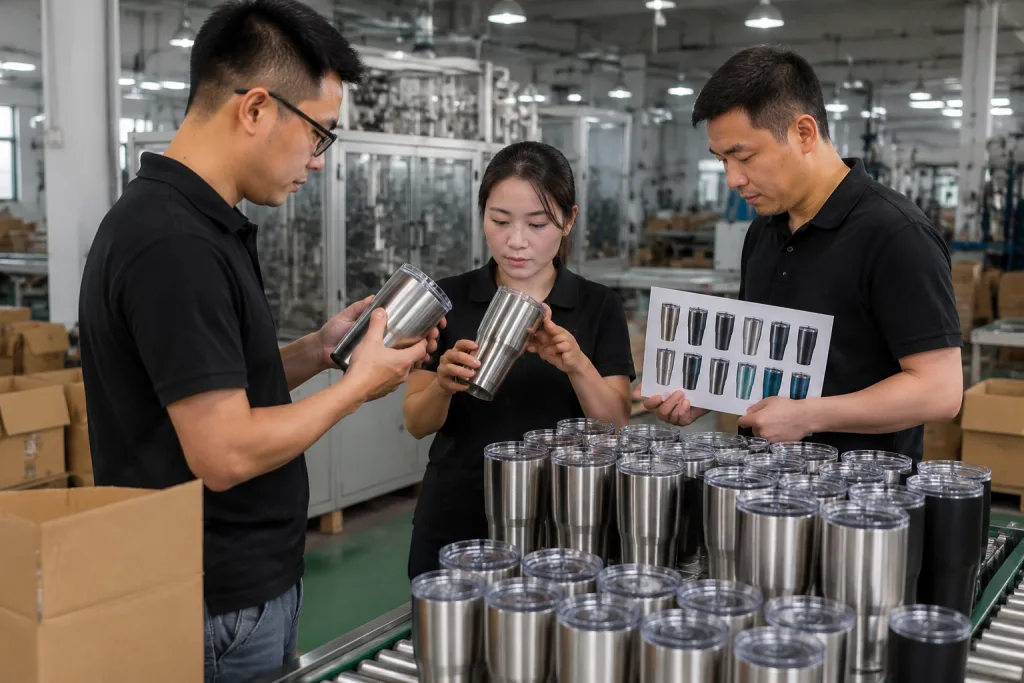
Decide four items before you ask for quotations: tumbler structure, branding method, order model, and compliance burden. Our Hangzhou, Zhejiang team has watched buyers lose 20–30 days because they sent the same loose RFQ to 12 coffee mug factory contacts and got 12 different answers back. We run better quotes when the PO says “304 stainless, powder coating, laser logo, 3,000 pcs MOQ target” instead of “send best price.” Cleaner specs mean cleaner pricing and fewer sample surprises from China.
Start with the buying decision
Before you build a travel tumbler supplier list, decide what problem the list must solve. A coffee brand launching shelf-ready merch is not buying the same risk as a corporate-gift buyer packing 5,000 onboarding kits. Retail buyers will push us on Pantone match, barcode stickers, and whether the color shifts after 30 minutes in the curing oven. Gift buyers usually chase the ship date and logo position first. Fair enough.
I would not start with a coffee mug supplier directory. That is the wrong question to ask. Directories are too wide; they put trading companies next to stock resellers and real coffee mug manufacturers with no clear separation. We have seen buyers send the same RFQ to 18 “factories,” then learn 11 were quoting the same Ningbo stock cup. Write a one-page buying brief first, then use it to cut suppliers before asking for prices.
Your brief should answer four decisions:
- Product format: 12 oz, 16 oz, 20 oz, or 30 oz; with handle or straight body; flip lid, slider lid, or straw lid; base diameter under 72 mm if car cup holder fit matters.
- Material and performance: 304 stainless steel; double-wall vacuum build; copper lining only when the heat-retention spec justifies the cost; leak test target and heat retention hours written on the PO.
- Branding plan: coffee mug custom logo by laser or silk print; full-color artwork with a signed AI file; coffee mug private label packaging with carton marks checked; coffee mug custom made tooling if the lid or body shape is not stock.
- Order model: one-time promotional run with a fixed delivery window; repeat wholesale line with spare lids held back; coffee mug OEM manufacturer relationship with drawings, golden sample, and AQL 2.5 inspection agreed before deposit.
If a supplier cannot answer against those four points, remove them from the supplier list. A real coffee mug factory direct partner will ask about lid tooling, coating thickness, carton drop test height, FDA or LFGB paperwork, and whether the logo on the PO says “matte black” while the artwork says “charcoal.” QC pulled the sample on that exact mismatch last year. A weak supplier sends a catalog and says “any logo is okay.” Convenient answer. Not engineering.
Choose the tumbler build first
The tumbler build drives the quote sheet: unit cost, shelf feel, dent risk, and carton weight. For coffee programs, we usually start with a double-wall vacuum travel tumbler in 18/8 304 stainless steel, inner wall around 0.4 mm and outer wall around 0.5 mm. That spec survives normal line handling better when the cups roll through the vacuum station and get checked with a 0.01 mm digital thickness gauge. Do not chase the thinnest bulk coffee tumbler. Saving USD 0.20–0.35 per piece looks nice on the PI, then QC pulls 18 dented samples from 200 pcs and the math doesn't work.
Most bulk travel tumbler projects fit 3 buying levels, but the gap is not just “cheap versus premium.” A basic 16 oz stainless tumbler with press lid may land around USD 3.20–4.20 FOB China at 3,000 pcs, usually with a plain white box and 24 pcs per export carton. A better 20 oz powder-coated tumbler with slider lid and retail box often sits around USD 4.50–6.20, because powder thickness, lid assembly, and box paper all add cost. A more engineered coffee mug custom made project with molded handle, ceramic lining, or exclusive lid can move above USD 7.00 before packaging, and tooling can add 12 days vs 18 days if the first T1 lid fit is off.
For corporate gifting, a 16 oz or 20 oz bulk coffee travel mug is usually the practical choice. It fits desks, car cup holders, and office coffee machines; our gauge on the line is 73–75 mm bottom diameter for most car-fit jobs. For coffee brands, 12 oz works when the range is built around café drinks. The buyer flagged this twice last quarter: Europe and North America retail teams still expect 16 oz as the default, unless the label clearly says espresso, flat white, or kids’ drinkware.
Check the lid before you argue about the cup body. Tritan or PP lids can both pass the job, but the gasket design matters more than the plastic name. Ask for photos of the silicone seal, drinking port, and exploded lid parts; we run a quick leak check by filling 90% hot water, closing the slider, and laying the sample on white tissue for 30 minutes. If the supplier avoids that detail, expect leakage disputes later. We’ve seen this go sideways: one PO even typed “slide lid” as “silide lid,” and nobody caught the wrong mold drawing until pre-production sample review.
Branding changes the supplier shortlist
A factory that runs plain bulk travel tumbler orders well is not automatically the right pick for a customized retail line. Branding changes the route sheet. A laser logo can go on after polishing and final washing; a Pantone powder coat or wraparound silkscreen must be frozen before the line loads blank bodies. We check the Pantone chip under a D65 light box because one buyer once flagged a 1-shade drift after 8,000 pcs were coated.
For promotional travel tumblers, laser engraving is still the lowest-risk logo method. It survives handling, looks clean, and works on 304 stainless steel or powder coating. The trade-off is color: laser gives substrate contrast, not a full-color mark. Silkscreen fits bold 1–2 color logos, but curved cups need the right jig diameter and ink curing time. The buyer usually asks, “Will it pass dishwasher?” The math doesn’t work if curing is rushed; poor curing shows logo rub-off after 20–50 dishwasher cycles.
For customizable travel tumbler campaigns with artwork, 3D UV printing handles gradients and small batches, often starting around 500–1,000 pcs depending on the blank model. It costs more than silkscreen, but it avoids screen setup limits on complex artwork. For private labeling, packaging is where timelines go sideways. A custom color box normally adds 7–12 days after dieline approval; a gift tube or molded insert needs a separate mockup, and our prepress desk once caught a PO typo that changed “matte black” to “mate black.”
Do not approve a bulk travel tumbler sample by photo only. Ask for a physical sample with the actual coating, logo process, lid fit, and packaging substrate.
Our Zhejiang team treats logo approval and packaging approval as two checkpoints. Slower on paper. Safer in production. QC pulled a sample last month where the tumbler matched the signed sample, but the 350 gsm box used the wrong barcode sticker by 12 mm. For coffee brands and retail travel tumbler programs, packaging errors are not small decoration issues; they break the shelf story before the cup is even opened.
Separate factory from trading desk
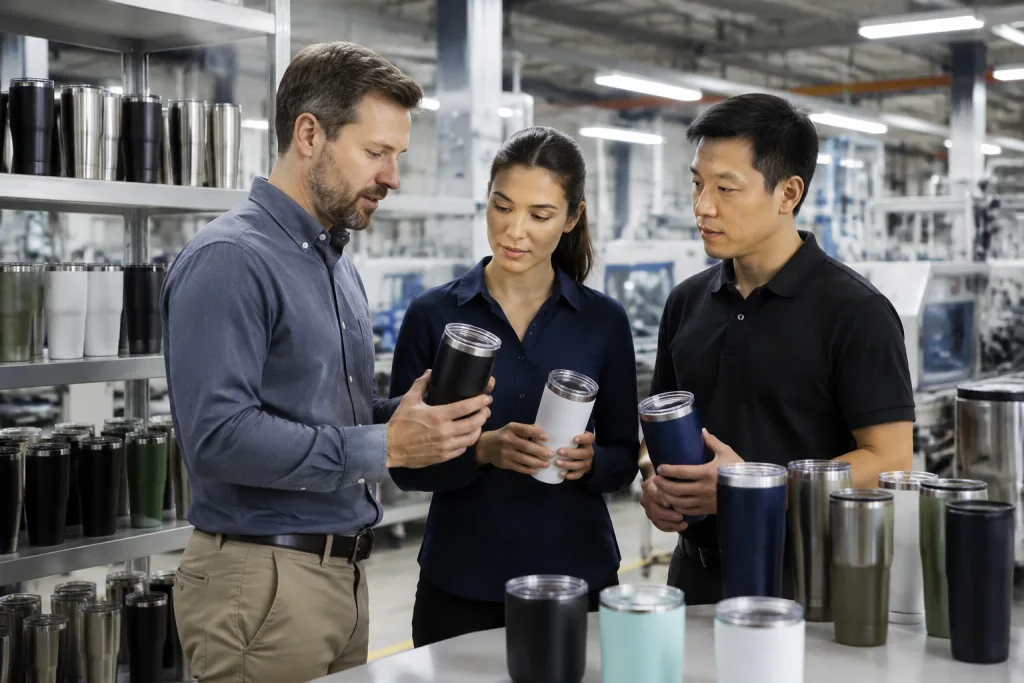
A useful travel tumbler supplier list should mark each company by role, not just product photo. You will see a coffee mug supplier, coffee mug manufacturer, exporter, trading company, and promotional distributor quoting the same 40 oz handle tumbler from the same catalogue page. Different partner. Different control. On our line in Hangzhou, the difference shows up fast when QC pulls 32 pcs from a packed lot and asks who can approve a lid gasket change.
A coffee mug factory direct supplier controls the production board, QC checkpoints, and process changes. A trading desk still makes sense for mixed SKUs, low quantities, or one-container consolidation across 6 vendors. The trouble starts when the role is hidden. If you think you are talking to the coffee mug factory but your logo-position question passes through two desks before it reaches the coating supervisor, a 12-day correction can become 18 days. We have seen this go sideways over a 2 mm logo shift the buyer flagged after the PP sample.
Ask direct questions:
- What is your monthly capacity for stainless travel tumblers? BottleForge Industrial can support about 450,000 units/month across drinkware lines in Zhejiang, China.
- What is your standard MOQ for a coffee mug custom logo order? For existing models, 1,000 pcs is practical; for custom coating and packaging, 3,000 pcs is cleaner.
- Do you own vacuum testing, leak testing, and coating inspection equipment?
- Can you provide BSCI audit records, ISO 9001 process documents, LFGB or FDA food-contact test reports, and REACH declarations when needed?
- Who signs the pre-production sample approval sheet?
A strong coffee mug manufacturer answers with process details, not a folder of certificates. Vacuum insulation should be checked by batch sampling; assuming it passed because the model passed last month is the wrong question to ask. We run hot-water retention checks with a digital thermometer, then QC records the drop after the agreed test time. Coating needs adhesion cross-cut and rub tests, not just a quick look under warehouse lights. For corporate-gift orders, AQL Level II with critical defects at 0, major at 2.5, and minor at 4.0 is a reasonable inspection starting point. If your order is for retail coffee mug distributors, tighten visual criteria on coating dust, logo alignment, and carton presentation; one 3 mm scratch near the logo can hold a pallet at final inspection.
Price the landed program, not cup
About 7 out of 10 new buyers compare a bulk travel mug by FOB unit price only. Wrong question. The tumbler cost is one line on the landed sheet. We price logo setup, packaging, inner cartons, master carton burst strength, inspection, freight, duty, Amazon FBA labels, and 3PL prep separately because each one can move the margin. We have seen a USD 0.30 cheaper cup lose the bid after QC pulled the sample carton and measured 0.083 CBM instead of 0.064 CBM, with a 3% higher defect rate on lid fit.
Ask every name on your coffee mug supplier list for one clean table. Unit price by quantity, mold or setup charge, sample cost, packaging cost, carton quantity, gross weight, carton dimensions, lead time, FOB port, and payment terms should sit in the same sheet, not across 6 WhatsApp screenshots. Ningbo and Shanghai are the common export ports for Zhejiang drinkware factories. If a supplier quotes EXW only, push for local trucking and export handling costs; we had one PO typo list “EXW Ningbo port,” and the buyer flagged it before the forwarder did.
For a typical 20 oz bulk coffee travel mug, we run planning numbers like this: 24 pcs per master carton, 13–16 kg gross weight, 0.06–0.08 CBM per carton depending on gift box size, and 30–45 days bulk lead time after deposit and sample approval. The line checks carton length with a tape measure before the packing trial because 8 mm extra on one side becomes real money across 1,200 cartons. Sea freight to North America or Europe changes too fast for casual quoting. Carton cube is enough for your forwarder to calculate the lane properly.
For coffee mug in bulk programs, negotiate repeat-order stability before chasing the first order discount. The math often does not work if the second run comes back with a slightly different powder coating, a new lid gasket, or a shifted packaging dieline. If you are a coffee mug distributor building a seasonal range, ask the factory to hold coating formulas, lid components, and packaging dielines for at least 12 months. We keep those files in the order folder with the Pantone code and box knife line, because we have seen this go sideways when a buyer reordered 18,000 pcs and expected the shelf display to match the first shipment exactly.

Build your supplier scorecard
Your final travel tumbler supplier list should be short. Three to five qualified suppliers are enough for a serious RFQ; after 6 names, the comparison sheet usually turns into noise. Score what you can verify. Not the pretty sales email. Last month QC pulled 3 pre-production samples from the line, and one supplier’s “same lid” had a 0.6 mm height difference at the drinking spout.
Use a 100-point scorecard. Give 25 points to product fit: list the mold ID, lid type, powder-coating line, and whether 3 samples from the same run match within your color tolerance. Give 20 points to compliance: food-contact reports, BSCI, REACH, Prop 65 awareness if you sell into California, and ASTM considerations for kids or special-use products. Give 20 points to commercial fit: MOQ, FOB price, payment terms, and ability to support coffee mug private label packaging without crushing cartons under 18 kg. Give 20 points to operations: production lead time, QC plan, inspection cooperation, and export documentation such as HS code and carton marks. Keep 15 points for communication: technical answers, artwork handling, and correction speed after the buyer flags a wrong Pantone or a typo on the PO.
This scorecard lets you compare a coffee mug OEM manufacturer with a promotional reseller without pretending they sell the same thing. A reseller can score well for 300 pcs mixed-color orders from stock. A factory should score better for repeat orders, custom lids, and cost control once the order moves past 3,000 pcs. The wrong question is “who is cheapest?” We have seen this go sideways when a reseller quoted low, then failed the drop test because the inner box used 250 gsm paper instead of 350 gsm.
For coffee mug promotional campaigns under 1,000 pcs, stock decoration may be enough. For a branded retail line, choose a coffee mug manufacturer with repeat production control. If you want coffee mug factory direct pricing from China, send clearer specifications: capacity in ml, steel grade, lid material, logo size in mm, carton drop-test request, and target ship date. The math does not work if the buyer asks for factory-direct pricing but sends only “send best price” and a blurry screenshot.
At BottleForge Industrial in Hangzhou, Zhejiang, we usually ask buyers for artwork, target retail price, sales channel, compliance market, and delivery date before quoting. It is not bureaucracy. We run the quote through mold availability, coating schedule, packing method, and lead time before we put a number on paper. That is how we avoid quoting the wrong bulk coffee mug for the job, such as a 12 oz office mug when the buyer actually needs a 20 oz travel tumbler for gas-station retail.
Send your tumbler brief for factory-direct review
Share quantity, artwork, market, and delivery date. Our Zhejiang team will return practical options, MOQ, FOB pricing, and sample timing.
Frequently asked questions
What should I include when asking for travel tumbler supplier quotes?
Send capacity, material, finish, logo method, packaging, quantity, destination market, and target delivery date. For example: 20 oz double-wall 304 stainless steel, powder coating, one-color logo, custom retail box, 3,000 pcs, FOB Ningbo, EU market. Attach logo files in AI, PDF, or EPS format and mention any REACH, LFGB, FDA, or Prop 65 needs. If you need a bulk coffee mug for corporate gifting, include the event date and whether individual mailer boxes are required. A complete RFQ usually gets a reliable quotation within 24–48 hours; vague requests often need 3–5 rounds of clarification.
What MOQ should coffee brands expect for custom travel tumblers?
For an existing tumbler model with a simple logo, 1,000 pcs is a realistic MOQ from many China factories. For custom powder coating, Pantone color, coffee mug private labeling, or retail packaging, 3,000 pcs is a better planning number. Full custom tooling for a coffee mug custom made body or lid can require 5,000–10,000 pcs depending on mold cost. Some suppliers advertise 100 pcs, but that is usually stock decoration through a reseller, not factory-direct production. Low MOQ can be useful for testing, but the unit cost and color control will not match a repeat wholesale program.
How long does a custom travel tumbler order take?
Plan 7–10 days for a physical pre-production sample after artwork confirmation, then 30–45 days for bulk production after deposit and sample approval. Custom packaging can add 7–12 days if dielines or printing files are late. Sea freight to Europe or North America adds several weeks depending on port, season, and shipping method. If your project is a dated coffee mug promotional order, build in at least 10 days for third-party inspection and export paperwork. Rushed schedules are possible, but they reduce your options on coating, packaging, and QC correction.
Is laser engraving better than silkscreen printing for coffee tumblers?
Laser engraving is usually better for durability and low defect risk, especially on powder-coated stainless steel. It works well for corporate logos, coffee roaster marks, and premium gifts. Silkscreen is better when you need a specific logo color or larger artwork, but it requires correct ink, curing, and jig control on the curved surface. For a 3,000 pcs bulk coffee tumbler order, laser may cost around USD 0.10–0.25 per unit, while silkscreen can vary with color count and print area. If the tumbler will be washed often, ask for rub testing and adhesion checks before bulk approval.
How do I know if a coffee mug supplier is really a factory?
Ask for production floor photos, audit documents, equipment lists, and the name of the export license holder. Then ask technical questions: vacuum test method, coating line capacity, AQL standard, lid leakage test, and monthly output by product category. A real coffee mug factory should answer without long delays. You can also request a video call from the production area or arrange a third-party audit in Zhejiang or another China manufacturing region. A trading company may still be useful, but it should be transparent. Hidden layers increase sample errors, delay corrections, and make repeat orders harder to control.