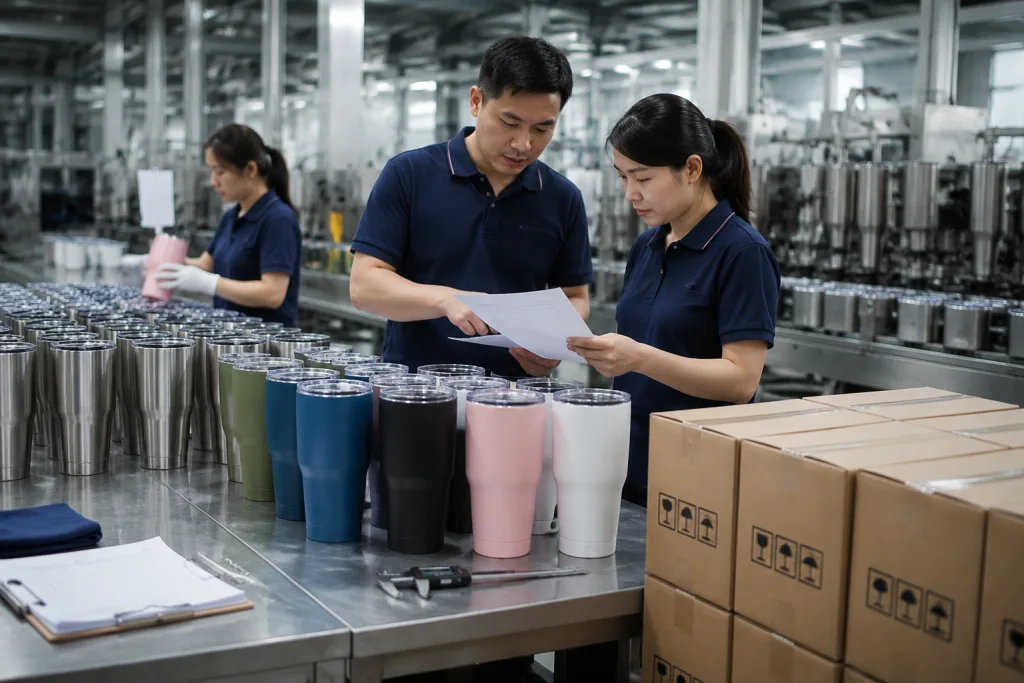
Key Takeaways
- Start RFQs with 8 line items: capacity, steel grade, lid type, finish, logo, packing, compliance, delivery term
- Realistic custom sample timing is 7-12 days after artwork and deposit approval
- For bulk travel mug projects, 1,000-3,000 pcs per SKU is a workable MOQ range
- Use AQL 2.5/4.0 inspection and define defects before paying the final 70%
A travel tumbler supplier directory gives you 30 names on a screen, not the answer you need: which coffee mug factory can hold a 1.0 mm logo position tolerance, which coffee mug manufacturer knows retail packaging, and which coffee mug distributors are just reselling stock from Yiwu. We see this gap often. Last month QC pulled a powder-coated sample under the D65 light box, and the buyer flagged the PMS match before the PO even had the lid color typed correctly. If you are buying for a coffee brand or a corporate-gift campaign, that kind of miss burns days.
You need a sourcing process that moves from RFQ to sample to bulk with dates, drawings, and inspection points. BottleForge Industrial in Hangzhou, Zhejiang, China runs factory direct drinkware programs with MOQ from 1,000 pcs per SKU and monthly output around 450,000 units. We run the line with a torque gauge for lids, calipers for mouth diameter, and a packing drop test before cartons leave the floor. The wrong question is “who is cheapest in the directory?” Ask who can ship the approved bulk travel tumbler order cleanly, with sample approval in 12 days vs 18 days when artwork and packaging files arrive late.
Start with the actual use case
Before you email a travel tumbler supplier directory contact list, write down the job the cup has to do. A coffee roaster selling merch is not buying the same item as a corporate-gift team shipping 12,000 pieces to 8 regional offices. The roaster will push us on shelf appeal, retail box corners, and whether matte cream matches the approved Pantone after baking at 180°C. The gift buyer asks about ship-date risk, logo position tolerance within 1.5 mm, and how many lids crack after a 76 cm carton drop. Different problems. Different quote.
Your first sourcing note should be short and specific. For a bulk coffee travel mug, name the drinking environment: commuter coffee, desk use, conference giveaway, subscription-box insert, loyalty reward, or retail resale. That choice decides whether we run a leak-resistant screw lid, sip lid, straw lid, or slide lid on the line. It also changes capacity. In North America, 20 oz and 24 oz travel tumblers move well for coffee and cold drinks; in Europe, 350 ml, 450 ml, and 600 ml are easier for retail buyers to read on a PO. Last month QC pulled a 450 ml sample because the straw lid made it too tall for the buyer’s 215 mm retail shelf.
Do not start with only “send price for coffee mug custom made.” This is the wrong question to ask. It gives the supplier room to quote the cheapest shell, the thinnest coating, and a lid you did not approve. A good RFQ opener looks more like this:
- Product: 20 oz stainless steel vacuum travel tumbler
- Material: 304 inner, 201 or 304 outer, BPA-free lid
- Finish: powder coating, matte black, Pantone reference
- Logo: 1-color silkscreen or laser engraving, 60 mm wide
- Packing: white box or printed retail box, master carton 24 pcs
- Quantity: 1,000 / 3,000 / 5,000 pcs price breaks
- Market: EU or US, with REACH, LFGB, FDA, or Prop 65 needs
- Term: FOB Ningbo or Shanghai, required ship date
This cuts weak coffee mug suppliers fast. A real coffee mug oem manufacturer will come back with wall thickness, vacuum structure, lid drawings, logo limits, and carton data in kg and cm. A reseller often sends one catalog page and skips the hard points. We’ve seen this go sideways: one buyer wrote “black logo” on the RFQ, but the PO said “white logo,” and the line stopped for 6 hours while sales, prepress, and the buyer argued over the artwork file.
Turn the directory into a shortlist
A supplier directory earns its keep only after you cut it hard. Talking to 40 coffee mug manufacturers burns time. Build a shortlist of 3 to 5 suppliers who can quote the same spec sheet and keep that spec on the line after the deposit lands. If the directory mixes trading companies, coffee mug distributors, and factory direct producers, send every one the same screening questions. We have seen this go sideways when a buyer compared a 0.4 mm liner quote against a 0.5 mm liner quote and thought the cheaper one was better.
Start with factory identity. Ask whether the supplier owns the production lines, where the factory sits, and which processes stay in-house. Around Zhejiang, China, a solid drinkware factory is often within 80 to 150 km of stainless steel forming shops, powder coating lines, printing rooms, and packaging vendors. That helps lead time, but it is not proof of quality. This is the wrong question to ask if you stop at location. Ask who controls the vacuum test station, who signs the powder coating color card, and whether QC pulled the sample from mass production or from a sales shelf.
Your first shortlist email should request these items:
- Business license name and export company name, matched against the name on the PI and bank account
- Factory audit status such as BSCI, Sedex, ISO 9001, or customer audit history, with the last audit date shown
- Monthly production capacity for travel tumbler and coffee mug in bulk orders, split by 20 oz and 30 oz if possible
- Available molds for 12 oz, 16 oz, 20 oz, 24 oz, and 30 oz sizes, including lid type and body diameter in mm
- Logo processes: laser for stainless finish, silkscreen for 1 to 2 colors, heat transfer for full wrap, UV print for small batch, embossing for sleeves, sleeve options for retail sets
- Standard MOQ for coffee mug customized projects and private label packaging, with separate MOQ for carton, gift box, and insert card
- Recent test reports for food-contact material, preferably tied to 304 stainless and the lid material used on your quoted model
If you are a coffee mug distributor or managing coffee mug promotional products for corporate buyers, watch communication speed. A good supplier should return a structured RFQ answer within 24 to 48 hours on working days. Slow replies at quotation stage usually get worse when production is under pressure. We run into this every peak season: the buyer flags a missing Pantone code on Friday, the sales reply comes Monday, and the printing line has already booked another 12,000 pcs job.
At BottleForge in Hangzhou, Zhejiang, we prefer buyers to send one complete RFQ instead of five partial messages. It saves 2 to 3 days and cuts wrong assumptions. A bulk coffee tumbler with a powder-coated body and printed gift box will not price the same as a bare stainless tumbler in a white box, even if both are 20 oz. The math does not work. Last month one PO typed “mat black” instead of “matte black”; QC caught it against the approved color card before coating, but that single typo still cost half a day on the line.
Build an RFQ suppliers can price
Your RFQ should read like a small purchase order before any deposit is paid. Clear specs leave less room for “almost the same” production. We see this often on coffee mug private label programs: one buyer approved a satin black tumbler, then the PO said “black cup,” and QC pulled a glossy sample from the line at 8:40 a.m. The tumbler, logo, carton, barcode, and insert card all sit in front of your customer, so loose wording gets expensive fast.
For each SKU, build a separate line item. Do not bury 4 products in one paragraph. A proper RFQ line item for a coffee mug customizable project should state the base model, capacity, dimensions in mm, steel grade, insulation claim, lid style, gasket material, coating, logo method, logo position, packing, carton size, compliance request, and Incoterm. If you need Amazon or retail warehouse delivery, add FNSKU, carton label, drop-test requirement, and pallet preference. The line needs this detail because our costing clerk prices a 20 oz 304 stainless body with a caliper in hand, not from a mood board.
Here is a practical RFQ table structure you can copy into an email:
- Item 1: 20 oz vacuum travel tumbler, 304 inner, 201 outer, powder coated, sip lid
- Logo: laser engraving front, 55 mm x 35 mm, artwork in AI or PDF
- Packing: printed kraft box, 1 pc per box, 24 pcs per master carton
- Quantity: 1,000 / 2,500 / 5,000 pcs, quote FOB Ningbo
- Testing: FDA for US or LFGB/REACH for EU, no BPA in plastic lid
- Commercial: sample cost, tooling if any, mass lead time, payment terms
Ask for three prices, but make each one mean something: blank tumbler with standard packing, logo tumbler with exact logo size, and full coffee mug private labeling package with box, barcode, and insert card. This shows where the money goes. We had a buyer flag a USD 0.34 gap after approval because the printed box added USD 0.28, the inner bag added USD 0.03, and carton marks needed another handling charge. The math does not work if the RFQ hides packaging until the PI stage.
For reference, a factory direct 20 oz stainless travel tumbler often sits around USD 3.20 to USD 6.80 FOB China depending on steel grade, lid complexity, coating, logo, and packing. Low quotes can be real for stock shapes and simple packing. If one quote is 18% below the other 5 suppliers, this is the wrong question to ask: do not ask why it is cheap first, ask for wall thickness in mm, vacuum failure rate from the last batch, coating adhesion result after cross-hatch tape test, and food-contact test proof for the lid plastic. We have seen this go sideways when a 0.38 mm outer wall was quoted against a 0.45 mm sample.
Read the quote like an engineer
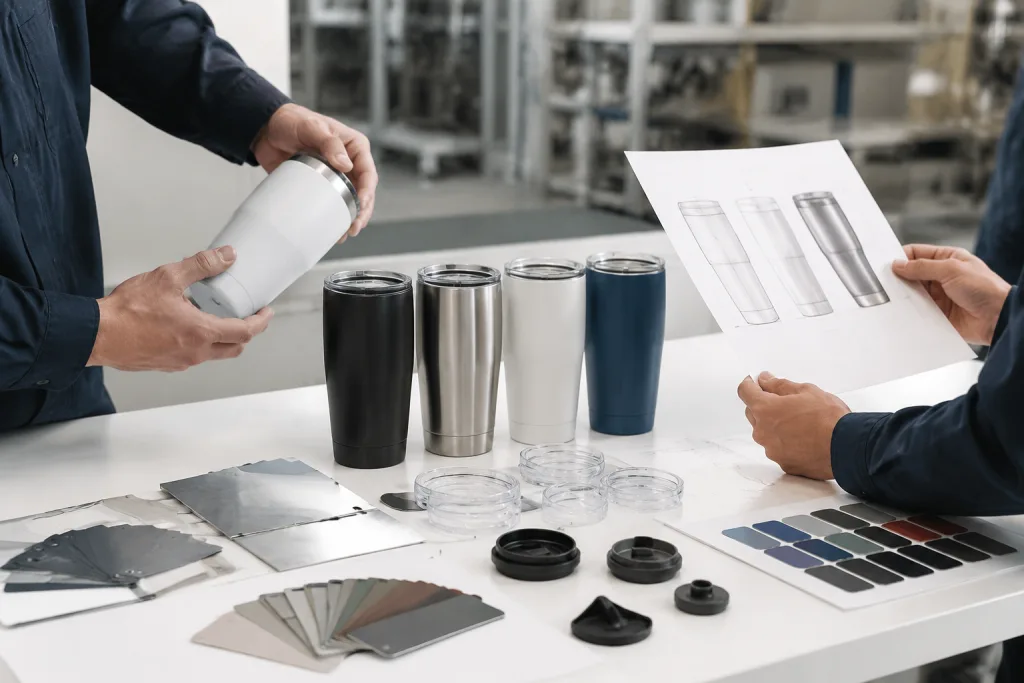
A quote is not just a price. It tells you what the supplier thinks is included. Read every line before you approve samples. We’ve seen this go sideways: a buyer approved a bulk travel tumbler quote with “SS body” written on it, then QC pulled the sample and found 201 outer steel, no coating thickness record, 14.8 kg cartons instead of the expected 12 kg, and no AQL 2.5 inspection line.
For stainless travel tumblers, start with the body construction. Most vacuum tumbler lines we run use 0.4 mm to 0.6 mm stainless sheet, based on shape, capacity, and target FOB price. Inner 304 stainless steel is standard for coffee-contact surfaces. Outer 201 stainless steel works for price-driven promotional orders, say 3,000 pcs for an event giveaway, while 304 outer makes more sense for premium retail or rough daily use. If you want a premium coffee mug custom program, write 304 inner and 304 outer in both the quote and PO. Do not leave it as “stainless steel.”
Coating needs its own line. Powder coating should pass cross-hatch adhesion, boiling water resistance, and abrasion checks; our QC team uses a 3M tape pull after the cross-cut, not just a thumb scratch at the packing table. If your design uses a light Pantone color, expect more visible dirt and a higher rejection rate than matte black or navy. We had one beige order where the buyer flagged tiny black specks under 1 mm, and the math did not work after re-spraying. If the supplier says every color carries the same production risk, push back.
Logo pricing also needs detail. Laser engraving is durable and clean on stainless or powder coat, but it cuts through the coating and shows the base metal. Silkscreen suits simple 1-color logos and usually has a lower setup charge; on our line, the screen fee is often easier to absorb above 1,000 pcs. Heat transfer or UV print can cover larger graphic areas, but scratch resistance must be tested. For coffee mug promotional products, a 1-color logo is often enough. For retail coffee mug customized designs, buyers usually ask for printed boxes, barcode placement, and tighter Pantone control.
Put these quote items into your PO later: unit price, mold number, steel grade, lid material, logo process, logo size, box type, carton quantity, gross weight, payment terms, lead time, inspection level, and allowed over/under shipment. Small details matter here. We once received a PO with “mat black” instead of “matte black,” and the merchandiser had to stop the order for 6 hours to confirm the finish. If it is not in the quote or PO, arguing after production is usually a losing job.
Approve samples without guessing
Samples are where sourcing stops being theory. Do not approve a coffee mug custom made project from photos unless it is a repeat order with the same mold, same coating, same logo file, and same lid. For a new bulk coffee mug or bulk travel mug program, order 3 physical samples per SKU: one for your team, one for your client or brand owner, and one sealed control sample with a signed label for production comparison. We keep the control sample in a polybag beside the QC desk, not in somebody’s inbox.
We run 3 sample stages on most custom tumbler jobs. The stock sample checks shape, hand feel, lid thread, sip opening, and insulation; if the model is on our Hangzhou shelf, it can ship in 2 to 4 days. The logo sample is normally 7 to 12 days after artwork approval, assuming the AI file has outlined fonts and the Pantone code is not missing. The pre-production sample should match the confirmed material, coating, logo, box, and insert as closely as the line can hold. If a buyer asks to skip this step to save 8 days, the math does not work when 5,000 pcs come out with the wrong lid gasket.
For coffee brands, test real use. Fill the tumbler with hot coffee at about 90°C, close the lid, then check odor, taste transfer, leakage, and drinking comfort. QC pulled one sample last month where the lid passed the water shake test, but coffee smell stayed in the silicone ring after 3 rinses. Measure heat retention after 3 hours and 6 hours. Do not rely only on a supplier’s “keeps hot 12 hours” claim. That result changes with room temperature, fill volume, starting temperature, and lid design.
Your sample approval needs line items, not just “approved.” Use wording like this, and put it on the PO or sample approval sheet so the merchandiser cannot miss it:
- Body shape approved based on sample BF-TT20-2405, with lid fit checked by hand on 3 pcs
- Powder coat Pantone 426C approved with tolerance Delta E under 2.0 where practical, measured on a color meter before bulk coating
- Laser logo approved at 58 mm width, centered 85 mm from bottom, based on the marked sample body
- Retail box approved, barcode position fixed, no supplier logo, carton mark spelling checked against the buyer’s PO
- Pre-production sample required before bulk coating, with QC photo record kept for the line
If you are handling coffee mug private labeling, approve the instruction insert, warning label, carton marks, and any FNSKU or warehouse label. Packaging errors sound boring. They are not. We have seen a 12-day delay from one wrong FNSKU sticker, and the buyer flagged it only after the cartons reached the forwarder.
Write the PO before production
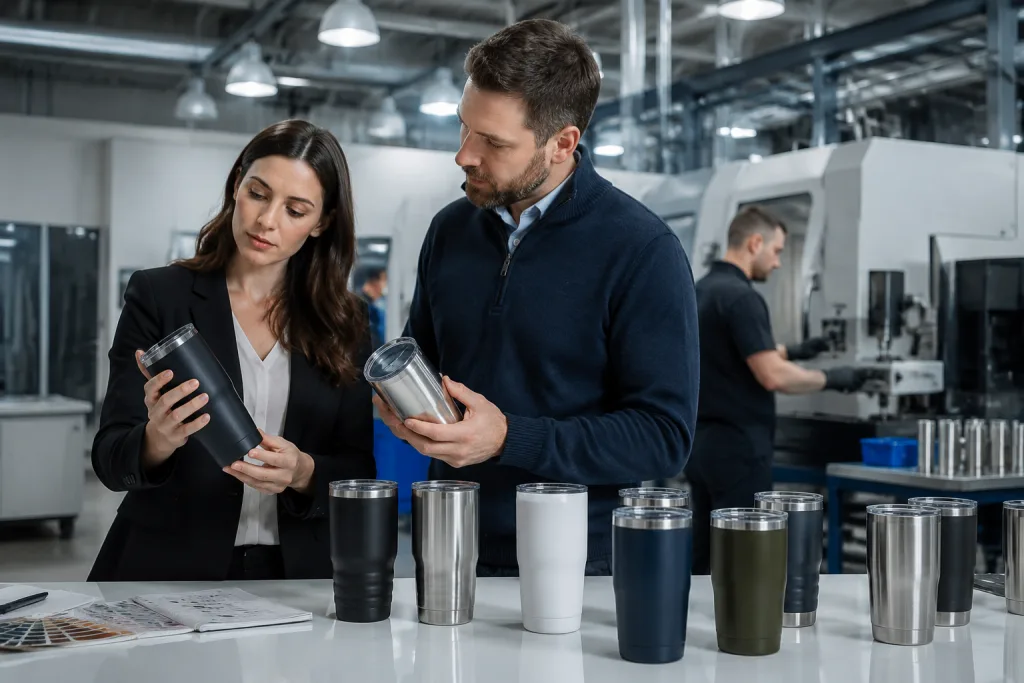
The PO is where loose sourcing gets expensive. A vague line like “5,000 pcs coffee mug with logo” is the wrong question to ask, because the line has nothing the production planner can check against. Write the PO so our merchandiser, mold room, printing tech, and carton line can all read the same spec. If you buy China factory direct, bilingual wording is fine when your team needs it, but the English and Chinese must point to one exact item, not “mug” on page 1 and “tumbler” on the artwork folder. We have seen that typo hold a job for 2 days.
Use one PO line per SKU. Three colors need three lines, not one hidden note at the bottom. Example: Item 001, 20 oz travel tumbler, matte black, 2,000 pcs. Item 002, 20 oz travel tumbler, cream white, 1,500 pcs. Item 003, 20 oz travel tumbler, forest green, 1,500 pcs. Each line should show unit price, total price, artwork file name, packing type, and delivery date. We run the line by SKU, and QC pulls cartons by SKU, so “same as above” creates mistakes fast.
Add the money terms in plain wording. Common payment is 30% deposit and 70% balance after inspection before shipment. Repeat buyers with payment history can negotiate terms, but first orders should not expect open account. The math does not work for a factory buying 304 stainless, lids, powder coating, and color boxes before collecting a deposit. State FOB port, usually Ningbo or Shanghai for Zhejiang-based factories, or EXW if your consolidator picks up from Hangzhou. If you need DDP, quote it separately because freight, duty handling, and last-mile risk are priced into that number.
Include quality clauses before the first sheet of steel is cut. For drinkware, AQL General Inspection Level II with Critical 0, Major 2.5, Minor 4.0 is a practical baseline. Define critical defects as leakage, sharp edges, wrong material, unsafe odor, broken lid, missing gasket, wrong logo, or failed vacuum. Define major defects with numbers: coating chip over 1 mm, logo shift over 2 mm, dented body, wrong box, or unreadable barcode. QC pulled one sample last quarter with a 3 mm logo drift; the buyer flagged it, and the PO clause made the rework decision simple.
At BottleForge Industrial, normal bulk production for a custom bulk coffee tumbler order is 30 to 45 days after deposit and final sample approval. Put the ship-ready date on the PO, not only the arrival date. That small line saves arguments when an event is fixed and the vessel rolls from Ningbo by 6 days. Ocean freight to the US or Europe can add 25 to 45 days depending on port and season. If your carton mark, barcode, or gift box file lands late, we do not have a magic button; the line waits, and 30 days becomes 37.
Inspect before the balance payment
Final inspection is not a nice-to-have on a serious travel tumbler supplier directory order. It is where you check the bulk goods against the approved sample before the final 70% payment and shipment release. For orders above 3,000 pcs, we tell buyers to book a third-party inspection; the fee is cheaper than sorting 86 cartons in a warehouse later. For smaller orders, still ask for factory QC photos, a 2-minute packing video, carton dimensions in mm, gross weight in kg, and random pull tests from sealed cartons. QC pulled the sample, not the sales team.
Inspection needs to cover function, appearance, packing, and quantity, but do not leave those words floating. Function means a 180-degree leak test, lid fit checked with the actual sipping lid, gasket presence, thermal retention spot check, and vacuum failure check. Appearance means coating color under a D65 light box, scratches over 3 mm, dents, logo position within the approved tolerance, logo clarity, and contamination inside the cup. Packing means retail box print, barcode, FNSKU if used, carton marks, carton strength, and master carton count. We have seen one PO say “matte black” while the artwork file said “black rubber finish”; the buyer flagged it only after the cartons were taped.
For a travel tumbler factory direct order, tell the inspector to compare against the signed control sample and the PO, not just the supplier’s invoice. This is the wrong question to ask: “Did the factory say it is ready?” Ask, “Which cartons were opened?” The inspector should open cartons from the front, middle, and back of the finished goods stack, not the top 3 cartons sitting beside the office. If the order is 5,000 pcs packed 24 pcs per carton, that is about 209 cartons. Under standard sampling, dozens of pieces will be checked, not one carton staged for clean photos on a white table.
If defects show up, sort them by severity. Minor scuffs under 2 mm may pass on a low-cost travel tumbler promotional order if the buyer approved that grade. Leakage, wrong material, wrong logo, or incorrect retail barcode should stop shipment. Full stop. Your PO should give the supplier a route: rework with a heat gun or new lids, replace failed pieces, issue a discount, or hold shipment until QC signs off. We have seen this go sideways when the buyer waits until goods hit a U.S. 3PL and then argues over barcode rework at USD 0.18 per unit.
The best suppliers in China do not fight a reasonable inspection standard. They will push back on loose wording, and they are right to do it. “Good logo” means nothing on the line; “logo centered within 1.5 mm, no broken letters, no ink bleed visible at 30 cm” gives QC a ruler and a decision. Set the criteria before mass production starts, preferably before the deposit leaves your account.
Send your tumbler RFQ for factory review
Share quantity, logo, packaging, and target market. We will return a practical quote with MOQ, sample timing, and FOB China pricing.
Frequently asked questions
How do I compare suppliers in a travel tumbler supplier directory?
Compare the same SKU, not catalog claims. Send one RFQ with capacity, steel grade, lid type, finish, logo, packing, compliance, quantity, and FOB port. Ask each supplier for MOQ, sample time, bulk lead time, audit status, and test reports. A real coffee mug manufacturer should answer with material details such as 304 inner stainless steel, lid plastic type, carton quantity, and logo limits. If one supplier is 15-20% cheaper, check whether the quote excludes printing, retail box, testing, or inspection support.
What MOQ should I expect for a custom travel tumbler order?
For a standard mold with one logo and one color, 1,000 pcs per SKU is a common starting MOQ. For custom powder coating, printed retail boxes, or coffee mug private label work, 2,000-3,000 pcs is more realistic because coating setup, printing plates, and packaging runs need volume. New mold development is a different project and can require 10,000 pcs or more to make tooling economical. If you need 300 pcs, choose stock blank tumblers with simple laser engraving.
Is laser engraving better than silkscreen for coffee mug custom orders?
Laser engraving is more durable because it removes the coating or marks the metal surface; it will not peel like poor ink. It is good for premium corporate gifts and coffee brand merch with simple logos. Silkscreen is better when you need a specific ink color or a larger flat graphic area, but it needs adhesion testing on powder coat. For most bulk coffee travel mug orders, laser costs about USD 0.10-0.35 per piece depending on size, while silkscreen depends on colors and setup.
What should be included in a travel tumbler purchase order?
Your PO should list one line per SKU with model number, capacity, color, steel grade, lid type, logo method, logo size, packaging, quantity, unit price, total value, payment terms, FOB port, and ship-ready date. Add artwork file names and approved sample reference numbers. Include AQL terms such as Critical 0, Major 2.5, Minor 4.0, plus defect definitions for leakage, coating chips, dents, wrong logo, and barcode errors. This makes the PO a production standard, not just an accounting document.
How long does a bulk travel tumbler project take from RFQ to shipment?
A realistic timeline is 2-3 days for RFQ clarification, 7-12 days for a logo sample, 2-5 days for sample review, and 30-45 days for bulk production after deposit and final approval. Add 3-5 days for inspection and export paperwork. Ocean freight to Europe or North America often adds 25-45 days depending on port congestion and season. If you have an event date, start sourcing at least 90 days ahead, especially for coffee mug customized retail packaging.