Key Takeaways
- Set stainless steel grade, wall thickness, and vacuum retention before confirming a 1,000 pcs MOQ
- Logo defects often come from curved-wall artwork, not only poor printing
- Use AQL 2.5/4.0 inspection and 24-hour leak testing for promotional travel tumbler orders
- FOB China pricing can move 8-15% when lids, coatings, and packaging are underspecified
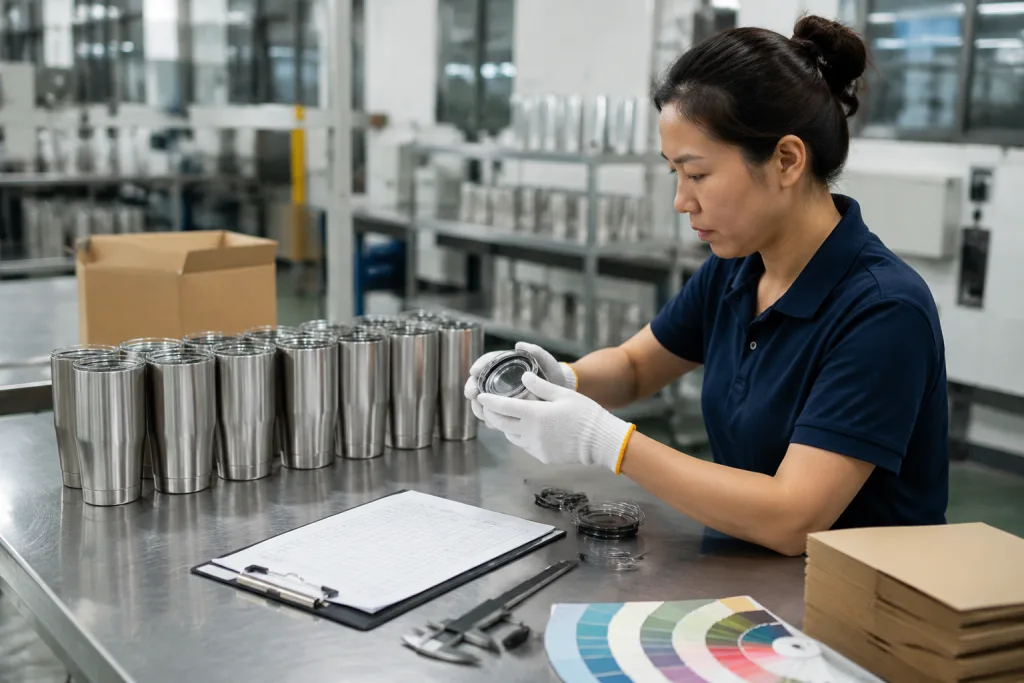
A travel tumbler promotional order looks simple until 8,000 pcs land with weak vacuum, tilted logos, scratched powder coating, or lids leaking inside the gift box. The cup shape is rarely the profit killer. Loose specs are. Last April, QC pulled 32 samples with a Mitutoyo caliper and found the logo centerline drifting 3 mm off the artwork; the buyer flagged it only after packing because the PO just said “logo on front.” Coffee brands and corporate-gift buyers lose money when the factory is left to fill blanks with the cheapest workable option.
From our Hangzhou, Zhejiang production office, we see the same trouble every season: 201 steel quoted where 304 stainless was expected, logo artwork placed across a taper, cartons failing a 76 cm drop test, and inspection booked after 60% of the goods are already sealed. We run this line weekly. If you are buying a bulk coffee travel mug or building a coffee mug private label program in China, “what is your best price?” is the wrong first question. Write the order like a buyer, not like someone clicking through a catalog.
Vacuum Failure Starts With Loose Specs
The first production failure is not visible at the factory gate: poor insulation. A buyer writes “stainless travel tumbler” on the PO, the quotation says 304 stainless steel, and the line is expected to ship a cup that keeps coffee hot until 5 p.m. The math doesn’t work. Last March, QC pulled 32 samples from a 20 oz run and found 5 cups dropping below spec after the 6-hour hot-water test. A vacuum-insulated bulk travel tumbler needs the steel grade written clearly, wall thickness before forming in mm, vacuum temperature/time settings, and the exact heat-retention test method.
For coffee mug promotional products, we run 304 stainless steel on the inner wall, then choose 201 or 304 for the outer wall based on the buyer’s target price. Our normal sheet is 0.4-0.5 mm before forming. Cheap 0.32 mm material can look fine under a desk lamp, but it dents after carton drop testing and feels weak when the buyer holds the sample. Thin cups get flagged fast. For a 20 oz bulk coffee tumbler, a workable retention target is 60°C or higher after 6 hours, filled with 95°C water and tested at 20-25°C room temperature. If the brief says 8-12 hours, tell the factory before tooling and costing, not after the first PP sample lands.
At BottleForge Industrial in Zhejiang, our monthly drinkware capacity is about 420,000 units across tumbler, thermos, and sports bottle lines. Standard MOQ for a coffee mug custom made program is usually 1,000 pcs per color, with 25-35 days mass-production lead time after artwork approval. Those numbers hold only when the technical spec is locked before deposit. We have seen this go sideways over one missing line on a PO: “outer wall 304” was typed as “outer wall 201,” and the buyer flagged it after 12 cartons were already packed.
If you are checking a coffee mug supplier list or coffee mug supplier directory, FOB Ningbo versus FOB Shanghai unit price is the wrong first question. Ask each coffee mug manufacturer for the heat-retention protocol in writing: water temperature, room temperature, test hours, sample quantity, and pass/fail standard. On our side, QC uses a calibrated digital thermometer and logs the reading at 0, 3, and 6 hours. If the answer comes back as “keeps hot long time,” you are not getting a controlled coffee mug factory direct offer. You are buying risk inside a reseller-style quotation.
Lids Leak When Fit Is Assumed
The lid is where 7 out of 10 travel tumbler promotional complaints start, even after the cup body clears inspection. Buyers approve a clean silhouette, then QC pulls the sample and finds the slider lid seeping at 45°, the gasket rolling after a dishwasher-style hot rinse, or the sip opening cutting into the upper lip. Promotional users are rough. They throw a bulk coffee mug into a backpack, leave it in a car cup holder, or rinse it in an office sink with hot water.
Define the lid job in plain language. Is it spill-resistant or leakproof? Different claim. A press-fit plastic lid with a silicone gasket works for desk and car use, but calling it leakproof is the wrong question to ask unless it passes an inverted test. For most corporate-gift buyers, we suggest a 30-minute inverted leak test on finished samples, plus a 24-hour room-temperature gasket compression check. For high-value coffee mug private labeling orders, add a hot-water shake test: fill to 80%, use 80°C water, close the lid, shake 10 times, then check the tissue under the lid seam for seepage.
Material matters too. AS and PS lids look clear on the light table, but we have seen hairline cracks appear around the slider rail after 3 drop checks from 1 meter. Tritan or PP lids usually handle daily use better, though the mold cost or unit cost may be higher by USD 0.10-0.35. Silicone gaskets should be food-grade and removable for cleaning; if the gasket groove is under 1.2 mm, the line will fight it during assembly. For Europe, we normally prepare LFGB or EU food-contact documentation where required; for North America, FDA food-contact compliance is the usual baseline.
If your product is a coffee mug customizable gift for a bank, airline, or coffee subscription box, write the lid claim carefully on packaging. “Spill-resistant for commuting” is safer than “100% leakproof” unless the structure truly supports that claim. We once had a buyer flag this exact wording after the PO already said “leak proof lid” with a missing hyphen, and the carton artwork had to wait 2 days. A good coffee mug oem manufacturer will push back when the marketing promise does not match the engineering.
Logo Placement Breaks Good Artwork
Logo failure is almost never about ugly artwork. It happens when a flat logo gets forced onto a curved, tapered, powder-coated metal body with no room for production tolerance. For a travel tumbler promotional order, the wrong question is “How big can we print it?” Ask where the logo can sit without distortion. A 70 mm wide logo can look strong on a PDF mockup, then bend at the edge when the pad-print jig wraps it around a 20 oz tapered tumbler. QC pulled one sample last month where the buyer’s round icon looked like an egg by 2.3 mm.
For coffee mug custom work, lock the decoration method before the PO goes to our line. Laser engraving is durable and clean on powder coating, but it cuts through to the stainless base color and will not match Pantone chips. Silkscreen works for one-color logos on straight wall areas, adding USD 0.08-0.18 per position depending on print size and ink coverage. Heat transfer handles multi-color art with gradients, but we run 3M tape and cross-hatch tests because edge lift shows up fast near the hand grip. UV printing can look sharp; some matte coatings fail the scratch test after 50 rubs with an alcohol cloth.
A practical rule: keep critical text at least 8 mm away from the body curve, vertical seam area, lid interference zone, and bottom radius transition. Short text survives better. For wraparound designs, ask for a printed production proof, not only a digital mockup. On a bulk coffee travel mug order above 3,000 pcs, we recommend a pre-production sample using the exact coating, logo process, and carton packing. It adds 5-7 days, and the math still works because one rejected container costs more than the sample delay. We have seen this go sideways over a missing “R” in a PO artwork file.
Coffee brands need tighter control than generic corporate buyers. If you sell roasted coffee, the tumbler sits next to your bag, menu board, and checkout counter. A coffee mug customized with a weak logo position makes the brand look cheap even when the cup passes leak and insulation tests. Ask your coffee mug manufacturer for a decoration tolerance, such as +/-1.5 mm vertical and +/-2 mm horizontal, and write it into the purchase order. We run that check with a clear acrylic positioning gauge before packing; if the buyer flagged logo drift at incoming inspection, that line on the PO decides the argument.
Coating Chips From Bad Pretreatment
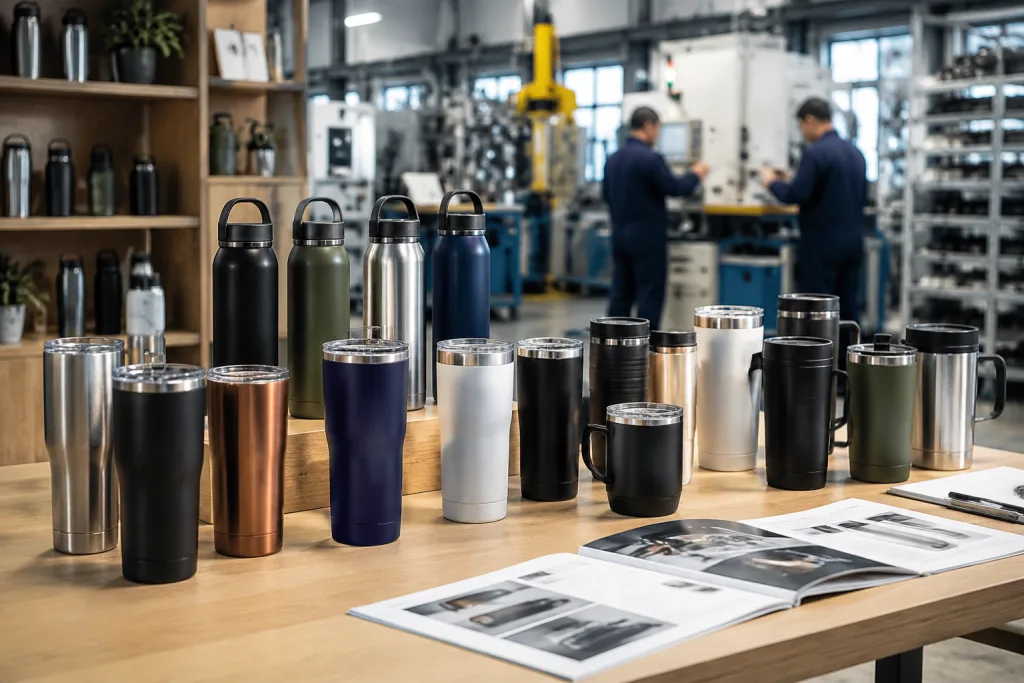
Powder coating can make a bulk travel mug look retail-ready, but it is also where we see the most after-sale photos: chipped rims, scuffed bodies, and two cartons that look like different colors. It is not just powder sprayed on 304 stainless. We run alkaline degreasing, water rinse, drying, electrostatic spray, then oven curing; if the pretreatment bath is tired or the cup body still has oil from deep drawing, the film can look fine under a 6000K inspection lamp and start lifting after 14 days in a backpack. QC pulled a matte black sample last month where the cross-hatch tape test failed on the lower body. Bad sign.
For coffee mug promotional projects, write the finish on the PO: matte powder, glossy powder, spray paint, or raw stainless. Do not leave it as “black coating.” Matte black and dark navy show key scratches faster than beige or silver, and white looks clean in the catalog but shows carton rub on the shoulder after 12 days in sea shipment vibration. If the cup is used as coffee mug promotional products for a 1-day event, a 2% light scratch rate might pass the math. For coffee mug private label retail stock, this is the wrong place to save USD 0.06 per piece; the buyer flagged it fast when shelf lighting made every rim chip visible at 30 cm.
We normally classify coating defects under AQL inspection. Critical defects include exposed rust, sharp burrs, and unsafe contamination. Major defects include obvious chips over 1 mm, logo peeling, severe color mismatch, or dents visible at 30 cm. Minor defects include tiny dust points or light marks that do not affect function. AQL 2.5 for major defects and 4.0 for minor defects is a common starting point, but retail buyers often push for fewer visible marks on the front logo panel. On the line, we check with a 1 mm defect gauge, 3M tape, and a 30 cm viewing distance because “looks bad” is not an inspection standard.
Color control needs numbers. Ask for a Pantone reference or an approved physical color chip, then allow a realistic tolerance because powder coating on metal will not match paper exactly. If you source from China, keep one approved sample at your office and one sealed golden sample at the Zhejiang factory; we label ours with order number, finish code, and approval date so nobody grabs the wrong cup from the sample rack. When both sides judge against the same sample, arguments drop sharply, especially after the second production lot.
Packaging Fails Before The User Opens It
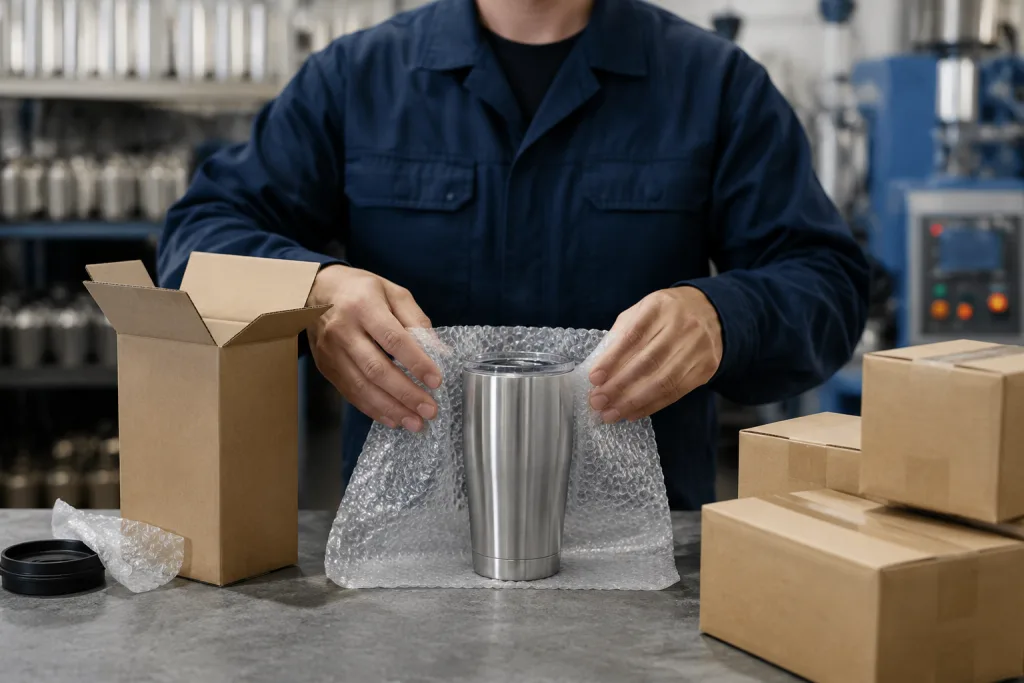
A tumbler can leave the line clean and still arrive with a dent because someone treated packaging like decoration. We see this on 3,000-10,000 pcs coffee mug in bulk orders shipped by sea, then handled by a distributor warehouse, a parcel carrier, or an Amazon-style 3PL. Gift boxes crush. Lids rub through powder coating. Cartons split on the taped corners when the handler grabs one side. Last April, QC pulled a 20 oz sample from a rubbed inner box and found a 14 mm scratch near the logo area. The user blames the product, not the route it took.
For a standard 16-20 oz bulk coffee mug, an individual white box or kraft box is usually enough for corporate giveaways. For retail coffee mug private labeling, we run a printed gift box with inner support, or a corrugated sleeve when the tumbler has a handle. Carton strength beats pretty artwork here; buyers push back on this until the first crushed corner photo arrives. We often use 5-ply export cartons for heavier bulk coffee tumbler orders, with 24 pcs per master carton for 7 common 20 oz styles we ship. Gross weight should normally stay below 15-18 kg per carton to reduce handling damage, and our packing line checks this on a 30 kg platform scale before sealing.
Write drop testing into the order. A practical test is 1 corner, 3 edges, and 6 faces from 76 cm for a filled master carton, then inspect for dents, broken lids, and crushed retail boxes. If the product is going into parcel shipping, raise the standard; 76 cm is not enough when one carton becomes one courier parcel. We use a simple drop tester and photograph each face after the test, because vague “strong packing” wording on a PO does not protect anyone. If you need FNSKU labels, suffocation warnings, carton barcodes, or country-of-origin marks, provide the label file before mass packing begins. Relabeling 5,000 cartons in China after inspection is slow and avoidable; we once lost 2 working days because “Made in China” was missing from the buyer’s PDF.
Coffee mug distributors and corporate-gift agencies should confirm pallet requirements before we quote final carton cube. European warehouses may ask for EUR-pallet dimensions, while North American buyers often prefer floor-loaded containers for lower freight cost. This is the wrong question to leave until shipment week. Packaging changes carton cube, container load quantity, and sometimes FOB price by USD 0.20-0.60 per unit. On one 40HQ order, changing from 24 pcs to 20 pcs per master carton cut corner damage, but the math removed 1,120 pcs from the container load plan.
Compliance Gaps Delay Promotional Launches
Compliance failure feels boring until it eats your launch date. We have seen a coffee brand approve 2 sample rounds, pay a 30% deposit, then find the test report covered a brushed 304 stainless body, not the powder-coated body and flip lid on the PO. For a travel tumbler promotional program shipping to Europe or North America, check compliance before the quotation is locked. Do it early. Last month QC pulled the sample from line 3 and the lid resin code on the material tag did not match the report, which would have added 12 days for retesting instead of 2 days for a document check.
Common requirements include FDA food-contact compliance for the U.S., LFGB or EU food-contact testing for Germany and wider European retail, REACH screening for coatings or plastic parts, and sometimes Prop 65 assessment for California distribution. For children’s drinkware, ASTM and CPSIA considerations may apply, but most adult travel tumblers sit outside that category. If your buyer needs BSCI, Sedex, or ISO 9001 factory approval, put it in the RFQ before sourcing, not after artwork approval. We had one buyer flag Sedex after 5,000 pcs were already on the production schedule, and the math did not work because the audit slot was 18 days out.
The usual failure is document mismatch. A supplier sends an old 304 stainless steel report, but the order uses a different PP lid, silicone gasket, or spray coating. Sometimes the report belongs to another factory. Sometimes the test was done 3 years ago on a coating that looks the same in a photo but uses a different powder batch. That may pass a quick desk check, but larger retailers and importers will reject it. We have seen this go sideways when the buyer’s compliance team measured the lid with a 0.01 mm caliper and found a different mold cavity number than the sample file.
A disciplined coffee mug supplier ties each report to the BOM: inner steel, outer steel, lid, gasket, coating, ink, and packaging if needed. At BottleForge Industrial in Hangzhou, Zhejiang, we run the compliance checklist during sampling, not during final inspection. This is the wrong question to ask: “Do you have reports?” Ask which report matches which material on this order. China can produce strong drinkware at scale, but compliance has to sit beside the MOQ, artwork file, and packing method from day 1. On our floor, the checklist is clipped to the sample tray with the Pantone card and the 3D lid drawing, so QC is not guessing at carton inspection.
Inspection Too Late Finds Expensive Problems
The last failure is timing. Buyers wait until the goods are finished, packed, and booked to ship in three days, then ask for inspection. Too late. At that point, the line has moved on, cartons are sealed with 48 mm BOPP tape, and rework means opening pallets one by one. If 12% of lids leak or 8% of logos are tilted, you are no longer fixing the root cause. You are arguing over a discount that never covers the damage.
For a coffee mug factory direct order, inspection needs layers. Approve a golden sample first, with the exact body, lid, coating, logo, and packing. Then check first-article production after 50-100 pcs come off the line; QC pulled the sample too late on one 3,000 pcs order and found the straw hole was 1.5 mm off center. Run pre-shipment inspection when at least 80% of goods are packed. For orders over 5,000 pcs, pay for an in-line inspection. The math works better than sorting 5,000 leaking lids after packing.
Use a written checklist. Include capacity or volume check, weight tolerance, vacuum test, lid fit, leak test, coating adhesion, logo position, barcode scan, carton mark, and quantity count. We run adhesion checks with a cross-hatch tape test on samples, usually using 3M 600 tape and a 1 mm cutter grid. Vacuum can be screened with hot-water temperature measurement or vacuum detection equipment, depending on factory setup. For AQL, 7 out of 10 buyers we see use general inspection level II, AQL 0 for critical, 2.5 for major, and 4.0 for minor defects.
If you are new to buying from a coffee mug distributor or coffee mug manufacturers in China, do not rely on photos alone. Photos show progress, not release status. We have seen this go sideways when the buyer approved a carton photo, then the warehouse found the PO number had one digit wrong on 126 master cartons. A third-party inspection in Zhejiang or another production area usually costs less than one pallet of rejected goods. Negotiate quality before deposit; after the container is booked, your options shrink fast.
Send your tumbler spec before buying blind
Share target volume, logo file, market, and budget. We will return a practical China factory quote with QC points marked clearly.
Frequently asked questions
What MOQ should I expect for a travel tumbler promotional order?
For most stainless steel travel tumblers, a realistic MOQ is 1,000 pcs per color for existing molds and standard powder colors. If you need a special Pantone coating, custom lid, or coffee mug custom made shape, expect 3,000-5,000 pcs because the factory must set up coating, fixtures, and sometimes tooling. For coffee mug customized logo work, 1,000 pcs is usually enough for laser engraving or one-color silkscreen. Lead time is normally 25-35 days after deposit and artwork approval, plus 5-7 days for a confirmed pre-production sample. Smaller trial orders are possible, but the unit price and setup cost will be higher.
What is a fair FOB China price for a bulk coffee travel mug?
For an existing 16-20 oz stainless steel vacuum tumbler, FOB China pricing often sits around USD 3.20-6.80 depending on steel grade, lid design, coating, logo method, and packaging. A simple bulk coffee mug with single-color logo and white box is near the lower end. A retail coffee mug private label item with 304/304 steel, Tritan lid, powder coating, heat-transfer artwork, and printed gift box can be USD 5.50 or higher. Be careful with prices that are 15-25% below the market. The savings usually come from thinner steel, weaker coating, cheaper lids, or no real QC buffer.
Which logo method works best for coffee mug promotional products?
For long-term use, laser engraving on powder-coated stainless steel is the safest choice because it will not peel and handles dish handling better than ink. The tradeoff is that it cannot reproduce Pantone colors. Silkscreen works well for one-color logos on straight areas and usually costs about USD 0.08-0.18 per print position. Heat transfer is better for multi-color branding but needs adhesion testing, especially on matte coatings. UV printing can look premium for short-run coffee mug customizable projects, but it should be scratch-tested before mass production. Always approve a physical logo sample, not only a mockup.
Can one coffee mug factory handle private label packaging too?
Yes, a capable coffee mug factory can usually handle logo decoration, insert cards, retail boxes, carton marks, barcodes, and basic private label packing. The risk is timing. Packaging artwork should be ready before mass production starts because printed boxes often need 7-12 days. If you need FNSKU labels, QR codes, retailer carton labels, or multilingual warnings, send final files with dimensions and placement notes. For coffee mug private labeling, ask for a packing photo set before full packing: open box, closed box, inner protection, carton mark, and pallet if used. This avoids expensive repacking in China.
How do I compare coffee mug suppliers without choosing the cheapest mistake?
Compare a coffee mug supplier by specification control, not only by unit price. Ask each supplier for steel grade, wall thickness, lid material, gasket material, coating type, logo tolerance, MOQ, lead time, AQL standard, and available compliance reports. A real coffee mug manufacturer should answer these points directly. A trading-style quotation may only show photos and a low FOB price. If you are using a coffee mug supplier directory or building a coffee mug supplier list, shortlist factories that provide golden samples, first-article checks, and pre-shipment inspection support. A USD 0.30 cheaper tumbler is not cheaper if 5% arrive defective.