Key Takeaways
- A safe first OEM MOQ is usually 1,000-3,000 pcs per color, not 200 pcs with full customization
- Specify 304 stainless steel at 0.4-0.5 mm inner wall and 0.5-0.6 mm outer wall for most travel tumblers
- Run AQL 2.5 major / 4.0 minor inspection plus 100% lid leak testing before carton sealing
- Plan 35-50 days production after sample approval for custom color, logo, and retail packaging
A travel tumbler looks simple until 8,000 units land with lids that wiggle 1.5 mm, heat retention dropping after 3 hours, scratched coating, or a logo that rubs off after one dishwasher cycle. If you buy for a coffee brand or corporate gifting program, chasing the lowest FOB is the wrong question to ask. The real job is spotting which shortcuts turn into complaint emails; QC pulled one sample last month where the silicone ring was seated upside down, and the buyer flagged it before we packed the first master carton.
At our Hangzhou, Zhejiang facility, we see the same failures in travel tumbler promotional products: drawings with no lid tolerance, lids that never saw a leak test, powder coating that fails a 3M tape pull, rushed laser or silk-screen logo work, and inspection plans that only count cartons. We run bulk travel tumbler programs well when the spec is tight enough that the line does not guess. China can ship clean work, but the math doesn’t work if a PO says “same as sample” and the sample has no color code, no coating thickness, and no AQL 2.5 checklist.
Failure starts with a soft brief
The costliest tumbler failures usually start before we cut the first 304 stainless coil on the slitting line. A buyer asks for a bulk coffee travel mug with a logo, one color, and a target price. The coffee mug factory then guesses the rest: steel grade, lid structure, coating type, carton strength, test level. Bad start. Last March, QC pulled a pre-production sample from a 3,000 pcs order and found the carton burst test missing from the PO. That is not sourcing. That is gambling with your campaign budget.
For travel tumbler promotional products, write the use case at the top of the RFQ. A commuter coffee tumbler for a roaster’s loyalty bundle has different risks than a desk tumbler for a 2-day conference giveaway. If it must fit a car cup holder, specify bottom diameter, usually 68-74 mm; we check it with a digital caliper, not by eye. If it must sit under espresso machines, give the total height with lid removed. If it must be dishwasher safe, reject the cheap painted finish before quotation, because “recommend hand wash only” in 6-point type is where we’ve seen this go sideways.
A usable brief includes capacity in both ml and oz, tolerance of ±5%, lid type, sip opening, straw requirement, insulation target, color standard, logo method, packaging, compliance market, and inspection standard. Better: 600 ml double-wall 304 stainless steel, vacuum insulated, PP lid with silicone gasket, powder coated Pantone 5473C, laser logo 45 x 22 mm, EU REACH and LFGB food-contact documents, one unit per kraft box, AQL 2.5/4.0, FOB Ningbo. We run this through costing faster because the line knows the mold, the powder room knows the color chip, and packing can calculate carton CBM before the buyer asks for freight.
That level of detail lets a coffee mug manufacturer quote cleanly. It also catches weak suppliers early. If a coffee mug supplier cannot confirm wall thickness in mm, gasket material, or the leak-test method, the math doesn’t work for a coffee mug private label program. We ship private label orders only after the buyer signs the artwork sheet; one PO typo, “Pantone 547C” instead of “Pantone 5473C,” once cost 12 days of rework instead of a normal 3-day sample approval.
Leak complaints are rarely random
Leaks kill a coffee mug promotional product faster than a late carton photo. We see the same 3 failure points on the line: lid tooling that shifts after 20,000 shots, silicone gaskets sitting proud by 0.2 mm, and cup mouths pulled out of round after welding and mirror polishing. A catalog photo hides all of it. QC pulled one sample last month that looked perfect, then left a 12 mm wet ring on the kraft test paper in 90 seconds.
For a bulk travel mug order, ask for lid drawings and material confirmation before the PO is locked. Food-contact PP is common for lids, and the silicone gasket should pop out for cleaning without twisting during assembly. A gasket tolerance difference of 0.2 mm can matter. On press-fit lids, we check cup-mouth diameter with a digital caliper and roundness with a go/no-go gauge. If rim ovality runs past 0.35 mm, one side seals while the opposite side weeps. The math does not work if the buyer only approves color and logo.
Our Zhejiang production line uses water-fill inversion testing on sampling lots, with the timer started after the operator wipes the rim dry. For promotional programs with tight deadlines, we often recommend 100% lid leak testing before final packing. It adds labor cost, usually USD 0.03-0.06 per pc, but replacing 500 wet backpacks costs more than 18 minutes at the leak-test station. We run straw lids separately for upright splash resistance; do not print “leakproof” if the straw hole is open. We have seen that claim go sideways.
Write the claim carefully. “Spill-resistant” is safer for slider lids, especially when the buyer’s artwork file says LEAK PROOF in 6 mm text near the handle. “Leakproof when closed” should only be used after 360-degree inversion testing for at least 30 minutes at room temperature. If you are a coffee mug distributor supplying corporate buyers, that wording protects your customer and keeps your margin out of the returns folder.
Heat retention numbers get exaggerated
Vacuum insulation gets oversold fast. A catalog line like “keeps hot 12 hours” means little unless the test sheet shows starting water temperature, room temperature, lid structure, fill volume, and the pass/fail temperature. We run 600 ml samples with 95°C water in a 20°C lab, then log readings with a probe thermometer at 2, 4, and 6 hours. That result will not match a half-filled cup opened every 20 minutes in a car cup holder.
For travel tumbler promotional products, use a test your buyer can repeat. The wrong question is “Can we print 12 hours on the gift box?” Ask what temperature remains after 6 hours. In our line checks, a solid 304 stainless steel vacuum tumbler with a sensible lid should hold water above 55-60°C after 6 hours under controlled conditions. QC pulled one 600 ml sample last month that read 58°C at hour 6; the buyer accepted that because the test method was written on the PI. Cold retention is easier, but every lid opening still costs you.
The common failure is not always vacuum loss. We have seen this go sideways when the buyer picked a wide sip lid, cut body thickness to save USD 0.18 per pc, or added a decorative handle that became a heat bridge. For most bulk coffee tumbler orders, specify 304 stainless steel inner wall, 201 or 304 outer wall depending on budget, and inner wall thickness around 0.4-0.5 mm. Outer wall at 0.5-0.6 mm feels better in hand and survives carton-drop dents better; our caliper check often catches 0.38 mm bodies before they reach packing.
Ask the factory to run vacuum testing after welding and again after powder coating. Powder ovens at 180-200°C can expose weak vacuum seals that looked fine after the first weld test. We ship fewer claims when the line does the second check with a vacuum detector before final packing. A coffee mug oem manufacturer that skips post-coating checks can pass samples and still fail mass production.

Coating fails before the cup fails
The stainless body can last years; the coating can look old after two weeks if the spec is too light. We see it first on the rim and the lower curve, where cups rub in the carton tray. On coffee mug customized programs, QC pulled the sample more than once for 0.5 mm rim peeling, fingernail scratches near the logo, or a color shift between the lid band and body. The usual cause is cheap paint, weak degreasing before spray, short curing time in the oven, or asking a textured powder coat to match a flat Pantone card exactly. That math does not work.
If your tumbler is for a coffee brand, the finish is part of what the customer paid for. Do not approve color from a screen image. Start with Pantone, then sign off a physical color chip or sprayed sample under daylight; we check ours beside the spray line window at about 10:00 a.m., not under yellow office lamps. For powder coating, matte and textured finishes throw light differently from paper Pantone swatches, so the buyer should expect a small visual gap. Discuss a ΔE tolerance if color matters; 6 out of 10 promotional programs can live with ΔE under 2.0-3.0, but premium retail should be tighter.
For durability, specify real tests: cross-hatch adhesion with a 1 mm cutter, alcohol rub testing for printed areas, then a 3M tape pull after the coating has cooled for 24 hours. If the product is advertised as dishwasher safe, run dishwasher cycles before approving mass production. Cheap coatings can pass a quick fingernail test on the sample table and still fail after 10-20 wash cycles. We have seen this go sideways when a paid coffee campaign launched before the buyer tested five production cups, not just the golden sample.
A coffee mug factory direct quote may look attractive at USD 3.20 FOB versus USD 3.55, but a 4% complaint rate on coating turns the cheaper cup into the expensive one. On a 10,000 pcs order, that is 400 angry end users and a long email chain over replacement stock. In China, better factories will tell you which finishes are risky; we push back on gradients, rubberized coatings, and glossy dark colors because the line shows every dust point and handling mark. Listen when the factory says the finish needs a higher-grade powder or 12 days for sampling instead of 7.
Logo methods have hidden limits
A logo that looks sharp on a PDF can fail on a curved tumbler. We see this on about 3 out of 20 coffee mug custom made inquiries, usually after the buyer sends a thin-line logo built for paper, not steel. Laser engraving, silk screen printing, pad printing, heat transfer, UV printing, and embossing all have hard limits; the right process depends on logo size, color count, surface finish, MOQ, and wash target. The line does not care about your brand book.
Laser engraving is durable and clean on powder-coated stainless steel, and we run it with a rotary jig so the mark stays square to the cup wall. It works best for one-color marks, fine text above 1.2 mm stroke width, and programs expected to survive 300 hand-wash cycles. Silk screen printing gives solid color at low cost, but 2-color registration on a curved wall can drift 0.5 mm if the body taper is not controlled. UV printing handles colorful designs, but test abrasion with a 3M tape pull and dishwasher resistance before using it on high-use coffee mug customizable projects.
For corporate-gift buyers, we usually recommend a logo area under 50 x 60 mm unless the tumbler body is straight enough for larger printing. Bigger is not always better; this is the wrong question to ask if the cup has a waist or powder texture. Wraparound artwork needs an extra screen setup and can push rejects from 2% to 6% on a 5,000 pcs order. If you need a retail-grade finish, ask for a pre-production sample from the same jig, same coating, and same logo process planned for mass production.
Do not approve only a digital mockup. Approve a physical logo sample and keep it as the golden sample; QC pulled one last month where the logo sat 4 mm too close to the lid seam even though the PDF looked perfect. On mass inspection, compare position tolerance, color, edge clarity, and adhesion. For coffee mug private labeling, check barcode labels, insert cards, and carton marks too. A beautiful tumbler with the wrong FNSKU, or a PO typo like “matte balck,” can still block your shipment.
Compliance is not just paperwork
Food-contact compliance is where 6 out of 10 promotional travel tumbler projects get messy after the buyer moves from local printing to imported bulk orders. For the EU, buyers usually ask us for LFGB, REACH, and migration test reports covering 304 stainless steel, plastic lid, silicone gasket, powder coating, and printing ink. For North America, FDA food-contact expectations and relevant ASTM or CPSIA checks may apply if the tumbler is aimed at children, campus stores, or family retail packs. QC pulled a 40 oz handle tumbler last month because the PP lid resin code on the BOM did not match the test report.
The mistake is accepting one old report for a different item. A 2021 report for another lid does not prove your current bulk travel tumbler is compliant. Ask whether the tested materials match your exact bill of materials, down to lid color, gasket compound, coating supplier, and logo ink. Small change, big problem. We have seen this go sideways when a buyer approved a black silicone gasket, then the PO said “gray gasket” by typo, and the lab report no longer matched the shipment file.
Social compliance also matters for larger corporate buyers. BSCI, Sedex, ISO 9001, and factory audit documents are often requested before PO release, not after production starts. BottleForge Industrial in Hangzhou, Zhejiang can produce around 450,000 stainless drinkware units per month across tumbler, sports bottle, and thermos lines, but capacity alone is the wrong question to ask. We run batch cards on the line with heat number, coating lot, carton mark, and inspection date, because document control is what saves a 30,000 pcs order when the buyer’s audit team asks for traceability.
If you sell through a coffee mug supplier directory or manage a coffee mug supplier list, separate trading companies from factories that control welding, polishing, coating, and assembly. Trading support is not bad. The risk shows up when a 0.3 mm rim burr, weak laser logo, or leaking push-button lid needs a fast answer and nobody knows which workshop made the part. For risk-heavy travel tumbler promotional orders, factory-level process control matters more than a nice PDF catalog.
Inspection cannot wait until cartons
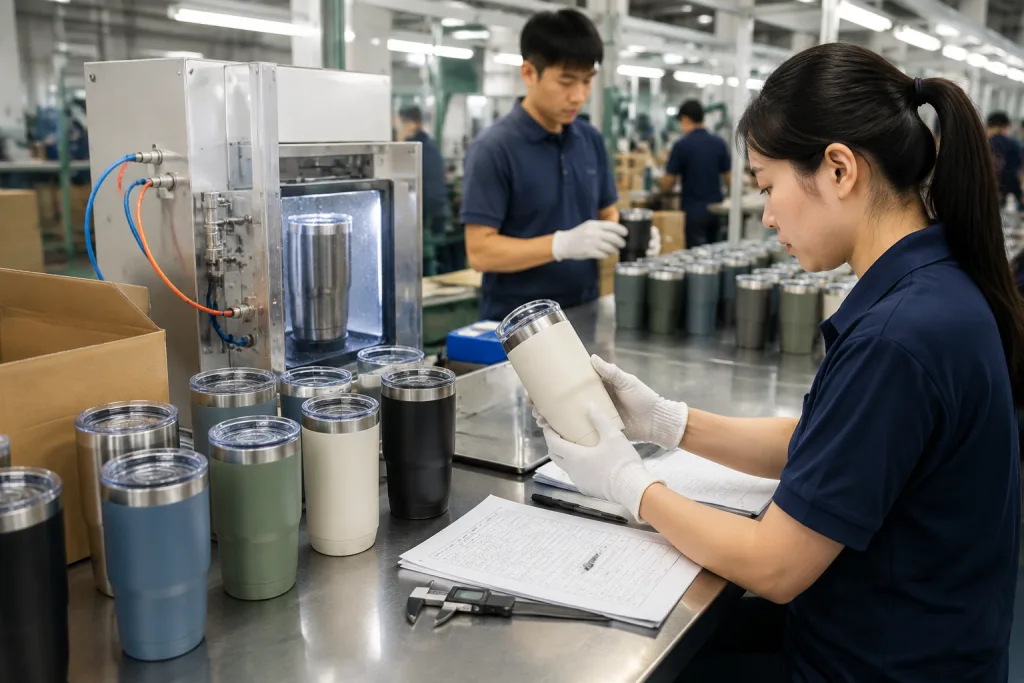
Final inspection has value, but it will not fix a weak production plan. If QC only opens sealed cartons, they may count pieces and check shipping marks while missing vacuum loss, weak powder coating, lid fit drift, or logo adhesion after tape test. We run staged control on the line: incoming 304 stainless thickness checked by micrometer, first-article approval with the golden sample beside it, patrol checks every 2 hours, then final AQL inspection. Cartons are too late.
For most coffee mug bulk orders, use AQL 2.5 for major defects and 4.0 for minor defects. Set critical defects at zero tolerance: sharp rim burrs over 0.2 mm, rust spots, metal dust or plastic flash inside the cup, severe leakage after 30 seconds upside down, wrong material, unsafe odor, or cracked lid. Major defects include vacuum failure on the 100°C hot-water hold test, missing logo, coating peel after 3M tape pull, wrong Pantone color, body dent over the approved limit, or failed lid assembly on the go/no-go gauge. Minor defects cover small specks, slight color variance, and polishing marks that match the signed standard sample.
Ask for production photos at 10%, 50%, and 80% completion. For a 5,000 pc coffee mug customized order, we usually advise pre-shipment inspection when at least 80% is packed and 100% is produced. If your order uses retail packaging, drop test the master carton from 76 cm on 1 corner, 3 edges, and 6 faces. A common export carton is 5-ply corrugated, but wall strength, divider fit, and 18 kg gross weight control matter more than the phrase “export carton.” We have seen this go sideways when the buyer approved the color box but skipped the carton drop test.
Lead time should be written into the PO. A normal custom travel tumbler order is 7-10 days for sampling and 35-50 days for production after approval, depending on coating and packaging. Put the dates next to artwork approval, deposit received, bulk start, inspection booking, and ETD; one PO typo from “matte black” to “black” once cost a buyer 12 days vs 18 days on rework and reinspection. Low MOQs under 500 pcs and impossible ship dates are where defects hide. The math does not work.
Send your tumbler spec before quoting
Share capacity, logo, color, packaging, market, and target delivery date. We will flag risky details before you lock the PO.
Frequently asked questions
What MOQ should I expect for travel tumbler promotional products?
For factory-direct OEM work in China, a realistic MOQ is 1,000-3,000 pcs per color for custom powder coating and logo. If you use an existing stock color with laser engraving, 500 pcs may be possible, but the unit price is usually higher. Fully custom lid color, molded parts, or private retail packaging can push MOQ to 3,000-5,000 pcs. Be careful with offers of 100 pcs plus full customization at a very low price; those orders are often handled from mixed stock with limited color control and basic inspection only.
Which logo method is best for a coffee brand tumbler?
For daily-use coffee tumblers, laser engraving on powder coating is usually the safest method because it resists rubbing and does not rely on ink adhesion. It works best for one-color logos and clean line art. Silk screen printing is cheaper for simple logos and large runs, often adding USD 0.05-0.12 per pc, but it needs adhesion testing. UV printing is useful for multi-color artwork, but you should run alcohol rub and wash tests before approval. Always approve a physical logo sample, not only a mockup.
How much should a custom travel tumbler cost FOB China?
For a 500-600 ml stainless steel vacuum travel tumbler, a practical FOB China range is often USD 3.20-6.50 per pc depending on steel grade, lid design, coating, logo method, packaging, and order quantity. A basic bulk coffee mug with stock lid and one-position logo sits near the lower end. A retail-ready tumbler with custom color, stronger carton, insert card, barcode labels, and better coating moves toward the higher end. If a quote is 20% below the market, check wall thickness, vacuum testing, and coating quality first.
Can you make coffee mug private label packaging for retail or gifting?
Yes. Common options include kraft boxes, color boxes, belly bands, instruction cards, barcode stickers, and master carton marks. For corporate gifts, one unit per gift box is standard. For retail and Amazon-style distribution, you may need FNSKU labels, suffocation warnings for polybags, carton weight limits, and drop-tested packaging. Custom color boxes usually make sense above 1,000 pcs because plate and setup costs are spread across the run. Ask for a packaging dieline and printed sample before mass production.
How do I compare coffee mug manufacturers without a supplier directory?
Ask each coffee mug manufacturer the same technical questions: steel grade, wall thickness, lid material, gasket material, leak test method, coating test method, AQL level, compliance reports, monthly capacity, and lead time. A serious coffee mug factory should answer with numbers, not only catalog photos. Also ask whether welding, polishing, coating, and assembly are in-house or subcontracted. A coffee mug distributor can be useful, but for larger promotional orders you should know who controls the actual production line and QC records.