Key Takeaways
- Start with a 1,000-3,000 pcs pilot SKU before ordering 10,000 pcs across colors
- Use 304 stainless steel with 0.4-0.5 mm inner wall for most coffee travel programs
- Plan 7-10 days for pre-production samples and 30-45 days for mass production
- Run AQL 2.5/4.0 inspection on coating, lid fit, vacuum performance, and carton marks
Your coffee tastes right. Your retail bag looks right. Then the buyer asks for 3,000 branded tumblers for subscription boxes, cafés, staff gifts, or a December corporate-gift drop, and the job changes fast. Now we are talking 304 stainless steel, PP lids, powder coating thickness at 60–80 μm, master cartons, FDA or LFGB paperwork, and whether the PO says “matte black” while the artwork file says “satin black.” We’ve seen this go sideways.
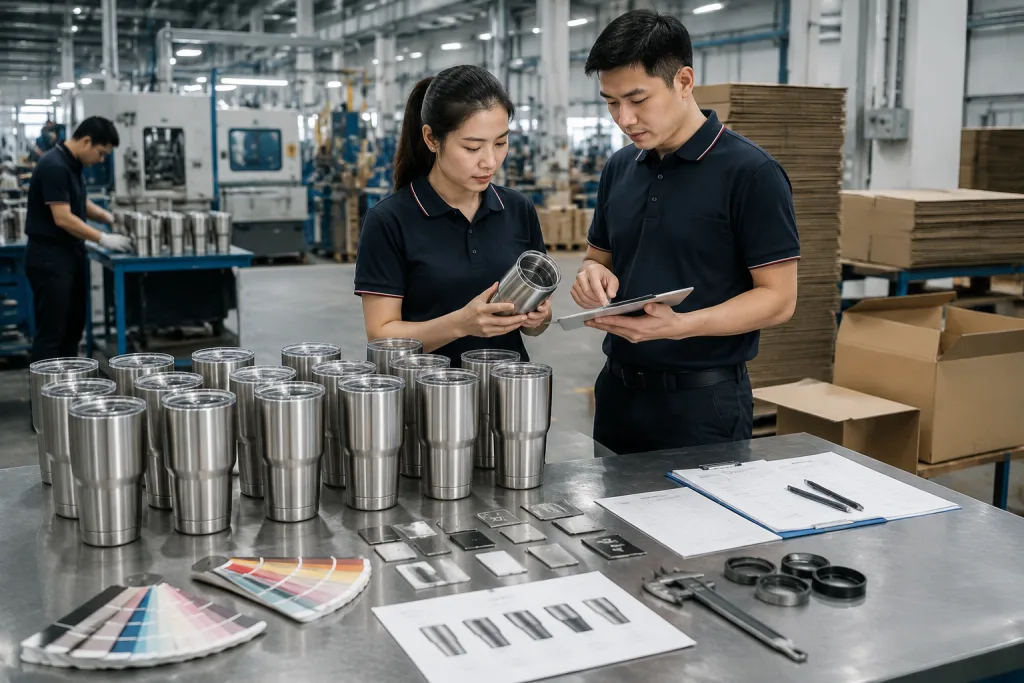
The practical route from Hangzhou, Zhejiang is simple: define where the tumbler will be used, choose the body, lock the logo method, approve samples, inspect the line, then ship against a clear carton mark and packing spec. QC pulled one café sample last month because the laser logo sat 2 mm too low; small issue, big argument if it reaches retail. BottleForge Industrial makes private-label drinkware in China with typical MOQ from 1,000 pcs per SKU and monthly capacity around 450,000 units.
Start with the real order
Start with a real PO, not a catalog dream. Say you are a mid-size coffee brand in Germany or the United States, buying a 20 oz insulated tumbler for café shelves and 500 corporate-gift kits. You search “coffee mug manufacturer,” “coffee mug factory direct,” or a coffee mug supplier directory, then receive 8 quotes that look close on screen but don’t match on the line. Last month one buyer flagged a USD 0.18 gap; QC later found one quote used a 0.4 mm inner wall while the approved sample was 0.5 mm.
The first mistake is asking, “How much for a custom tumbler?” Wrong question. A useful RFQ says: 20 oz double-wall vacuum travel tumbler, 304 stainless steel inner and outer shell, powder coating, slide lid, laser logo, individual kraft box, export carton, FOB Ningbo or Shanghai, 3,000 pcs, two colors, REACH compliant coating, food-contact test report available. We also ask for lid material, carton drop-test target, and Pantone code because a PO typo like “matte black 6C” instead of “Black C” can stop pre-production for 2 days.
For a coffee brand, price is only one line on the sheet. The tumbler has to fit the drinking occasion. A bulk coffee mug for desk use usually needs a handle with at least 35 mm finger clearance. A bulk coffee travel mug for commuting should stay under about 75 mm at the cup-holder base. A bulk coffee tumbler for café resale needs retail packaging that survives parcel shipping; we run a 1.2 m drop test on the kraft box before carton approval. Corporate-gift buyers often care more about logo alignment within 1.5 mm and clean individual box corners than 12-hour heat retention, and we agree with them.
At our Zhejiang factory network in China, a realistic private-label tumbler project usually starts at 1,000 pcs per color for standard mold models. If you need a coffee mug custom made with a new body shape, expect tooling charges from about USD 1,200 to 5,000 and a sample cycle closer to 18 days vs 12 days for an existing mold. For most first orders, the math doesn’t work on new tooling. Use an existing mold, then spend the budget on coating finish, packaging structure, and AQL 2.5 inspection; QC pulled one sample last week for a 2 mm logo lean, and that is exactly the kind of issue buyers notice on a shelf.
Choose the tumbler body first
Body choice sets the cost, hand feel, and complaint rate before we even talk about logo. For travel tumbler private labeling, we usually start buyers with a straight or slightly tapered 16 oz, 20 oz, or 30 oz stainless vacuum tumbler; our spinning line checks the mouth diameter with a 0.02 mm caliper because one loose lid fit can ruin a reorder. Coffee brands usually take 16 oz for café retail, 20 oz for commuters, and 30 oz for North America promo kits. Start simple.
Ask the factory for steel grade and wall thickness, not just “stainless steel.” For coffee and tea, 304 stainless steel is the normal inner wall choice. A 201 stainless outer wall cuts cost, but 7 out of 10 European and North American buyers we quote still push back and ask for 304/304 because the spec sheet looks cleaner. Typical wall thickness is 0.4-0.5 mm for the inner shell and 0.5 mm for the outer shell, depending on shape. Too thin saves USD 0.08-0.15 per cup, then QC pulls dented samples after carton drop testing. The math doesn't work.
For a coffee mug private label program, lids matter as much as the cup. A push-on AS or PP lid is cheaper and fine for desk use; we run it when the buyer says “no bag carry claim” on the PO. A threaded lid seals better but changes the drinking feel, so ask for 3 samples before locking the mold. A slider lid should pass repeated open-close testing, normally 3,000 cycles for a serious promotional or retail program. Do not call any lid leakproof unless the design has a threaded seal and gasket structure built for that claim; we have seen this go sideways when a buyer printed “leakproof” on 5,000 sleeves before the pre-shipment test.
Price moves with steel, finish, and lid. As a rough FOB China range, a 20 oz powder-coated stainless tumbler with laser logo often lands around USD 3.20-5.80 at 3,000 pcs. A handle version, ceramic lining, special lid, or full-color print pushes it higher, and the line also slows down when the artwork wraps over 180° because the jig needs tighter positioning. If a quote is 25% lower than the rest, ask what changed: steel grade, coating thickness, carton strength, QC level, or vacuum test percentage. Last month one PO even had “304 inner” typed as “340 inner”; QC flagged it before production, but not every factory will stop the job for that.
Specify branding without overbuilding it
Branding is where 7 out of 10 travel tumbler private-label briefs get overbuilt. You do not need the priciest decoration method; you need the one that fits the logo file, MOQ, and how long the buyer expects the cup to sit on a retail shelf. We see this on the line: a buyer asks for 6-color artwork on a 500 pcs test order, then pushes back when the print charge beats the lid cost. The math does not work.
Laser engraving is the workhorse for a premium coffee mug customized program. It cuts through the coating and shows the stainless steel underneath, usually 304 stainless on the bodies we run. Clean finish. No peeling. It suits one-color logos, café names, staff gift runs, and corporate-gift buyers who hate labels lifting after 30 dishwasher cycles. The catch is color: laser is not full-color print. For 1,000-5,000 pcs, laser usually adds about USD 0.20-0.45 per unit depending on logo size and position, and QC checks the first piece with a 150 mm caliper to confirm placement before the batch moves.
Silkscreen printing works when you need one solid color on stainless, powder coat, or plastic. It is cheaper for simple artwork, but it scratches sooner than laser if the coating thickness or oven curing is off; we pulled samples last month where the 3M tape test lifted a corner after 2 passes. Heat-transfer or UV printing is better for multi-color graphics with small text, gradients, or campaign artwork, but it needs cleaner files and slower setup. A coffee mug customizable order with names or variable QR codes is possible. Expect the lead time to move from 12 days to 18 days once variable data enters the job.
Private label is not just the logo on the tumbler. For coffee mug private labeling, put these items in writing before deposit: bottom stamp and care label, barcode and FNSKU for fulfillment channels, color box dieline and insert card, master carton marks, spare lid policy. We have seen this go sideways over one PO typo, “FNSKU” typed as “FNSK,” then 38 cartons were held until the buyer resent the label file. For Amazon-style programs, the carton drop test and barcode scan matter as much as the logo finish.
Good artwork files are AI, PDF, or EPS with outlined fonts. Send Pantone references for printed logos and powder coating, not just a screenshot from Canva. “Matte black” is not a specification; our spray room can produce at least 4 blacks that look close under office light and different under a D65 light box. A supplier in China can match a Pantone color, but the tolerance must be agreed before production. For powder coating, a visible color deviation of Delta E under 1.5-2.0 is a reasonable target for controlled batches, and QC should pull the signed color chip beside the pre-production sample before mass spraying.

Build a quote you can compare
If you ask five coffee mug manufacturers for a bulk travel mug quote and compare only the unit price, you will pick the wrong factory at least 3 times out of 5. We see it every Canton Fair season: one quote uses a 0.38 mm inner wall, another uses 0.45 mm, and the buyer says both are “500 ml tumblers.” Wrong question. Ask what is inside the price.
Send every coffee mug supplier the same quote sheet: product model, capacity in ml and oz, steel grade, lid material, coating type, decoration method, individual packaging, carton quantity, carton size, gross weight, MOQ, sample cost, production lead time, Incoterm, payment terms, test documents, and inspection standard. We run this in a single Excel file, with carton size checked against the packing sample on the table. Last month QC pulled one 40 pcs carton sample and found the supplier quoted 15.2 kg gross weight, but the packed carton was 17.6 kg. That changes freight.
MOQ is a factory cost issue, not a sales mood. It comes from coating line setup, logo fixture setup, carton printing minimums, and material purchase quantities. For standard BottleForge models in Zhejiang, MOQ is often 1,000 pcs per SKU for laser logo and 2,000-3,000 pcs for custom powder colors. A coffee mug in bulk order with mixed colors may be accepted, but each color still needs stable coating setup; our powder booth usually needs 35-45 minutes to clean before the next color. If you split 1,000 pcs into five colors, expect a surcharge or a straight refusal.
For a coffee mug distributor or coffee mug distributors serving multiple clients, consolidate orders around one body model. Change the logo and packaging, but keep the tumbler body and lid stable. The math works better: fewer silicone gasket SKUs, fewer spare lids, and repeat orders that can ship in 32 days instead of 45 days when artwork is unchanged. A coffee mug oem manufacturer can support 12 variants on paper, but we have seen this go sideways when the buyer flagged mixed lids during final AQL 2.5 inspection.
Write lead time by stage: 3-5 days for quote confirmation, 7-10 days for logo sample, 3-5 days for sample approval comments, 30-45 days for mass production after deposit and artwork approval, then shipping. Sea freight to Europe or North America may add 25-45 days depending on port and season. Air freight is possible, but the math does not work on low-value promotional orders; we once quoted 0.48 kg per packed tumbler and the air cost landed higher than the cup itself.
Approve samples like an inspector
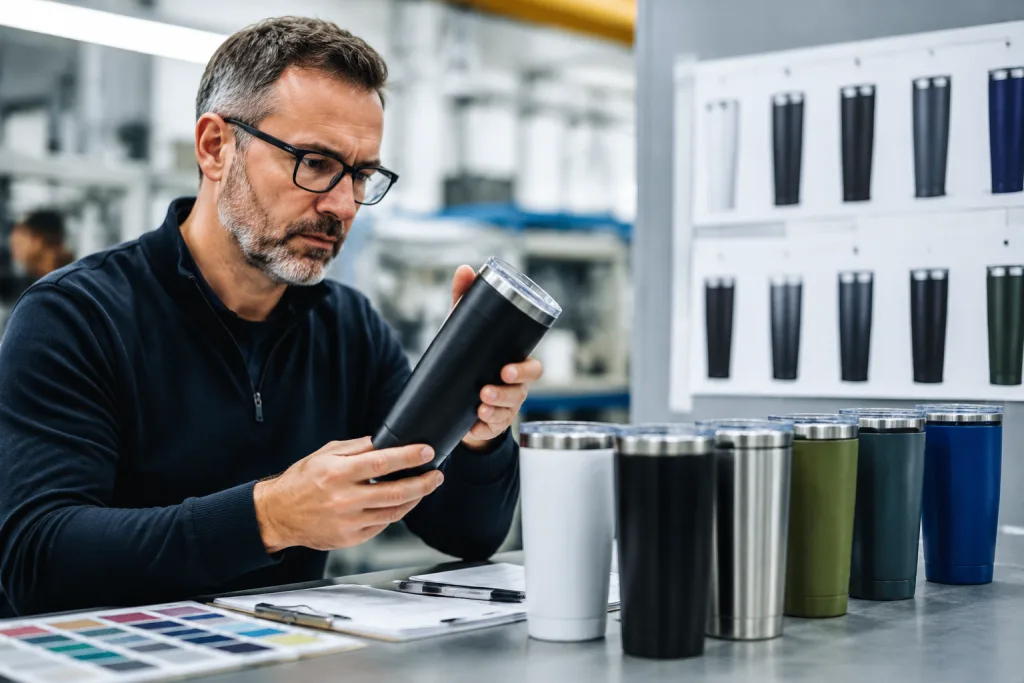
A pre-production sample is not a souvenir. It is the contract sample for your travel tumbler private labeling order, so we treat it like a controlled document and tag it with the PO number, color code, and sample date before it goes near the line.
Open the carton and do the boring checks first. Measure height, mouth diameter, bottom diameter, and weight with a caliper and digital scale, then write the numbers on the approval sheet. Confirm the capacity with water to the practical fill line, not just brim-full volume. A tumbler sold as 20 oz may hold 20 oz to the rim but only 18.5 oz with the lid installed. That matters if your packaging promises a specific capacity, and we have seen buyers flag a 1.5 oz gap during final carton inspection.
Test the lid with hot water. Fill to normal use level, install the lid, turn it over if the supplier claims leak resistance, and place it in a 72 mm cup holder gauge if commute use is part of the brief. For non-leakproof slider lids, check splash resistance and drinking comfort instead of asking for physics to disappear. Run a simple heat test: 95°C water, lid closed, room temperature 20-25°C, record temperature after 1, 3, and 6 hours. Use the same thermometer and same fill volume for each supplier sample, or the math does not work.
For coating, use a cross-hatch tape test if you can, or at minimum scratch an inconspicuous area with consistent pressure from the same utility blade. Check logo position with a ruler: centerline deviation over 2 mm becomes visible on a premium retail item. For coffee mug custom programs with gift boxes, inspect the box board thickness, print registration, barcode readability, and whether the tumbler rattles inside. QC pulled one sample last month because the sleeve looked fine, but the EAN code failed on a Honeywell scanner after lamination.
Never approve a sample with “small changes to be fixed in mass production” unless those changes are written in the purchase order, marked on photos, and confirmed by the factory.
Keep one approved sample at your office and one at the factory. In China production, that physical sample saves 12 days of email argument versus an 18-day remake fight when the coating shade, logo size, or even a typo on the PO gets questioned later.
Control production before shipment
Mass production problems do not wait for the invoice. They show up when nobody signs off the first 100 pcs, the powder coating lot changes from 24A to 24B, or cartons are taped before QC checks the lids with a torque jig. A workable QC plan is simple. Agree on it before deposit, or the line will follow the fastest route, not the safest one.
For a 3,000 pcs bulk travel tumbler order, we normally set three control points: pre-production confirmation with sealed golden samples, inline check at 20-30% completion, and final random inspection before shipment. Final inspection can use ANSI/ASQ Z1.4 with AQL 2.5 for major defects and 4.0 for minor defects. Critical defects such as sharp edges, rust, strong odor, wrong food-contact material, broken glass liner if applicable, or unsafe lid failure should be zero tolerance. We had one buyer flag a 0.6 mm burr on the rim during video inspection; that is exactly the kind of issue you want caught before 60 cartons are closed.
Inspection should include vacuum performance sampling. We run hot water temperature drop testing, then check the body after the vacuum process for pinhole marks and bottom weld issues. For serious retail programs, require 100% vacuum check at the production line and random retention testing during final QC. Also inspect coating bubbles, dust spots, orange peel, logo scratches, lid fit, gasket installation, internal cleanliness, and odor. QC pulled the sample last month because 7 of 80 lids had gaskets sitting 1 mm proud; the cups looked fine, but the leak test said otherwise.
Compliance depends on the selling market. For Europe, ask for LFGB or relevant EU food-contact testing, REACH for coating or surface materials, and packaging requirements if applicable. For the United States, buyers often request FDA food-contact material conformity and sometimes ASTM-related physical tests for specific use cases. BSCI, ISO 9001, or factory audit reports help evaluate management systems, but they do not replace product testing. This is the wrong question to ask: “Does the factory have certificates?” Ask whether the tested material matches your PO, because we have seen POs with “304 stainless” typed in English while the Chinese spec line was left blank.
Cartons deserve attention. A coffee mug promotional order can be ruined by weak export cartons, even when the tumbler itself passes inspection. Specify 5-ply corrugated cartons for sea freight, clear shipping marks, inner dividers where needed, and a carton drop test if the goods will go into parcel networks. If you are a coffee mug distributor shipping to multiple warehouses, confirm pallet height, carton weight under about 18 kg where possible, and label placement before production ends. The math does not work if a 21 kg master carton goes into courier handling; we have seen corner crush after 12 drops on the lab floor, then the buyer asks why Amazon received dented color boxes.
Ship, reorder, and improve
After final inspection passes, do not relax too early. Match the commercial invoice, packing list, HS code description, carton count, gross weight, and shipping marks against the PO line by line. We once caught “matte black” typed as “mate black” on a shipping mark draft, and QC pulled 12 cartons back before the warehouse taped them shut. For FOB Ningbo or Shanghai from Zhejiang, the factory covers local trucking and export customs; your forwarder covers ocean freight, insurance, destination charges, and import clearance. New China buyers should price these items before comparing FOB and DDP. Otherwise the math does not work.
For first-time travel tumbler private labeling, keep the first order tight. One body, two colors, one lid, one packaging structure. That is enough. If the first 3,000 pcs sell through, the second order can add a seasonal color with a Pantone target, a gift sleeve, a retail display tray, or a bundled coffee offer with a barcode sticker. On the line, every extra SKU means another artwork file, another color card, another carton label check, and usually 12 days vs 18 days for approval. We have seen this go sideways when buyers launch 8 variations before the first pallet has even left Ningbo.
Track complaints after delivery. Useful data means lid leakage reports per 1,000 pcs, coating chips per 1,000 pcs, dented units on arrival, barcode scan failures, and returns by channel. Send photos with carton numbers, not just “customer unhappy.” If you send this data back to your coffee mug factory, a serious supplier can adjust gasket hardness, carton dividers, coating pretreatment, or logo placement; for example, we changed one silicone gasket from 55 Shore A to 60 Shore A after 7 leakage claims in 1,000 pcs. If the supplier only argues, find another partner.
Some buyers search every year for a new coffee mug supplier list to save USD 0.10 per unit. That can work for disposable campaigns, but it is the wrong habit for branded retail drinkware. A stable coffee mug factory direct relationship gives you repeat color control, faster sample approval, spare lids that fit, and fewer surprises. The buyer may push back and say “same 20 oz tumbler, why not cheaper?” We usually put the claim cost on the table: 2% returns on 3,000 pcs can eat more than the saving before you count replacement freight. The lowest quote is not factory-direct value if you spend the margin fixing claims.
For coffee brands and corporate-gift buyers, the best private-label tumbler is not the fanciest model. It is the model your customer actually uses, arrives clean, matches your brand, passes inspection, and can be reordered without starting from zero. We ship plenty of plain 304 stainless bodies with a simple powder coat because they survive the drop test, scan at the warehouse, and fit the same spare lid mold next season. Boring sells.
Send your tumbler brief for a factory quote
Share capacity, quantity, logo file, packaging needs, and destination port. We will return a practical FOB quote with MOQ and lead time.
Frequently asked questions
What MOQ should I expect for travel tumbler private labeling?
For standard stainless travel tumbler molds, expect MOQ around 1,000 pcs per SKU for laser engraving or one-color logo printing. If you need a custom powder-coated color, many China factories require 2,000-3,000 pcs per color because the coating line setup and powder purchase have minimums. Fully custom body shapes usually need tooling and a larger first run, often 5,000 pcs or more. If your project is a corporate-gift test, start with one 20 oz model and one or two colors. Splitting 1,000 pcs across five colors usually raises cost and creates production instability.
How much does a private-label coffee travel tumbler cost?
A standard 20 oz double-wall 304 stainless travel tumbler with powder coating, laser logo, individual box, and export carton often sits around USD 3.20-5.80 FOB China at 3,000 pcs. The low end usually means a simple lid, standard color, and existing packaging. Ceramic lining, handle lids, full-color UV print, custom box inserts, or retail sleeves can add USD 0.30-1.50 per unit. Do not compare prices unless steel grade, lid type, packaging, coating, logo size, and inspection requirements are the same.
Is laser engraving better than printing for a coffee mug custom logo?
Laser engraving is usually better for long-term durability on powder-coated stainless tumblers. It will not peel, and it gives a clean retail look for café shelves and corporate gifts. Printing is better when your logo requires exact Pantone color, multiple colors, gradients, or campaign graphics. For a coffee mug custom order of 1,000-5,000 pcs, laser often costs about USD 0.20-0.45 per unit, while UV or heat-transfer printing can cost more depending on coverage. The right choice depends on the artwork and how the tumbler will be used.
What quality checks should I require before shipment?
Use a written inspection standard before deposit. For most bulk travel tumbler orders, require final random inspection using AQL 2.5 for major defects and 4.0 for minor defects. Check vacuum performance, capacity, lid fit, gasket installation, coating adhesion, logo position, odor, internal cleanliness, carton strength, barcode readability, and shipping marks. Critical defects should be zero tolerance. For a 3,000 pcs order, also request an inline check when 20-30% of goods are finished so coating or logo problems are caught before all units are packed.
Can one factory handle coffee mug private labeling and retail packaging?
Yes, but you should confirm the exact packaging scope. A capable coffee mug manufacturer can manage logo application, bottom markings, kraft box or color box, insert card, barcode, FNSKU label, carton marks, and pallet instructions. Custom packaging usually adds 7-15 days during first setup because dielines, print proofs, and barcode placement need approval. For repeat orders, it is much faster if the artwork stays unchanged. Ask the supplier for box material, carton size, gross weight, and drop-test method before you approve the quote.