Key Takeaways
- A practical travel tumbler private label MOQ starts at 1,000 units per color for standard molds
- 304 stainless steel at 0.45-0.55 mm wall thickness is the normal baseline for export tumblers
- Powder coating usually adds USD 0.35-0.70 per unit versus plain stainless finish
- A realistic China lead time is 35-50 days after approved sample and deposit
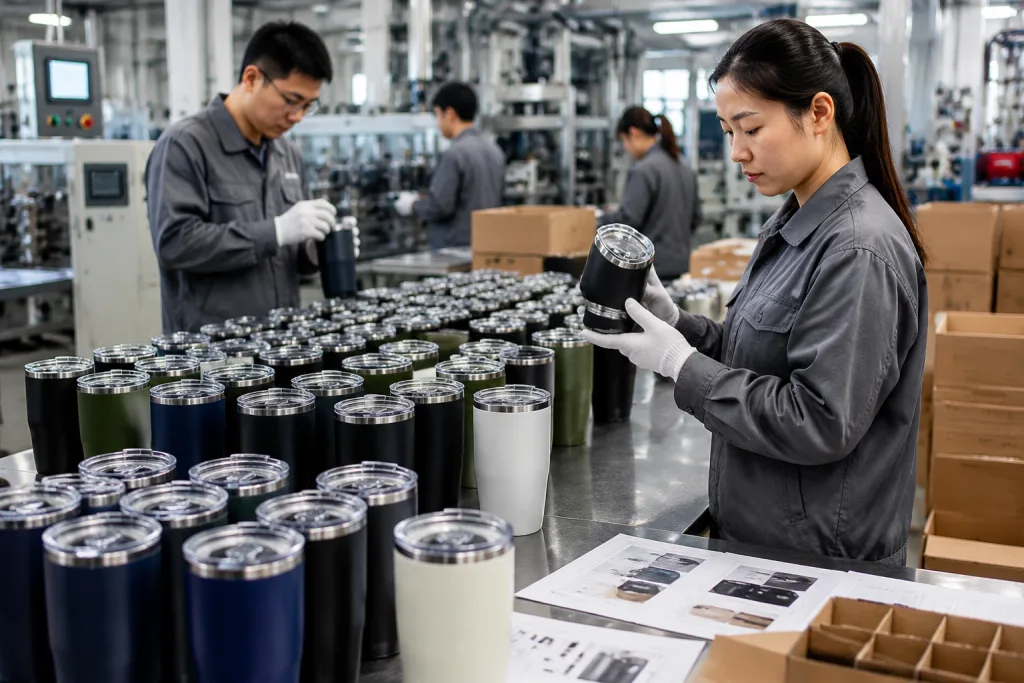
If you sell coffee, run corporate gifting, or manage a coffee mug distributor catalog, the hard part is not finding a shiny cup. The hard part is turning a travel tumbler private label idea into a spec sheet our line can quote, sample, pressure-test, and repeat for 5,000 or 50,000 units without a lid mismatch or a carton problem showing up on day 18.
At BottleForge Industrial in Hangzhou, Zhejiang, we see about 14 of these RFQs each week: the buyer asks for a bulk coffee travel mug, but the sheet skips capacity tolerance, lid material, coating type, carton drop test, or logo position in mm from the base. QC pulled one sample last month where the PO said “matte black,” the artwork file said “sand black,” and the lid callout was blank. A coffee mug factory direct quote from China only works when the spec lines are tight.
Start with the capacity line
The first spec line looks harmless: 12 oz, 16 oz, 20 oz, 24 oz, or 30 oz. For a travel tumbler private label project, that line changes steel weight, mold choice, carton size, shipping cube, lid fit, and where the item sits on a retail shelf. We run 12 oz and 16 oz more often for espresso drinks; 20 oz is the safer commuter size. Corporate-gift buyers pick 20 oz in about 6 out of 10 quote requests because it feels solid but still clears a car cup holder. On the line, QC pulled one 20 oz sample last month at 286 g body weight; the buyer had budgeted for a lighter wall, and the FOB math moved fast.
Do not write only “500 ml tumbler” and expect every coffee mug manufacturer to read it the same way. This is the wrong question to ask. Ask whether capacity is measured to brim, usable fill line, or recommended hot-liquid fill. A 20 oz tumbler may hold 600 ml to brim but is safer to sell around 560 ml if the lid needs headspace. For North America, ounce labeling matters. For Europe, buyers ask for ml labeling and REACH documentation more often; we had one PO typo say “500 m1” instead of “500 ml,” and the artwork team caught it before laser marking.
If you compare a bulk coffee tumbler from a coffee mug supplier directory with a factory quotation from Zhejiang, check diameter and height before you compare volume. A 74 mm bottom diameter fits many vehicle holders; 80 mm gets complaints. A 210-230 mm height fits most e-commerce carton layouts. Small dimensional changes can add 8-12% to ocean freight when packed 24 pieces per master carton. We’ve seen this go sideways: the buyer approved a taller sample, then the master carton failed the 15 kg target during packing trial, and the carton cube killed the “cheaper” quote.
Buyer impact: capacity is not a marketing word. It drives FOB price, carton cube, lid tooling, and end-user complaints.
Steel grade and wall thickness
For export travel tumblers, we run 304 stainless steel on the inner wall as the baseline, then quote the outer wall in 304 or 201 depending on the target price. For coffee mug private label programs, 304 inner wall is the red line. Acidic coffee, milk film, and dishwasher detergent are hard on cheap steel; QC pulled 12 inner-wall samples last month after a 48-hour salt spray check, and the 201 inner wall samples showed staining around the weld seam. A 201 outer wall is fine for price-sensitive coffee mug promotional products if the buyer accepts the trade-off. Just write it on the PO.
Wall thickness is where cheap quotes hide. A practical range is 0.45-0.55 mm per stainless sheet before forming, measured with a Mitutoyo digital caliper before the sheet goes to the hydraulic press. Some low-price bulk travel mug quotes use thinner material, around 0.35-0.40 mm. The cup may look fine in a video inspection, then dent when 18 kg cartons get stacked in the container. For corporate gifts, asking for the lightest cup is the wrong question to ask; the math does not work if the end user thinks the gift feels disposable.
For vacuum insulation, the double-wall body is welded, evacuated, and sealed on the line. Ask the coffee mug oem manufacturer to state vacuum performance as a test condition, not a slogan. Use wording like this: hot water at 95°C, room temperature 20°C, tested after 6 hours, result above 55°C. Cold retention claims also need starting temperature and duration; our lab uses a probe thermometer and logs 30 cups per batch when the buyer asks for a written report. Without test conditions, “keeps hot 12 hours” is packaging copy, and we have seen this go sideways during retail buyer review.
- Standard inner wall: 304 stainless steel, food contact grade; we reject mixed-grade inner shells at incoming material check
- Common outer wall: 304 for premium retail orders, 201 for budget programs where the buyer signs off on the spec
- Practical thickness: 0.45-0.55 mm before forming, checked by caliper on the sheet and again after drawing
- Factory check: vacuum test plus random water-leak test before packing, usually 2 cartons pulled per 500 cartons
In our Zhejiang production network, a normal stainless travel tumbler line can handle about 300,000 units per month across standard models, but that capacity only helps if your material spec is locked before sampling. We once lost 4 days because a PO said “SS304 body” while the approved sample used 304 inner and 201 outer; the buyer flagged it after mass production pricing was already issued.
Lid construction changes the product
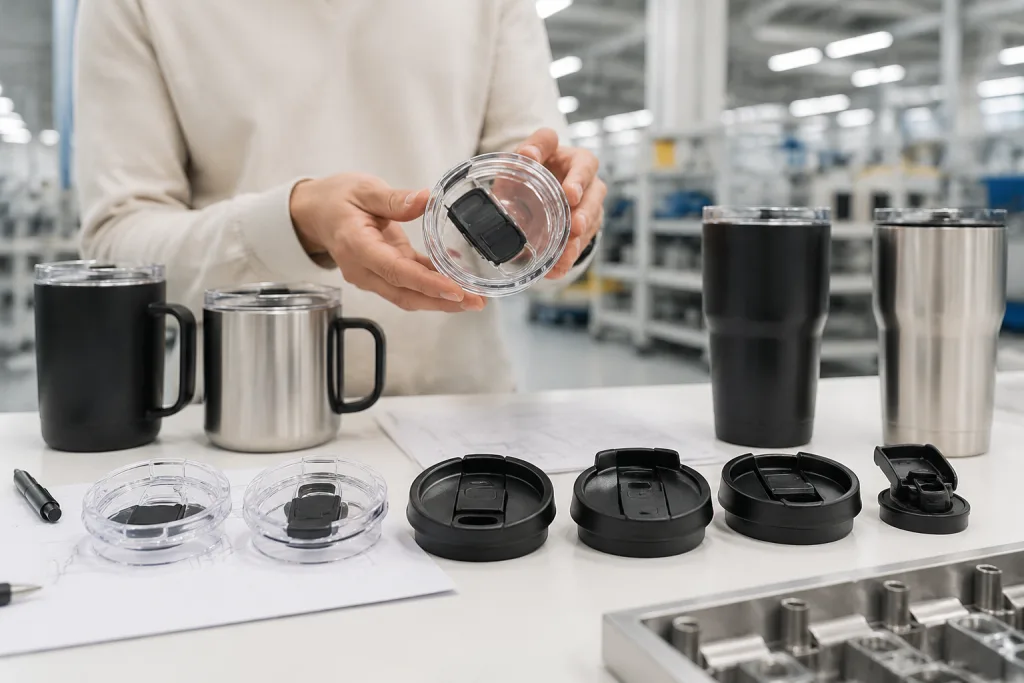
The lid is where 7 out of 10 coffee mug customized projects get into trouble. Buyers spend 3 weeks checking Pantone chips and logo size, then approve the lowest-price lid on the quote sheet. Six months later, customer service is sorting leak claims, loose sliders, cracked flip tabs, and silicone odor. We’ve seen this go sideways. For a bulk coffee mug program, treat the lid as a separate assembly with resin grade, gasket hardness, drinking port size, and test requirements; on the line, QC pulled one sample last month with a 0.4 mm gap between the PP lid and the stainless rim.
Common lid materials include PP, AS, Tritan, and stainless insert designs. PP keeps cost down and survives drops well, but it is not transparent. AS gives a clear look, but one buyer flagged corner cracks after a 1.2 m carton drop test. Tritan costs more, usually USD 0.18–0.35 extra per lid depending on structure, but it gives better clarity and toughness for a premium bulk coffee travel mug. Silicone rings should be food-grade and removable for cleaning. If the tumbler is intended for coffee with milk, removable seals cut odor complaints; our QC team checks the ring with a Shore A durometer before packing.
Decide early: splash-resistant or leak-resistant. This is the wrong question to leave until artwork approval. Most slider lids are splash-resistant, not fully leakproof. If a buyer puts a hot tumbler sideways in a laptop bag, 6 common travel lids out of 10 will fail our bench test. A screw lid with gasket and locking mechanism is safer, but it changes the drinking feel and adds cost. We run this check with room-temperature water first, then repeat after the cup sits 5 minutes with hot water to see whether pressure pushes the slider open.
For coffee mug custom made orders, we usually specify a 100% lid-fit check on the first production run and AQL sampling for later runs. No shortcuts. A practical leak test is inversion for 30 seconds with room-temperature water, and the inspector records seepage around the drinking port and air vent. For hot liquids, pressure can build, so do not overpromise. If you are selling through corporate channels, a conservative claim beats a refund wave; one PO typo we caught said “leakproof slider lid,” and the buyer accepted changing it to “splash-resistant lid” before mass production.
Surface finish and logo method
Surface finish is the first thing your buyer touches, so it cannot be treated as a color tick box. Plain stainless is the lowest-cost route and it survives the 3M tape test well. Powder coating gives better grip and shelf presence; we run 60-80 μm film thickness on most travel tumbler private label orders. Spray painting can match tricky Pantone colors for less money, but abrasion is where we see it fail. For a coffee mug customizable gift, powder coating is usually the safer middle ground when the budget allows it.
Typical finish adders vary by size and color. On standard 16-20 oz models, powder coating often adds USD 0.35-0.70 per unit FOB China. A soft-touch coating can add USD 0.60-1.10, and it needs cleaner carton packing because scratches show faster; QC pulled 12 pcs last month after the divider edge rubbed the cup body. Glossy finishes look bright in photos but show fingerprints after 5 minutes on a buyer’s desk. Matte finishes forgive small handling marks, so they work better for corporate gifting.
Logo method depends on artwork, order quantity, and how the tumbler will be used. Laser engraving is durable on stainless or powder-coated surfaces, but the final mark color follows the base layer; black powder often engraves to a silver-grey tone, not pure white. Silk screen is cost-effective for simple one-color marks, often with a setup charge around USD 40-80 per color, and our line checks placement with a 0.5 mm scale before bulk printing. Heat transfer handles gradients and larger artwork, but the math does not work if nobody budgets for abrasion testing. Full-wrap designs need tight seam control, or the buyer flags the back line immediately.
If you are ordering coffee mug promotional products for events, a one-color silk screen may be enough. If you are building a coffee mug private labeling retail line, laser engraving or clean heat transfer looks more permanent. For coffee brands, we often suggest the main logo on the front and a small roast message or QR code on the back, with at least 15 mm clearance from the bottom curve. We have seen this go sideways when a PO says “logo centered” but the artwork file includes a tiny website line; confirm the printable area in mm before sampling.
- Laser: durable mark for simple logos, strong choice when the cup will be washed daily
- Silk screen: lower cost for 1-2 solid colors, best when Pantone matching matters more than texture
- Heat transfer: better for gradients and full artwork, but needs rub testing before bulk approval
- Powder coating: better hand feel and higher perceived value, especially on matte retail colors
MOQ, pricing, and tooling math
MOQ is not a punishment; it is how the line avoids losing money on color change, coating setup, printing setup, and packaging changeover. For travel tumbler private label orders using existing molds, we usually run 1,000 units per color because the powder-coating booth purge takes about 25 minutes and the first 30-50 pcs often get pulled for shade checking. Some stock programs can start at 300-500 units, but expect 6-8 fixed colors and one simple logo method, usually laser or one-color silk screen. Custom mold projects usually start around 5,000-10,000 units because tooling, trial runs, and QC setup need volume.
For a standard 16-20 oz double-wall stainless bulk travel tumbler, a practical FOB China range is often USD 3.20-6.80. The swing comes from steel grade, lid structure, finish, logo process, retail packaging, and inspection level, so ask for the spec sheet line by line. A low quote often hides cost in the parts buyers do not touch during a Zoom call: 0.38 mm wall instead of 0.45 mm, cheaper PP lid resin, 5-ply carton changed to 3-ply, or no real AQL inspection. The math doesn't work if the price is down 18% but the carton fails a 76 cm drop test. That is not coffee mug factory direct value; it is deferred risk.
Tooling needs a separate line in your quote. A new lid, special handle, custom body shape, or molded brand icon can require USD 800-4,000 for tooling depending on complexity. We had one PO where the buyer wrote “matte black lid” but the drawing showed a glossy slider; QC pulled the sample at 9:40 a.m. and the mold shop had to re-cut the small slider insert. A simple color match to Pantone does not need body tooling, but it may need a coating sample fee and 2-3 sprayed panels before approval. For coffee mug custom projects, ask what happens to the mold after production: exclusivity, storage period, and maintenance fee must be written down.
Buyers sometimes compare a coffee mug supplier list as if every quote includes the same service. It rarely does. One quote may include export carton, individual kraft box, logo setup, and pre-shipment inspection support; another may cover only the bare tumbler in a thin polybag. We have seen this go sideways when a buyer approved USD 0.12 less per unit, then found the retail box was missing and the Amazon FBA label was never quoted. Put each cost line into the same format before choosing a coffee mug manufacturer in China.
Packaging for retail and gifting
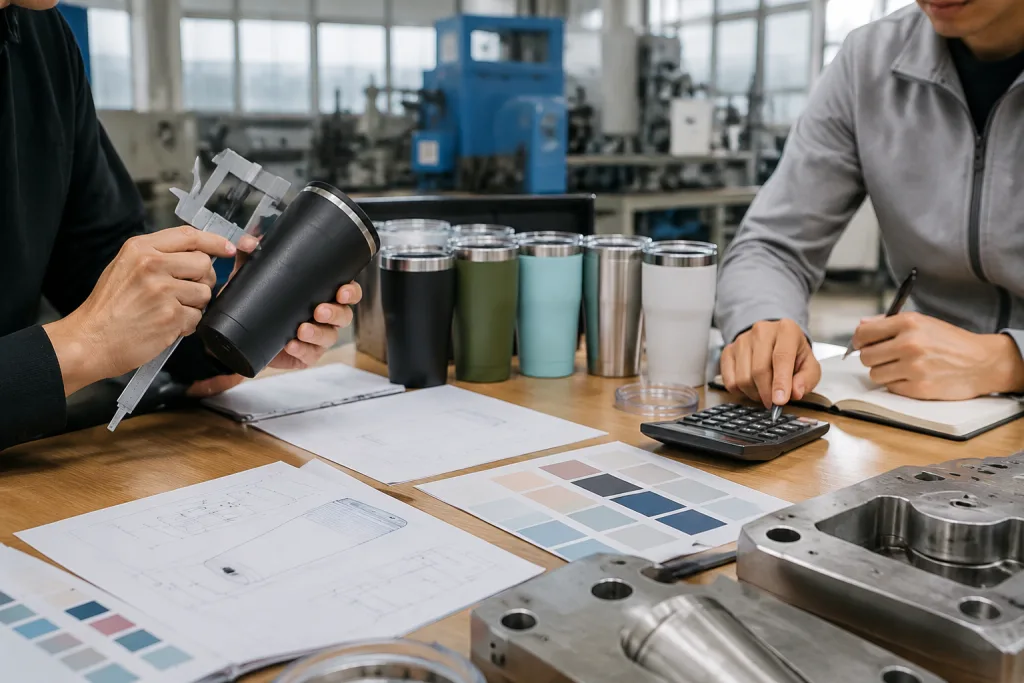
Packaging is not decoration. It controls breakage, barcode scans, warehouse picks, and whether the gift feels worth keeping after the event. For corporate-gift orders, we often run a white box with a 1-color printed logo; one buyer flagged a 2 mm logo shift on the box proof, so we now mark the print area on the dieline before sampling. For coffee brands selling retail, a color box needs product story, care instructions, capacity, material claims, and barcode with at least 8 mm quiet zone. If you sell on marketplaces, plan FNSKU labels and carton marks by SKU from day one.
A common packing method is 1 piece per kraft or color box, 24 pieces per master carton. For a 20 oz tumbler, a master carton might be around 52 x 35 x 48 cm, but the number changes fast when the cup has a side handle or a rigid gift box. Ask for carton dimensions and gross weight before approving the final quote; our carton scale once showed 13.6 kg gross while the PO still said 12.8 kg. That typo cost 2 days with the forwarder. Freight forwarders charge by actual weight or volumetric weight, and drinkware often loses on cube.
For coffee mug in bulk shipments, carton strength matters. We normally recommend 5-ply export cartons for ocean freight and drop-test review for e-commerce fulfillment; QC pulled one sample after a 76 cm corner drop and found the lid scuffed through the inner box. If the individual box uses thin 250 gsm board, corners crush easily. For gift sets, 350-400 gsm board is more realistic. Foam gets pushback from sustainability teams, so molded pulp or paper dividers are now the safer choice, though they may add USD 0.10-0.30 per unit.
If you are buying as a coffee mug distributor or working with coffee mug distributors, insist on a packing specification with carton marks, barcode position, inner box artwork file version, and pallet requirements. The line needs those details before mass packing, not after 60 cartons are taped shut with 48 mm BOPP tape. A beautiful tumbler packed poorly becomes a claims problem before the end user even opens it. We’ve seen this go sideways.
Compliance and inspection details
Compliance starts with where you will sell and which channel will list the tumbler. For Europe, buyers usually ask for LFGB or EU food contact testing, plus REACH when the powder coating, paint, or printed surface is part of the spec. For the United States, FDA food contact expectations apply, and 6 out of 10 Amazon or retail buyers we deal with also ask for California Proposition 65 screening. If the tumbler is sold for children, ASTM and CPSIA questions come up; most coffee tumblers and corporate gift bottles are adult-use, so do not pay for children’s testing unless the sales page, carton wording, or PO says it. QC pulled one 600 ml sample last month because the gift box copy said “school bottle” by mistake.
Factory audits and product tests are not the same thing. BSCI, Sedex, or ISO 9001 tells you the factory has management controls, records, and audit discipline, but it does not prove your specific coffee mug bulk order is safe or built to spec. Product testing must match the material and finish on the order: 304 stainless body, lid resin, silicone gasket, coating, ink, and any straw parts. Change the coating supplier or swap a PP lid for Tritan, and the old report may not cover the new run. We have seen this go sideways when a buyer sent a 2023 LFGB report for a matte black sample, then ordered a glossy gradient finish from a different coating line.
For inspection, use AQL terms both teams can read without guessing. A common pre-shipment inspection setup is General Inspection Level II with AQL 2.5 for major defects and 4.0 for minor defects. Critical defects should be zero. Major defects include leaks, sharp edges, wrong logo, severe dents, failed lid fit, or wrong material; our line checks lid fit with a simple torque test and a 180° inverted leak check for 30 seconds. Minor defects include small coating specks inside an agreed tolerance, such as 1 speck under 0.5 mm outside the front logo area. Define the defect list before mass production. After 10,000 units are packed, the math doesn’t work.
At BottleForge Industrial in Hangzhou, Zhejiang, a normal timeline is 7-10 days for artwork and pre-production sample after file approval, then 35-50 days for mass production after deposit and sample approval. That is realistic for China export orders with coating, logo, and packaging. If you need 10,000 units in 18 days during peak season, say it on day one, not after the carton mark is approved. Sometimes we can run stock bodies and keep the schedule tight; if you want a new mold color, custom lid, laser logo, and retail box, 18 days becomes 35 days fast. The buyer flagged one PO typo this year where “matte white” became “mate white,” and we stopped the line before 42 cartons were labeled wrong.
Send your tumbler spec sheet for factory review
BottleForge will check capacity, lid, logo, packaging, MOQ, and compliance details before you commit to production.
Frequently asked questions
What is the best MOQ for a first travel tumbler private label order?
For an existing mold, 1,000 units per color is the cleanest starting MOQ because coating, logo setup, packing, and inspection can be controlled without making the unit cost silly. If you only need a test run, some stock programs can do 300-500 units, but you will have fewer color choices and higher unit pricing. For a new body shape, handle, or lid tooling, expect 5,000-10,000 units. Coffee brands testing a retail SKU often start with 1,000 units in one color and 2 logo positions, then reorder once sell-through data is real.
How much should a private label travel tumbler cost FOB China?
For a standard 16-20 oz vacuum stainless tumbler, a realistic FOB China price is usually USD 3.20-6.80. The low end normally means standard lid, plain finish or simple coating, 304 inner wall, basic box, and one-color logo. The high end may include 304 inner and outer walls, premium lid, powder coating, laser engraving, color box, barcode labeling, and stricter inspection. If a quote is 20-30% below the market, check wall thickness, lid resin, coating test, carton grade, and whether AQL inspection support is included.
Can I use one tumbler for both coffee retail and corporate gifting?
Yes, but choose the spec carefully. A 16 oz or 20 oz tumbler with 304 inner wall, powder coating, and a splash-resistant slider lid works for many coffee retail and corporate-gift programs. Keep the logo area clean, around 45-60 mm wide for most front marks, and use packaging that can accept either retail barcode or gift message. If you plan both channels, avoid overly seasonal colors. Black, white, navy, stainless, and dark green usually move better across mixed buyers than bright campaign colors.
Which logo method is best for coffee mug private labeling?
Laser engraving is the safest for durability, especially on powder-coated or stainless surfaces. It will not peel, and it gives a premium feel for coffee mug private labeling. Silk screen is cheaper for simple 1-color artwork and event gifts, with setup commonly around USD 40-80 per color. Heat transfer is better for gradients, large graphics, or full-wrap designs, but you should request abrasion and tape tests. For a retail coffee brand, laser front logo plus small back print is a practical balance of durability and brand detail.
What files and details should I send before requesting a quote?
Send capacity, target market, estimated quantity, color count, logo file in AI or PDF vector format, packaging type, required test standards, delivery address or FOB port preference, and target launch date. If you are comparing coffee mug manufacturers, send the same spec sheet to each supplier. Include whether you need FNSKU, UPC, carton marks, palletization, or Amazon-style prep. With complete details, a China factory can usually quote within 24-48 hours. Without them, the quote will be full of assumptions that later become price changes.