Key Takeaways
- Specify 304 stainless steel, 0.45-0.55 mm inner wall, and vacuum loss testing at 100% or AQL 0.65
- Leakage usually starts with lid tooling, silicone hardness, and thread tolerance, not the cup body
- For corporate-gift orders, confirm carton drop test, barcode placement, and spare lid ratios before deposit
- A realistic China OEM lead time is 30-45 days after sample approval, plus 7-10 days for pre-production samples
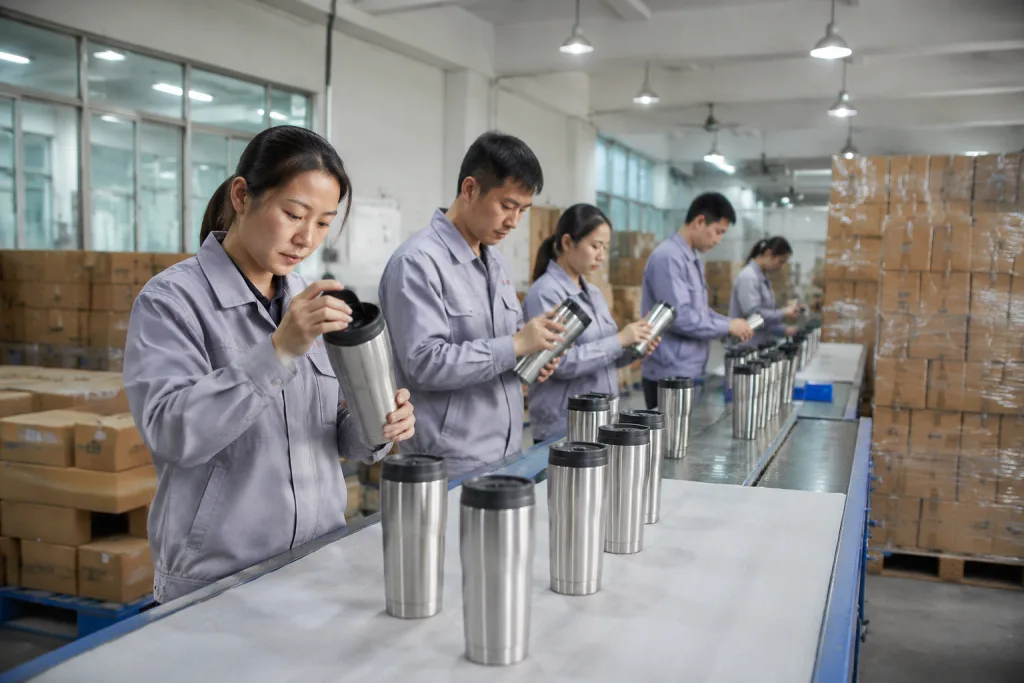
A travel tumbler looks simple until the first 40HQ arrives with lid seepage, logos scratched through after a 3M tape test, outer cartons crushed on two corners, and stainless bodies weighing 18 g less than the signed sample. We’ve seen this go sideways. For coffee brands and corporate-gift buyers, the loss hits after the campaign is sold or the retail shelf is booked.
If you are choosing a travel tumbler oem manufacturer in China, picking a catalog shape is the wrong question to ask. You need a purchase spec that blocks the usual trouble before the line starts: lid torque range, logo abrasion standard, carton drop-test requirement, body weight tolerance, and AQL 2.5 inspection points. BottleForge Industrial in Hangzhou, Zhejiang runs travel tumbler lines at 300,000 units/month, with OEM MOQ from 1,000 units per color and normal lead time of 30-45 days after artwork approval; last week QC pulled 32 pre-production samples because a PO typo changed “matte black” to “mate black.”
The sample lies by omission
The first failure is believing the perfect hand-built sample. This is the wrong question to ask: “Does the sample look good?” Ask whether the line can repeat it 5,000 times. A polished pre-production sample helps, but it does not prove the shipment will match. In our sample room, the senior tech may use a slower 800 grit wheel, pick the best 10 lids from a tray of 200, and spend 3 minutes lining up the logo by eye. Production is rougher. Operators change shifts, molds run hotter after 4 hours, powder coating can drift by 15-25 microns, and cartons move past the tape machine at commercial speed.
When you compare travel tumbler oem manufacturer quotes, ask whether the sample comes from production tooling or prototype tooling. For a tapered 20 oz bulk travel tumbler, a 0.3 mm diameter difference at the lid seat can change leak performance. QC pulled one 20 oz sample last April that passed on the desk but leaked after 6 turns in the rotary leak tester because the lid seat was 0.28 mm undersize. For a handle tumbler, the handle weld or rivet position can shift by 1-2 mm and still look fine, then the buyer flags it because the retail carton bulges by 3 mm.
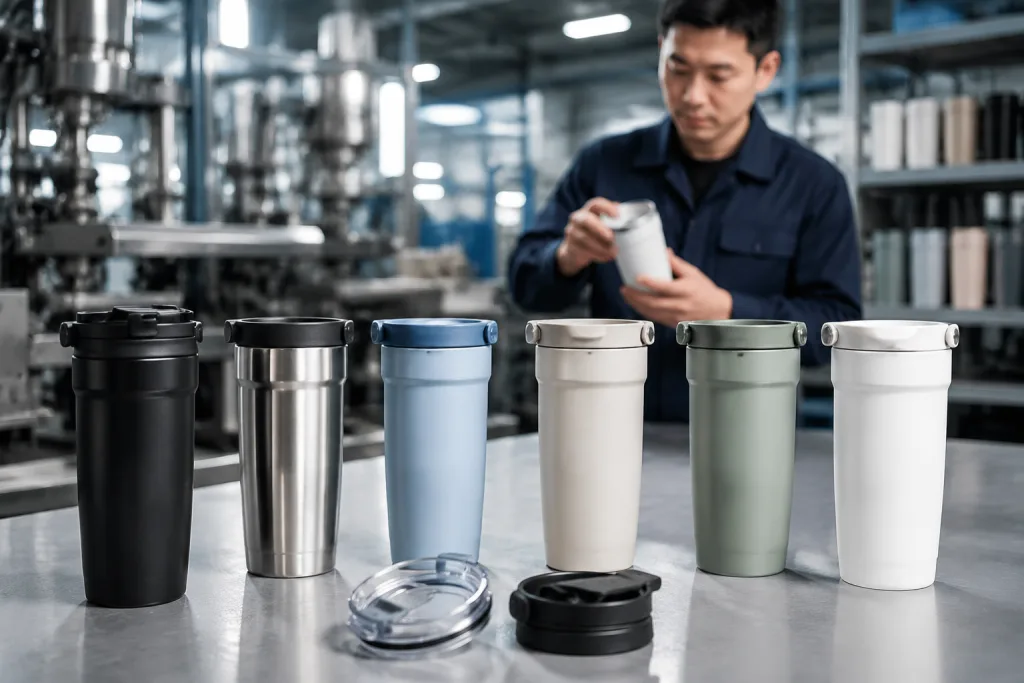
Your approval file needs more than photos. Lock the capacity tolerance, body weight, stainless grade, lid material, silicone color, finish code, logo size, and packaging layout with actual values, not “same as sample.” For a 20 oz stainless tumbler, we usually see finished body weight from 285-360 g depending on wall thickness, handle, and lid style. We run a digital scale at incoming QC and write the target weight on the inspection sheet. If a supplier will not write target weight into the proforma invoice, the math does not work. You are leaving room for downgrade.
This matters whether you call it a bulk coffee mug, bulk coffee travel mug, bulk coffee tumbler, or bulk travel mug. The buyer risk is the same: the sales sample may not represent the production average. A serious coffee mug factory direct partner should keep one signed golden sample in China and one with you. Both should be labeled with date, project number, finish code, and approved artwork revision. We also add the PO number and artwork file name, because we once saw “matte sand beige” typed as “matte send beige” on a PO, and that tiny typo almost sent 3,000 pcs into the wrong powder coating batch.
Leak claims start at the lid
Buyers often blame the tumbler body, but 8 out of 10 leak claims we see start at the lid system. A sliding lid has a drink-slot risk, a flip lid depends on hinge pressure, a straw lid is usually spill-prone by design, and a screw lid lives or dies on thread fit. Corporate-gift buyers sometimes pick the cleanest-looking lid, then the buyer flagged it after staff tipped the cup inside a car bag and coffee came through the slider slot. That is the wrong question to ask at sampling. The lid was never sold as leakproof.
Use exact language on the quote sheet and PO. Say splash resistant, leak resistant, or leakproof when closed. They are not the same claim. For a coffee mug custom made for commuters, we recommend screw-thread lids with silicone gasket compression of 10-20% and silicone hardness around Shore A 50-60, checked with a Shore A durometer at incoming QC. Too soft, and the gasket takes a set after 3 heat cycles. Too hard, and it misses a 0.2 mm tolerance gap on the lid seat.
Testing has to copy real use. We run 100% visual lid inspection under the line lamp, hot-water inversion testing by random pull, and torque checks on screw lids with a 0-5 N·m torque meter. For a 10,000-piece coffee mug customized order, use AQL 1.5 for major defects and AQL 4.0 for minor cosmetic issues, but set leakage as critical with zero tolerance in the inspected sample. If retail needs a stricter rule, write it before deposit; we have seen this go sideways when the buyer added a 30-minute upside-down test after mass production.
Ask your coffee mug oem manufacturer to record the lid resin on the material sheet. PP is common for heat resistance, Tritan gives better clarity, and AS keeps cost down but needs a closer market check. For Europe, food-contact compliance and REACH-related material declarations matter. For North America, FDA food-contact expectations and, where relevant, Prop 65 review should be handled early. QC pulled one sample last year where the carton label said Tritan but the PO typo said “AS”; that low-cost lid erased the savings from a cheap coffee mug supplier once returns started after delivery.
Vacuum failure is not visible
Double-wall vacuum insulation is the part buyers cannot judge by eye. We have seen a tumbler look clean on the table and still drop heat in 90 minutes. The leak usually starts at the weld bead, a dirty seam, weak vacuum pumping, or a knock after sealing. QC pulled one 500 ml sample last month: the outside looked perfect, but the Helium leak tester caught a slow leak after 3 hot-cold cycles.
For stainless travel tumblers, specify 304 stainless steel for the inner wall and outer wall unless there is a clear cost reason to use 201 on the exterior. For coffee brands, we do not recommend 201 inner wall. The math doesn't work after complaints start. A normal inner wall thickness is 0.45-0.55 mm, with outer wall around 0.45-0.60 mm depending on shape. If a quote is 18-22 g lighter than the approved sample, ask for the wall-thickness report from the micrometer check. Ultra-light pricing is a red flag on coffee mug in bulk programs where the buyer is pushing a landed cost target.
A proper coffee mug manufacturer should run insulation testing, not only water-fill checks. We run 95°C water, close the lid, then measure after 6 hours at room temperature with a probe thermometer. Your acceptable result might be 55-65°C depending on volume, lid opening, and mouth diameter. Wide-mouth tumblers lose heat faster than narrow-mouth bottles. Do not compare them as if they are the same product. This is the wrong question to ask during sampling; ask for the test setup and the pass line instead.
At BottleForge in Zhejiang, China, vacuum performance is tested before packing, and failed units are rejected before decoration when the schedule allows it. That saves money because laser engraving or powder coating a bad vacuum cup is wasted labor. On one 3,000 pcs coffee mug private label order, the line held 47 units before coating after the vacuum station flagged weak insulation. If you are building a coffee mug private label line, ask for the vacuum test point in the production flow chart. A coffee mug factory that cannot explain this step is not ready for repeat retail orders.
Decoration fails after shipping
Logo decoration is where 2 out of 10 corporate-gift tumbler orders get uncomfortable after delivery. The PDF looks clean, then QC pulled the sample after a 3M tape rub and the logo scratched, shifted 1.8 mm, faded, or sat crooked on the curved wall. Travel tumblers punish lazy setup because the body taper changes the print head distance from top to bottom. Curved walls lie. A coffee mug custom project with a wraparound design usually needs 45 to 60 minutes more fixture adjustment on the line than a single front logo.
Choose decoration by how the tumbler will be used, not by what the catalog shows first. Laser engraving holds up well on 304 stainless or powder-coated surfaces, but it will not give you a bright red or blue logo. Silk screen works for one- or two-color logos on smoother bodies, and we usually run it from 1,000 units because the screen cost and setup time make smaller runs messy. Heat transfer and UV printing can carry richer graphics, but adhesion lives or dies on coating quality and curing time, such as 160°C for 25 minutes on one powder line. For coffee mug promotional products, buyers often pay for complex decoration when a plain laser mark would last longer. The math doesn't work.
Write checks that an inspector can measure with a caliper, not just “logo must look good.” Logo position tolerance should be around ±1.5 mm for standard front placement and ±2.0 mm for wrap designs. Color should reference Pantone, not a screenshot copied into a PO. For powder coating, specify cross-hatch adhesion testing, boiling-water test, and rub test if the tumbler is intended for daily coffee use; last month one buyer flagged coating lift after 30 minutes in boiling water, even though the dry sample looked fine. Dishwasher-safe claims need separate validation. Do not assume them because the coating feels strong in hand.
If you are a coffee mug distributor or manage coffee mug distributors, watch repeatability before you add 48 logo versions to one order. A coffee mug customizable platform with small logo changes needs artwork control, version names, and pre-production approval photos for every SKU. We have seen this go sideways from one typo on a PO, “Logo-12B” written as “Logo-12D,” and the wrong sleeve artwork went into 600 pcs. A mixed carton of 24 logos sounds convenient, but it increases picking errors unless the factory uses barcode scanning and clear inner labels, such as 60 x 30 mm SKU stickers on each inner box.
Cartons fail before customers do
A tumbler can pass factory QC and still land at the buyer’s warehouse with a dented shoulder. Packaging was the weak link. We have seen 20 oz samples survive the vacuum test, then fail after a 14.6 kg master carton took one bad corner hit on the loading dock. Thin white boxes collapse at the rim; loose dividers let lids rub against powder coating. For corporate gifts, the box sells the product before the tumbler comes out. For online sellers, one crushed retail box is often a return request with photos attached.
Put packaging into the export spec, not a side chat on WeChat. A normal individual white box for a 20 oz travel tumbler uses 300-350 gsm paperboard, and QC should check the caliper with a paper thickness gauge before packing starts. Premium gift boxes may use 1200 gsm greyboard with wrapped paper, but the math changes fast: carton weight goes up, CBM goes up, and the buyer may ask why freight jumped by USD 420 on one 40HQ. Master cartons should be five-layer corrugated board, commonly around K=A or similar export grade, depending on your forwarder and pallet plan. Ask for carton dimensions before mass production so freight is calculated from actual L × W × H, not guessed after the line is sealed.
Drop testing is cheap insurance. For a carton under 15 kg, we run a 76 cm drop height as a practical benchmark: one corner, three edges, then six faces, with QC pulling the sample from packed goods instead of the clean sample room. If you ship to Amazon FBA or a 3PL, lock the label rules early: FNSKU placement, suffocation warnings for polybags, master carton barcodes, and carton weight limits each need a printed proof. Do this before artwork release. We have seen this go sideways when a PO had “FNSK” typed instead of “FNSKU,” and 312 cartons needed relabeling at the warehouse.
FOB Ningbo or FOB Shanghai from Zhejiang, China is common for our customers, and both ports work well if the carton plan is clean. If your supplier quotes only EXW, check whether inland trucking, export declaration, and local handling are included by your forwarder; on a Hangzhou pickup, that can add 1-2 days before the container even reaches Ningbo. A low unit price from a coffee mug supplier list can become expensive when carton size is sloppy. This is the wrong question to ask if you only compare cents per piece. For high-volume coffee mug bulk orders, a 5% CBM reduction may save more than a 3-cent unit discount, especially when the forwarder charges by volume and the cartons leave empty air above the insert tray.
Compliance gets checked too late
Compliance failure hurts because it usually shows up after the deposit, mold charge, and first carton artwork have already been paid. We had one German coffee brand freeze a 6,000 pcs launch because the black powder coating report did not match the final Pantone chip. A coffee brand shipping to Germany, France, Canada, or the United States cannot treat certificates like catalog decoration. The material, coating, ink, silicone gasket, and PP lid plastic all need a check against the sales market. Food grade on a supplier quotation is not a test report.
For Europe, ask for LFGB food-contact testing where it fits the product, REACH SVHC screening for coatings and plastics, and packaging files. For the United States, request FDA food-contact documentation; look at ASTM or CPSIA only when the tumbler is built for children. If you sell a kids-style tumbler, ASTM F963 and CPSIA lead/phthalate limits may become relevant. Adult travel tumblers usually follow another route, but artwork and coating still matter. QC pulled one 30 oz sample from the line last April where the UV logo ink passed rub testing for 50 cycles, yet the coating supplier’s REACH file was for a different matte finish. That mismatch delays shipment.
Factory audits sit inside buyer risk as well. BSCI, ISO 9001, Sedex, or customer-specific audits do not guarantee perfect goods, but they show whether the factory runs a controlled system. A trading company can help on sourcing, but factory-direct accountability is a different conversation: who owns the tooling, who signs the QC report, and which workshop handles rework after AQL 2.5 inspection. We run lid fit checks with a 0.10 mm feeler gauge; if the buyer flagged leakage at pre-shipment, the rework should happen on our line, not in a rented warehouse 40 km away. The phrase coffee mug factory direct should mean you can see production capability, not just receive a lower invoice.
If you are searching a coffee mug supplier directory or comparing a coffee mug supplier list, separate document readiness from quote speed. Fast quotes feel good. The wrong question is “can you quote today?” Ask whether the compliance pack matches the exact SKU, coating, liner, lid resin, silicone color, and print method. For private label programs, request test reports that match the actual material and finish you will buy, not an old report for a different coating from three years ago. We once saw a PO typed as “matte white” while the approved sample tag said “gloss white”; the buyer caught it before mass production, and that saved about 12 days of retesting against an 18-day launch window.
Cheap quotes move risk to you
The lowest quote usually cuts one hidden item: 0.4 mm steel instead of 0.5 mm, thinner powder coat, cheaper PP lid resin, 5-ply carton changed to weak 3-ply, skipped AQL 2.5 inspection time, or no after-sales buffer. You often see it after the campaign ships, when QC pulls a returned sample and the lid gasket has already gone oval. This is the wrong question to ask. A coffee mug manufacturer quote should read like an engineering sheet, not a price menu.
For a 20 oz stainless travel tumbler, factory pricing moves with lid type, handle tooling, finish, and logo process. As a rough FOB China range, simple powder-coated tumblers may sit around USD 3.20-5.80 at 3,000-10,000 units, while handled or premium lid versions can run USD 5.50-8.50 or more. Small MOQ orders cost more because setup, sampling, and color changeover are spread across fewer units. On our line, one Pantone powder change can burn 2.5 hours, and the buyer still asks why 1,000 pcs cannot match the 10,000 pcs price.
Private label adds cost in small bites. Coffee mug private labeling may include custom bottom mark, retail box, insert card, barcode, carton mark, and sometimes new lid color. We once had a PO typo where the carton mark said 30 oz but the artwork file said 20 oz; QC flagged it before mass packing, but it still cost 1 day. If you need coffee mug promotional pricing for a one-off event, do not overbuild the spec. If you need a repeat retail line, do not strip the spec to win a tender by 12 cents. The math does not work.
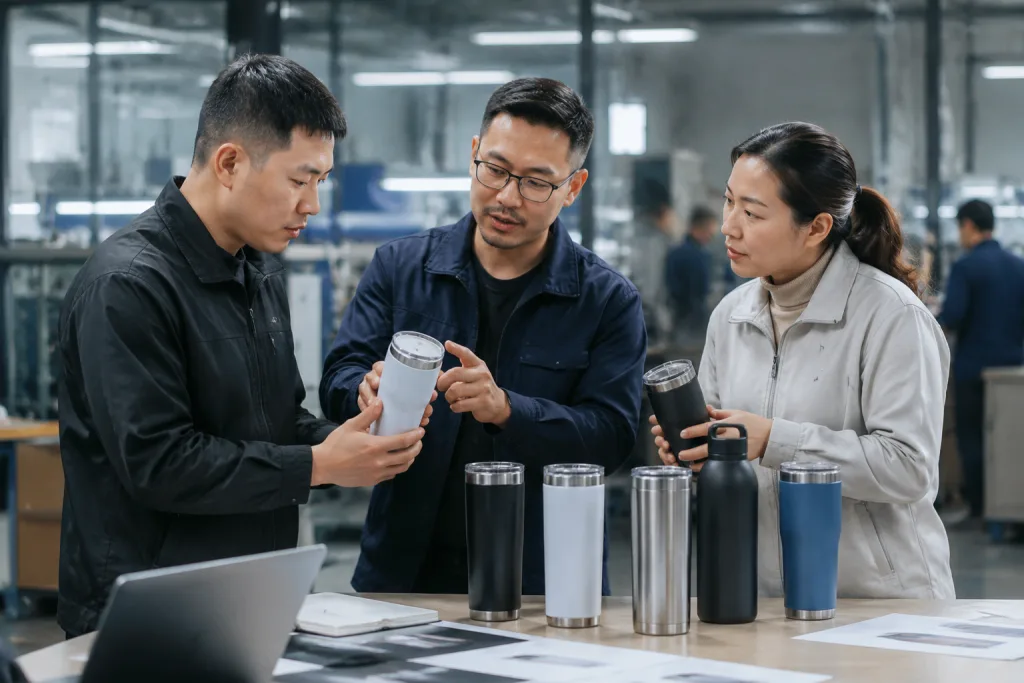
The clean way to buy is to send one RFQ sheet to every coffee mug manufacturers candidate: capacity and dimensions with mm tolerance, lid function, steel grade, finish, decoration method, packaging, compliance market, inspection standard, Incoterm, and delivery window. A real coffee mug supplier answers line by line and may push back on weak points, such as a glossy logo on rough powder coat. A weak supplier sends a catalog page and a smile. We have seen this go sideways after deposit, when the buyer expects 18 days and the factory schedule was built around 30 days. That is your first quality test.
Send your tumbler spec for a factory review
We will check steel, lid, logo, packaging, MOQ, and lead time before you commit to mass production.
Frequently asked questions
What MOQ should we expect from a travel tumbler OEM manufacturer?
For standard BottleForge travel tumbler shapes, the usual OEM MOQ is 1,000 units per color, with total order quantities from 3,000 units giving better pricing and production priority. Custom powder coating, silicone colors, and retail boxes are normally workable at 1,000-2,000 units. New mold development is different: expect 5,000-10,000 units for the first run, plus tooling cost that may range from USD 1,500 to over USD 8,000 depending on lid complexity and body shape. If your order is a corporate-gift project with one logo and a standard box, do not pay for new tooling unless the shape is truly strategic. Use an existing proven mold and put your budget into decoration, packaging, and inspection.
How long does OEM travel tumbler production take after we approve the sample?
A realistic schedule is 7-10 days for artwork layout and pre-production sample, then 30-45 days for mass production after sample approval and deposit. Add 3-5 days if you need third-party inspection, and add time for sea freight: roughly 25-35 days to the US West Coast, 35-45 days to the US East Coast, and 30-40 days to major European ports, depending on season. Q4 corporate-gift orders should be booked earlier because coating, packaging, and vessel space tighten. If a supplier promises 15 days for a customized 10,000-unit order with retail boxes, ask what step they are skipping. It is usually coating cure time, inspection, or packaging control.
Can we use the same tumbler for coffee retail and corporate gifts?
Yes, but the spec should change slightly. Coffee retail needs stronger shelf presentation, barcode discipline, repeatable color, and compliance documents matched to your selling market. Corporate gifts usually need faster artwork handling, logo accuracy, gift-box appearance, and predictable delivery date. For retail, we recommend a tighter AQL plan, often AQL 1.0 or 1.5 for major defects, and full carton labeling by SKU. For a gift order, we focus heavily on decoration position, visible scratches, and carton crush resistance. If you plan to serve both channels, choose a standard 16 oz or 20 oz shape, keep the lid simple, and design packaging that can accept either a retail barcode or event-specific label.
What is the safest logo method for a bulk coffee travel mug order?
Laser engraving is usually the safest method for long-term durability, especially on powder-coated stainless steel. It will not peel like a poorly cured print, and it handles daily handwashing well. The tradeoff is that the logo color is created by exposing the layer below, so you do not get full Pantone color. Silk screen is cost-effective for simple one- or two-color logos, usually good from 1,000 units, but adhesion must be tested on the exact coating. UV printing and heat transfer are better for multicolor graphics, but we recommend rub testing, tape testing, and hot-water exposure before mass production. For premium coffee brands, durability usually beats a complicated full-color mark.
How do we compare quotes from different coffee mug manufacturers fairly?
Build a one-page RFQ and force every supplier to quote the same spec. Include capacity, body weight target, 304 stainless requirement, wall thickness range, lid type, silicone hardness if leak resistance matters, coating finish, logo method, packaging, test standards, MOQ, lead time, and Incoterm such as FOB Ningbo or FOB Shanghai. Ask for carton size and gross weight because freight can change your landed cost by 5-15%. Also ask whether the quote includes pre-production sample, mold charge, inner box, master carton, export declaration, and spare parts. A USD 0.20 cheaper quote is not cheaper if it removes the gift box, weakens the lid, or shifts inspection cost to you.