Key Takeaways
- Choose the drink size first: 12 oz, 16 oz, or 20 oz changes insulation, lid cost, and carton count by 15-20%.
- For custom branding, laser engraving is usually safer than print for wash durability, while full-color wraps work better on coated steel.
- Ask for REACH, LFGB, and BPA-free declarations before deposit; a serious factory should also quote AQL 2.5 inspection.
- A real factory quote should show FOB unit price, MOQ, lead time, carton pack, and print method, not just a sample price.
Buyers rarely lose margin on the tumbler body. They lose it on the choices around it: 600 ml instead of 900 ml for a commuter program, a flip lid that leaks after the carton drop test, a laser logo placed too low on a tapered wall, or a “cheap” quote that changes once the 5-layer carton size and freight CBM are checked. We’ve seen this go sideways. If you are sourcing from travel tumbler manufacturers for coffee brands or corporate gifts, start with the use case, not the product photo.
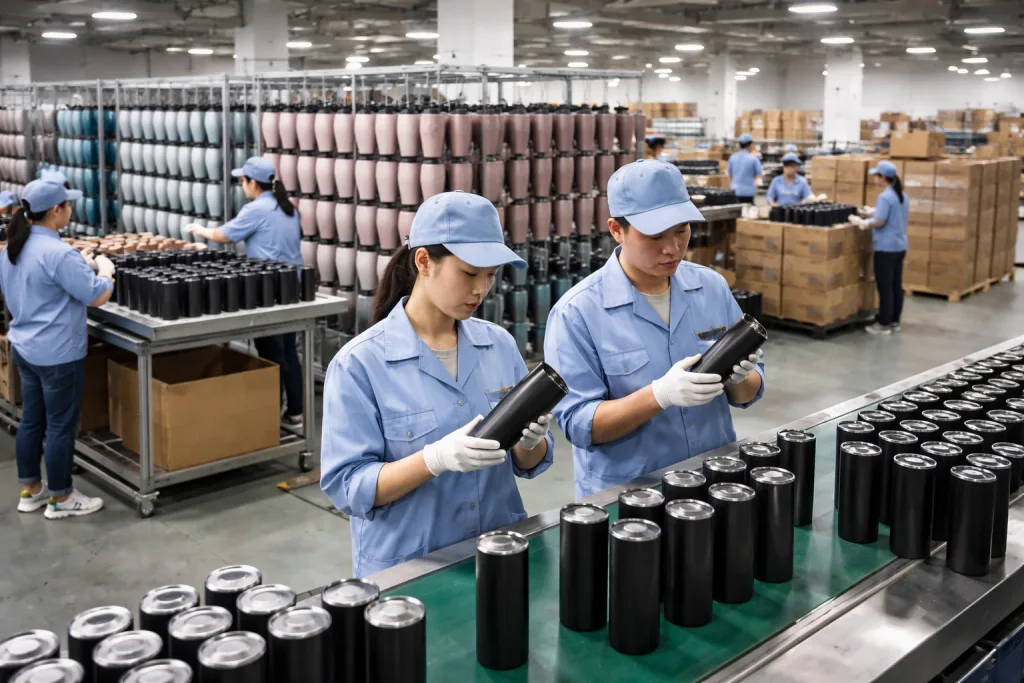
In Zhejiang and across China, a serious factory should build to a brief, not push stock SKUs and call it custom. At BottleForge Industrial in Hangzhou, we run an export line of around 300,000 units per month, with a common MOQ of 3,000 pieces and 30-35 day lead time for standard custom orders. QC pulled a sample last month where the lid thread was 0.4 mm loose; that detail matters more than a polished catalog render. That is the level of detail you should expect when comparing a coffee mug factory, a coffee mug supplier, or a coffee mug factory direct quote.
Start with the drinking scenario
If you start the brief with “a travel tumbler,” you are asking the wrong question. A commuter drinking black coffee at 7 a.m. needs a lid that opens cleanly with one hand and does not smell after 48 hours in a laptop bag. A corporate-gift buyer ordering 5,000 pieces for onboarding usually cares more about logo position, gift-box fit, and whether HR can hand it out without scratches on the powder coat. Gym users and highway drivers also push the design in different directions: wall thickness, sip opening angle, cup-holder diameter, and carry loop all change. We’ve seen this go sideways when the buyer only sent a photo from Amazon; QC pulled the first sample and the lid overhung the 73 mm body by 1.8 mm.
For coffee brands, lock the fill volume first. A 12 oz cup works better for espresso drinks and premium retail sets. A 16 oz format is still the safest pick for a bulk coffee tumbler or bulk coffee travel mug because most café buyers know that size already. A 20 oz body gives more print area and stronger shelf value, but it adds stainless steel weight, bigger cartons, and higher sea freight. The math doesn’t work for every order. In real terms, moving from 16 oz to 20 oz can add 8-12% to unit cost before decoration, and on our line that usually means checking the rolled rim with a 0.02 mm feeler gauge before approving mass production.
For corporate gifts, capacity is often the secondary issue. Packout decides the order. Do you need a coffee mug customized with a presentation box, or a plain master carton for warehouse distribution? If the tumbler goes into a mailer kit, height and gross weight matter more than extra ounces. A coffee mug promotional products program lives or dies by logistics, not by the sample sitting on a buyer’s desk. Last quarter a buyer flagged a 9 kg carton limit after PO approval, and we had to change from 24 pcs to 18 pcs per carton to keep their courier rate.
Use this filter before requesting quotations:
- Daily commute with cup-holder fit, office gifting with logo alignment, retail shelf with barcode space, or event giveaway with low breakage risk
- Hot drink only with tight steam control, cold drink only with straw lid, or dual-use with a wider sip opening
- Reusable coffee cup feel with lighter hand weight, or insulated bottle performance with longer heat retention
- Retail unit pack with barcode sticker, gift box with insert tray, or bulk coffee mug carton for direct distribution
Pick the body that fits margin
Material choice is where buyers overcomplicate the order. We run 304 stainless steel for roughly 8 out of 10 export travel tumbler programs; 316 stainless steel makes sense for stricter corrosion resistance or salty coastal use. Single-wall steel or plastic outer shells belong in cost-down projects, not premium retail. For most shipments, 304 stainless is the safer baseline because customs teams know it, LFGB/FDA paperwork is straightforward, and buyers do not need to defend claims they cannot test. QC pulled a 304 cup last month with the wrong steel grade typed as “340” on the PO. Small typo. Big delay. If you are sourcing coffee mug in bulk for retail, start with 304.
Wall construction matters more than most buyers expect. A 0.4 mm inner and outer wall is common for entry-level vacuum tumblers. A premium body may use 0.5 mm or 0.6 mm thickness, so it feels stiffer and gets fewer dents after carton drop testing. The extra metal looks minor on a caliper, but it changes hand-feel, lid fit, and rim roundness after repeated use. We check this with a digital thickness gauge and a go/no-go lid fixture on the line. For a coffee mug factory, that number is not decoration; it affects tooling, unit weight, and whether the tumbler still behaves after 50 dishwasher cycles.
If your program is price-led, say it early. A bulk coffee mug at USD 2.80 FOB and a better-built bulk travel tumbler at USD 4.20 FOB are not the same product. The first one hits a target. The second one protects your return rate. We have seen this go sideways when a buyer asks for 0.6 mm steel, soft-touch powder coat, gift box, and AQL 2.5 inspection, then wants the USD 2.80 price. The math does not work. In China, that difference is clear inside the factory. In Zhejiang, a solid supplier will tell you which model fits your margin and which one only looks cheap on paper.
Ask for these body details in every quote:
- Stainless grade: 304 or 316, with test report matched to the batch coil number
- Wall thickness: 0.4 mm, 0.5 mm, or 0.6 mm, checked by thickness gauge before assembly
- Vacuum level and temperature retention target, such as 6 hours hot or 12 hours cold
- Powder coat, spray paint, or raw steel finish, with color tolerance agreed before mass production
If you are comparing a coffee mug manufacturer against a coffee mug distributor, remember that distributors often quote from stock. A factory direct quote should let you adjust thickness, finish, and carton spec. That is where factory value is real. Last week a buyer flagged a 5-ply carton because their Amazon warehouse wanted 7-ply for a 24 pcs master carton; a distributor could not change it, but we changed the carton spec before print plates were made.
Choose branding that survives use
Logo method is not a design detail. It is a wear decision. For a premium customer gift, we usually push laser engraving because the mark cuts into the coated shell by about 0.03-0.06 mm and survives carton rubbing better than ink. Clean result. Low complaint rate. If you need a colorful retail look, silkscreen or heat transfer can work, but the math changes: 4-color artwork means more screens, more curing checks, and weaker scratch performance on coated steel. We have seen buyers ask for “full-color, no extra cost” on a PO, and QC pulled the sample after 200 rubs because the red layer started to haze. Most coffee mug custom made programs should start with one-color print on a coated body, then move to complex decoration after the buyer approves real samples.
For a coffee mug custom or coffee mug customizable order, start with how the cup will be handed out or sold. A corporate buyer often wants a logo on one side and a 45 mm name field on the other, with the print centered 20 mm below the rim. A coffee brand may want a wraparound print that reads like packaging, not a cheap ad. A distributor building coffee mug private label stock may run the same body in laser engraving and one-color silkscreen first, then add heat transfer if sell-through is proven. The decoration method changes your MOQ, lead time, and defect risk; this is where we have seen orders go sideways when the buyer treats artwork like a last-minute file upload.
Expect these rough realities: laser engraving typically adds little to no lead time once the file is approved; one-color silkscreen can add 3-5 days; multi-color wrap graphics may add a week or more because color matching on curved steel is not forgiving. Curved steel lies. A Pantone 186C red that looks right on paper can look dull after baking at 160°C on a matte black body, so we check it under a D65 light box before mass production. If you want a coffee mug promotional product that looks sharp after shipping and re-handling, ask the factory for rub-test photos and a carton drop sample, not just a flat mockup.
Good artwork control also protects your margin. A clean AI or PDF file reduces plate charges, and a tight proof reduces remakes. In our Hangzhou line, one missing outline font can burn half a day before the pre-production sample even reaches the UV printer. In a factory in Hangzhou or any serious coffee mug factory direct operation in China, the difference between a smooth private label run and a painful one is usually the artwork approval process.
Test the lid before you trust the sample
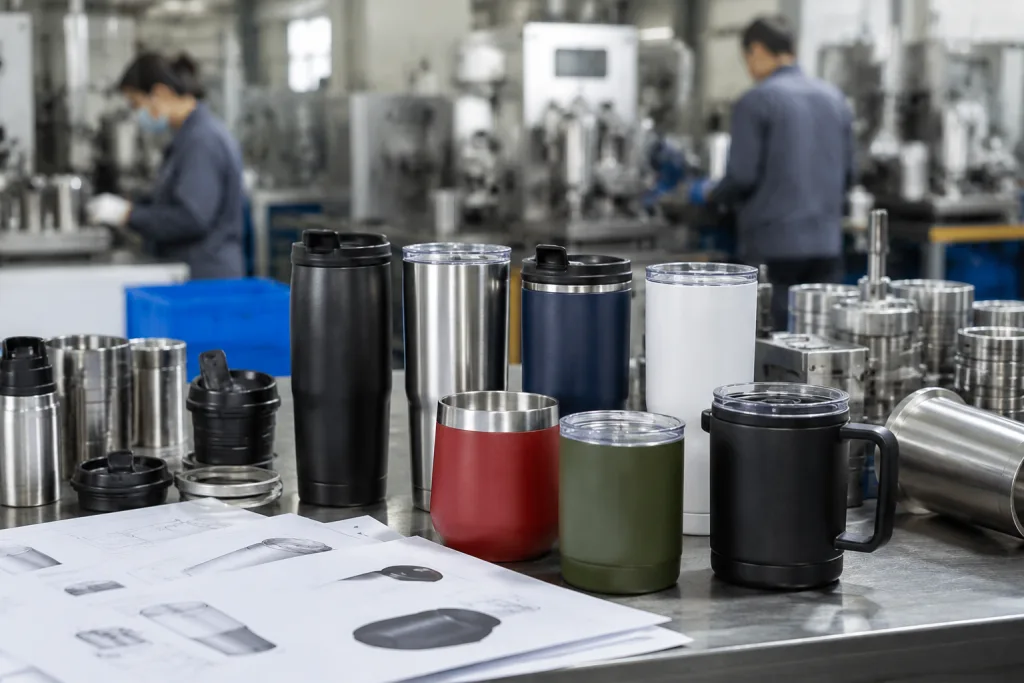
Leak claims are where buyers get hurt. A tumbler can pass the photo sample and still leak in a backpack, under a car seat, or after 8 hours of truck vibration before air freight. Do not approve the sample until the lid type is clear: push-on lids rely on gasket compression, while twist-lock lids depend on thread fit and stop position. Sliding and flip-top lids need a separate check around the drinking port. Magnetic closures look clean, but we have seen them fail when the magnet pocket had a 0.3 mm gap after ultrasonic welding. If your customer carries coffee beside a laptop, this is the wrong question to ask if the focus is only another 0.1 mm of wall thickness.
Ask the factory to run a shop-floor test, not send a glossy leakproof sentence. We run a 24-hour static inversion with hot water at 90°C, then 30 hard shakes by hand and a drop test from 75 cm onto our epoxy floor. QC pulled the sample last month after the silicone ring twisted out by 1.5 mm on the second drop. A tighter buyer brief should also set a thermal retention target such as 6 hours hot and 12 hours cold, measured with water volume, start temperature, room temperature, and lid position recorded. If the supplier cannot explain the test method, the number is decoration, not engineering.
For Europe, ask for REACH and LFGB statements where relevant. For North America, ask for BPA-free confirmation and food-contact compliance paperwork tied to the actual lid material, not a random old report for another SKU. A serious coffee mug supplier will not flinch at documentation. If they do, move on. We once had a buyer flag a PO typo where “PP lid” became “PS lid,” and that small line would have broken their Amazon FBA file review. You are not buying one sample from a trade-show table; you are building a program that ships into retail or direct-to-customer fulfillment.
Check the lid seal after repeated opening too. A good lid should still align after 300-500 cycles, and the slider should not rattle when the cup is empty. On the line, we use a simple cycle jig and a 0.05 mm feeler gauge to check whether the gasket lip has started to lift. That is where the cheap part shows itself. For a bulk coffee travel mug order of 3,000 pcs or 30,000 pcs, the lid is the part your customer touches every day. Ignore it and the math does not work: you end up paying for returns on what looks like a product problem but started as a sourcing problem.
Force the quote to show the real cost
Too many buyers still compare unit price; this is the wrong question to ask. Compare landed value. A quote that leaves out print setup, carton size, test reports, or freight-ready packout is half a quote, not a buying basis. Ask travel tumbler manufacturers to put the FOB price, sample charge, any tooling charge, lead time, packing details, and carton quantity on the same sheet. We run into this every month: the buyer flags a USD 0.18 gap, then the “cheaper” supplier adds USD 0.42 for an extra lid and color box. If you are also sourcing a bulk coffee mug or coffee mug bulk program, use the same discipline. The low headline price often dies at the packing table when QC checks the sleeve fit with a 0.5 mm gap gauge.
A clean factory quote should show the product spec with capacity and steel grade, decoration method with logo size, MOQ, sample time, mass production lead time, master carton count, and payment terms. For example, an order may be 3,000 pieces MOQ, 12-15 day sample lead time, and 30-35 days production after sample approval and deposit. If the supplier in Zhejiang gives you those numbers clearly, that beats a glossy brochure. We’ve seen this go sideways when the PO says “matte black” but the artwork file says PMS 426C gloss. China has 2,000+ drinkware factories on paper; the ones worth your time quote like engineers and can tell you the carton gross weight before the buyer asks.
Inspection matters too. Ask for AQL 2.5 for critical and major defects, with photos of the inspection report. If the order is going to a retailer or a coffee mug distributor network, a bad first shipment can damage the channel before the product even gets listed. A coffee mug manufacturer that knows export work will talk about carton drop tests, pallet height, and moisture protection without being prompted. QC pulled one sample from a 3,600-piece run last spring and found lid threading rough at the 2nd turn; catching that at final inspection is cheaper than handling 47 distributor complaints later.
One more practical point: if you need fast reorders, ask how much capacity is already booked. A factory making 300,000 units a month can still be full for the next six weeks if one large program is running. The quote is only useful if it reflects real production space. Ask whether your line slot is before or after powder coating, because that can mean 12 days vs 18 days on a repeat order. The math doesn’t work if the supplier promises “ready fast” while 80,000 pieces are already waiting at the laser logo station.
Match the supplier to your order size
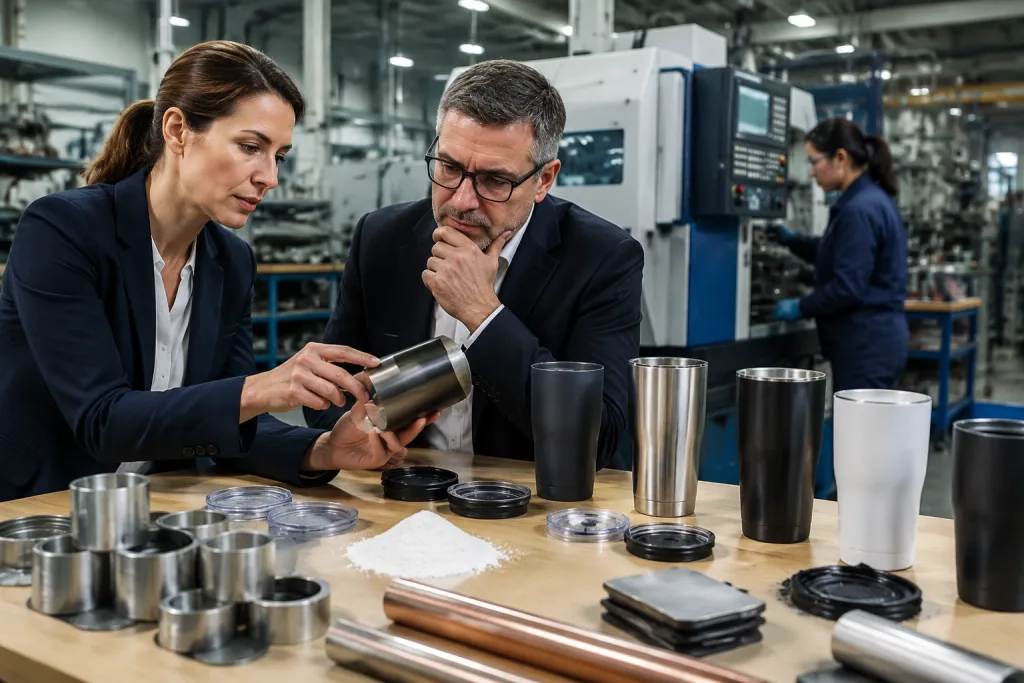
A travel tumbler supplier, a tumbler distributor, and a travel tumbler OEM manufacturer are not the same animal. A distributor works when you need 300 pcs next week and accept whatever lid, carton, and color they have in stock. A factory direct partner makes sense when you need price control, a new powder-coat color, a revised sip lid, or private label repeat orders that look the same in March and again in October. Brand order? Go factory. We run into this every season: the buyer asks for “factory price,” then sends a distributor sample with no mold ownership and no coating record.
For small tests, a supplier directory or supplier list lets you screen 20 names in one afternoon. For real purchasing, this is the wrong question to ask. You need to know who owns the mold, who runs the coating line, and whose QC stamp goes on the final AQL 2.5 report. In China, ask for the factory license, recent audit reports, and clear photos of the actual line, not a showroom wall. QC pulled one 40 oz sample last month where the straw hole was 1.2 mm off-center; the trading company could not tell us which injection machine made the lid. If a company claims to be a travel tumbler factory but cannot show welding, polishing, or coating areas, walk away.
Use the following rule of thumb:
- Under 1,000 units: stock items or distributor inventory, usually no custom mold and limited carton changes
- 1,000-3,000 units: limited customization, simple one-color logo print, standard lid and body shape
- 3,000-10,000 units: true OEM, custom PMS colors, custom lids, and better control over 304 stainless body specs
- 10,000+ units: private label optimization, packaging review, tooling review, and line scheduling before deposit
For most coffee brands ordering travel tumblers, the clean starting point is 3,000 to 5,000 pieces. The math works there: you can spread setup cost across enough units without trapping six months of cash in one SKU. We usually ship 3,000 pcs in about 18 days after sample approval; a rushed stock-color order might leave in 12 days, but custom coating will not. If you are comparing travel tumbler manufacturers in Zhejiang or elsewhere in China, match the supplier model to your cash cycle and reorder plan, not the one that looks biggest on a slide deck.
Send your tumbler brief for a factory quote
We will check spec, MOQ, print method, and packout before pricing so you avoid the usual export mistakes.
Frequently asked questions
What MOQ do travel tumbler manufacturers usually require?
For custom stainless travel tumblers, a normal MOQ is 3,000 pieces per color or per decoration setup. Some factories will quote 1,000 pieces for stock bodies with simple laser engraving, but the price is usually 12-20% higher. If you want custom color coating, custom lid parts, or coffee mug custom made packaging, expect 3,000-5,000 pieces. For a coffee mug factory direct order from China, MOQ is tied to coating line changeover and printing setup, not just raw material. If a supplier promises 300 pieces with full customization, check the tooling and QC terms carefully.
Should I choose a 12 oz, 16 oz, or 20 oz tumbler?
Choose the drink size your customer already uses. A 12 oz tumbler suits espresso drinks and premium gift sets. A 16 oz tumbler is the safest all-round option for coffee brands because it fits standard café drinks and most commuting use cases. A 20 oz body gives you more branding area and better perceived value, but it adds weight, freight volume, and usually 8-12% to the factory cost. For bulk coffee tumbler programs, 16 oz is often the easiest SKU to restock. If you are building a coffee mug promotional product line, one size should not try to serve every channel.
What decoration method lasts longest on a travel tumbler?
Laser engraving usually lasts longest because the mark is cut into the coating or steel surface instead of sitting on top of it. That makes it the best choice for daily-use corporate gifts and premium retail. Silkscreen is fine for simple one-color logos, but it can wear faster if the tumbler is washed aggressively or carried in a bag every day. Full-wrap printing looks strong at launch, yet it needs better artwork control and more careful curing. For coffee mug customized orders, ask for a rub test and a sample that has been washed 20-30 times. That is more useful than a perfect mockup file.
What compliance documents should I ask for?
At minimum, ask for food-contact compliance documents, BPA-free confirmation, and market-specific declarations such as REACH for Europe and LFGB where applicable. For North American retail, many buyers also request testing against relevant FDA food-contact expectations and a clear material declaration. If the tumbler has a powder-coated finish, request coating details as well. A serious coffee mug manufacturer should also be able to show QC records, AQL inspection standards, and carton drop-test results. If you are selling through Amazon, keep your own file ready for FNSKU labeling, carton dimensions, and packing density so the factory can pack correctly from day one.
Can a factory handle packaging and Amazon FBA prep?
Yes, if you ask early. Many travel tumbler manufacturers can do polybags, kraft boxes, window boxes, master carton labeling, and FNSKU sticker application. The key is to send the packing spec before production starts. If you need Amazon FBA prep, confirm barcode placement, carton weight, drop-test requirements, and whether each unit needs a suffocation warning bag or retail sleeve. For a 5,000-piece order, packaging changes can add 3-8% to the landed cost, but they are still cheaper than repacking in the US or Europe. A coffee mug supplier with export experience should give you a carton count, gross weight, and pallet plan without guessing.